
Key takeaways
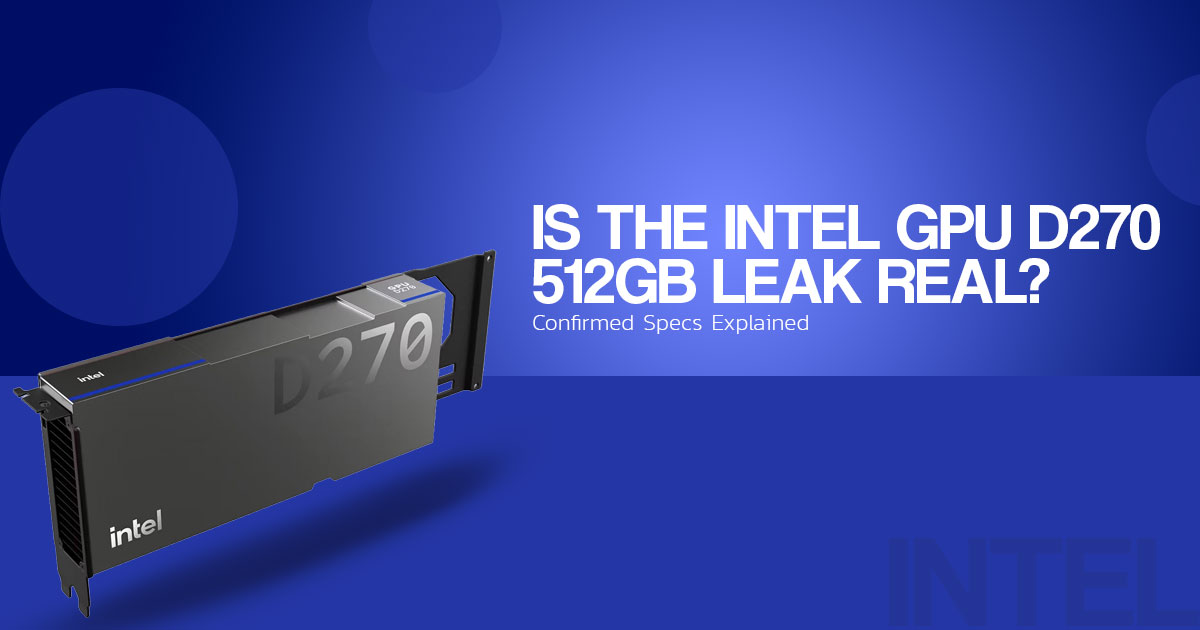
- On October 12, 2026, at the Open Compute Project (OCP) Global Summit, Intel named its Xe3P inference accelerator the Intel GPU D-series, formerly code-named Crescent Island. The first product in the family is the Intel GPU D270.
- Published reporting puts the Intel-branded card at 160GB of LPDDR5X memory, while Intel lists up to 480GB for ODM-branded cards.
- A leaker named Haze (@Haze2K1) claims partner boards with 512GB Intel has not confirmed this, and no manufacturer has been named.
With more than 20 years of experience in hardware and application research and development, we assess products based on real-world performance, durability, and value for money. Our goal is to help readers make informed technology decisions, whether they are evaluating hardware for professional workloads, comparing computing platforms, or considering long-term value. Our recommendations draw on research, component analysis, practical usability, and industry experience.
For developers, AI infrastructure teams, hardware enthusiasts, and businesses evaluating AI inference accelerators, memory capacity is only one part of the picture. Understanding what Intel has confirmed, what its manufacturing partners may offer, and what remains unverified is essential to assessing the Intel GPU D270 and its place in the growing AI hardware market.
What Intel has confirmed
Intel’s OCP 2026 press release and the Intel GPU D270 product page provide the following details. Intel lists up to 480GB per card; ServeTheHome reports that the Intel-branded configuration has 160GB:
| Specification | Intel GPU D270 (official specifications and reported configurations) |
| Architecture | Xe3P, with 32 Xe3P cores and 256 XMX matrix engines |
| Memory type | LPDDR5X |
| Memory capacity | 160GB on Intel-branded card (ServeTheHome); up to 480GB per card (Intel) |
| Memory bandwidth | 1.5 TB/s |
| Compute | 1.3 petaflops of FP8 (Intel does not state whether this figure is dense or sparse) |
| Board power | 350W |
| Interface and cooling | Standard PCIe 5.0 x16, air-cooled |
| Model support | Up to 300 billion parameters on one card; more than one trillion parameters in an eight-GPU system |
| Status | Customer sampling is underway. Intel has not announced pricing or a general availability date. |
Where the 160GB, 480GB, and 512GB figures come from
Intel does not publish its package density or board layout. Public details come from press reports:
- 160GB: The Intel-branded card uses 20 × 8GB LPDDR5X chips, according to ServeTheHome.
- 480GB: ServeTheHome reports that ODM configurations can use 24GB LPDDR5X Intel’s public product page lists up to 480GB but does not specify the package densities.
- Board layout: Leaked PCB photos from May 2026 reportedly show 20 LPDDR5X sites, 12 on the front of the board and 8 on the back, according to VideoCardz. Intel has not confirmed this layout.
The 512GB claim does not fit the reported 20-site layout using identical 8GB or 24GB packages. Dividing 512GB across 20 sites gives an average of 25.6GB per site, so a 512GB card would require a different layout or mixed package capacities. For example, twelve 32GB packages and eight 16GB packages would total 512GB. This is an arithmetic example only; no source has reported it as a planned design.
In an October 13 post, Haze wrote, “There is even 512GB partner boards.” The post names no manufacturer and provides no specifications. Intel has not confirmed any 512GB configuration. Source: VideoCardz.
Intel also showed a liquid-cooled OAM module containing two D-series GPUs at OCP, as reported by WCCFtech. Intel has not published specifications for this module, so its memory and compute figures are not included here.
Architecture: what the chip includes and omits
The D-series uses the Xe3P architecture, with 32 Xe3P cores, 256 XMX engines, and a 32MB unified L2 cache. ServeTheHome’s coverage of Intel’s Hot Chips 2026 disclosures reports support for data types ranging from FP4 and MXFP4 to FP64.
Intel says it reallocated die area from graphics and ray-tracing pipelines to compute, as described on Intel’s product page. The silicon has no 3D graphics elements and includes a media engine with four encoders and four decoders. Intel has not announced a gaming product based on this silicon.
Comparison with three PCIe accelerators
The table compares the Intel GPU D270 with three PCIe accelerators. Each entry uses the manufacturer’s product name.
| Specification | Intel GPU D270 | AMD Instinct MI350P | NVIDIA H200 NVL | NVIDIA RTX PRO 6000 Blackwell Server Edition |
| Architecture | Xe3P | CDNA 4 | Hopper | Blackwell (GB202) |
| Memory | 160GB LPDDR5X (Intel card); up to 480GB (ODM cards) | 144GB HBM3E | 141GB HBM3e | 96GB GDDR7 with ECC |
| Memory bandwidth | 1.5 TB/s | 4.0 TB/s (peak) | 4.8 TB/s | 1,597 GB/s |
| FP8 compute | 1.3 PFLOPS (basis not stated) | 2.3 PFLOPS OCP-FP8 (peak) | 3,341 TFLOPS (with sparsity) | 2 PFLOPS (basis not stated) |
| Board power | 350W | 600W max; 450W configurable | Up to 600W (configurable) | Up to 600W (configurable) |
| Interface | PCIe 5.0 x16 | PCIe Gen5 x16; passive card | PCIe Gen5 x16 | PCIe 5.0 x16 |
| Availability | Customer sampling; no price or availability date | OEM availability; check supplier | Available now, per NVIDIA | Available now, per NVIDIA |
Three points qualify this comparison:
- FP8 figures are not directly comparable. Intel does not state whether its 1.3 PFLOPS is dense or sparse. NVIDIA’s H200 NVL figure is with sparsity. AMD lists 2.3 PFLOPS for OCP-FP8 and 4.6 PFLOPS with structured sparsity; its MXFP8 figure is also 3 PFLOPS. NVIDIA’s RTX PRO 6000 page does not state the basis for its 2 PFLOPS figure.
- Capacity and bandwidth trade-off. Even the 160GB Intel-branded card holds more memory than the other three cards in this table, and the 480GB ODM configuration widens that Its 1.5 TB/s bandwidth is lower than the 4.0 TB/s of the MI350P and the 4.8 TB/s of the H200 NVL.
- Model-fit arithmetic has limits. At FP8 precision, assuming one byte per parameter, a 300-billion-parameter model needs about 300GB for its weights alone. That exceeds the 141GB of the H200 NVL and the 144GB of the MI350P, as well as the 160GB Intel-branded card. Under these assumptions, fitting the model on one D270 would require a higher-capacity configuration; runtime overhead and the KV cache would require additional Intel does not specify the precision or KV-cache assumptions behind its 300-billion-parameter support claim.
Intel’s product page also says its performance projections compare the D270 with an “RTX Pro 6000,” based on internal analysis as of February 2026. Intel does not name the edition, so this article does not reproduce those projections.
Software support
Intel says it is working to support new open models across D-series and Xeon platforms, including Day 0 support for Meta’s Muse Glimmer, as announced by Intel. Muse Glimmer is a 30-billion-parameter open-weight model from Meta. Meta’s separate developer article lists Core Ultra laptops, Arc Pro B70 GPUs, and Xeon processors, but does not mention the D270.
What remains unconfirmed
- Pricing for any D-series configuration
- A general availability date
- Any 512GB configuration, including the board design and package densities
- Specifications for the dual-GPU OAM module
Frequently asked questions
What is the Intel GPU D270?
It is an inference-optimized data center GPU and the first product in the Intel GPU D-series.
Does Intel offer a 512GB D-series card?
Intel has not announced one. Intel lists up to 480GB of LPDDR5X per card; ServeTheHome reports a 160GB Intel-branded configuration and ODM configurations of up to 480GB. The 512GB figure comes from a leaker and has not been confirmed.
Can the D270 be used for gaming?
Intel positions the D270 as an AI inference accelerator, not a gaming GPU. It has not announced a gaming product based on the D-series.
Conclusion
The D270’s main selling point is memory capacity per card at 350W, balanced against lower memory bandwidth than the MI350P and H200 NVL. Intel lists up to 480GB of LPDDR5X per card; ServeTheHome reports a 160GB Intel-branded configuration and ODM configurations of up to 480GB. The 512GB claim remains unconfirmed unless Intel or a named board partner publishes a configuration. Without pricing, a meaningful cost comparison is not yet possible.
What do you think of Intel’s new GPU D270? Do you have questions about its memory capacity, AI inference performance, or how it compares with competing accelerators? Share them in the comments.
Follow us for technology coverage that goes beyond the headlines. We check specifications, compare competing products, investigate claims, and explain what new developments mean in practice—helping you make better-informed technology decisions.
Disclaimer

This article is based on our research, analysis, available product information, user feedback, and industry knowledge. It is not an official statement from any brand or manufacturer mentioned in the article.

Product specifications, prices, software features, and availability can change. We do our best to keep the information up to date, but please check the latest details with the manufacturer or retailer before making a purchase.

Some links in this article may be affiliate links. If you buy something through one of these links, we may earn a small commission at no extra cost to you. These commissions help support the site and our work. They do not affect how we assess or discuss products. Comments and opinions shared by readers belong to the people who post them and do not necessarily represent our views. Information on this site is provided for general purposes, and we cannot guarantee a particular result from using it. Where professional advice is needed, consult a qualified professional.

All product names, logos, and trademarks belong to their respective owners. We use them only to identify the products and companies discussed and do not imply endorsement or affiliation.