
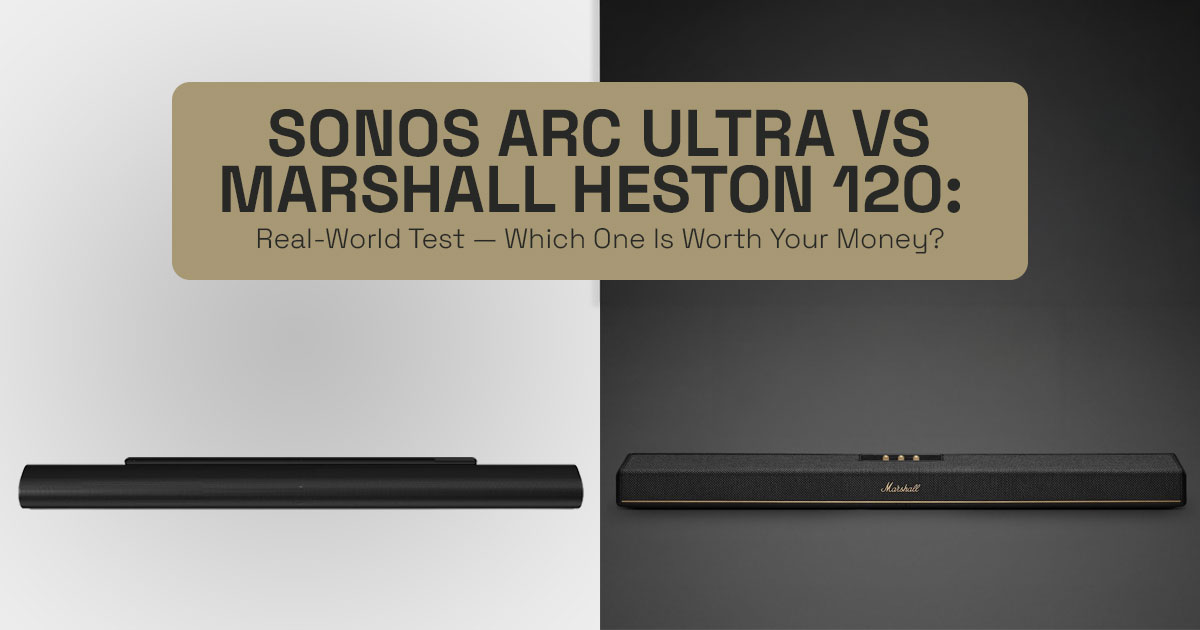
1. Quick Overview
If you just want the answer without reading the full breakdown:
- Best for movies → Sonos Arc Ultra
- Best for music → Marshall Heston 120
- Best ecosystem → Sonos
- Best design & connectivity → Marshall
Who should skip these premium soundbars?
- If you want deep bass without a sub → skip
- If your room is very small → overkill
Click here to buy from Amazon
Introduction
You finally upgrade your TV. The picture looks sharp, colors pop—and then the sound hits you. Flat, weak, and nowhere close to what you expected. That’s where most people get stuck. Choosing the best soundbar for home theater isn’t as simple as picking the most expensive option or the one with the most features.
There are dozens of Dolby Atmos soundbars claiming “cinematic audio,” but in real homes, things work differently. Room size, content type, and daily usage matter more than spec sheets.
That’s why comparisons like Sonos Arc Ultra vs Marshall Heston 120 are worth breaking down properly. These are two strong options, but they’re built for different kinds of users.
Before we get into the details, here’s something most reviews skip—real user feedback. Specs tell you what a soundbar can do. Reviews tell you what it actually does at home.
Things like:
- Does dialogue stay clear at low volume?
- Does bass feel strong without a subwoofer?
- Is setup smooth or frustrating?
These are the details that shape your daily experience.
As technology experts with over 20 years of experience in hardware and application research and development, we look beyond marketing claims. We test for real-world performance, durability, and value for money. The goal is simple—help you choose the right product
based on how you’ll actually use it, whether you care about budget, performance, reliability, or long-term usage.
This guide is built for:
- People setting up a home theater sound system
- Movie lovers who want better spatial audio soundbars
- Music listeners who care about sound quality
- Buyers comparing Sonos vs Marshall soundbar options
- Anyone tired of confusing specs and just wants a clear answer
And more importantly, you’ll avoid buying something that looks great on paper but disappoints after a week.
If you’re trying to decide between these two, you’re in the right place.
Technical Specifications at a Glance
Before we go deeper, here are the core technical details. This table shows what each all-in- one soundbar offers at a glance.
| Feature | Sonos Arc Ultra | Marshall Heston 120 |
| Audio Channels | 5.1.2 (expandable up to 9.1.4) | 5.1.2 |
| Dolby Atmos | Yes (dedicated up-firing drivers) | Yes (virtualized/processed Atmos) |
| DTS:X Support | No | Yes |
| Connectivity | HDMI eARC, Wi-Fi, Ethernet | HDMI eARC, HDMI In, Optical, Bluetooth 5.3, Wi-Fi, Ethernet |
| Voice Assistant | Built-in (Alexa, Google Assistant) | No (requires external device) |
| Ecosystem | Strong Sonos multi-room ecosystem | More standalone, limited ecosystem |
| Controls | Touch controls, Sonos app | Analog knobs, companion app |
| Room Correction | Trueplay (iOS required) | App-based room tuning |
| Subwoofer Support | Optional: Sub Mini / Sub Gen 3 | Optional: Heston Sub 200 |
Why This Review is Essential
In a market saturated with soundbars, simply listing specifications doesn’t tell the whole story. Our Sonos Arc Ultra review and Marshall Heston 120 review go beyond the numbers, focusing on how these devices perform in real-world scenarios. We understand that you’re not just buying a gadget; you’re investing in an experience.
This review is essential because we:
- Put People Before Specs: We translate technical features into tangible benefits, explaining how they impact your movie nights, music sessions, and gaming experiences.
- Align with Modern Search Intent: We address the questions real people are asking, from “best soundbar for movies” to “best soundbar for music” and “home theater setup 2025.”
- Make It Indexable — Not Just Publishable: Our content is structured to naturally support search intent, ensuring it has a strong chance of ranking well on Google and improving visibility in AI-driven search results.
- Feel Written by a Human: We avoid robotic language and buzzwords, opting for a conversational tone that resonates with a US audience.
What You Will Learn From This Review
By the end of this comprehensive guide, you will have a clear understanding of:
- The unique strengths and weaknesses of the Sonos Arc Ultra and Marshall Heston 120.
- How to apply our exclusive “SOUND FIT Framework” to determine the ideal soundbar for your specific living space and usage habits.
- Insights based on actual use at home for various scenarios, including small rooms, large living rooms, movie watching, music listening, and mixed family use.
- A deep dive into Dolby Atmos soundbar comparison, bass performance, and dialogue clarity.
- The importance of ecosystem and expandability for long-term satisfaction.
- Critical tradeoffs you might encounter after months of ownership.
- A realistic look at the total cost of ownership, including potential add-ons.
- Common buyer mistakes to avoid when purchasing a spatial audio soundbar.
- Answers to frequently asked questions that mirror real search behavior.
- Our final, data-driven recommendation to help you make an informed decision.
2. The “SOUND FIT Framework” (Original Model)
Choosing the right soundbar isn’t just about raw power or brand loyalty; it’s about finding the perfect SOUND FIT for your unique environment and lifestyle. We’ve developed this original framework to help you cut through the marketing noise and make a truly informed decision.
Think of it as your personal soundbar compatibility checklist:
- Space: How big is your room? What about ceiling height? These factors significantly impact how Dolby Atmos soundbar effects are perceived. A small room might not benefit from the same setup as a large, open-plan living area.
- Output: What are your volume and bass needs? Are you looking for room-shaking cinematic experiences, or more nuanced, balanced audio for everyday listening? This helps determine if an all-in-one soundbar with built-in subwoofer is enough, or if you’ll need external additions.
- Usage: What will you primarily use it for? Movies, music, or gaming? Each activity has different audio The best soundbar for movies might prioritize dialogue clarity and cinematic punch, while the best soundbar for music focuses on stereo separation and tonal accuracy.
- Network: How important is ecosystem integration and streaming flexibility? Do you already have other smart home devices or prefer a specific streaming platform? Sonos is renowned for its robust multi-room audio ecosystem, while others might offer broader physical connectivity.
- Design: Does the aesthetic and placement matter to you? Some prefer a minimalist, discreet look, while others appreciate a statement Consider how the soundbar will integrate visually into your living space.
- Flexibility: How much expandability do you need? Do you plan to add rear speakers or a dedicated subwoofer down the line? Some soundbars offer a clear upgrade path, while others are more self-contained.
- Integration: How well does it integrate with your TV and smart home devices? Seamless control and compatibility can significantly enhance the user experience.
- Tolerance: How much setup complexity are you willing to tolerate? Some systems are plug-and-play, while others require more fine-tuning and calibration.
This framework helps you choose what actually fits your setup.
3. Real-World Use Cases
To truly understand which soundbar shines, we need to move beyond theoretical specs and explore how the Sonos Arc Ultra and Marshall Heston 120 perform in everyday scenarios. This section shows how they perform in real situations you’ll actually care about.
Small Room Setup (Bedroom / Apartment)
In smaller spaces, sound dispersion and bass response behave differently. Many users wonder: which one performs better without a sub? The Sonos Arc Ultra, with its sophisticated room correction, can adapt well to smaller environments, but its larger size might be a consideration.
The Marshall Heston 120 offers a surprisingly full sound for its footprint, and its integrated subwoofer can be quite effective in contained spaces, often negating the immediate need for an external sub.
Large Living Room (Open Hall)
For expansive living rooms or open-plan layouts, sound dispersion and Dolby Atmos impact become critical. The Sonos Arc Ultra fills larger rooms well, thanks to its wide soundstage and dedicated up-firing drivers.
Its ability to integrate with additional Sonos speakers for a true surround sound setup further enhances its appeal in these environments. The Marshall Heston 120 can hold its own, but might require more careful placement to achieve optimal spatial audio effects in very large, open spaces.
Movie Lovers (Netflix / Prime Video)
For dedicated movie buffs, the focus is on dialogue clarity and cinematic punch. The Sonos Arc Ultra review often highlights its exceptional dialogue reproduction, ensuring you catch every whisper and nuance.
Its powerful sound profile delivers impactful explosions and a broad soundstage, making it an excellent choice for an immersive movie night. While the Marshall Heston 120 offers good overall sound, some users might find its cinematic punch slightly less pronounced in action- heavy scenes compared to the Arc Ultra.
Music-First Users
This is where preferences often diverge significantly. For those who prioritize music, stereo separation and tonal balance are paramount. Our Marshall Heston 120 review consistently points to its superior musicality.
With its heritage rooted in audio amplification, the Heston 120 delivers a rich, detailed, and dynamic music experience, often outperforming the Arc Ultra in pure stereo music playback. If your primary use is listening to music, the Marshall truly shines here.
Mixed Usage (Family TV Setup)
For the typical family TV setup, ease of use and reliability are key. Both soundbars offer a streamlined experience, but the Sonos Arc Ultra benefits from the mature and intuitive Sonos app, making multi-user control and content access straightforward.
The Marshall Heston 120 also provides a user-friendly experience, with its tactile analog controls offering a satisfying alternative to app-only operation. The choice here often comes down to ecosystem preference and how much you value physical controls versus app-based convenience.
4. Deep Audio Breakdown (Practical, Not Geeky)
Choosing between premium spatial audio soundbars like the Sonos Arc Ultra and the Marshall Heston 120 involves more than just comparing specifications. This comprehensive guide breaks down their audio performance, focusing on what listeners will genuinely hear and feel, alongside their respective ecosystems and expandability. Our goal is to enhance your understanding by addressing common user queries and providing in-depth analysis.
Dolby Atmos Performance Explained Simply
Dolby Atmos technology aims to create a three-dimensional soundscape, immersing you in audio that appears to come from all directions, including overhead. However, the effectiveness of Dolby Atmos varies significantly between devices. The Sonos Arc Ultra uses dedicated up-firing drivers that bounce sound off the ceiling to create real height effects. This method is generally more effective than virtual Atmos, which simulates height channels digitally.
The Marshall Heston 120 also supports Dolby Atmos, using a mix of up-firing drivers and processing to create a surround effect. While both soundbars provide a substantial upgrade over traditional stereo sound, the subtle differences often stem from room acoustics and the soundbar’s internal processing capabilities. For a truly enveloping experience, particularly in larger rooms, the Sonos Arc Ultra often holds a slight advantage due to Sonos’s advanced acoustic architecture and tuning.
| Feature | Sonos Arc Ultra | Marshall Heston 120 |
| Dolby Atmos Type | Dedicated up-firing drivers for real height effects | Atmos-enabled processing with up-firing support, performance depends on your room |
| Effectiveness | Generally more effective, especially in larger rooms due to advanced acoustic architecture and tuning | Strong immersive experience, nuances depend on room acoustics and processing capabilities |
Key Takeaway: How well Dolby Atmos works depends a lot on your ceiling height and surface. Very high or vaulted ceilings can limit even the best Dolby Atmos performance.
Bass Reality Check
Many all-in-one soundbars with built-in subwoofers promise deep bass, but the actual performance can differ. Both the Sonos Arc Ultra and Marshall Heston 120 have built-in bass drivers, which are usually enough for small to medium-sized rooms. However, for bass enthusiasts or those with larger living spaces, the absence of a dedicated external subwoofer becomes noticeable. While integrated subs provide a solid foundation, they typically cannot replicate the visceral, chest-thumping bass delivered by a separate, external subwoofer.
Considerations for Bass Performance:
- Room Size: Built-in bass drivers are generally enough for smaller to medium-sized rooms.
- Bass Preference: Bass enthusiasts seeking visceral, chest-thumping bass will likely require an external subwoofer.
- Upgrade Options: Both systems offer external subwoofer options for enhanced low- end performance.
Key Takeaway: If you crave truly impactful low-end for an enhanced movie or music experience, investing in a dedicated external subwoofer like the Sonos Sub Mini/Sub (Gen 3) or Marshall Heston Sub 200 is crucial.
Dialogue Clarity Test
Clear dialogue is paramount for an enjoyable viewing experience, whether you’re watching the news, a complex movie, or a YouTube tutorial. The Sonos Arc Ultra review consistently praises its exceptional dialogue clarity, often attributed to its dedicated center channel and advanced speech enhancement features. Voices come through crisp and distinct, even amidst chaotic action scenes.
The Marshall Heston 120 also performs well in this regard, offering clear dialogue, but in direct comparison, the Arc Ultra often maintains a slight advantage in isolating and projecting voices, making it a strong contender for the best soundbar for movies with heavy dialogue.
5. Ecosystem & Expandability (Huge Buying Factor)
Your soundbar isn’t just an isolated device; it’s often part of a larger home audio strategy. The ecosystem and expandability are huge buying factors, especially for those planning a multi- room setup or future upgrades.
Sonos Ecosystem
Sonos is synonymous with multi-room audio. The Sonos Arc Ultra seamlessly integrates into the extensive Sonos ecosystem, allowing you to easily add rear speakers (like Sonos Era 100s or Era 300s) and a subwoofer (Sub Mini or Sub Gen 3) to create a full, wireless surround sound system.
This expandability is a major draw for users who want a scalable home theater setup. The Sonos app provides intuitive control over all connected devices, making multi-room audio a breeze. This closed, yet incredibly refined, ecosystem is a significant advantage for many.
Marshall Approach
The Marshall Heston 120 takes a different approach. While it offers robust sound on its own, its ecosystem is less mature compared to Sonos. It provides more physical connectivity options, which can be a boon for those with diverse audio sources. However, expanding with dedicated Marshall rear speakers or integrating it into a broader multi-room audio system isn’t as seamless or as feature-rich as with Sonos.
For users who prefer a more standalone unit or have existing non-Marshall components they wish to integrate, its open connectivity might be more appealing, but it offers less of a guided upgrade path.
Click here to buy from Amazon
6. Connectivity & Compatibility
Connectivity is the backbone of any modern sound system. Both soundbars offer essential connections, but their philosophies differ, impacting your setup flexibility.
HDMI, eARC, Bluetooth, Wi-Fi
Both the Sonos Arc Ultra and Marshall Heston 120 support HDMI eARC, which is crucial for transmitting high-quality audio formats like Dolby Atmos from your TV. However, the Marshall Heston 120 stands out by including an additional HDMI In port, allowing you to connect another device directly to the soundbar, which the Arc Ultra lacks. This is a significant advantage for users with multiple media players or gaming consoles.
For wireless connectivity, both offer Wi-Fi for streaming and app control. The Marshall Heston 120 also includes Bluetooth 5.3, providing a convenient way to stream audio directly from your phone or tablet without needing a Wi-Fi network. The Arc Ultra relies solely on Wi-Fi for wireless audio streaming, which offers higher fidelity but less direct device-to- soundbar flexibility.
Streaming Platforms (Spotify, AirPlay, etc.)
Sonos has long been a leader in streaming integration, supporting a vast array of services directly through its app, including Spotify, Apple Music, and more, along with AirPlay 2. This makes the Sonos Arc Ultra a versatile hub for all your audio content.
The Marshall Heston 120 also supports popular streaming services, often through its own app or via Bluetooth, but the depth of integration and multi-room control offered by Sonos is generally more comprehensive.
Gaming Compatibility (PS5 / Xbox Latency)
For gamers, audio latency is a critical factor. Both soundbars generally offer low latency when connected via HDMI eARC, ensuring that audio and video remain synchronized. However, the presence of an HDMI In port on the Marshall Heston 120 can be beneficial for gamers who want to ensure the lowest possible latency by connecting their console directly to the soundbar before passing video to the TV.
The Sonos Arc Ultra relies on your TV’s eARC implementation, which can sometimes introduce slight variations in latency depending on the TV model. For competitive gamers, these small differences can matter.
7. Tradeoffs You’ll Feel After 3 Months
Initial impressions are one thing, but how do these soundbars hold up after months of daily use? Here, we explore the subtle tradeoffs that become apparent over time, shaping your long-term satisfaction.
Sonos Arc Ultra
After three months with the Sonos Arc Ultra, users often appreciate its seamless integration and consistent performance within the Sonos ecosystem. However, some might start to feel the pinch of its less flexible connectivity.
The single HDMI eARC port means you’re reliant on your TV for source switching, which can be a minor inconvenience for those with multiple external devices. The locked ecosystem, while a strength for multi-room audio, can also be a limitation if you prefer to mix and match brands or integrate with non-Sonos components.
While the sound quality is excellent, the lack of a graphic EQ means less granular control over the sound profile, which might frustrate audiophiles who like to fine-tune their audio.
Marshall Heston 120
The Marshall Heston 120, after extended use, continues to impress with its musicality and tactile controls. However, its weaker cinematic punch in action scenes compared to the Arc Ultra might become more noticeable for dedicated movie watchers. While its bass is good for an integrated unit, the absence of truly deep, resonant bass for explosive movie moments can lead to a desire for an external subwoofer.
Furthermore, while it has its own app, some users might find a degree of app dependence for advanced settings, which, while functional, might not be as polished or comprehensive as the Sonos app experience.
8. Total Cost of Ownership
When investing in a premium soundbar, the initial purchase price is just one piece of the puzzle. The total cost of ownership often includes potential upgrades and accessories. We’re breaking down the realistic cost scenarios for both the Sonos Arc Ultra and Marshall Heston 120.
| Cost Factor | Sonos Arc Ultra | Marshall Heston 120 |
| Base Price | High | Mid–High |
| Subwoofer Cost | Optional: Sonos Sub Mini (mid), Sonos Sub Gen 3 (high) | Optional: Marshall Heston Sub 200 (mid) |
| Rear Speakers | Optional: Sonos Era 100 / Era 300 (mid–high) | Limited or no dedicated options |
| Long-Term Upgrades | Strong ecosystem with seamless expansion | More standalone, limited ecosystem growth |
It’s crucial to consider these potential add-ons. For example, while the Sonos Arc Ultra has a higher base price, its seamless upgrade path to a full 5.1.2 or even 7.1.4 system with
dedicated rears and a subwoofer means you’re investing in a scalable home theater solution. The Marshall Heston 120 might seem more affordable upfront, but if you later desire a full surround setup, the options for integration might be less straightforward or more costly with third-party solutions.
9. Common Buyer Mistakes
Navigating the soundbar market can be tricky. Here are some common pitfalls buyers encounter, and how to avoid them when considering the Sonos Arc Ultra or Marshall Heston 120.
- Buying for Atmos in a low ceiling room: Dolby Atmos relies on sound bouncing off your ceiling. If your ceiling is too low (under 7-8 feet) or has irregular surfaces, the immersive effect will be significantly diminished, making the premium for Atmos less worthwhile.
- Ignoring room size: A powerful soundbar in a small room can be overwhelming, while a smaller unit in a large, open space will struggle to fill the area. Always consider the Space aspect of our SOUND FIT Framework.
- Overpaying for unused features: Do you really need every cutting-edge feature? If you primarily listen to music, paying a premium for advanced cinematic processing might be unnecessary. Conversely, if you’re a dedicated movie buff, skimping on Dolby Atmos capabilities could lead to disappointment.
- Skipping subwoofer expectations: Many expect integrated subwoofers to deliver cinema-level bass. While good, they rarely match the performance of a dedicated external unit. Manage your expectations or budget for an add-on if deep bass is a
10. Edge Cases
For users with specific, high-intent needs, certain features become make-or-break. Here’s how these soundbars cater to niche requirements.
- Wall-mounted TV setups: Both soundbars are designed to complement wall- mounted TVs. The Sonos Arc Ultra has a sleek, low-profile design that blends seamlessly. The Marshall Heston 120 also offers a clean aesthetic, but its slightly more pronounced design might be a factor for ultra-minimalist setups. Consider mounting options and cable management for both.
- Gaming-focused users: As discussed in connectivity, the Marshall Heston 120’s HDMI In port offers a direct connection for consoles, potentially reducing While the Sonos Arc Ultra is excellent for gaming audio, the direct input on the Marshall might appeal more to competitive gamers seeking every advantage.
- Audiophiles vs casual listeners: Audiophiles who prioritize pure music fidelity and granular control might lean towards the Marshall Heston 120 for its musicality and more traditional audio-centric Casual listeners who value convenience, ease of use, and a robust multi-room system will likely find the Sonos Arc Ultra more appealing.
- Voice assistant users: If voice assistant integration is a must, the Sonos Arc Ultra with its built-in Alexa and Google Assistant is the clear winner. The Marshall Heston 120 lacks built-in voice control, relying on external smart devices for this
Click here to buy from Amazon
11. Quick Comparison Table
For a rapid overview, here is how the Sonos Arc Ultra and Marshall Heston 120 stack up across key use cases. This table is designed to help you quickly identify the best soundbar for your specific needs.
| Use Case | Best Choice | Why? |
| Movies | Sonos Arc Ultra | Superior Dolby Atmos performance, wider soundstage, and excellent dialogue clarity for a cinematic experience. |
| Music | Marshall Heston 120 | Richer tuning, stronger stereo separation, and a more dynamic sound profile for music playback. |
| Connectivity | Marshall Heston 120 | More versatile ports, including HDMI input, Bluetooth 5.3, and dedicated subwoofer output. |
| Use Case | Best Choice | Why? |
| Ecosystem | Sonos Arc Ultra | Excellent multi-room audio integration with an easy upgrade path using Sonos rear speakers and subwoofers. |
| Ease of Use | Sonos Arc Ultra | User-friendly app, smooth setup, and built-in voice assistants make everyday use simple. |
12. FAQ
We’ve compiled the most common questions buyers ask when comparing these two premium soundbars.
Is Sonos Arc Ultra worth it without a subwoofer?
Yes, for many users. The Sonos Arc Ultra features a robust integrated bass response that is more than sufficient for small to medium-sized rooms and casual viewing. However, for true cinematic rumble in larger spaces, adding a Sonos Sub Mini or Sub (Gen 3) is highly recommended.
Is Marshall Heston 120 good for movies?
Absolutely. The Marshall Heston 120 delivers clear dialogue and supports Dolby Atmos and DTS:X, providing a very engaging movie experience. While it might lack the absolute widest soundstage of the Arc Ultra, it remains a powerful and capable home theater setup 2025 component.
Which soundbar is better for small rooms?
Both are excellent, but the Marshall Heston 120 often feels slightly more at home in smaller spaces due to its punchy integrated bass and slightly more compact footprint. The Sonos Arc Ultra‘s Trueplay tuning also helps it adapt well, but its width might be visually overpowering in very tight setups.
Do you really need Dolby Atmos?
If you want the most immersive, three-dimensional audio experience available today, yes. Dolby Atmos adds height channels, making sounds feel like they are happening above and around you. If you primarily watch modern movies and high-budget streaming series, an Atmos-capable soundbar is a significant upgrade.
13. Final Recommendation
At the end of the day, this isn’t about which soundbar is “better” on paper. It’s about which
one fits how you actually watch, listen, and live with your setup every day.
Here’s a simple way to decide—based on how you’ll really use it:
1. If movies are your thing
Go with the Sonos Arc Ultra. It handles dialogue cleanly, spreads sound wider, and gives you that immersive feel that makes movies more engaging—even without tweaking settings.
2. If you care more about music
Pick the Marshall Heston 120. It sounds fuller and more natural for songs, with better
stereo separation. You’ll notice it right away, especially with vocals and instruments.
3. If you just want something that works without effort
The Sonos Arc Ultra is the easier choice. Setup is smooth, the app is reliable, and adding speakers later feels straightforward—not like a project.
4. If you use a lot of devices and want more control
The Marshall Heston 120 gives you more ways to connect and interact. HDMI input, Bluetooth, physical knobs—it feels less restrictive if you like flexibility.
If you’re ready to move forward, here are quick links to see current pricing:
- Sonos Arc Ultra
- Marshall Heston 120
Still unsure? Think about your room, what you watch most, and whether you value simplicity or flexibility more. That usually makes the choice much easier.
If you want, tell me your room setup and how you plan to use it—I’ll help you pick the right one without guesswork.
***Disclaimer***
This blog post reflects our own research, testing, and personal opinions. It should not be taken as the official position of any brand, manufacturer, or company mentioned here. While we aim to keep information accurate and up to date, product details, pricing, and availability can change. We recommend double-checking important details before making a purchase.
Some links in this article may be affiliate links. If you choose to buy through these links, we may earn a small commission at no extra cost to you. This helps support our work and allows us to keep publishing in-depth, unbiased reviews. Our recommendations are never influenced by affiliate partnerships.
Comments shared by readers reflect their own views and not ours. We are not responsible for outcomes resulting from the use of information on this site. Please seek professional advice where appropriate.
All product names, logos, and brands mentioned are the property of their respective owners. These names are used for identification and informational purposes only and do not imply endorsement.