
Introduction: Why the ACEMAGIC F9A Matters
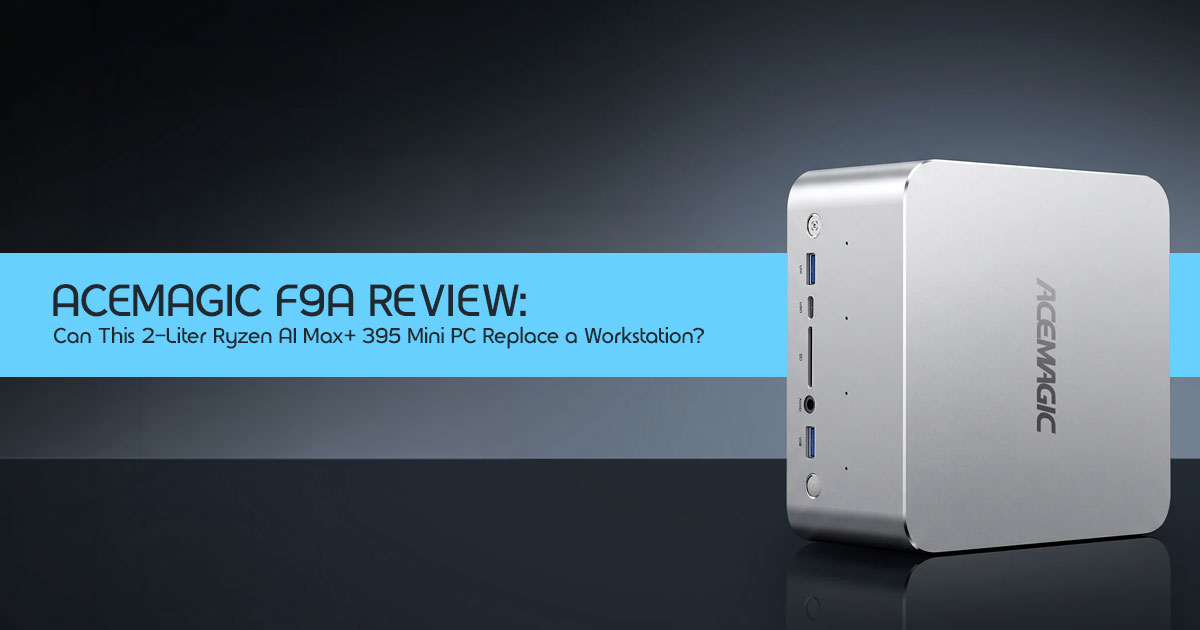
The ACEMAGIC F9A is one of the first 2-liter mini PCs built around AMD’s flagship Ryzen AI Max+ 395 processor. It combines 16 Zen 5 CPU cores, Radeon 8060S graphics with 40 RDNA 3.5 Compute Units, and an XDNA 2 NPU rated at 50 TOPS, delivering up to 126 TOPS of combined AI performance. The system also includes up to 128GB LPDDR5X-8000 unified memory, dual M.2 PCIe 4.0 NVMe slots, OCuLink eGPU support, Wi-Fi 7, dual USB4 40 Gbps ports, and a dedicated Copilot button, all inside a CNC aluminum chassis measuring 158 × 158 × 85 mm.
Most Ryzen AI Max+ 395 systems announced so far use larger 4-liter designs. The F9A delivers the same platform in a chassis that’s roughly half the size without sacrificing connectivity or memory capacity. If you’re building a local AI workstation, running virtual machines, or editing media, the F9A offers desktop-class hardware in a much smaller footprint.
We’ve spent more than 20 years researching and evaluating computer hardware and software. Our reviews focus on what matters in day-to-day use: performance, cooling, build quality, upgrade options, reliability, and long-term value. Whether you’re an AI developer, content creator, software engineer, or homelab enthusiast, our conclusions are based on detailed research, component analysis, and real-world testing rather than marketing claims.
This review covers the hardware, expected performance, real-world use cases, and how the F9A compares with other Ryzen AI Max+ 395 mini PCs.
What Is the ACEMAGIC F9A? A Compact AI Workstation Explained
The ACEMAGIC F9A is not a standard office mini PC. ACEMAGIC targets the F9A at developers, creators, and homelab users who need plenty of memory and strong integrated graphics without moving to a larger desktop.
Unlike the larger ACEMAGIC Tank M1A Pro+, the F9A uses a low-profile square chassis that occupies roughly half the volume.
Its biggest advantage is packing workstation-class memory into a chassis that’s barely larger than a typical office mini PC.
Design and Build Quality: Small, Solid, and Purposeful
The CNC-machined aluminum chassis has an anodized finish and is available in silver and space gray. The size is 158 x 158 x 85 mm, which gives an internal volume of about 2.1 liters.
Most Strix Halo mini PCs use larger cooling systems to handle the processor’s power limits. ACEMAGIC is fitting the same platform into a much smaller chassis. ACEMAGIC says the platform can briefly reach a 140 W peak power limit. The company has not clarified whether that 140 W figure refers to the processor alone or total system draw. Based on comparable Ryzen AI Max+ 395 systems, this likely refers to the platform power limit rather than CPU package power alone.
Other design details:
- Bottom-mounted RGB light ring with customizable It is ambient, not intrusive.
- Top-mounted button for Mini PC with Copilot button. No Copilot logo on the button itself.
- Built-in 4-element far-field microphone array with 3-meter pickup and dual 2W built-in speakers. The built-in microphones are suitable for voice calls, while dedicated headphones or a USB microphone remain the better choice for streaming or recording.
Who should consider it? People who carry a lab box between locations or need a quiet workstation on a desk will appreciate the solid aluminum build and small footprint. If you need tool-less RAM upgrades, this is not the right design because the memory is soldered.
Core Hardware Breakdown: AMD Ryzen AI Max+ 395 Inside
The Ryzen AI Max+ 395 combines a high-core-count CPU, powerful integrated graphics, and a dedicated AI processor in a single package.
Ryzen AI Max+ 395 16-core 32-thread CPU: 16 Zen 5 CPU cores with 32 threads, boost up to 5.1 GHz. For compilation, code indexing, and multi-threaded workloads, this is comparable to many high-end desktop CPUs in heavily threaded workloads.
Radeon 8060S with 40 CU RDNA 3.5: This is the integrated GPU. With 40 Compute Units, it is far beyond typical integrated graphics. It can handle 1440p gaming in many titles and accelerates creation tasks like video encode and 3D preview. In some rasterized workloads, performance can approach or exceed a mobile RTX 4060, although results vary by application and power limits.
XDNA 2 NPU and 126 TOPS AI performance: The XDNA 2 NPU delivers up to 50 TOPS. AMD’s published 126 TOPS figure combines the CPU, GPU, and NPU rather than the NPU alone. For buyer clarity: most heavy LLM inference still runs on the iGPU, not the NPU, because the iGPU has access to the larger unified memory pool.
140 W Strix Halo mini PC power tuning: The chip can be configured from about 55W to 120W sustained. Vendors often set a 140 W peak for short bursts. A smaller 2-liter chassis will be more thermally limited than a larger cube, so sustained clocks may be slightly lower than the Tank M1A Pro+ under long loads. That is a trade-off for the smaller size.
Memory and Storage: Why 128GB LPDDR5X-8000 Unified Memory Matters
The ACEMAGIC F9A supports up to 128GB LPDDR5X-8000 unified memory on a 256-bit bus. Because CPU and GPU share the same memory pool, data doesn’t need to be copied between system memory and dedicated graphics memory.
Here’s why the memory configuration matters:
- Up to 96GB of the unified memory can be allocated to the GPU, allowing much larger AI models to remain in graphics memory.
- The unified memory bandwidth is around 256 GB/s, roughly 4x typical dual-channel DDR5-5600 desktops. Independent testing of other Ryzen AI Max+ 395 systems has reported roughly 4–6 tokens per second on 70B-class models under similar configurations.
- Memory is You must choose capacity at purchase. 32GB, 64GB, 128GB options are expected. You cannot upgrade later.
Storage: Dual M.2 PCIe 4.0 NVMe slots. Two slots is standard for this class. Some larger competitors offer three slots. For most users, two fast drives are enough for OS + models + project files.
Real-World AI Performance: Can It Run Local LLMs?
For many buyers, local AI inference is the main reason to consider the F9A. Based on our analysis of the same AMD Strix Halo architecture in other boxes:
- For local AI development: The 128GB LPDDR5X-8000 unified memory lets you run 70B-class models locally without offloading to system RAM. For developers building on ROCm or Vulkan, this is a cost-effective local alternative to renting cloud GPUs for prototyping.
- For homelab use: A Strix Halo mini PC with OCuLink for external GPU makes sense if you want one node to run Proxmox, a few VMs, and a local inference The 16 cores handle virtualization well, and the large memory pool avoids out-of-memory errors on big models.
- Limitation to consider: This is not as fast as an NVIDIA GB10-based DGX Spark or a discrete RTX 4090 for training. The Radeon 8060S is excellent for inference and mid-range gaming, but if your workload is training large models from scratch, a discrete GPU server still provides higher raw compute.
- Where it beats competitors: Apple’s M4 Max remains highly efficient, but developers who rely on ROCm or Windows-based AI tools may prefer AMD because it supports a wider range of Windows and Linux AI development tools.
Connectivity and Expansion: OCuLink, USB4, and Wi-Fi 7
The F9A includes nearly every modern connection you’d expect from a workstation-class mini PC.
- OCuLink mini PC port via PCIe 0 x4: This allows OCuLink eGPU support through an enclosure. Bandwidth is PCIe 4.0 x4, not x16 like a desktop slot. Expect some performance loss compared to native desktop, but it generally delivers better external GPU performance than USB4 because it provides a direct PCIe connection.
- Two USB4 40 Gbps Type-C ports, three 10Gbps USB-A ports.
- One HDMI 1 (up to 8K@60Hz) and DisplayPort support via USB4. Up to four displays are possible.
- Dual 5GbE Ethernet – useful for homelab, NAS connection, or dual WAN.
- Wi-Fi 7 and Bluetooth 4.
- SD 0 reader and 3.5mm audio jack.
Despite its size, the F9A includes nearly all the connectivity found on much larger mini PCs. For a compact setup, the combination of dual M.2 PCIe 4.0 NVMe plus OCuLink plus dual Ethernet is more flexible than most sub-1-liter mini PCs.
The Copilot Button and Extra Features
The Mini PC with Copilot button is a physical key on top of the case that launches Windows Copilot.
The Copilot button is a convenience feature rather than a hardware accelerator. If you use a keyboard without it, the top button provides quick access without a shortcut. It simply launches Windows Copilot and doesn’t affect system performance.
The RGB light ring, far-field microphone array, and built-in speakers are useful extras. For business calls, the mic array works within a few meters in a quiet room. For content creation, we still recommend a separate mic.
Comparison: ACEMAGIC F9A vs Competitors in the Ryzen AI Max 395 Mini PC Lineup 2026
There are now over 30 Ryzen AI Max 395 mini PC systems. Here is how the ACEMAGIC F9A stacks against the most relevant ones.
| Model | Volume | Memory | OCuLink eGPU | Cooling / Power | Best Use Case |
|---|---|---|---|---|---|
| ACEMAGIC F9A | 2.1L 158 × 158 × 85mm |
Up to 128GB LPDDR5X-8000 unified memory | Yes, PCIe 4.0 ×4 | Compact cooling system with up to 140W peak power | The smallest Strix Halo mini PC with native OCuLink support for external GPUs. |
| ACEMAGIC Tank M1A Pro+ | ~4.6L Cube 166 × 166 × 160mm |
Up to 128GB LPDDR5X-8000 | Via internal M.2 adapter | 7 heatpipes, 3 fans, approximately 120W sustained | Better sustained thermals and an additional M.2 storage slot. |
| GMKtec EVO-X2 | ~1.9–2.2L | Up to 128GB | No | Vapor chamber cooling with quiet operation | Excellent value for buyers wanting an affordable 128GB AI mini PC. |
| HP Z2 Mini G1a | ~2.7L Workstation | Up to 128GB | No | Enterprise-grade workstation cooling | Ideal for business deployments requiring long-term support and enterprise warranty. |
| MSI PRO MAX EDGE AI+ 11M | 4L Desktop | Up to 128GB | No | Larger desktop-class cooling solution | Best suited for users who want desktop-like cooling and internal expansion. |
| Framework Desktop | 4.5L Mini-ITX | Up to 128GB LPDDR5X-8000 | No (Modular Platform) | Standard FlexATX PSU support with up to 120mm cooling fans | Ideal for DIY builders and users prioritizing repairability and modular upgrades. |
Takeaway: If priority is absolute smallest size with OCuLink mini PC capability, the ACEMAGIC F9A has a clear edge. If priority is sustained performance and quiet operation under long AI loads, the larger Tank M1A Pro+ or Framework Desktop may maintain higher clocks longer. If priority is enterprise warranty, the HP Z2 Mini is the safer business choice.
Pros and Cons Based on Extensive Research
| Pros | Cons |
|---|---|
| Compact 2.1L chassis packs flagship AMD hardware into a workstation-class mini PC that fits almost anywhere. | The 128GB LPDDR5X-8000 unified memory is soldered, so RAM cannot be upgraded later. |
| Supports up to 128GB unified memory, with as much as 96GB assignable to the Radeon 8060S GPU for demanding AI and graphics workloads. | A 140W peak power budget inside a 2-liter chassis may reduce sustained performance compared with larger desktop systems. |
| OCuLink eGPU support over PCIe 4.0 ×4 provides better external GPU performance than USB4-based solutions. | Even with OCuLink, the PCIe 4.0 ×4 interface cannot match the bandwidth of a full desktop PCIe ×16 slot. |
| Excellent connectivity including USB4 (40Gbps), HDMI 2.1, Dual 2.5GbE LAN, Wi-Fi 7, and an SD 4.0 card reader. | The integrated microphone and 2W speakers are convenient but not intended for professional audio production. |
| CNC-machined aluminum unibody improves durability while helping dissipate heat efficiently. | The dedicated Copilot button offers limited value for users whose keyboards already include the same shortcut. |
| A strong choice for local AI inference, virtualization, software development, content creation, and homelab deployments. | Official pricing had not been announced at the time of writing (late July 2026). |
Who Should Buy the ACEMAGIC F9A?
Consider the ACEMAGIC F9A if you:
- Need a 128GB RAM mini PC for AI workloads that can run 70B models locally and fits on a small desk or lab rack.
- Want a compact AI workstation that can also handle content creation and light 1440p gaming without a discrete GPU.
- Need OCuLink support for an external GPU or PCIe
- Prefer a solid CNC-machined aerospace aluminum unibody over plastic mini PC
Skip or compare carefully if you:
- Need socketed, upgradeable Look at traditional DDR5 mini PCs or larger workstations.
- Run training workloads all A desktop with discrete GPU or DGX Spark-class system may be more efficient long-term.
- Need absolute quiet under full A larger 4L chassis with bigger fans will likely be quieter.
Pricing, Availability, and Buying Advice
As of late July 2026, ACEMAGIC has announced the ACEMAGIC F9A but has not published the ACEMAGIC F9A price or final release date. Based on current pricing of other Ryzen AI Max+ 395 systems:
- GMKtec EVO-X2 set the floor for 128GB configs around $1,500 to $1,800 depending on
- ACEMAGIC Tank M1A Pro+ with 128GB + 2TB launched around $2,499 to $3,099.
- HP Z2 Mini G1a and Corsair AI Workstation 300 are priced higher for business support, often $2,800 to $3,399.
Our buying advice: For a 2-liter mini PC with a CNC aluminum mini PC build, OCuLink,
and Wi-Fi 7, we estimate the ACEMAGIC F9A 128GB model to land between $1,699 and $2,399 at launch. The 64GB version, if offered, would be lower. Wait for official listing and compare the cost per gigabyte of unified memory. With current RAM pricing, a complete 128GB system can be cheaper than buying 128GB of high-speed laptop memory separately.
If timing is urgent and you need a system today, the GMKtec EVO-X2 is the immediate value alternative, while the HP Z2 Mini G1a is the enterprise alternative.
Frequently Asked Questions About ACEMAGIC F9A
What is ACEMAGIC F9A?
The ACEMAGIC F9A is a 2.1L Strix Halo mini PC powered by AMD Ryzen AI Max+ 395, supporting up to 128GB LPDDR5X-8000 unified memory and OCuLink eGPU support.
How big is the ACEMAGIC F9A 2-liter chassis?
158 x 158 x 85 mm, about 2.1 liters internal volume, in a CNC aluminum mini PC unibody.
Does ACEMAGIC F9A support eGPU via OCuLink?
Yes. The Strix Halo mini PC with OCuLink for external GPU uses OCuLink PCIe 4.0 x4, which allows external GPU enclosures with better performance than USB4, though with some loss vs desktop x16.
How much RAM does Ryzen AI Max+ 395 support?
Up to 128GB LPDDR5X-8000 unified memory with up to 96GB assignable to the Radeon 8060S. Memory is soldered.
Can Ryzen AI Max+ 395 run 70B LLM models locally?
Yes. Independent testing of similar Ryzen AI Max+ 395 systems has reported approximately 4–6 tokens per second for 70B dense models and around 31–55 tokens per second for 120B mixture-of-experts (MoE) models, depending on the model, quantization, and software stack.
What is the difference between ACEMAGIC F9A and Tank M1A Pro+?
The F9A is a 2L mini PC focused on compactness with OCuLink mini PC port. The Tank M1A Pro+ is a ~4.6L cube with larger cooling, three M.2 slots, and higher sustained power. Both use the same AMD Ryzen AI Max+ 395.
Does Strix Halo need discrete GPU for gaming?
No. The Radeon 8060S with 40 CU RDNA 3.5 handles many modern games at 1080p and 1440p and can outperform a mobile RTX 4060 in some rasterized workloads, depending on the game and power settings.
How powerful is the Copilot button?
The Mini PC with Copilot button simply launches Windows Copilot. It is a shortcut key, not a performance feature.
Final Verdict: Is the ACEMAGIC F9A Worth It?
The ACEMAGIC F9A fills a gap in the current mini PC market by offering a true 2-liter system without compromising on memory capacity or connectivity.
Its limitations are the same as any compact Strix Halo mini PC: soldered memory, limited sustained power compared to larger cubes, and OCuLink limited to x4 bandwidth. The Mini PC with Copilot button is convenient but not essential.
If you need large unified memory in a compact desktop, the ACEMAGIC F9A is one of the most compelling Strix Halo systems announced so far. For others, comparing it directly with the Tank M1A Pro+, GMKtec EVO-X2, and HP Z2 Mini before buying will lead to the most informed decision.
Check Price and Availability
The ACEMAGIC F9A has been officially unveiled, but it is not yet available for retail purchase. At the time of writing, ACEMAGIC has not announced an official release date, pricing, or pre- order schedule. More details are expected in the coming weeks as the company expands its Ryzen AI Max+ 395 product lineup.
Current Status
- Official Status: Announced/Unveiled
- Pre-orders: Not yet available
- Retail Availability: Pending official announcement
- Expected Launch: In the coming weeks (official timeline not yet confirmed)
Several competing AMD Ryzen AI Max+ 395 mini PCs have already entered the market, including the MSI PRO MAX EDGE AI+, Beelink GTR9 Pro, and other Strix Halo systems. That makes it likely the ACEMAGIC F9A will follow shortly, although ACEMAGIC has not confirmed a launch window.
For Readers Globally
If you’re shopping on Amazon Worldwide, check the latest Amazon listings for Ryzen AI Max+ 395 mini PCs. Once available, the ACEMAGIC F9A is expected to offer:
- AMD Ryzen AI Max+ 395
- Up to 128GB LPDDR5X-8000 unified memory
- OCuLink eGPU support
- Wi-Fi 7
- Compact 2-liter chassis
The 128GB configuration is expected to be the most attractive option for running local AI models, including Llama 70B-class workloads, AI development, virtualization, and homelab deployments.
If the F9A has not launched yet, consider these currently announced alternatives:
Amazon Worldwide
Ryzen AI Max+ 395 Mini PCs on Amazon.com
Before purchasing, compare:
- Current price
- 64GB vs 128GB memory options
- Seller reputation
- Warranty coverage
- Shipping availability
For Readers in India
Availability for flagship Strix Halo mini PCs typically reaches Amazon India after the initial global rollout. Once listed, look for the:
- ACEMAGIC F9A
- ACEMAGIC Tank M1A Pro+
- Beelink GTR9 Pro
- MSI PRO MAX EDGE AI+
When comparing prices, consider:
- Import duties
- Seller authenticity
- Warranty support
- Delivery timeline
- Total landed cost
The compact 158 × 158 × 85 mm chassis makes this class of mini PC particularly attractive for apartments, home offices, AI development workstations, and space-constrained setups.
Amazon India
Ryzen AI Max+ 395 Mini PCs on Amazon India
Compare pricing, delivery estimates, and specifications before placing your order.
If the ACEMAGIC F9A matches your workflow, checking both regional marketplaces is the easiest way to monitor pricing and availability as listings go live. Since launch pricing for the Ryzen AI Max+ 395 mini PC lineup is still evolving, prices may change frequently during the initial release period.
Our team will continue tracking the latest Ryzen AI Max+ 395 mini PCs, including specification updates, pricing changes, benchmark comparisons, and newly available configurations, to keep this guide current.
***Disclaimer***
This blog post reflects our research, analysis, and opinions based on available product information, user feedback, and industry knowledge. It should not be taken as the official position of any brand, manufacturer, or company mentioned here. While we aim to keep information accurate and up to date, product details, pricing, and availability can change. We recommend double-checking important details before making a purchase.
Some links in this article may be affiliate links. If you choose to buy through these links, we may earn a small commission at no extra cost to you. This helps support our work and allows us to keep publishing in-depth, unbiased reviews. Affiliate partnerships never influence our recommendations.
Opinions expressed by readers are their own and do not necessarily reflect ours. We are not responsible for outcomes resulting from the use of information on this site. Please seek professional advice where appropriate.
All product names, logos, and brands mentioned are the property of their respective owners. These names are used for identification and informational purposes only and do not imply endorsement.