
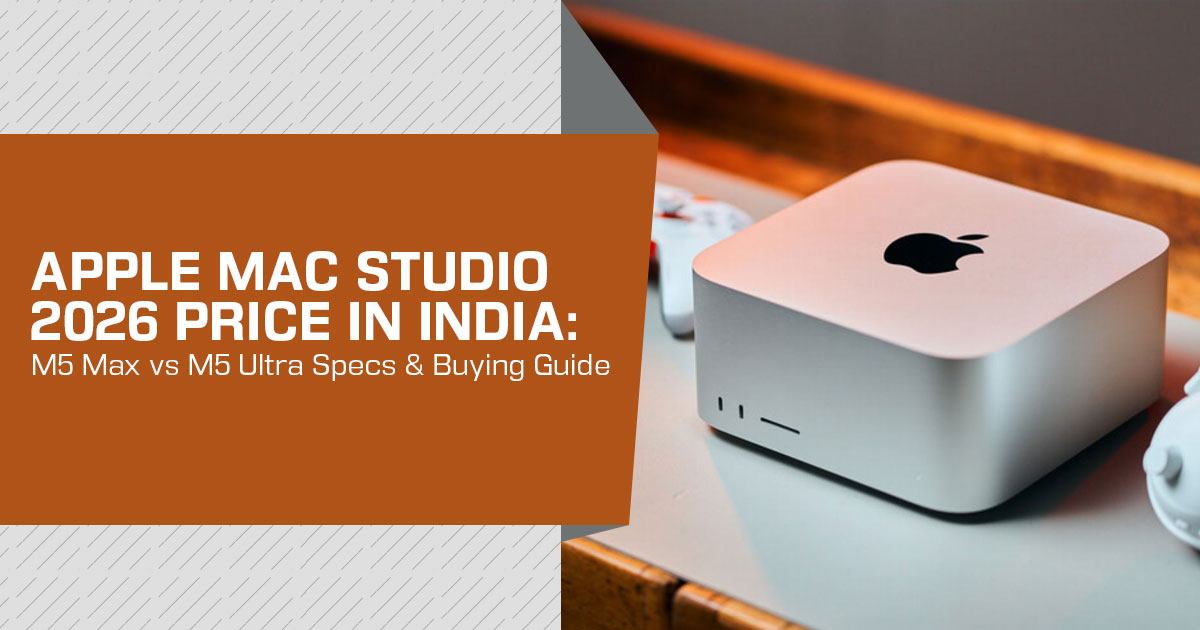
If you’re considering the Mac Studio 2026 for professional work, creative projects, software development, or demanding everyday use, it’s important to know what this guide is—and what it isn’t.
Rather than presenting this as a conventional hands-on Mac Studio review, this is a research-based buying guide. We have not tested the machine ourselves. The 2026 Mac Studio reaches buyers on 22 September 2026, so independent benchmarks and long-term user testing are not available at the time of writing.
The specifications in this guide come from Apple’s official Mac Studio technical specifications and its 25 August 2026 press releases. India starting prices are confirmed by Apple; higher configuration prices are identified as current Apple Store listings or secondary reporting where applicable.
We look beyond the specification sheet. We assess products using published specifications, component analysis, available reporting, usability, and value for money. Our goal is simple: to help you choose the right product for your needs, whether your priority is budget, performance, reliability, or long-term use.
For the Mac Studio 2026, that means our recommendations are aimed at professionals, creators, developers, power users, and buyers who need a desktop Mac for demanding workloads. Since we do not have independent test results yet, any judgement we make is about value, configuration, expected use, and who the machine makes sense for, not measured performance.
We will update this guide when independent benchmarks and real-world testing become available.
A Note on the Name
Apple’s official product name is simply Mac Studio. We use Mac Studio 2026 throughout this guide to separate the new model from the 2022, 2023, and 2025 Mac Studio models. This also follows the naming convention Apple uses in its support documentation.
Apple Mac Studio at a glance
| Specification | Mac Studio (M5 Max & M5 Ultra) |
|---|---|
| Official Name | Mac Studio (M5 Max and M5 Ultra) |
| Chips | Apple M5 Max and Apple M5 Ultra |
| Mac Studio Price in India | Starting at ₹2,79,900 for M5 Max and ₹6,29,900 for M5 Ultra |
| US Price | Starting at $2,499 for M5 Max and $5,499 for M5 Ultra |
| Education Pricing | From ₹2,56,900 and ₹5,84,900 in India; $2,299 and $5,099 in the US |
| Release Date | Pre-orders opened 25 August 2026; general availability begins 22 September 2026 |
| Unified Memory | Up to 128GB with M5 Max or 512GB with M5 Ultra |
| Memory Bandwidth | Up to 614GB/s with M5 Max or 1.2TB/s with M5 Ultra |
| Storage | 512GB–8TB with M5 Max or 1TB–16TB with M5 Ultra |
| Size & Weight | 9.5 cm high and 19.7 × 19.7 cm; approximately 2.7 kg for M5 Max or 3.6 kg for M5 Ultra |
The short version: this is two quite different machines sharing one chassis. The M5 Max is a compact workstation aimed at creative professionals. The M5 Ultra is aimed at people who need very large
amounts of memory in a single box. For most buyers who do not need the Ultra’s larger memory configurations, the M5 Max is the more sensible starting point.
Apple Mac Studio 2026: product overview
Apple announced the 2026 Mac Studio on 25 August 2026 through a newsroom post rather than a stage event. The enclosure appears unchanged from earlier generations. What has changed sits underneath: two new chips, faster storage, updated wireless, and a higher memory ceiling.
Three points of context matter more than the chip names.
First, the Mac Pro was discontinued in 2026, so the Mac Studio is the top of Apple’s current desktop range. Apple describes the new model as “our most powerful Mac ever” — that is Apple’s claim, not an independent finding.
The compatibility point that affects buying is clear: macOS 27 supports Apple silicon Macs, including Mac Studio models. Apple says macOS 26 is the last macOS release with full Intel Mac support, with security updates continuing for Intel Macs for three years. macOS 27 still includes Rosetta for Apple silicon Macs, but Intel Macs are not supported by macOS 27.
Third, Apple has restored the high-memory configurations that disappeared from the 2025 Mac Studio earlier in 2026. Reporting from MacRumors documented the removal of the 512GB option in March and the 256GB option in May, leaving 96GB as the only M3 Ultra memory tier for a period. Both higher tiers return with the M5 Ultra.
Mac Studio key features and what each one means for buyers
Specifications only matter when they change what you can do. Here is what each headline feature delivers.
M5 Max and M5 Ultra chips explained
The M5 Max has an 18-core CPU with six super cores and twelve performance cores, with no efficiency cores. Its GPU is 32-core as standard, configurable to 40-core, with a 16-core Neural Engine.
Memory bandwidth on the M5 Max depends on the configuration: 460GB/s with the 32-core GPU, rising to 614GB/s with the 40-core GPU. The M5 Ultra is built differently. Apple uses UltraFusion to connect two dual-die M5 Max chips into a quad-die architecture — Apple states this is a first for Apple silicon. Apple puts inter-die bandwidth at over 4.4TB/s and says connection density increased by over 6x.
Why that matters: when separate silicon dies act as one chip, data that crosses between them normally has an interconnect cost. Apple says the higher-bandwidth UltraFusion link lets the four dies behave as a single unified processor.
| Specification | M5 Max | M5 Ultra |
|---|---|---|
| CPU (Standard) | 18-core (6 Super + 12 Performance) | 30-core (10 Super + 20 Performance) |
| CPU (Configurable) | Not applicable | 36-core (12 Super + 24 Performance) |
| GPU (Standard) | 32-core GPU | 64-core GPU |
| GPU (Configurable) | 40-core GPU | 80-core GPU |
| Neural Engine | 16-core | 32-core |
| Memory Bandwidth | 460GB/s, increasing to 614GB/s with the 40-core GPU configuration | 1.2TB/s |
For readers weighing the M5 Ultra vs M3 Ultra, the clearest generational step is in memory bandwidth and capacity rather than core count.
Note the M5 Ultra’s base configuration carefully. It ships with a 30-core CPU (10 super + 20 performance). The widely quoted “12 super cores and 24 performance cores” figure describes the 36-core upgrade, not the standard machine.
Up to 512GB unified memory
Unified memory is shared between the CPU, GPU and Neural Engine rather than split into separate system RAM and graphics memory. A model or project can draw on nearly all of it instead of being capped by a smaller graphics pool.
The M5 Ultra is available with 96GB, 256GB or 512GB of unified memory. The 256GB and 512GB options sit above the standard 96GB tier, and the 512GB option requires the 36-core CPU and 80-core GPU.
Two configuration rules are easy to miss and worth knowing before ordering:
- 128GB on the M5 Max requires the 40-core GPU configuration.
- 512GB on the M5 Ultra requires both the 36-core CPU and the 80-core
Both come from Apple’s technical specifications page. Ordering a lower GPU configuration caps your memory ceiling.
There is a further catch worth stating plainly: the unified memory is part of the chip package and cannot be upgraded after purchase. The configuration chosen at purchase is permanent.
1.2TB/s memory bandwidth and why it matters
Bandwidth is how fast data moves between memory and the processor. For most desktop work it is not the limiting factor. For some local AI inference workloads, memory bandwidth can be an important limiting factor.
Once a model is loaded, generation speed depends on several factors, including memory bandwidth, model size, quantisation, context length, compute resources and the software stack. Apple states the M5 Ultra’s 1.2TB/s memory bandwidth is 50 percent higher than M3 Ultra.
Neural Accelerators in every GPU core
Both M5 chips include Neural Accelerators — dedicated hardware inside each GPU core for the matrix operations that dominate AI workloads. Apple notes the M5 Ultra is the first Ultra chip to include them.
For buyers, this affects AI tasks most. Conventional creative applications use the GPU cores themselves.
Faster storage and professional connectivity
Apple states storage performance is up to 2× faster through a next-generation SSD architecture. Apple does not offer a post-purchase storage upgrade, so choose the capacity you need when ordering.
Mac Studio Thunderbolt 5 support delivers up to 120Gb/s. Apple describes the Mac Studio as offering “up to six ports of Thunderbolt 5”, which reflects the M5 Ultra’s four rear ports plus two front ports.
Apple Mac Studio technical specifications
The Mac Studio specs below are taken from Apple’s official technical specifications page. Where a figure differs by chip or configuration, both values are shown.
| Specification | M5 Max | M5 Ultra |
|---|---|---|
| CPU (Standard / Configurable) | 18-core (6 super + 12 performance) | 30-core (10 super + 20 performance) / 36-core (12 super + 24 performance) |
| GPU (Standard / Configurable) | 32-core / 40-core | 64-core / 80-core |
| Neural Accelerators | Integrated into every GPU core | Integrated into every GPU core |
| Neural Engine | 16-core | 32-core |
| Unified Memory | 36GB; configurable to 48GB, 64GB, or 128GB | 96GB; configurable to 256GB or 512GB |
| Memory Bandwidth | 460GB/s (up to 614GB/s with 40-core GPU) | 1.2TB/s |
| Storage (Standard / Configurable) | 512GB / 1TB, 2TB, 4TB, 8TB | 1TB / 2TB, 4TB, 8TB, 16TB |
| Media Engine | H.264, HEVC, ProRes, ProRes RAW, AV1 decode; 1 decode engine, 2 encode engines, 2 ProRes engines | H.264, HEVC, ProRes, ProRes RAW, AV1 decode; 2 decode engines, 4 encode engines, 4 ProRes engines |
| Ray Tracing | Third-generation hardware-accelerated ray tracing | Third-generation hardware-accelerated ray tracing |
| Maximum External Displays | 5 | 8 |
| Rear Ports | 4× Thunderbolt 5, 2× USB-A (5Gb/s), HDMI 2.1, 10Gb Ethernet, 3.5mm headphone jack | 4× Thunderbolt 5, 2× USB-A (5Gb/s), HDMI 2.1, 10Gb Ethernet, 3.5mm headphone jack |
| Front Ports | 2× USB-C (10Gb/s), SDXC (UHS-II) | 2× Thunderbolt 5 (120Gb/s), SDXC (UHS-II) |
| Wireless | Apple N1 chip: Wi-Fi 7 (802.11be), Bluetooth 6, Thread | Apple N1 chip: Wi-Fi 7 (802.11be), Bluetooth 6, Thread |
| Ethernet | 10Gb Ethernet (Nbase-T: 1Gb / 2.5Gb / 5Gb / 10Gb) | 10Gb Ethernet (Nbase-T: 1Gb / 2.5Gb / 5Gb / 10Gb) |
| Dimensions | 9.5cm high × 19.7 × 19.7cm | 9.5cm high × 19.7 × 19.7cm |
| Weight | 2.7kg | 3.6kg |
| Maximum Continuous Power | 480W | 480W |
Apple Mac Studio 2026 performance claims: how to read the results
Every figure in this section comes from Apple’s own controlled testing, conducted in July 2026. No independent benchmarks exist yet, so these should be read as directional rather than verified results.
What Apple reports for M5 Max
| Workload | Compared with M1 Max | Compared with M4 Max |
|---|---|---|
| LLM Prompt Processing (LM Studio) | Up to 10.7× faster | 3.9× faster |
| Text-to-Image Generation | Up to 7.4× faster | Up to 3.5× faster |
| Magic Mask (DaVinci Resolve Studio) | Up to 5.3× faster | Up to 3× faster |
| DNA Sequencing Basecalling (Oxford Nanopore MinKNOW) | Up to 3.5× faster | Up to 1.9× faster |
What Apple reports for M5 Ultra
| Workload | Compared with M1 Ultra | Compared with M3 Ultra |
|---|---|---|
| CopyCat ML Training (Foundry Nuke) | Up to 15.4× faster | Up to 3.3× faster |
| LLM Prompt Processing (LM Studio) | Up to 9.8× faster | Up to 4× faster |
| Text-to-Image Generation | Up to 8.2× faster | Up to 4.3× faster |
| Scene Rendering (Maxon Redshift) | Up to 4.7× faster | Up to 1.7× faster |
Apple separately states the M5 Ultra reaches up to 4.3× the peak AI compute performance of M3 Ultra and up to 1.8× faster graphics than the prior generation in its Mac Studio announcement. In its chip announcement, Apple cites up to 40 percent faster graphics than M3 Ultra and up to 4.5× the peak GPU compute for AI compared with M3 Ultra.
We are reporting both sets rather than blending them, because Apple gives different comparative figures in the two documents and they are not directly equivalent.
Three cautions before acting on these numbers
Compare against the right baseline. The M1-generation multiples span roughly five years of progress. For an upgrade decision, the M4 Max and M3 Ultra columns matter more, and those are more measured: roughly 1.7× to 4.3× depending on workload.
These are applications Apple selected. Your tools and projects may behave differently.
Sustained performance is unmeasured. Apple’s figures cover specific tasks. Behaviour under long renders — thermal throttling, fan noise — has not been independently assessed for this generation, and we are not able to characterise it.
Local AI and large language model capability
For local AI work, two important numbers are memory capacity and bandwidth. Compute performance and the software stack also affect real-world inference speed.
Apple says the M5 Ultra can run very large LLMs entirely on device. We are not assigning specific model sizes to each memory tier because model requirements vary with parameter count, quantisation, context length, architecture and runtime overhead.
Treat memory capacity as a planning figure, not a promise of a specific model or token rate. Requirements change with quantisation, context length and the software used to run the model, and we have not measured real token rates on the M5 Ultra.
On software, Apple provides Core AI — described by Apple as a new framework for building, running and deploying models on Apple silicon — and MLX, its open-source machine learning framework. Third-party tools including LM Studio and Ollama support Apple silicon, with both offering MLX-based options for Mac.
Multiple Mac Studio systems can also be clustered over Thunderbolt 5 using RDMA into a shared memory pool. Apple states that a cluster of four systems can deliver up to 3× faster AI inference than a single system.
Our assessment: this suits teams that need more capacity than one machine provides. Four base M5 Ultra systems cost about $21,996 in the US at Apple’s listed prices before memory or storage upgrades. That comparison is about scaling capacity, not a claim of better value.
Design and build quality
The Mac Studio keeps the compact aluminium enclosure used since 2022. Apple states it is made with 35 percent recycled content, including 100 percent recycled aluminium in the enclosure and 100 percent recycled rare earth elements in all magnets, and that it is manufactured with 40 percent renewable energy across the supply chain. Paper packaging is 100 percent fibre-based.
Verified physical details:
| Specification | M5 Max | M5 Ultra |
|---|---|---|
| Height | 9.5 cm (3.7 in) | 9.5 cm (3.7 in) |
| Width × Depth | 19.7 × 19.7 cm (7.7 × 7.7 in) | 19.7 × 19.7 cm (7.7 × 7.7 in) |
| Weight | 2.7 kg (6.0 lb) | 3.6 kg (8.0 lb) |
| Maximum Continuous Power | 480W | 480W |
Two sections we have deliberately left out. The Mac Studio is a desktop with no built-in screen and no battery, so the usual review sections on display quality and battery life do not apply. Buyers should budget separately for a monitor.
Connectivity, ports and display support
| Position | Ports |
|---|---|
| Rear | 4× Thunderbolt 5, 2× USB-A (up to 5Gb/s), HDMI 2.1, 10Gb Ethernet, and 3.5mm headphone jack |
| Front — M5 Max | 2× USB-C (up to 10Gb/s) and SDXC card slot (UHS-II) |
| Front — M5 Ultra | 2× Thunderbolt 5 (up to 120Gb/s) and SDXC card slot (UHS-II) |
Apple states the Mac Studio enables genlock over USB-C for synchronising a display with professional camera capture, citing iPhone 17 Pro as an example. This is mainly relevant to broadcast and virtual-production workflows.
One limitation to weigh: the Mac Studio has no internal PCIe slots. Everything connects externally. Apple supports PCIe expansion chassis over Thunderbolt 5, but anyone relying on internal capture or accelerator cards should confirm that an external setup meets their needs.
How many displays can Mac Studio support?
Apple’s specifications split this by chip:
- M5 Max — up to five external Either five displays (four at up to 6K/60Hz or 4K/165Hz, plus a fifth at up to 5K/60Hz over HDMI), or three at higher resolution (two at up to 8K/60Hz, 5K/120Hz or 4K/240Hz, plus a third at up to 5K/60Hz over HDMI).
- M5 Ultra — up to eight external Eight at up to 6K/60Hz or 4K/165Hz, or up to four at up to 8K/60Hz, 5K/120Hz or 4K/240Hz.
Apple also states support for up to four Studio Display XDR at full 5K resolution and 120Hz.
Software: macOS 27 Golden Gate and the AI stack
The 2026 Mac Studio is designed for the upcoming macOS 27 Golden Gate. Apple says macOS 27 will bring Siri AI, Apple Intelligence features, refinements to the Liquid Glass interface, and improvements to performance and search. At the time of writing, macOS 27 is still scheduled as a free software update for this fall.
The compatibility point that affects buying: macOS 27 supports Apple silicon Macs, not Intel Macs. Apple says macOS 26 is the last macOS release with full Intel support.
For AI development, Apple’s stack includes Core AI, Core ML, Metal, MLX and Xcode. One caveat worth stating: for training and fine-tuning pipelines, NVIDIA’s CUDA ecosystem has broader tooling support than Apple’s. For running and experimenting with models locally, Apple’s tooling is well established. That is our assessment of the ecosystem landscape, not a benchmark result.
Mac Studio 2026 pros and cons
Based on Apple’s specifications and announced pricing, and on the reporting cited above — not on hands-on testing.
Strengths
- 512GB unified memory with 2TB/s bandwidth, the highest memory ceiling in Apple’s current Mac lineup
- The 256GB and 512GB tiers return after Apple withdrew them earlier in 2026
- M5 Max from Rs 2,79,900 should cover a broad range of professional creative, development and productivity workloads on paper
- Neural Accelerators in every GPU core on both chips, including the first Ultra to have them
- Up to six Thunderbolt 5 ports on the M5 Ultra
- Wi-Fi 7 and Bluetooth 6 arrive for the first time on Mac Studio
- Up to eight displays on the M5 Ultra
- Compact at 7 × 19.7 × 9.5 cm
- Education pricing reduces the Indian price by Rs 23,000 to Rs 45,000
- Clustering over Thunderbolt 5 and RDMA offers a scaling path
Limitations
- Memory cannot be upgraded after purchase, and configure-to-order pricing is steep
- The M5 Ultra costs more than double the M5 Max in India
- The 512GB configuration has no announced price and is scheduled for late
- The M5 Ultra starts $1,500 above the M3 Ultra’s March 2025 launch price in the
- The Mac Studio has no internal PCIe slots; external PCIe expansion is supported through Thunderbolt
- Apple does not offer a post-purchase storage
- All performance figures are Apple’s own claims; no independent benchmarks yet
- Sustained-load behaviour — thermals and acoustics — is unmeasured for this generation
- Exterior design remains broadly unchanged from 2022
Mac Studio price in India and full configuration guide
Important on sources. The US prices below are Apple’s official announced figures. The India starting prices are also now confirmed by Apple’s India newsroom and online store; some higher configuration prices remain based on current store listings or secondary reporting. All prices are starting prices for the base configuration unless stated.
| Configuration | Chip & Hardware | India Price (Reported) |
|---|---|---|
| Base M5 Max | M5 Max — 18-core CPU, 32-core GPU, 36GB unified memory, 512GB storage | ₹2,79,900 |
| Upgraded M5 Max GPU | M5 Max — 18-core CPU, 40-core GPU | ₹3,15,900 |
| Base M5 Ultra | M5 Ultra — 30-core CPU, 64-core GPU, 96GB unified memory, 1TB storage | ₹6,29,900 |
| Upgraded M5 Ultra | M5 Ultra — 36-core CPU, 80-core GPU | ₹7,85,900 |
| High-End M5 Ultra | M5 Ultra — 36-core CPU, 80-core GPU, 256GB unified memory, 16TB storage | ₹21,65,900 — verify current configuration pricing on the Apple India Store |
The Rs 3,15,900 and Rs 7,85,900 figures are currently listed through Apple’s India configurator. Apple’s India store currently lists the 256GB/16TB configuration at Rs 21,65,900. Apple has not published a 512GB price yet.
US pricing (Apple’s official figures):
| Model | Standard Price | Education Price |
|---|---|---|
| M5 Max | $2,499 | $2,299 |
| M5 Ultra | $5,499 | $5,099 |
Apple also lists Apple Upgrade lease pricing in the US from $48.99 per month for the M5 Max and $110.10 per month for the M5 Ultra on a 36-month lease, excluding taxes and trade-in credit.
Mac Studio M5 Max price in India
The M5 Max price in India starts at Rs 2,79,900. The 40-core GPU configuration is reported at Rs 3,15,900. If you want 128GB of memory, the 40-core GPU configuration is required — that is an Apple specification rule, not a pricing choice.
Mac Studio M5 Ultra price in India
The M5 Ultra price in India starts at Rs 6,29,900, rising to a reported Rs 7,85,900 for the 36-core CPU and 80-core GPU configuration. The 512GB tier requires that same 36-core/80-core configuration and is scheduled for late October.
Mac Studio education pricing
| Model | Standard Price (India) | Education Price (India) | Standard Price (US) | Education Price (US) |
|---|---|---|---|---|
| M5 Max | ₹2,79,900 | ₹2,56,900 | $2,499 | $2,299 |
| M5 Ultra | ₹6,29,900 | ₹5,84,900 | $5,499 | $5,099 |
The education saving in India ranges from Rs 23,000 to Rs 45,000. Eligibility rules apply.
India price compared with US price
Using roughly Rs 95.3 per US dollar as of 29 August 2026 — our own calculation, not an Apple figure:
| Model | India Price | US Price Converted | Price Difference |
|---|---|---|---|
| M5 Max | ₹2,79,900 | ₹2,38,155 (US$2,499) | India price is approximately 17.5% higher |
| M5 Ultra | ₹6,29,900 | ₹5,24,055 (US$5,499) | India price is approximately 20.2% higher |
The difference may reflect taxes, duties, currency movements, distribution costs and local pricing decisions rather than any hardware variation. The exchange rate moves, so recheck the calculation before drawing conclusions.
On the trend: Apple increased Mac Studio pricing in June 2026 before this M5-generation launch. Macworld reported that the June increase was attributed to higher component costs. The M3 Ultra Mac Studio launched at $3,999 in March 2025; its US starting price later rose to $5,299, while the M5 Ultra now starts at $5,499.
Mac Studio release date and availability
| Date | What Happens |
|---|---|
| 25 August 2026 | Officially announced, with pre-orders opening in 30 countries and regions, including India. |
| 22 September 2026 | Begins arriving to customers and becomes available through Apple Store locations and Apple Authorized Resellers. |
| Late October 2026 | Mac Studio configurations with 512GB of unified memory become available. |
Apple states pre-orders run through apple.com/store and the Apple Store app. If you need the 512GB tier, ordering now will not speed up delivery.
Mac Studio 2026 alternatives: how it compares
Mac Studio vs Mac mini
The Mac mini now starts at Rs 99,900 with the M6 chip, against the Studio’s Rs 2,79,900. For many buyers who do not need the Studio’s higher memory, GPU options or display support, the Mac mini is likely the better-value choice. Choose the Studio when a specific workload needs its higher memory capacity, bandwidth, GPU options or display support.
Mac Studio vs MacBook Pro
The MacBook Pro is the main portable alternative. The decision is largely about portability and total setup cost. A Mac Studio plus a separate display often costs more than an equivalent MacBook Pro with its screen included.
Mac Studio vs Mac Pro
Now largely historical. Apple discontinued the Mac Pro in 2026, leaving the Mac Studio as Apple’s highest-end desktop. The Mac Pro’s removal was reported by 9to5Mac after Apple confirmed the discontinuation.
Mac Studio vs NVIDIA DGX Spark
For local AI buyers, the NVIDIA DGX Spark is one of the more direct alternatives. It pairs a GB10 Grace Blackwell superchip with 128GB of unified memory.
| Specification | Mac Studio (M5 Ultra) | NVIDIA DGX Spark |
|---|---|---|
| Maximum Unified Memory | 512GB | 128GB per system |
| Memory Bandwidth | 1.2TB/s (Apple) | ~273GB/s (reported) |
| AI Software Stack | Core AI, Core ML, MLX, and Metal | CUDA |
| Operating System | macOS | DGX OS |
The trade-off: the M5 Ultra has about 4.4× the listed memory bandwidth and four times the maximum unified memory of one DGX Spark. Higher bandwidth can help bandwidth-bound workloads, but it does not prove faster token generation without comparable testing. DGX Spark’s main advantage is its CUDA-based software ecosystem.
We have not benchmarked either system. Competitor specifications are from their manufacturers, and the comparisons here should be treated as structural rather than as performance rankings.
Mac Studio vs AMD Ryzen AI Max+ 395 systems
Ryzen AI Max+ 395 hardware offers another route to 128GB.
| Specification | Mac Studio (M5 Max) | Framework Desktop (128GB) | AMD Ryzen AI Halo |
|---|---|---|---|
| Maximum Unified Memory | 128GB | 128GB | 128GB |
| Memory Bandwidth | Up to 614GB/s (Apple) | Approximately 256GB/s (reported) | Approximately 256GB/s (reported) |
| AI / GPU Software Stack | Core ML, MLX, Metal | ROCm, Vulkan | ROCm, Vulkan |
| Operating System | macOS | Linux / Windows | Windows 11 + Linux |
| Price | From $2,499 (Apple) | Current pricing varies by configuration | Reported at $3,999 |
Framework currently offers a 128GB configuration, but its pricing has changed since launch, so the older $1,999 figure should not be used as a current price comparison. The AMD Ryzen AI Max+ 395 platform offers another 128GB option. The Mac Studio offers higher listed memory bandwidth, while the Windows and Linux systems provide different software and expansion options. Performance depends on the workload.
Mac Studio vs Windows workstations
A discrete-GPU Windows workstation can be faster in some GPU-bound applications and can offer hardware expansion options that the Mac Studio does not. The M5 Ultra’s 512GB unified-memory ceiling is unusual in a desktop system, but memory capacity alone does not establish overall performance.
Who should buy the Mac Studio 2026 The M5 Max may suit you if:
- You edit video in 4K or occasional 8K and have outgrown a Mac mini
- You produce music with large sample libraries
- You develop software and want a high-performance desktop for builds plus a local coding model
- You need a compact workstation with strong connectivity
- Your budget sits below Rs 6 lakh
The M5 Ultra may suit you if:
- You run large models locally and need more than 128GB
- You work in 3D, VFX or animation where rendering time affects revenue
- You handle multi-cam 8K ProRes timelines regularly
- You need support for more than five displays
- You plan to cluster several units
Consider waiting if:
- You need 512GB — it is scheduled for late October and has no announced
- You are on an M4 Max and do not do AI work
- You are unsure about memory — there is no upgrade path
- Your work is GPU-bound rather than memory-bound and you want independent benchmarks first
Mac Studio buying advice: picking a configuration
Three decisions, in this order.
1. Decide memory first, then the chip
Because unified memory is fixed at purchase, start with your realistic ceiling over three or four years. Anything above 128GB requires the M5 Ultra, and 512GB additionally requires the 36-core CPU and 80-core GPU.
2. Choose memory based on your workload
For many professional workloads, 64GB is a balanced starting point. Move to 128GB when your work involves large local AI models, very large datasets, heavy multitasking, or other memory-intensive workloads. Remember the 128GB tier requires the 40-core GPU configuration.
3. Pay for the Ultra only when memory or bandwidth is the constraint
The CPU gains over M3 Ultra are based on Apple’s testing — up to 1.3× higher multithreaded performance. The bigger practical reason to consider the Ultra is its higher memory capacity and 1.2TB/s bandwidth.
One cost caveat: configure-to-order memory is expensive relative to the base machine. Apple’s US store currently shows a $4,000 step from 96GB to 256GB on the M5 Ultra. Check the live configurator before ordering because configuration pricing can change.
Mac Studio FAQ
How much does a Mac Studio cost? The 2026 Mac Studio starts at Rs 2,79,900 in India for the M5 Max and Rs 6,29,900 for the M5 Ultra. Apple confirms these starting prices in its India newsroom and online store. In the US, Apple’s official starting prices are $2,499 and $5,499.
When is the Mac Studio 2026 release date in India? Pre-orders opened 25 August 2026. Apple states availability begins 22 September 2026.
When is the 512GB Mac Studio available? Late October 2026, per Apple. Apple has not announced its price.
Can Mac Studio RAM be upgraded after purchase? No. Unified memory is part of the system’s fixed memory architecture and cannot be upgraded after purchase. Configure what you need at purchase.
How many displays can Mac Studio support? Per Apple’s specifications: up to five external displays on the M5 Max, and up to eight on the M5 Ultra.
What is the maximum memory on the Mac Studio 2026? 512GB on the M5 Ultra with the 36-core CPU and 80-core GPU, scheduled for late October. The M5 Max tops out at 128GB, which requires the 40-core GPU.
Is the Mac Studio good for video editing? Based on Apple’s specifications, yes. Both chips include hardware-accelerated H.264, HEVC, ProRes, ProRes RAW and AV1 decode. Apple states the M5 Ultra’s Media Engine has twice the encode and decode blocks of the M5 Max and can play up to 33 streams of 8K ProRes 422 at 30fps.
Mac Studio or Mac mini: which should you buy? The Mac mini starts at Rs 99,900 and suits everyday work. The Mac Studio suits workloads that need more memory capacity, bandwidth, GPU cores or display support.
Is the Mac Studio 2026 worth upgrading to from an M3 Ultra? It depends on your workload. Apple cites up to 1.3× higher multithreaded performance, while the M5 Ultra also raises memory bandwidth and restores a 512GB option. Without independent benchmarks, there is no basis for a blanket upgrade recommendation.
Does the Mac Studio support Wi-Fi 7 and Thunderbolt 5? Yes. Both configurations include Wi-Fi 7, Bluetooth 6 and Thread via Apple’s N1 chip, plus four rear Thunderbolt 5 ports. The M5 Ultra adds two more Thunderbolt 5 ports on the front.
Final verdict
The 2026 Mac Studio makes more sense once you look beyond its starting prices, and the value is spread unevenly across the range.
The M5 Max at Rs 2,79,900 should cover a broad range of professional creative, development and productivity workloads on paper. For editors, producers, photographers and developers who have outgrown a Mac mini, it is likely the sensible purchase. Choose 128GB when your workload can make use of the extra memory; otherwise, a lower configuration may offer better value.
The M5 Ultra at Rs 6,29,900 is more specialized. Its justification is not the extra cores, which deliver measured generational gains, but the 512GB memory ceiling and 1.2TB/s bandwidth. If you run large models locally, work with demanding 3D rendering, VFX or simulation workloads, or need more than five displays, it offers a 512GB memory ceiling that no other current Mac offers. If you do not need that extra memory, bandwidth or GPU capacity, the additional Rs 3.5 lakh is harder to justify.
Two things give us pause. Memory is fixed at purchase and configure-to-order pricing is steep relative to the base machine, which makes the configuration decision effectively permanent. And the 512GB tier — the configuration most central to the Ultra’s purpose — is unavailable until late October with no announced price.
Against alternatives, the picture is nuanced. The M5 Ultra has much higher listed memory bandwidth and capacity than the DGX Spark, while Spark’s CUDA ecosystem has broader training and deployment tooling. Ryzen AI Max+ 395 systems can also reach 128GB, but current pricing varies by system and configuration. We have not benchmarked these systems, so treat these as structural comparisons rather than performance rankings.
Our recommendation: decide on memory capacity first, then choose the chip. Start with a sensible memory configuration for your workload rather than paying for 128GB unless your work can make use of it. Anyone who can wait for independent benchmarks after 22 September will have more real-world evidence to work with before ordering.
Where to buy Mac Studio
Pre-orders are open through Apple and the Apple Store app, with availability from 22 September 2026 at Apple Store locations and Apple Authorized Resellers. The 512GB configuration ships in late October.
Comparing more than one source is worth the time. Launch-period pricing, bank offers, education discounts and exchange deals vary between Apple’s own store and resellers, and Indian pricing has historically moved with duties and currency. Verify current figures before ordering.
Check the Mac Studio 2026 on Amazon US
For readers in the United States, Apple’s official starting prices are $2,499 for the M5 Max and $5,499 for the M5 Ultra, with education pricing from $2,299 and $5,099.
The M5 Max should cover a broad range of professional creative, development and productivity workloads on paper. The M5 Ultra adds the 512GB memory ceiling and 1.2TB/s bandwidth for large local models. Since reseller pricing can differ from Apple’s store — particularly around the 22 September launch — confirm the current listing and any available offers.
→ Check the latest Mac Studio 2026 price and offers on Amazon US
For readers in India, Apple’s India starting prices are Rs 2,79,900 for the M5 Max and Rs 6,29,900 for the M5 Ultra, with education pricing from Rs 2,56,900 and Rs 5,84,900. Confirm the current price and configuration on Apple’s India store before ordering.
Indian buyers should compare Apple’s store, authorized resellers and online listings, as bank offers and exchange deals can shift the effective price at launch. The 512GB configuration does not ship until late October.
If you’re planning to buy the Mac Studio 2026 and still have questions about the right configuration, pricing, performance, or value, let us know in the comments. We’d love to hear what you’re considering and help where we can.
Follow us for more buying guides, hardware research, and product comparisons. If there’s something you think we should cover or a question you want answered, drop it in the comments.
***Disclaimer***
This blog post reflects our research, analysis, and opinions based on available product information, published specifications, reporting, and industry knowledge. It should not be taken as the official position of any brand, manufacturer, or company mentioned here. We make every effort to keep this guide accurate, but product specifications, pricing, and availability may change after publication. We recommend double-checking important details before making a purchase.
Some links in this article may be affiliate links. If you choose to buy through these links, we may earn a small commission at no extra cost to you. This helps support our work. Affiliate partnerships do not determine our recommendations.
Opinions expressed by readers are their own and do not necessarily reflect ours. We are not responsible for outcomes resulting from the use of information on this site. Please seek professional advice where appropriate.
All product names, logos, and brands mentioned are the property of their respective owners. These names are used for identification and informational purposes only and do not imply endorsement.