
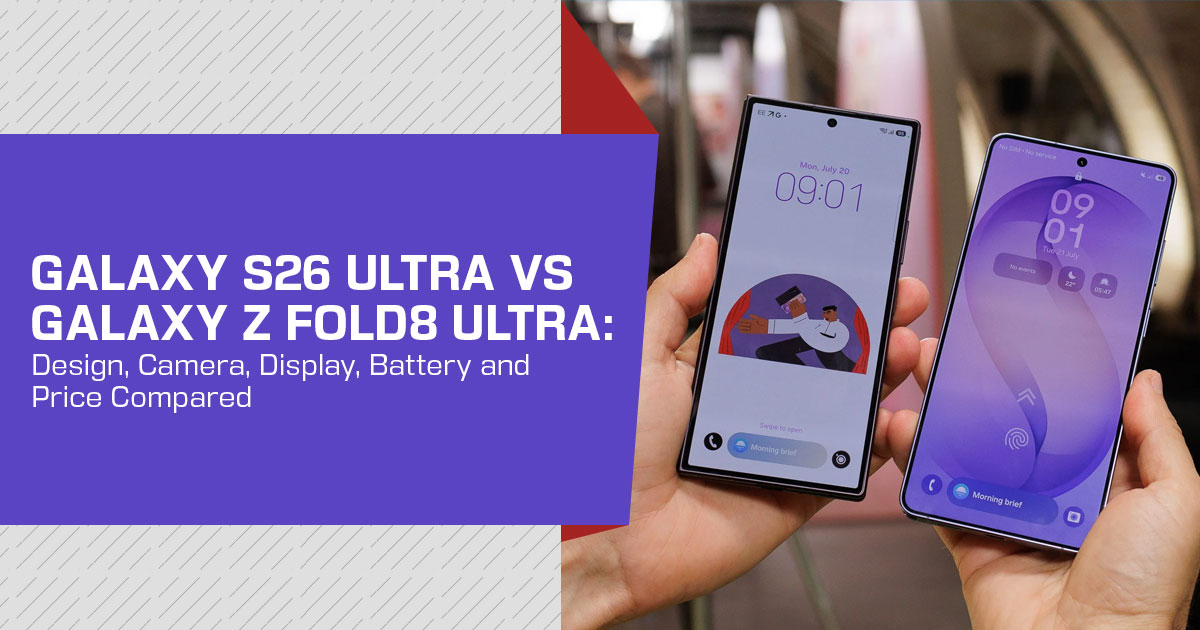
How we work: we do not run laboratory tests. This guide combines manufacturer documentation with reputable independent coverage and reviewer observations, then adds our own analysis. Where reviewers disagree, we say so. Where a claim comes from Samsung itself, we identify it. Key specifications are cross-checked against manufacturer and independent sources, and pricing is labeled by market, currency, and date.
Why the Galaxy S26 Ultra and Galaxy Z Fold8 Ultra Design Matters
In late August 2026, a post from Samsung leaks and renders account @TheGalox_ sparked a lively debate by calling the Galaxy S26 Ultra and Galaxy Z Fold8 Ultra two of the best-looking phones of 2026. Some people agreed immediately. Others felt Samsung had pushed its new design too far, especially with the S26 Ultra’s camera arrangement and softer shape. That disagreement matters because design affects how a phone feels, how easy it is to carry, how durable it may be, and whether you will still enjoy using it years from now.
Samsung’s 2026 flagship design also shows a clear shift. The Galaxy S26 Ultra uses a 7.9 mm Armor Aluminum frame, rounded corners, a hardware-level Privacy Display, and six color options, with Cobalt Violet as the hero finish. It launched from $1,299.99, with an India starting price of ₹1,39,999.
The Galaxy Z Fold8 Ultra takes the same design direction into a very different form. At 4.1 mm when open and 8.9 mm folded, it focuses on thinness and a large foldable screen. Its Flex Titanium structure combines a titanium-alloy film with a titanium plate beneath the OLED panel, helping support the display while reducing crease visibility. Violet Shadow gives the phone its signature look. It launched from $2,099.99, with an India starting price of ₹1,99,999.
Both phones also share the same processor and 200MP main camera, which makes the choice more interesting. For many buyers, the real question is not simply which phone has better specifications. It is which design and form factor fit their life better.
That matters to different people in different ways. If you want a premium everyday smartphone that feels familiar, fits easily into a pocket, and delivers strong long-term usability, the S26 Ultra deserves serious attention. If you value a larger screen, multitasking, reading, gaming, and a foldable design enough to accept a higher price and some practical compromises, the Fold8 Ultra makes a very different case.
As technology experts with over 20 years of experience in hardware and application research and development, we analyze products from the perspective of people who have to live with them—not just people comparing specifications on a screen. This guide is written for buyers who want a premium phone that balances performance, durability, reliability, usability, and long-term value.
Our recommendations are based on extensive research, component analysis, real-world usability, and industry expertise. We consider design quality, build materials, camera performance, durability, charging, comfort, software, price, and long-term ownership so you can choose the phone that makes the most sense for your needs and budget.
Neither flagship is perfect. The Galaxy S26 Ultra has attracted criticism over its camera-bump design and its move from titanium to aluminum. The Galaxy Z Fold8 Ultra brings different compromises, including its IP48 rating, large camera housing, 45W charging, lack of S Pen support, and much higher price.
So, is the Galaxy S26 Ultra one of the best-looking phones of 2026? Has Samsung made the Galaxy Z Fold8 Ultra refined enough to change how people think about foldables? Or do the practical compromises still matter more than the visual improvements?
Which one makes sense depends on what you value most.
Galaxy S26 Ultra Design and Build Quality: What Changed and Why It Matters
Rounded Corners, an Aluminum Frame, and a Slimmer Body
The Galaxy S26 Ultra design marks three notable changes from the S25 Ultra:
- Thickness: 9 mm — the first Ultra below 8 mm, and thinner than the 8.2 mm S25 Ultra (per SammyGuru’s spec comparison).
- Weight: 214 g, down from 218 g.
- Material: an Armor Aluminum frame replaces titanium. Samsung has not framed this as a downgrade, and TechRadar’s review notes aluminum made it easier to offer richer Some buyers will still see the loss of titanium as a step back — that is a fair concern to weigh, not a detail to brush aside.
The corners are now rounded across the whole S26 range, a direction set by the slimmer Galaxy S25 Edge. The rear camera arrangement also changed: a single camera island replaces the individual floating lenses of the previous two generations, and the camera bump grew slightly. The look is more unified with the standard S26 and S26+ — 9to5Google describes it as Samsung merging its design differences into one shape. Buyers who want their Ultra to look visually distinct from the cheaper models get less of that this year.
Galaxy S26 Ultra Colors: Every Option Explained
The Galaxy S26 Ultra colors lineup has six finishes. If you are deciding which Galaxy S26 Ultra color should you buy, here is the factual breakdown:
| Color | Availability | What to Know |
|---|---|---|
| Cobalt Violet | All channels | The 2026 hero color, featuring a distinctive violet finish with a matching S Pen button. |
| Black | All channels | A practical finish that does a good job of concealing minor scratches and everyday wear. |
| White | All channels | Provides a clean appearance under bright lighting, although lint and surface debris may be more noticeable. |
| Sky Blue | Most channels | A softer, muted blue finish complemented by matching frame accents. |
| Silver Shadow | Samsung.com exclusive | Features a subtle light metallic finish for a more understated premium appearance. |
| Pink Gold | Samsung.com exclusive | A warmer-toned finish available exclusively through Samsung’s online store. |
A practical note from accessory vendors and long-term users: darker finishes tend to show fingerprints, while lighter finishes tend to show micro-scratches. Neither issue changes the hardware — it only changes how the phone looks after months of use.
The Galaxy S26 Ultra Privacy Display, Explained
The Galaxy S26 Ultra Privacy Display is a practical highlight of this year’s design story. Samsung built the privacy feature into the 6.9-inch panel, allowing you to restrict side viewing so people nearby have a harder time seeing sensitive content. It can be activated from the Quick Panel or Settings, and it can also be configured to turn on automatically for selected apps, credentials, or notifications. The panel also carries anti-reflective treatment; its full display figures appear in the comparison table below.
For commuters, students, and anyone who handles sensitive work messages in public, this is a feature with clear daily use. It is also worth stating plainly: a privacy mode narrows viewing angles; it is not a security system, and it does not replace basic caution in public places.
How Thin Is the Galaxy S26 Ultra Compared to the iPhone 17 Pro Max?
Is the Galaxy S26 Ultra thinner than the iPhone 17 Pro Max? Yes — 7.9 mm against the iPhone 17 Pro Max’s officially published 8.75 mm depth on Apple’s specification sheet, a figure also cited in Yanko Design’s hands-on coverage. More notably, Samsung still fits a built-in S Pen silo inside that thinner body. Thickness is not a beauty metric on its own, but in-hand comfort and pocket fit are, and that is where the millimeters show up.
→ Current pricing on the S26 Ultra moves around — check today’s price on Amazon US or Amazon India.
[Image suggestion: S26 Ultra in Cobalt Violet, rear view — alt text: “Galaxy S26 Ultra in Cobalt Violet showing rounded corners and Armor Aluminum frame”]
Galaxy Z Fold8 Ultra Design and Build Quality: The Crease Question, Answered
What Is Flex Titanium on the Z Fold8 Ultra?
What is Flex Titanium on the Galaxy Z Fold8 Ultra? Samsung uses the name for a display structure that combines a titanium-alloy film with a titanium plate beneath the OLED panel. The two components add support while keeping the display flexible, helping Samsung make the phone thinner and reduce crease visibility.
The hands-on reports back this up with unusual consistency. SamMobile writes that running a finger over the center feels like touching a standard non-folding display, and calls it the flattest foldable display Samsung has fitted to a Fold. CNET calls it “one of the most invisible-seeming creases I’ve ever seen on a foldable phone.” HowToGeek describes the crease as essentially invisible both to the eye and to touch. The display is not flawless, though — it is still a foldable panel, and buyers sensitive to screen texture should try one in a store before committing.
How Thin Is the Galaxy Z Fold8 Ultra?
How thin is the Galaxy Z Fold8 Ultra? 4.1 mm when open and 8.9 mm folded, at 215 g — figures verified by Trusted Reviews and Ars Technica. Samsung also redesigned the Armour FlexHinge and widened the inner bezel gap slightly. CNET’s review calls that small gap a genuine quality-of-life improvement: it gives your thumb purchase to pry the halves apart, which matters when you open the phone dozens of times a day.
One design choice separates the Ultra from the standard Fold8: the Galaxy Z Fold8 Ultra is designed around its larger 8-inch display and revised hinge, while both models support Flex Mode. For desk use, video calls, and partially folded typing, Flex Mode remains a useful functional feature rather than just a spec-sheet line.
Galaxy Z Fold8 Ultra Colors: The Full Lineup
The Galaxy Z Fold8 Ultra colors are more restrained than the S26 range. What colors does the Galaxy Z Fold8 Ultra come in? Four:
| Color | Availability | Notes |
|---|---|---|
| Violet Shadow | All channels | Hero color featuring a dark violet, low-gloss finish. |
| Graphite | All channels | Dark neutral finish that helps conceal fingerprints and smudges. |
| Cream | All channels | A light, warm neutral finish with a clean and understated appearance. |
| Green Shadow | Samsung.com exclusive | Exclusive online-only color option available through Samsung’s website. |
If you are weighing Violet Shadow vs Graphite, the difference is mostly tone: Violet Shadow reads dark enough to pass as a neutral indoors, while Graphite may be less likely to make everyday marks noticeable. CNET notes the Fold8 Ultra’s display colors are slightly more muted than the Fold 7’s — a small point, but a real one for anyone comparing Z Fold8 Ultra vs Z Fold 7 in person.
Design Trade-Offs to Know Before Buying
Honest limitations, drawn from hands-on reviews and teardown reporting:
- The large rear camera housing can make the phone rock slightly when placed on a table, according to HowToGeek.
- IP48, not IP68. The Fold8 Ultra is rated for submersion in up to 5 meters of fresh water for 30 minutes under Samsung’s lab conditions, but its solid-particle protection is lower than the S26 Ultra’s IP68 rating. Samsung specifically advises against beach or pool use, so fine dust, sand, and other particles remain sensible concerns for a foldable.
- No S Pen Neither Fold8 model works with Samsung’s stylus.
- The tall, narrow 6.5-inch cover screen divides users. It makes one-handed use natural, but some apps sit better on the shorter, wider cover screen of the standard Galaxy Z Fold8 — a point several reviewers and buyers raised.
- Charging tops out at 45W, below the S26 Ultra’s 60W wired charging.
→ The Fold8 Ultra launched at $2,099.99 — check current Amazon US pricing or Amazon India pricing before paying full price.
[Image suggestion: Fold8 Ultra half-open in Violet Shadow, showing hinge and crease area — alt text: “Samsung Galaxy Z Fold8 Ultra in Violet Shadow opened at an angle showing Armour FlexHinge”]
Galaxy Z Fold8 Ultra vs Galaxy S26 Ultra: Full Comparison
Which is better, the Galaxy Z Fold8 Ultra or the Galaxy S26 Ultra? Neither — they optimize for different buyers. The Galaxy Z Fold8 Ultra vs Galaxy S26 Ultra comparison below uses verified launch specifications only.
| Specification | Galaxy S26 Ultra | Galaxy Z Fold8 Ultra |
|---|---|---|
| Launch Price (US) | $1,299.99 | $2,099.99 |
| Launch Price (India) | ₹1,39,999 | ₹1,99,999 |
| Main Display | 6.9″ Dynamic AMOLED 2X, 3120 × 1440, 120Hz, 2,600 nits | 8.0″ foldable Dynamic AMOLED 2X, 2504 × 2256, 120Hz, 3,000 nits |
| Second Display | — | 6.5″ cover display, 2520 × 1080 |
| Processor | Snapdragon 8 Elite Gen 5 for Galaxy | Snapdragon 8 Elite Gen 5 for Galaxy |
| Rear Cameras | 200MP f/1.4 main + 50MP ultrawide + 10MP 3× telephoto + 50MP 5× periscope | 200MP f/1.7 main + 50MP ultrawide + 10MP 3× telephoto |
| Battery | 5,000mAh | 5,000mAh |
| Wired Charging | 60W | 45W |
| Frame, Thickness & Weight | Armor Aluminum, 7.9mm, 214g | Armor Aluminum, 8.9mm folded / 4.1mm unfolded, 215g |
| Water & Dust Resistance | IP68 | IP48 |
| S Pen | Built-in | Not supported |
| Software at Launch | One UI 8.5 | One UI 9 (Android 17) |
| Update Policy | Approximately 7 years | 7 years |
| Colors | 6 options (4 standard + 2 online-exclusive) | 4 options (3 standard + 1 online-exclusive) |
| Wireless Charging | Up to 25W | 20W |
Three differences do most of the deciding:
- At launch prices, the gap is roughly $800 in the US and about ₹60,000 in India. At that price difference, the Fold8 Ultra needs to justify itself through its larger foldable screen and productivity benefits.
- The S26 Ultra keeps a fourth lens — the 50MP 5× periscope — and CNET’s review states plainly that the Fold8 Ultra’s cameras are not on par with Samsung’s cheaper flagship.
- The screen An 8-inch foldable canvas with Flex Mode is something no slab phone can offer.
Display Quality: What Each Screen Does Well
The S26 Ultra’s 6.9-inch panel carries the anti-reflective Privacy Display treatment described above, with a 3120×1440 resolution and an adaptive refresh rate that runs up to 120 Hz.
The Fold8 Ultra’s 8-inch inner display is listed at 3,000 nits peak brightness — the figure HowToGeek reports from its review unit — and SamMobile describes the Fold8 Ultra’s panels as the brightest yet on a Galaxy phone. Its anti-reflective treatment is designed to reduce glare and improve visibility outdoors. Samsung says the display is 15% brighter than the Fold7, while independent reviews also report improved outdoor readability. The 6.5-inch cover screen keeps the tall, narrow ratio of the Fold 7, at 2520×1080.
In plain terms: the S26 Ultra is the better one-handed screen, and the Fold8 Ultra is the better screen for reading, media, and split-screen use.
Performance: Same Chip, Different Bodies
Both phones run the Snapdragon 8 Elite Gen 5 for Galaxy — the same top-tier chip, shared by both of Samsung’s 2026 Ultra models (the standard S26 and S26+ use different silicon depending on the market). For everyday use — apps, photography, gaming, multitasking — burst performance is essentially identical wherever this chip appears; reviewer Matthew Moniz measured near-identical benchmark scores between the S26 Ultra and the standard Galaxy Z Fold8.
Where the bodies differ, sustained performance may differ too. A conventional slab has more internal volume for cooling, but we have not found a published sustained-load test directly comparing the S26 Ultra with the Fold8 Ultra. We therefore would not call a thermal advantage proven. For everyday apps, photography, multitasking, and normal gaming, both use the same Snapdragon 8 Elite Gen 5 for Galaxy platform and sit in the same performance class.
Cameras: Where the Two Ultras Diverge
The S26 Ultra carries a quad system: a 200MP f/1.4 main sensor, a 50MP ultrawide, a 10MP 3× telephoto, and a 50MP 5× periscope telephoto. A wider f/1.4 aperture gathers more light than narrower apertures do, which should matter most for indoor and night shots. TechRadar’s review rates its color, detail, and skin tones as the best it has seen from a Galaxy, rivaling what it gets from the iPhone 17 Pro Max.
The Fold8 Ultra carries three rear cameras: a 200MP f/1.7 main, a 50MP ultrawide, and a 10MP 3× telephoto. It has no 5× periscope camera. The difference matters most for buyers who regularly use longer-range zoom.
Battery Life and Charging: What Reviews Actually Say
| Feature | Galaxy S26 Ultra | Galaxy Z Fold8 Ultra |
|---|---|---|
| Battery Capacity | 5,000 mAh | 5,000 mAh |
| Wired Charging | 60W (charger not included) | 45W |
| Wireless Charging | Up to 25W | Up to 20W |
| Reported 30-Minute Top-Up | Up to 75% in approximately 30 minutes (Samsung laboratory figure) | Up to 67% in approximately 30 minutes with a 45W adapter (Samsung laboratory figure) |
The S26 Ultra introduces 60W wired charging on the Ultra line, up from 45W on the previous Ultra. Samsung rates it for up to 75% charge in around 30 minutes with a 60W adapter. The charger is sold separately.
The Fold8 Ultra picture is mixed. Samsung says its 5,000mAh battery is engineered into a slim and light foldable, while independent reviews differ on how much real-world battery life has improved. Usage patterns on an 8-inch screen vary widely, so treat strong battery claims with measured expectations rather than assuming a fixed result.
Software and Long-Term Support
The Fold8 Ultra ships with One UI 9 on Android 17, with seven years of OS and security updates. The S26 Ultra launched on One UI 8.5 with a similar multi-year update commitment, and both phones build their software experience around Galaxy AI; the S26 Ultra pairs its power button with Gemini on the side rail, per TechRadar’s review. Software is not the main reason to choose between them. The bigger distinction is how One UI takes advantage of each phone’s form factor: the S26 Ultra is optimized for a conventional slab, while the Fold8 Ultra makes greater use of its larger display and multitasking features.
Pros and Cons, Stated Plainly
| Galaxy S26 Ultra — Strengths | Galaxy S26 Ultra — Limitations |
|---|---|
| ✔ Slimmest Ultra yet at just 7.9mm, with a lighter 214g body. | ✖ Aluminum frame replaces the titanium construction of its predecessor. |
| ✔ Privacy Display provides hardware-level privacy for sensitive on-screen information. | ✖ Its design is visually closer to the standard Galaxy S26, reducing some of the Ultra model’s visual distinction. |
| ✔ Retains the integrated S Pen for handwriting, annotations, and productivity. | ✖ The larger camera bump may be visually divisive. |
| ✔ Supports faster 60W wired charging. | ✖ No charger is included in the box, while magnetic wireless accessories require a compatible case. |
| ✔ Dedicated 5× periscope telephoto camera provides a major zoom advantage over the Fold. | ✖ Available colors lean toward muted finishes rather than bold options. |
| Galaxy Z Fold8 Ultra — Strengths | Galaxy Z Fold8 Ultra — Limitations |
|---|---|
| ✔ Multiple reviews report a near-invisible display crease, improving the unfolded viewing experience. | ✖ The large camera housing can cause the phone to wobble when placed flat on a table. |
| ✔ Measures just 4.1mm when unfolded and weighs 215g, making it exceptionally light for a large foldable. | ✖ IP48 protection provides water resistance but lower solid-particle protection than IP68. |
| ✔ 3,000-nit inner display with improved anti-reflective treatment enhances visibility in bright environments. | ✖ No S Pen support, limiting its appeal for users who prioritize stylus-based productivity. |
| ✔ Flex Mode supports multiple viewing angles for video calls, media consumption, and hands-free use. | ✖ Limited to 45W wired charging and lacks a dedicated periscope zoom camera. |
| ✔ Described by SamMobile as Samsung’s most polished Fold hardware yet. | ✖ Premium launch pricing of US$2,099.99 / ₹1,99,999 makes it considerably more expensive than a conventional flagship. |
How They Fit Against the Competition
Galaxy S26 Ultra vs iPhone 17 Pro Max design: the S26 Ultra is the thinner phone (7.9 mm versus the iPhone 17 Pro Max’s published 8.75 mm) and the only one of the two with a built-in stylus. The iPhone 17 Pro Max uses familiar flat rails and Apple’s distinctive orange finish, while Samsung leans on rounded aluminum and muted colorways. On thinness and stylus integration, the comparison is measurable and favors Samsung. Ecosystem preference, software familiarity, and service coverage are personal factors no spec table can settle.
In the foldable space, the Motorola Razr Ultra (2026) took Mashable’s best-foldable pick for 2026, and the standard Galaxy Z Fold8’s wider cover screen has its own supporters. Dust-sensitive buyers should also know, per iFixit’s teardown coverage, that Google’s Pixel 10 Pro Fold and Pixel 11 Pro Fold ship with full IP68 ratings and Honor’s Magic V6 adds IP69 for high-pressure water — ingress ratings Samsung’s 2026 foldables have not matched. The Fold8 Ultra is not the only polished foldable
— it is the one with the biggest inner screen of Samsung’s 2026 foldables and the flattest display, which is a different argument.
For buyers comparing Samsung’s 2026 range, the choice is straightforward: the S26 Ultra is the conventional flagship, while the Fold8 Ultra is built around a larger foldable workspace and productivity needs.
Who Should Buy Which: Practical Buying Advice
| If You… | The Better Pick Is |
|---|---|
| Take zoom photos regularly | Galaxy S26 Ultra — its 5× periscope camera gives it an advantage for long-range photography. |
| Want the S Pen | Galaxy S26 Ultra — the Galaxy Z Fold8 Ultra does not offer stylus support. |
| Prefer one-handed use | Galaxy S26 Ultra — its conventional smartphone design is more practical for everyday one-handed operation. |
| Read, annotate, or use split-screen multitasking every day | Galaxy Z Fold8 Ultra — the larger foldable display provides substantially more workspace for reading and multitasking. |
| Want a phone and tablet in one pocket | Galaxy Z Fold8 Ultra — its folding design delivers a tablet-like screen while remaining pocketable. |
| Are sensitive to price | Galaxy S26 Ultra — or consider the regular Galaxy S26 if keeping the purchase price down is the main priority. |
| Worry about drops, dust, or long-term durability | Galaxy S26 Ultra — its IP68 protection and hinge-free design make it the more straightforward durability-focused choice. |
A note on color strategy, since this is a design-focused decision: the online-exclusive finishes (Silver Shadow, Pink Gold, Green Shadow) ship only from Samsung’s own store. Standard colors are available everywhere and tend to drop in price faster at third-party retailers. If saving money matters more than a specific finish, buy the standard colors.
Pricing and Availability: US and India
| Storage Variant | Galaxy S26 Ultra (US / India) | Galaxy Z Fold8 Ultra (US / India) |
|---|---|---|
| 256GB | $1,299.99 / ₹1,39,999 at launch | $2,099.99 / ₹1,99,999 at launch |
| 512GB | US price not listed / ₹1,59,999 | US price not listed / ₹2,19,999 |
| 1TB | US price not listed / ₹1,89,999 | US price not listed / ₹2,59,999 |
Availability: Samsung opened S26 Ultra pre-orders in India on February 25, 2026, with early deliveries beginning in March. Samsung unveiled the Z Fold8 Ultra on July 22, 2026; Samsung India says the Z Series 8 lineup was available for purchase from August 5, while Samsung’s global rollout began August 7 in select markets. All prices above are launch prices labeled by market and currency.
Sale prices are not standard prices, but they matter here. At the time of writing, Indian listings for the S26 Ultra have been observed around ₹1,19,990–₹1,24,999 during sales — well under launch pricing — a US listing was seen at $977 in June 2026 (per Mashable), and the Fold8 Ultra’s 512GB tier has been listed at ₹2,14,999 in India, below its launch price. Today’s prices move. Checking current listings before buying is one of the easiest ways to save real money on either phone.
Frequently Asked Questions
Is the Galaxy S26 Ultra made of titanium?
No. The S26 Ultra uses an Armor Aluminum frame; Samsung dropped titanium this generation. Aluminum allowed richer color finishes, but buyers who preferred titanium’s feel should factor the change in.
Does the Galaxy Z Fold8 Ultra have a visible crease?
Reviews consistently describe the crease as very hard to see thanks to Flex Titanium — CNET calls it one of the least visible creases on any foldable. It is reduced, not physically removed; try one in person if you are sensitive to it.
Is the Galaxy S26 Ultra thinner than the iPhone 17 Pro Max?
Yes — 7.9 mm versus Apple’s published 8.75 mm, while still fitting a built-in S Pen. Does the Galaxy Z Fold8 Ultra support the S Pen?
No. Neither the Fold8 nor the Fold8 Ultra supports S Pen input. Which is better, the Galaxy S26 Ultra or the Z Fold8 Ultra?
For cameras, durability, charging speed, and price, the S26 Ultra is the stronger all-round choice. For an 8-inch foldable workspace and Flex Mode, the Fold8 Ultra is the more capable tool — but it costs roughly $800 more at launch pricing.
What colors does the Galaxy Z Fold8 Ultra come in?
Violet Shadow, Graphite, and Cream, plus Green Shadow exclusively from Samsung.com. Is the Galaxy S26 Ultra worth buying in 2026?
For buyers who want the S Pen, long zoom, a Privacy Display, and Samsung’s seven-year flagship update policy in the slimmest Ultra yet — yes, based on the review record. Buyers wanting a dramatic redesign or titanium should look at the S25 Ultra at its reduced street price.
Is the Z Fold8 Ultra worth it for the design alone?
If “design” means Samsung’s most refined foldable hardware — a 4.1 mm unfolded profile, a flatter-looking display, and a redesigned hinge — the evidence supports that. If it means the best camera system or the stronger ingress rating, the S26 Ultra has the edge.
Final Verdict: Do They Deserve the “Most Beautiful Phones of 2026” Label?
Our read of the evidence: the claim holds up, with an asterisk.
The Galaxy S26 Ultra design is the more conventional kind of beautiful — thin, light, coherent, and finished in a well-judged palette. Its 5/5 design score at TechRadar and its measured thinness against the iPhone 17 Pro Max give the aesthetics real substance. The asterisk: it looks more like the rest of the S26 range than any Ultra before it, and the titanium-to-aluminum switch will not sit right with everyone.
The Galaxy Z Fold8 Ultra design is the more impressive engineering story. A 4.1 mm foldable with a crease that multiple independent reviewers describe as barely there is a genuine step forward for the category. Its asterisk: a large camera bump, an IP48 rating, and a $2,099.99 / ₹1,99,999 launch price.
Beauty is subjective; the hardware facts are not. Both phones earn their place in the 2026 design conversation, and both come with trade-offs no marketing brochure will print. Buy the S26 Ultra if the camera, the S Pen, and the price matter most. Buy the Fold8 Ultra if the big screen is the point. Either way, buy at the current price, not the launch price.
Where to Buy
Amazon US
- Galaxy S26 Ultra — the thinnest Ultra yet, built-in S Pen, 5× periscope zoom, and the Privacy Display. Sale listings have been observed well below its $1,299.99 launch price (around $977 in June 2026, per Mashable), so check the current Amazon US price and offers here.
- Galaxy Z Fold8 Ultra — the 8-inch foldable with a much less visible crease and a 3,000-nit display. At a $2,099.99 launch price, every discount matters: view the latest Amazon US offers here.
Amazon India
- Galaxy S26 Ultra — launched at ₹1,39,999, with sale listings observed near ₹1,19,990 at the time of writing. Check today’s Amazon India price.
- Galaxy Z Fold8 Ultra — launched at ₹1,99,999, with the 512GB tier listed at ₹2,14,999 at the time of writing. View current Amazon India pricing and offers.
Prices and availability change frequently. The figures above are labeled launch prices or observed sale listings as of August 2026, by market and currency — always confirm the current price at the retailer before purchasing. As Amazon Associates, we may earn from qualifying purchases.
What do you think? Is the Galaxy S26 Ultra the better-looking flagship, or does the Galaxy Z Fold8 Ultra have the design edge? More importantly, which one would you choose for your own everyday use?
Share your thoughts in the comments—especially if you already use a Galaxy Ultra or foldable phone. If you have questions about the Galaxy S26 Ultra, Galaxy Z Fold8 Ultra, cameras, display, durability, performance, pricing, or long-term value, feel free to ask. We’ll do our best to give you a clear, evidence-based answer.
And if you find our honest technology reviews, comparisons, and buying guides useful, follow us for more in-depth coverage. We’re here to help you make better technology decisions before you spend your money.
***Disclaimer***
This blog post reflects our research, analysis, and opinions based on available product information, user feedback, and industry knowledge. It should not be taken as the official position of any brand, manufacturer, or company mentioned here. We make every effort to keep this guide accurate, but product specifications, pricing, and availability may change after publication. We recommend double-checking important details before making a purchase.
Some links in this article may be affiliate links. If you choose to buy through these links, we may earn a small commission at no extra cost to you. This helps support our work and allows us to keep publishing in-depth, unbiased reviews. Affiliate partnerships never influence our recommendations.
Opinions expressed by readers are their own and do not necessarily reflect ours. We are not responsible for outcomes resulting from the use of information on this site. Please seek professional advice where appropriate.
All product names, logos, and brands mentioned are the property of their respective owners. These names are used for identification and informational purposes only and do not imply endorsement.