
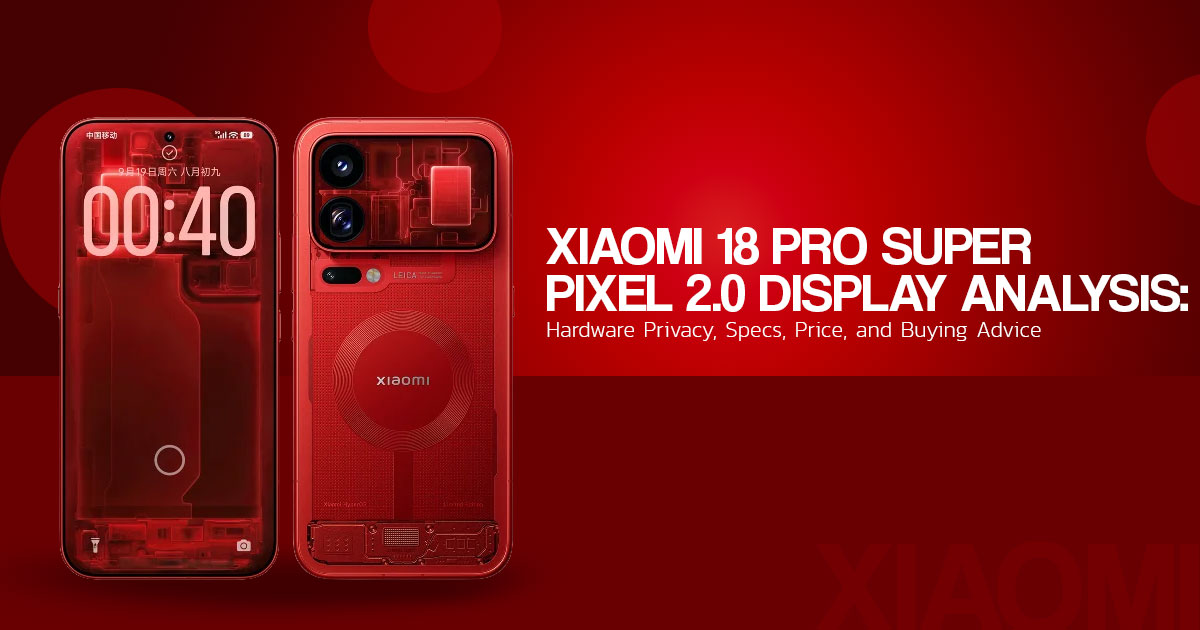
Xiaomi 18 Pro Super Pixel 2.0: What You Need to Know
The Xiaomi 18 Pro and Xiaomi 18 Pro Max launched in China on September 23, 2026, with Super Pixel 2.0 displays. Both phones use a 1–120Hz adaptive refresh rate and claim up to 4,000 nits peak brightness. Xiaomi also says the panels can deliver clarity comparable to a 2K display while using power closer to a 1.5K panel. These are Xiaomi’s claims, so independent testing is still needed.
The key change is the display architecture. Xiaomi combines a full-RGB pixel layout, its M11 light-emitting system, a new green light-emitting material, and hardware-level privacy protection in the same panel.
For buyers, the useful question is what Super Pixel 2.0 changes in daily use. That matters if you use a phone for banking, passwords, payments, private messages, or work information in public places.
This guide explains Xiaomi 18 Pro Super Pixel 2.0, how the display works, what Xiaomi claims about clarity, brightness, power efficiency, and privacy, and what buyers should check before buying.
As technology experts with over 20 years of experience in hardware and application research and development, we analyze products based on real-world performance, durability, and value for money. Our goal is to help readers find the right product across budget, performance, reliability, and long-term usage. This analysis is aimed at smartphone buyers, flagship phone shoppers, technology enthusiasts, professionals, and privacy-conscious users who want to understand the product before spending their money. Our recommendations are based on extensive research, component analysis, real-world usability, and industry expertise.
Xiaomi 18 Pro display specifications at a glance
| Specification | Xiaomi 18 Pro | Xiaomi 18 Pro Max | What it means for the buyer |
| Main display | 6.4-inch flat OLED | 6.9-inch flat OLED | The Pro is easier to handle; the Pro Max offers more room for reading and video. |
| Resolution | 2436 × 1120 | 2624 × 1208 | Both use unusual aspect ratios rather than a conventional 2K resolution label. |
| Refresh rate | 1–120Hz adaptive | 1–120Hz adaptive | The panel can reduce refresh for static content and raise it for scrolling or animation. |
| Peak brightness | Up to 4,000 nits claimed | Up to 4,000 nits claimed | The number suggests strong outdoor visibility, but sustained brightness requires testing. |
| Display technology | Super Pixel 2.0, M11 OLED, full RGB | Super Pixel 2.0, M11 OLED, full RGB | The full-RGB arrangement is intended to preserve text and image clarity. |
| Privacy protection | Hardware-level | Hardware-level | Side viewing is reduced when privacy mode is active. |
| Rear display | 2.7-inch OLED | 2.9-inch OLED | The rear panel can support selected controls, notifications, and camera-related functions. |
| China starting price | ¥5,999 | ¥6,999 | Regional pricing may differ across markets. |
What is Super Pixel 2.0?
Super Pixel 2.0 is Xiaomi’s name for the display system used in the 18 Pro series. It combines an M11 light-emitting system, a new green light-emitting material, a full-RGB pixel arrangement, and hardware-level privacy protection.
A conventional OLED phone screen may use a subpixel layout in which some color subpixels are shared or arranged in a pattern that balances resolution, power use, and manufacturing complexity. Xiaomi’s full-RGB layout gives each pixel a complete red, green, and blue subpixel set. In theory, that can help small text and fine lines look cleaner because each pixel has direct color information.
Xiaomi says the new green material improves luminous efficiency by 20%. It also claims that the panel can offer clarity similar to a 2K screen while consuming power closer to a 1.5K display. These are design and performance claims from Xiaomi, not proof that the phone will match every 2K panel in sharpness or every 1.5K panel in power use.
The practical question is whether the screen stays clear when privacy mode is active. Privacy systems can reduce apparent sharpness or brightness, so Xiaomi’s full-RGB design is intended to limit that trade-off. Independent measurements are still needed to confirm how well it works in real use.
How does the Xiaomi 18 Pro privacy display work?
The Xiaomi 18 Pro privacy display is not a software filter that simply darkens or blurs the screen. Xiaomi’s launch material and technical reporting describe a panel that combines normal wide-angle pixels with narrow-angle privacy pixels. The privacy pixels use physical structures that restrict the direction of emitted light.
In normal viewing mode, both pixel groups can illuminate. When privacy mode is enabled, the standard wide-angle pixels switch off and the narrow-angle pixels remain active. The person looking directly at the display can still see the content, while someone viewing from the side receives much less light.
Xiaomi says side brightness can fall to about 1% beyond a 60-degree viewing angle. That is a manufacturer claim; the visible result will still depend on room lighting, viewing distance, screen content, and the observer’s position.
This differs from a physical privacy protector, which affects the display whenever it is installed. A privacy film can narrow the viewing angle and reduce brightness during normal use. Xiaomi’s approach is designed to make privacy protection selectable instead of permanent.
Hardware privacy versus software privacy
The distinction between the two layers is important:
- Hardware privacy changes how the display emits light and limits side visibility.
- Software privacy controls decide when the hardware mode turns on and which part of the interface it affects.
The hardware layer is the reason the feature can work without a third-party screen protector. The software layer is what makes the feature more useful for individual apps, notifications, pages, or sensitive situations.
What can Smart Privacy Display protect?
Xiaomi’s privacy controls are described under Smart Privacy Display. Launch coverage shows that the feature goes beyond a simple on/off switch. Users can set privacy rules for individual apps or types of content, such as protecting a banking screen while leaving a video app in normal viewing mode.
Reported use cases include:
- Password entry screens
- Banking and payment applications
- Fund-transfer pages
- Private messages
- Selected lock-screen notifications
- Floating windows
- Split-screen content
Android Authority reports activation options that include Quick Settings, the customizable AI key, voice commands, location-based rules, and front-camera detection for possible shoulder surfers. These are reported software features; their reliability in everyday use still needs broader testing.
Selective controls can reduce the inconvenience of a global privacy mode. Instead of changing the whole display, users can apply protection to apps or sensitive content where it matters. The benefit depends on how easy the controls are to configure and how reliably they trigger.
Xiaomi 18 Pro versus Samsung Galaxy S26 Ultra privacy display
Samsung helped make privacy display a major flagship feature with the Galaxy S26 Ultra. Xiaomi’s implementation follows the same general goal: preserve front-facing visibility while reducing the information available to people viewing from an angle.
| Area | Xiaomi 18 Pro series | Samsung Galaxy S26 Ultra | Buying implication |
| Basic approach | Hardware-level viewing-angle control | Hardware-level viewing-angle control | Both use hardware-based viewing-angle control rather than relying only on software blur or an external film. |
| Pixel approach | Reported full-RGB layout with dedicated narrow-angle privacy pixels | Reported Diamond/Pentile-style arrangement | Xiaomi reports a full-RGB layout with dedicated narrow-angle privacy pixels; Samsung uses a different subpixel approach. |
| Selective controls | Reported app, page, notification, floating-window, and split-screen controls | Privacy behavior has its own system controls and limitations | Xiaomi reports more app, page, notification, floating-window, and split-screen options; practical usability needs testing. |
| Side-view claim | About 1% brightness beyond 60 degrees, according to Xiaomi | Reduced side visibility, with reported front-view trade-offs | Xiaomi reports about 1% side brightness beyond 60 degrees. Samsung’s system also limits side visibility, but the two need comparable measurements. |
| Main uncertainty | Global feature availability and real-world clarity | Brightness and clarity trade-offs in privacy mode | Independent testing is needed for comparable brightness, clarity, viewing-angle, and power results. |
The Xiaomi 18 Pro and Galaxy S26 Ultra take different approaches to the same basic problem: reducing side visibility while keeping the screen usable from the front. Xiaomi’s reported controls cover apps, notifications, floating windows, and split-screen content. That is a feature difference, not evidence that one phone delivers better privacy or image quality.
Display quality: what buyers should expect
The 4,000-nit peak brightness figure is useful for understanding the display’s maximum claimed output, but it does not mean the screen will hold 4,000 nits across the entire panel for long periods. Outdoor readability also depends on automatic brightness, reflectivity, color tuning, heat, and ambient light.
The 1–120Hz adaptive refresh rate can lower the refresh rate for static content and raise it during scrolling or animation. That can reduce unnecessary power use, but actual battery savings will depend on brightness, network conditions, gaming, camera use, and the software’s refresh-rate decisions.
The full-RGB design matters most for text-heavy use. People who read documents, edit spreadsheets, use remote desktops, or work with small interface elements may notice the benefit if Xiaomi’s clarity claims hold up. Video viewers are more likely to notice brightness, color, and motion handling.
Xiaomi 18 Pro and Pro Max: which model makes more sense?
The Xiaomi 18 Pro has a 6.4-inch display and starts at ¥5,999 in China. It keeps the same Super Pixel 2.0 and hardware privacy features as the Pro Max while using a smaller body.
The Xiaomi 18 Pro Max has a 6.9-inch display and starts at ¥6,999 in China. Its larger screen suits reading, video, navigation, and split-screen work, while the larger body may be less comfortable for one-handed use. The Pro Max also has a larger battery and rear display.
The main difference between the two models is size, battery capacity, and other hardware. Both use Super Pixel 2.0 and hardware-level privacy protection. Buyers should still check the exact regional configuration before ordering.
Buying advice: who should consider the Xiaomi 18 Pro?
The Xiaomi 18 Pro is worth considering for readers who:
- Frequently use a phone in trains, airports, offices, cafés, or other shared spaces.
- Handle banking, payment, password, or work information in public.
- Prefer selective privacy controls instead of a permanent screen protector.
- Want a high-refresh-rate OLED display with a compact flagship option.
- Are comfortable buying a China-market model or waiting for global availability.
The Xiaomi 18 Pro Max is more appropriate for readers who:
- Prefer a large display for documents, video, navigation, or split-screen use.
- Do not mind a larger and heavier phone.
- Want the larger battery and do not need the lower starting price of the Pro.
Who should wait before buying?
Buyers who need a confirmed international model, local warranty support, or region-specific software should check the global version before ordering. Xiaomi has confirmed that the Xiaomi 18 Pro series is going global, but market-by-market launch dates, prices, configurations, and feature availability still need to be confirmed.
If the display is the main reason for purchase, independent testing is worth checking before making a decision. Useful tests should measure front-facing brightness, side-view brightness at different angles, text clarity with privacy mode active, battery impact, heat, and automatic privacy triggers.
A China-market phone can also differ from a global model in software, network support, payment services, language options, and warranty coverage. Buyers should confirm supported bands, warranty terms, Google services, payment support, and the exact privacy features before ordering from an overseas seller.
Xiaomi 18 Pro price and availability
In China, the Xiaomi 18 Pro starts at ¥5,999, while the Xiaomi 18 Pro Max starts at ¥6,999. Higher RAM and storage configurations cost more. These are China prices and should not be treated as the final retail prices for other markets.
Xiaomi has confirmed that the 18 Pro series will launch globally, but the sources reviewed do not provide a complete market-by-market schedule or final international pricing. Check Xiaomi’s local announcements before relying on imported listings.
Where to check current offers
Amazon US
The phones may not have a verified official Amazon US listing at the time of publication. Readers in the United States can check current Xiaomi 18 Pro listings and pricing on Amazon US before buying. Confirm seller identity, model number, cellular bands, warranty coverage, return terms, and whether the device is a China or global variant.
Check Xiaomi 18 Pro offers on Amazon US
Amazon India
Availability in India should be checked separately because Xiaomi may release different configurations or launch only selected models. Before ordering, confirm 5G band support, warranty coverage, Google services, language support, and the expected delivery region.
Check Xiaomi 18 Pro offers on Amazon India
These are search links rather than a guarantee that an official or authorized listing is available. Do not treat an Amazon search result as proof of official availability. Affiliate tracking links should only be added to verified product listings with the required disclosure.
Xiaomi 18 Pro pros and cons
| Potential advantages | Important limitations |
| Hardware-level privacy is built into the display. | Xiaomi’s key brightness and efficiency figures still need independent testing. |
| Reported controls can apply privacy to apps, notifications, floating windows, and split-screen content. | The reliability of automatic triggers is not yet independently established. |
| Full-RGB Super Pixel 2.0 is designed to preserve fine detail. | Regional versions may not offer identical privacy features. |
| 1–120Hz adaptive refresh can support smooth scrolling and lower refresh for static content. | Peak brightness does not indicate sustained whole-screen brightness. |
| The Pro and Pro Max provide different screen sizes. | China-market imports may have warranty, software, or network limitations. |
| Global rollout is confirmed. | Exact international dates, prices, and regional configurations still vary by market. |
Frequently asked questions
Does the Xiaomi 18 Pro have a hardware privacy screen?
Yes. The Xiaomi 18 Pro hardware privacy display is built into the panel and is designed to reduce visibility from the side. It is not the same as a software blur or a third-party privacy film.
What is the Xiaomi 18 Pro display resolution?
The Xiaomi 18 Pro uses a 6.4-inch panel with a reported resolution of 2436 × 1120. The Xiaomi 18 Pro Max uses a 6.9-inch panel with a reported resolution of 2624 × 1208.
Does Xiaomi Super Pixel 2.0 use full RGB?
Yes. Xiaomi and specialist coverage describe Super Pixel 2.0 full RGB technology. Xiaomi positions the layout as a way to maintain clarity while supporting the panel’s privacy design.
Is the Xiaomi 18 Pro display 2K?
Xiaomi says the display can provide clarity comparable to a 2K panel while using power closer to a 1.5K panel. The phone’s listed pixel dimensions should be used for the specification; “2K-like clarity” is Xiaomi’s performance claim, not a formal resolution label.
Is Xiaomi’s privacy display better than Samsung’s?
Xiaomi and Samsung both use hardware-based privacy displays, but the implementations differ. Xiaomi reports app, page, notification, floating-window, and split-screen controls. These feature differences do not by themselves establish a difference in overall privacy, clarity, or power efficiency.
Is the Xiaomi 18 Pro available globally?
Xiaomi has confirmed that the Xiaomi 18 Pro series will launch globally, but the exact launch date, pricing, and feature availability for each market still require confirmation.
Should buyers import the Xiaomi 18 Pro from China?
Importing can provide earlier access, but buyers should verify network bands, warranty service, software support, payment features, return terms, and privacy features. Do not assume that a China-market model has the same configuration as the global version.
Final verdict: Is the Xiaomi 18 Pro worth considering?
The Xiaomi 18 Pro Super Pixel 2.0 display combines a new panel architecture with hardware-level privacy protection. The key features are full-RGB pixels, the M11 light-emitting system, 1–120Hz adaptive refresh, and up to 4,000 nits claimed peak brightness.
Xiaomi’s display claims are supported by a clear explanation of the panel design, but the strongest figures still need independent measurement. The most useful tests will show how brightness, clarity, power use, and side-view privacy behave under the same conditions used for competing phones.
For buyers in China, the main questions are screen size, price, and whether the privacy controls fit their daily use. For buyers in other markets, the key checks are local pricing, warranty, network support, software features, and the exact privacy hardware included in the regional model.
Have questions about the Xiaomi 18 Pro Super Pixel 2.0 display or want us to cover a specific feature in more detail?
Leave a comment below and tell us what you want to know. If you found this guide useful, follow us for more smartphone news, reviews, comparisons, and buying guides. We’ll keep looking at the details that matter before you spend your money.
Disclaimer

This article is based on our research, analysis, available product information, user feedback, and industry knowledge. It is not an official statement from any brand or manufacturer mentioned in the article. Product specifications, prices, software features, and availability can change. We do our best to keep the information up to date, but please check the latest details with the manufacturer or retailer before making a purchase.

Some links in this article may be affiliate links. If you buy something through one of these links, we may earn a small commission at no extra cost to you. These commissions help support the site and our work. They do not affect how we assess or discuss products. Comments and opinions shared by readers belong to the people who post them and do not necessarily represent our views. Information on this site is provided for general purposes, and we cannot guarantee a particular result from using it. Where professional advice is needed, consult a qualified professional.

All product names, logos, and trademarks belong to their respective owners. We use them only to identify the products and companies discussed and do not imply endorsement or affiliation.