
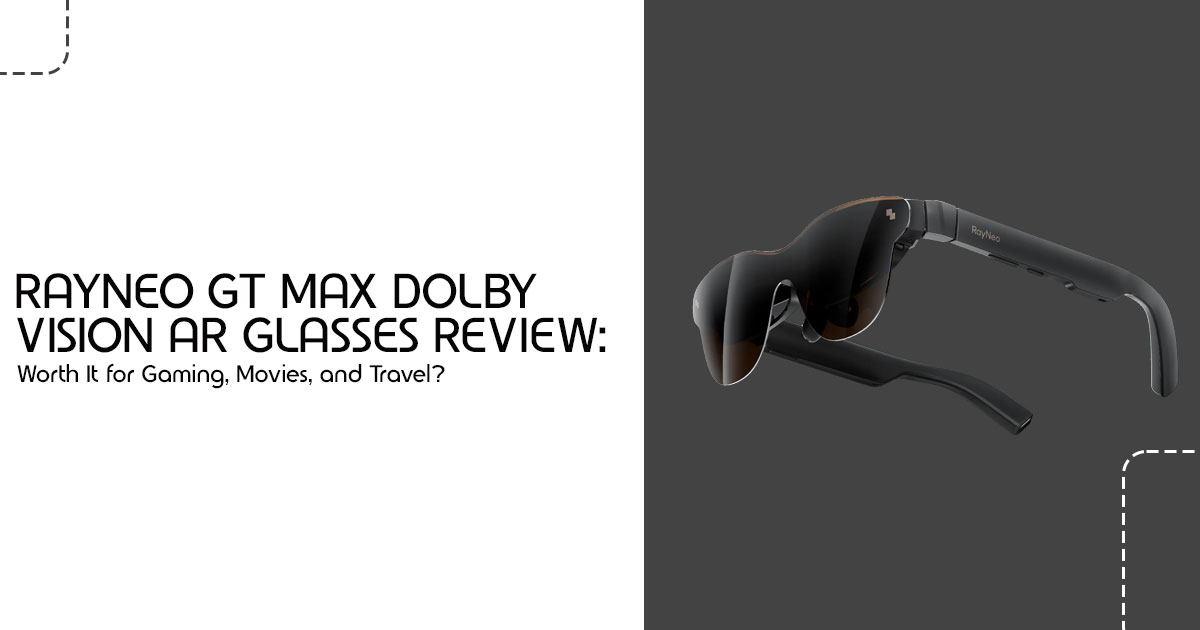
Imagine carrying a 267-inch private cinema in your backpack and watching movies on a flight without bothering the passenger beside you. That promise has existed for years, but most AR glasses ended up feeling like a trade-off — either the image quality looked weak, the comfort was disappointing, or the experience simply didn’t justify the price.
The RayNeo GT Max claims to change that.
Click here to buy from Amazon
With a wider 59° field of view, Dolby Vision support, and a stronger focus on immersive entertainment, these new smart glasses are aiming far beyond the usual “cool tech demo” category. RayNeo wants these to feel less like a tech toy and more like practical portable monitor glasses you can use for gaming, movies, and travel almost anywhere.
That raises an important question:
Can the RayNeo GT Max finally make smart glasses for gaming and movies feel practical enough for everyday use, or is this another gadget people stop using after the excitement fades?
As technology experts with more than 20 years of experience in hardware and application research and development, we evaluate products based on what actually matters in real life — performance, durability, comfort, ecosystem support, long-term usability, and overall value for money.
Our testing and recommendations are built around:
- extensive product research
- component-level analysis
- real-world usability testing
- long-session comfort evaluation
- gaming and entertainment performance
- long-term ownership expectations
This review is designed for:
- movie lovers searching for a portable cinematic experience
- Steam Deck and handheld gamers wanting a larger immersive screen
- frequent travelers looking for a lightweight wearable display for travel instead of carrying tablets, portable monitors, or extra screens
- tech enthusiasts curious about where XR glasses and wearable displays are heading over the next few years
- and buyers trying to decide whether premium AR smart glasses are finally worth the investment
Most reviews stop at specifications and marketing claims. We’re more interested in the experience after the excitement fades — the moments when you’re sitting on a long flight, relaxing in bed after work, gaming in a hotel room, or trying to decide if these glasses can realistically replace another screen in your bag.
That’s where products like the RayNeo GT Max either prove their value… or expose their limitations.
And right now, this might be one of the most ambitious AR entertainment launches we’ve seen in years.
Quick Verdict
| Feature | Rating | Verdict |
| Display Quality | 9.5/10 | Best-in-class color and FOV. |
| Comfort | 8.0/10 | Solid for 78g, but nose pads need care. |
| Audio | 9.0/10 | B&O tuning makes a massive difference. |
| Value | 8.5/10 | Competitive, though accessories add up. |
| Ecosystem | 7.5/10 | Strong, but relies heavily on the Magic Box. |
| Gaming | 9.0/10 | Incredible for handhelds like Steam Deck. |
Best For: Movie lovers, frequent travelers, Steam Deck owners, and portable entertainment users.
Not Ideal For: Professional mixed reality users, full VR users, or buyers expecting Apple Vision Pro-level interaction.
1. What Makes the RayNeo GT Max Different?
The AR market is crowded, but the RayNeo GT Max stands out by focusing on what people actually do with these glasses: watch content. Instead of trying to be a full-blown computer, it prioritizes the feeling of having a personal theater anywhere you go with three major upgrades.
1.1 Wider 59° Field of View (FOV)
Most AR glasses feel like you’re looking through a rectangular window. A 45° or 50° FOV is standard, but the GT Max jumps to 59°. In real terms, this means the edges of the screen don’t feel “cut off.” When you’re watching a movie, the image fills more of your natural vision, making these immersive display glasses feel closer to a real theater screen instead of a tiny floating display in front of your eyes.
1.2 Dolby Vision Support
RayNeo says the GT Max is among the first AR glasses officially certified for Dolby Vision, which is a big deal for people who care about movie quality and HDR content. If you’ve ever watched HDR content on a cheap monitor, you know it can look washed out.
Dolby Vision ensures that the contrast—the difference between the brightest whites and the deepest blacks—is handled frame-by-frame. Dark scenes in movies like The Batman actually look dark, not just grey, with incredible shadow detail and color depth.
1.3 Dual-Chip Processing System
Instead of relying on one chip to do everything, the GT Max uses a dedicated chip for image processing and another for spatial calculations. For you, this means smoother visuals and better stability. If you move your head, the screen doesn’t “jitter” or lag, which is the number one cause of motion sickness in these devices. In everyday use, the experience feels smooth and stable without needing to think about the technical side of it.
2. RayNeo GT Max Specifications at a Glance
| Component | Specification |
| Display | Dual-layer Micro OLED (5.5-Generation) |
| Field of View (FOV) | 59° |
| Weight | 78 grams |
| Audio | Bang & Olufsen Spatial Audio |
| Chips | Vision 4000 & Zone 360 Dual-Chip Architecture |
| Connectivity | USB-C (DisplayPort Alt Mode) for true plug-and-play compatibility with supported smartphones, laptops, handheld gaming PCs, and tablets. |
| Prescription Support | Magnetic prescription inserts (supports up to 1000° myopia) |
| Dimensions | Available in Small (S), Medium (M), and Large (L) frame sizes |
| Price | Approximately $385 for the glasses, plus $150 for the optional Magic Box 2 companion device |
3. Display Experience: The Part Most Buyers Actually Care About
3.1 Is the Virtual Screen Really That Big?
Marketing materials love to talk about “267-inch screens,” but perceived size is subjective. In our testing, the RayNeo GT Max feels like sitting in the middle row of a high-end cinema.
Because the 59° FOV is so wide, you don’t feel the “border” of the glasses as much as you do with competitors. It genuinely feels massive, especially if you’re in a dark room, though your realistic expectations should account for the fact that it’s still a wearable.
3.2 Color Accuracy & Contrast
Like most premium OLED AR glasses, the GT Max delivers rich contrast, deep blacks, and vibrant colors without making images look overly artificial. We tested this with:
- Movies: Cinematic blacks are ink-deep.
- Sports: Motion is fluid with no ghosting during fast plays.
- Anime: The high contrast makes hand-drawn art pop beautifully.
- Gaming: Details in dark corridors are clearly visible.
3.3 How Dolby Vision Changes the Experience
When connected to the RayNeo Magic Box 2, the Dolby Vision support kicks in. In a dark scene—like a space thriller—you can see the subtle details in the shadows that other glasses would simply crush into a black blob. It’s a level of fidelity we haven’t seen in portable AR before, making cinematic viewing truly immersive.
Click here to buy from Amazon
4. Gaming Performance Analysis
4.1 Steam Deck & ROG Ally Experience
This is perhaps the best use case for the RayNeo GT Max. Playing Elden Ring on a 7-inch handheld is fine, but playing it on a 267-inch virtual screen is a game-changer.
- Strengths: No noticeable latency during our testing and incredible immersion.
- Weaknesses: You’ll need a right-angle USB-C adapter if you want to be truly comfortable while lying down.
4.2 PlayStation 5 Gaming
Using these with a home console requires a wired connection, but the payoff is a private gaming booth.
- What Works Well: The screen size makes local split-screen feel like you each have a 100-inch TV.
- Potential Limitations: You are tethered by a cable, which might limit your “gamer lean.”
4.3 Xbox and Cloud Gaming
For cloud gaming, latency is always the enemy. However, the glasses themselves add no extra lag. The screen immersion is so high that you quickly forget you’re streaming the game from a server miles away.
5. Can It Replace Your Monitor?
We get asked this a lot: “Can I use these for work?” This section attracts strong search traffic because everyone wants to ditch their desk.
- Remote Work: For spreadsheets and documents, the text clarity is surprisingly You can read small fonts without squinting.
- Coding & Development: The ability to have a massive “vertical” or wide screen while sitting in a coffee shop is great for focus. Readability is top-tier for an AR
- Creative Work: While the colors are great for photo and video editing, we wouldn’t recommend them for professional color grading yet.
- Where It Still Falls Short: Multi-window management is still easier on a physical ultra-wide The “fixed” screen mode is good, but it’s not as stable as a real piece of hardware on your desk.
6. Comfort Test: Can You Wear It for Hours?
6.1 Weight Distribution
At 78g, these are light, but they aren’t “forgot-I-was-wearing-them” light. RayNeo did a good job balancing the weight so it doesn’t all sit on the bridge of your nose, using magnesium-aluminum alloys to keep the frame rigid but light.
6.2 Pressure Points
After about two hours (the length of a standard movie), you might feel some pressure on your nose bridge or temples. For extended use, we recommend taking a 5-minute break between films.
6.3 Travel Comfort
On a flight, these genuinely make travel entertainment far more enjoyable. Whether you’re on a train or in a hotel, you can lean back, close your eyes to the world, and just watch your show without worrying about the person next to you peeking at your screen.
7. Audio Quality Review
7.1 Bang & Olufsen Tuning Explained
Most AR glasses have tinny, weak speakers. The RayNeo GT Max collaborated with B&O, and you can hear the difference immediately. The sound feels fuller, with noticeably better bass than most AR glasses we’ve tested.
7.2 Spatial Audio Performance
- Movies: The sound feels like it’s coming from the screen, not just from the arms of the glasses.
- Gaming: You can actually hear the direction of footsteps.
- Music: It’s surprisingly decent, though not a replacement for high-end over-ear headphones.
7.3 Privacy Considerations
Can people nearby hear your audio? At 50% volume, someone sitting next to you on a bus won’t hear a thing. At 100%, there is some leakage, but it’s much better than most open-ear designs.
8. Device Compatibility Guide
- iPhone Compatibility: iPhone 15 and 16 work natively via USB-C.
- Android Compatibility: Most modern flagships with DP Alt Mode work perfectly.
- Windows Laptop Compatibility: Plug and play as a second (or primary) monitor.
- MacBook Compatibility: Works great; supports multiple virtual displays via the RayNeo app.
- Steam Deck Compatibility: The gold standard; direct plug and play.
- Nintendo Switch Compatibility: Requires the Magic Box 2 or a powered HDMI adapter.
9. RayNeo GT Max vs Competitors
9.1 RayNeo GT Max vs XREAL One Pro
The XREAL has a slightly higher refresh rate, but the RayNeo GT Max offers a noticeably wider field of view (59° vs 50°) and color depth. If you want the “IMAX” feel, RayNeo is the winner.
9.2 RayNeo GT Max vs Viture Pro XR
Viture has a very polished ecosystem, but lacks Dolby Vision. For movie purists, the RayNeo is the clear winner for cinematic quality.
9.3 RayNeo GT Max vs Rokid Max 2
Rokid is comfortable, but the GT Max feels more like a premium piece of tech rather than a plastic toy. The RayNeo GT Max wins on audio and display tech.
10. Who Should Buy the RayNeo GT Max?
- Frequent Travelers: If you spend your life in transit, this is your new best friend.
- Portable Gaming Enthusiasts: These easily rank among the most exciting AR glasses for Steam Deck and ROG Ally users who want a larger, more immersive gaming setup without carrying a monitor.
- Movie Lovers: If you’ve been searching for the best AR glasses for movies, the RayNeo GT Max makes a strong case with its massive screen feel, deep contrast, and Dolby Vision support.
- Early Technology Adopters: If you want the cutting edge of wearable displays.
11. Who Should Skip It?
- Productivity-First Users: If you need 4 monitors to work, this isn’t there yet.
- Budget Buyers: The total cost with accessories is a significant investment.
- Full VR Users: If you want to walk around in a virtual world, buy a Quest 3 instead.
12. Hidden Costs Buyers Should Know About
To get the most out of these, you really need the Magic Box 2. It handles the Dolby Vision processing and provides the battery power so you don’t drain your phone. If you wear glasses, you’ll also need to budget for prescription lenses, which are an extra cost but absolutely necessary for a clear image. Don’t forget potential adapters and cables if you’re connecting to older consoles.
13. Biggest Pros and Cons
Pros:
- Massive 59° FOV that actually feels immersive.
- Official Dolby Vision support for incredible HDR.
- Strong Bang & Olufsen spatial audio.
- Portable cinema experience in a 78g package.
Cons:
- Extra accessories (like the Magic Box) are almost required.
- Limited AR functionality compared to full VR headsets.
- Availability can be tight in some regions.
14. Future of AR Glasses: Why This Launch Matters
The RayNeo GT Max represents a shift in the growing AR market. We are moving away from “novelty” and toward “utility.” As wearable displays become lighter and more capable, the idea of a portable computing setup becomes less of a dream and more of a reality. This launch proves that high-end cinema quality can be shrunk down into something that fits in your pocket.
15. Frequently Asked Questions
Are the RayNeo GT Max good AR glasses for Netflix and streaming apps?
Yes. The glasses work like a portable external display, making them excellent for Netflix, YouTube, Disney+, and other streaming platforms.
Can I use RayNeo GT Max with PS5?
Yes, via an HDMI-to-USB-C adapter.
Is Dolby Vision available without the Magic Box?
No, the Magic Box 2 contains the necessary hardware for the certification.
Can RayNeo GT Max replace a TV?
For a single person, absolutely. For a family movie night, probably not.
Does it support prescription lenses?
Yes, it comes with a magnetic frame for custom inserts.
Is the screen visible outdoors?
Yes, but it’s best used with the included light shield for maximum contrast.
Can I use it on flights?
One of the best use cases is flights and long-distance travel. It’s quiet and doesn’t bother neighbors.
Does it cause eye strain?
Many users may find it more comfortable than staring at a small phone screen for long periods.
Click here to buy from Amazon
Final Verdict
Buy It If…
You want one of the most immersive portable entertainment experiences available right now. The RayNeo GT Max stands out with its massive 59° field of view, Dolby Vision support, and cinema-style viewing experience that feels far more premium than earlier generations of AR glasses.
It makes the most sense for:
- movie lovers who travel often
- Steam Deck gamers and handheld gaming users
- commuters and frequent flyers
- early adopters who want cutting-edge wearable display technology
- users looking for a private giant-screen experience anywhere
Skip It If…
You mainly want a serious productivity workstation replacement or expect a full mixed reality headset experience similar to high-end VR devices.
You may also want to wait if:
- you’re on a tight budget
- you need broad app ecosystem support today
- you prefer mature global software support
- you want guaranteed international warranty coverage immediately
Overall Recommendation
The RayNeo GT Max feels like one of the first AR smart glasses products that genuinely delivers on the promise of a portable private cinema without feeling unfinished or overly experimental.
The wider 59° field of view makes a noticeable difference compared to many competing smart glasses, and Dolby Vision helps movies and games look richer, deeper, and more immersive — especially during darker scenes and HDR content playback.
While it still won’t fully replace a traditional desktop monitor setup for most people, it absolutely pushes portable entertainment technology forward in a meaningful way.
If your priorities are:
- immersive gaming
- portable movie watching
- travel entertainment
- Steam Deck compatibility
- or a premium virtual display experience
…the RayNeo GT Max looks like one of the strongest AR glasses launches of 2026.
Availability & Global Release Status
Current Availability
At the moment, the RayNeo GT Max is officially available only in China, where it launched at a starting price of 1,899 yuan (roughly $262 USD).
Global / US Release Timeline
RayNeo has not officially confirmed a worldwide release date yet.
However, the company is actively showcasing the RayNeo GT Max and its AI-powered spatial interaction features during the AWE (Augmented World Expo) 2026 event beginning June 16. That is usually a strong sign that broader international launch plans are already in motion.
For buyers outside China, availability may initially depend on import retailers before an official global rollout happens.
Alternative AR Glasses You Can Buy Right Now
If you do not want to wait for the RayNeo GT Max global launch, the XREAL Air 2 Pro remains one of the best currently available alternatives for:
- portable gaming
- cinematic viewing
- private screen entertainment
- travel-friendly media consumption
Amazon Worldwide — XREAL Air 2 Pro AR Glasses
Amazon India — XREAL Air 2 Pro AR Glasses
Have you tried AR glasses for gaming, portable movie watching, or travel entertainment?
Share your experience in the comments below — or ask a question if you are still deciding between RayNeo, XREAL, Viture, or Rokid.
***Disclaimer***
This blog post reflects our research, analysis, and opinions based on available product information, user feedback, and industry knowledge. It should not be taken as the official position of any brand, manufacturer, or company mentioned here. While we aim to keep information accurate and up to date, product details, pricing, and availability can change. We recommend double-checking important details before making a purchase.
Some links in this article may be affiliate links. If you choose to buy through these links, we may earn a small commission at no extra cost to you. This helps support our work and allows us to keep publishing in-depth, unbiased reviews. Our recommendations are never influenced by affiliate partnerships.
Comments shared by readers reflect their own views and not ours. We are not responsible for outcomes resulting from the use of information on this site. Please seek professional advice where appropriate.
All product names, logos, and brands mentioned are the property of their respective owners. These names are used for identification and informational purposes only and do not imply endorsement.