
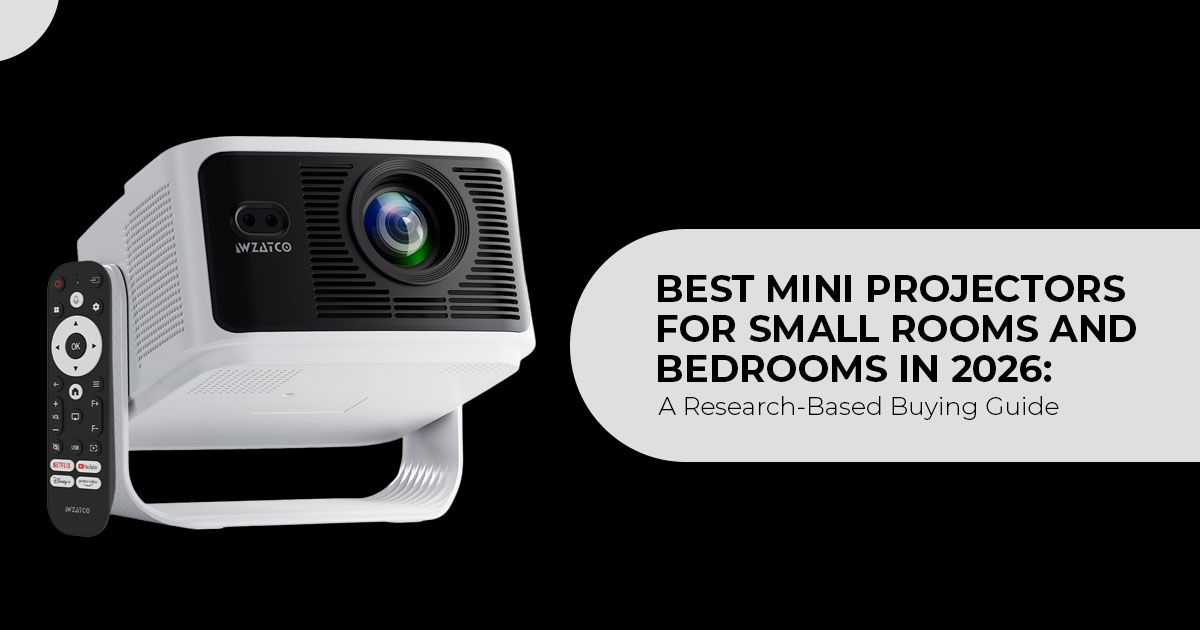
A mini projector for a bedroom should make movie nights easier, not turn setup into another job. For most bedrooms, the sweet spot is native 1080p resolution, around 300–500 ANSI lumens, a throw ratio close to 1.2:1, and automatic keystone correction. These features matter because they affect the things you notice every time you use the projector: picture sharpness, brightness, screen size, and how quickly you can get everything lined up.
Among the models we looked at, each takes a slightly different approach. The BenQ GV50 is the most purpose-built option for bedroom and ceiling projection, making it appealing if you like watching movies from bed.
The Aurzen BOOM mini puts more emphasis on built-in audio, with the highest speaker output among these models. If your budget is tighter, the WZATCO Yuva Go Ultra offers a wide mix of features for buyers searching for a projector under ₹20,000 in India.
One thing we want to make clear before you start comparing them: we did not physically test these projectors. Our assessment is based on manufacturer specifications, independent laboratory reviews from PCMag, ProjectorReviews and CNET, along with verified retail listings checked in August 2026. Projector specifications can sometimes be confusing, especially when brightness figures or feature lists differ between a brand’s website and its retail listings. Where we found a difference between a manufacturer’s claim and an independent measurement, we have shown both. If a brand’s own pages give conflicting information, we have called that out too.
We approach these comparisons with more than 20 years of experience in hardware and application research and development. That means we don’t simply look at a long list of specifications and pick the model with the biggest numbers. We consider reported real-world performance, build quality, reliability, ease of use, and value for money.
This guide is aimed at students, working professionals, couples, families, movie and sports fans, and anyone who wants a simple home-theatre setup without spending heavily on a television. Some readers will want the best budget projector. Others may care more about picture quality, built-in speakers, portability, bedroom ceiling projection, gaming, or long-term reliability. We have kept those different needs in mind rather than treating every buyer the same.
Our recommendations come from extensive research, hardware and optical design analysis based on published specifications, reported real-world usability, and industry experience. More importantly, we want you to know why a particular projector is worth considering and where its limitations are before you spend your money. A projector can look impressive on paper and still be the wrong choice for your room, your viewing habits, or your budget.
Why Mini Projectors Suit Small Rooms and Bedrooms
A bedroom is a favourable environment for a compact projector, because these devices are constrained by ambient light rather than by room size.
The models here with published ANSI or ISO ratings top out at around 500 lumens. That is not enough to overcome strong daylight, and bright room lighting will noticeably reduce image contrast. A bedroom at night with curtains drawn removes that constraint. The same unit that looks washed out in a sunlit living room can produce a clean 80 to 100 inch image once the lights are off.
There is a second, less obvious benefit. In a small room you sit closer to the image, so native 1080p at 80 inches holds detail better than the same panel stretched to 150 inches in a larger space.
The trade-offs are worth stating plainly:
- Ambient light control is not Without it, these projectors underperform.
- Built-in speakers vary widely, from 3 W mono units to 20 W stereo systems.
- Fan noise matters more in a quiet bedroom, especially during late-night viewing.
- Throw distance determines whether a projector physically fits, and it is the specification most buyers check last.
How We Selected and Assessed These Mini Projectors
We worked backwards from the specifications that change day-to-day use in a small room, rather than from headline numbers. Our priorities, in order:
- Native resolution, kept strictly separate from supported input resolution
- Brightness stated in ANSI or ISO lumens, with unqualified figures flagged
- Throw ratio and minimum projection distance, checked against realistic room depths
- Fan noise in decibels, where a figure is published
- Streaming platform and Netflix licensing, verified per model
- Retail pricing, checked in August 2026 and labelled by market and price type
Where an independent reviewer published a measured brightness figure differing from the manufacturer’s rating, both are recorded. That gap is common across the category and is not by itself evidence of a poor product.
Specifications at a Glance
| Model | Native Resolution | Rated Brightness | Throw Ratio | Smart Platform | Netflix | Battery | Fan Noise |
|---|---|---|---|---|---|---|---|
| BenQ GV50 | 1920 × 1080 | 500 ANSI lumens | 1.2 | Google TV (Android 11) | Licensed | Yes | 26–28 dB |
| Aurzen BOOM Mini | 1920 × 1080 | 500 ANSI lumens (SGS verified) | Not stated | Google TV | Licensed | No | ≤36 dB |
| XGIMI MoGo 2 Pro (XK04T) | 1920 × 1080 | 400 ISO lumens | 1.2:1 | Android TV 11 | Not native on XK04T | No | Under 30 dB claimed; 38 dB measured |
| LG CineBeam PF510Q | 1920 × 1080 | 450 ANSI lumens | 1.2 | webOS 22 | No app | No | 24–29 dB |
| WZATCO Yuva Go Ultra | 1920 × 1080 | 13,000 lm (measurement standard not stated) | 1.2:1 | Android 14, Google TV certified | Yes | Unconfirmed | Not published |
| Zebronics Zeb PixaPlay 25 | 1920 × 1080 | 6,300 lm (measurement standard not stated) | Not stated | Android 12 | App support | No | Not published |
| Magcubic HY320 | 1920 × 1080 | 390 ANSI lumens | 1.1:1 | Android 11 | Varies by unit | No | Not published |
| Magcubic HY320 Mini | 1280 × 720 | 300 ANSI lumens | 0.9:1 | Android 11 / 14 | Varies by unit | No | Not published |
Brightness figures in this table are not directly comparable across every row. The ANSI and ISO entries follow defined measurement standards. The unqualified “lm” entries do not state any standard. That distinction is explained below.
The Mini Projectors Worth Considering
BenQ GV50 — Built for Bedroom Ceiling Projection
The BenQ GV50 is the only model here designed around ceiling projection as a primary use case. Its base provides 135 degrees of vertical tilt and 360 degrees of horizontal rotation, allowing it to point at the ceiling from a bedside table without improvised supports.
The hardware supports that use case. It pairs a blue laser light source rated at 500 ANSI lumens with a native 1920 × 1080 DLP chip and accepts 4K input, which it downscales. Laser life is rated at 20,000 hours in normal mode and 30,000 hours in eco mode. Colour coverage is quoted at 92% of Rec. 709, and input lag is 22.4 ms at 1080p 60 Hz.
Two details matter specifically for bedroom use. Fan noise is rated at 26 to 28 dB, the lowest published figure among the models here alongside the LG. The 18 W 2.1-channel speaker system, combining two 4 W drivers with a 10 W woofer chamber, is capable enough that external audio is not required for most viewing.
It runs Google TV on Android 11 with licensed Netflix, avoiding the sideloading step that affects some competitors.
Points to weigh. Battery life is where sources diverge. BenQ’s datasheet and the Amazon.in listing both quote roughly 150 minutes of video playback, while HowToGeek’s review reported approximately 120 minutes.
Treat the manufacturer figure as an upper bound. At 2.1 kg including its base, it is among the heaviest units covered. One further note on labelling: BenQ states 500 ANSI lumens, while the Best Buy listing describes the same figure as 500 ISO lumens.
Pricing. India: listed at ₹59,990 on Amazon.in against an MRP of ₹89,990, with some retailers at ₹62,990. The India launch price in April 2025 was ₹69,990. United States: US$599.99 at Best Buy at the time of writing, with other retailers listing higher.
Suited to buyers whose main use is watching content while lying in bed, and who want picture, sound and streaming in one device.
Click here to purchase on Amazon US and Amazon India.
Aurzen BOOM mini — Highest Built-In Speaker Output Here
The Aurzen BOOM mini (model AU-PJ-BM501M, first available December 2024) uses a single-chip LCD panel with an LED light source, rather than the DLP designs used by BenQ, LG and XGIMI. Its distinguishing feature is a 20 W audio system built from two 10 W drivers with Dolby Audio support, the highest speaker output in this guide.
Brightness is rated at 500 ANSI lumens, and Aurzen states this was independently verified by SGS under the ANSI/IEC 21118 standard. Third-party verification is uncommon in this category. Aurzen also discloses that 500 ANSI represents the average across mass-produced units, while 535 ANSI was a peak measured on a single sample. That is a more transparent disclosure than most brands provide. PCMag’s own testing found the image closer to what it would expect from around 400 lumens, so the rating appears honest rather than conservative.
Resolution is native 1920 × 1080 with HDR10 and HLG support. It runs Google TV with licensed Netflix, uses ToF real-time autofocus, and sits on a 110-degree tilting gimbal stand. Contrast is rated at 1000:1, throw distance spans 1.2 to 6 m; Aurzen does not publish a formal throw-ratio figure. Warranty is one year, with an additional year available after registration.
Points to weigh. There is no internal battery, so mains power is required. At 2.13 kg it is not a device to move frequently. PCMag noted internal reflections affecting picture quality under some lighting conditions. One retailer listing claims the unit lacks an HDMI input, but PCMag, The Gadgeteer and hometheaterreview all confirm a single HDMI port, so that listing appears to be in error.
Pricing. United States: list price US$349.99, currently listed at US$259.99 direct from Aurzen. Promotional pricing has fallen below US$250 at times. We could not verify an official India retail channel.
Suited to buyers who want built-in sound handled properly, in a room with a permanent power outlet.
Click here to purchase on Amazon India.
XGIMI MoGo 2 Pro — Strong Setup Automation, With Streaming Limitations
The XGIMI MoGo 2 Pro (model XK04T) is the original 2023-generation model covered here. XGIMI launched a separate MoGo 2 Pro (New) in 2026 with Google TV and licensed Netflix, so buyers should verify the exact model before purchasing. Its ISA 2.0 feature set combines continuous autofocus, automatic keystone correction, obstacle avoidance and screen alignment, working quickly enough that repositioning mid-use is not disruptive.
It is rated at 400 ISO lumens with stated 1920 × 1080 output, 90% DCI-P3 colour coverage and a D65 white point. Audio comes from two 8 W speakers, and it projects 40 to 200 inches at a 1.2:1 throw ratio. It runs Android TV 11 with Chromecast built in, on 2 GB of RAM and 16 GB of storage.
Points to weigh, and there are several. Netflix is not natively supported on the original XK04T. XGIMI’s current documentation distinguishes this model from the newer MoGo 2 Pro (New), which has Google TV and licensed Netflix. Buyers of the original model need to use sideloading or an external streaming device. For many buyers this alone is decisive.
There is no internal battery despite the portable positioning; it runs from mains or a 65 W USB-C power bank. Fan noise is the weakest attribute for bedroom use: XGIMI claims under 30 dB, but AVNirvana measured 38 dB and MakeUseOf described the fans as becoming loud. In a quiet bedroom that difference is audible.
PCMag measured brightness closer to 300 lumens than the rated 400. Sources also disagree on the panel itself: XGIMI and PCMag describe native 1920 × 1080, while AVNirvana reports the 0.23-inch chip reaches 1080p through pixel shifting. That question is not publicly settled, so we report the manufacturer’s stated figure and note the disagreement rather than adopting either position.
Pricing. Global: list price US$599.99, currently discounted to US$319.99 through XGIMI’s own store. India availability runs through importers at roughly ₹34,999 to ₹54,990, without a consistent official channel.
Suited to buyers who value fast automatic setup, already own a streaming stick, and are not sensitive to fan noise.
Click here to purchase on Amazon US and Amazon India.
LG CineBeam PF510Q — Compact and Quiet, But Verify Availability
The LG CineBeam PF510Q is a compact and light unit here at approximately 1 kg and 148 × 66.5 × 148 mm. It is rated at 450 ANSI lumens from a 4-channel RGBB LED source with a 30,000-hour life, driving a native 1920 × 1080 DLP chip.
Its strongest attribute for bedroom use is acoustic: 24 dB in eco mode and 29 dB in normal operation. It also includes an Ethernet port, uncommon in this category and useful where Wi-Fi is unreliable.
Points to weigh, and these are significant. PCMag states that this model has no Netflix app. It carries Prime Video, Disney+, Apple TV and YouTube through webOS 22, but Netflix is absent.
Availability is a larger concern. LG lists the PF510Q as discontinued in Canada, while remaining retail stock still appears in some markets. Projector-database.com also lists the model as discontinued, originating from the 2022 model year. That makes pricing, warranty coverage and long-term availability worth checking before purchase.
Beyond that: focus is manual, keystone correction is vertical only, there is no battery, audio is a single 5 W mono speaker, and the projector does not accept 4K input.
Pricing. United States: MSRP US$599.99, with ProjectorCentral showing US$524 and Best Buy having listed US$509.99 while out of stock. Amazon third-party listings around US$748 sit well above reasonable value.
India listings appear near ₹44,550. Pricing is unstable given the discontinued status.
Suited to buyers who want a compact, quiet option.
Click here to purchase on Amazon US and Amazon India.
WZATCO Yuva Go Ultra — Widest Feature Set Under ₹20,000 in India
For Indian buyers, the WZATCO Yuva Go Ultra offers the broadest specification list at its price. It provides native 1920 × 1080 resolution, runs Android 14 with official Google TV certification, and includes Wi-Fi 6, Bluetooth 5.0, HDMI ARC, autofocus and 4-point automatic keystone correction. Contrast is rated at 7000:1.
Two features are practically useful rather than promotional. The sealed optical engine is designed to reduce dust entering the optical system, which can be useful in dusty environments.
Points to weigh. The advertised 13,000 lumens does not state a measurement standard, and WZATCO publishes no ANSI figure. The reviewer at t2online noted this omission directly. Independent testing also suggests that the projector is best suited to darker rooms, with the image washing out as ambient light increases. WZATCO’s own page lists two different projection ranges: 40–200 inches in its main specification block and 30–240 inches elsewhere on the same page. Buyers should verify the actual usable range before purchase.
Pricing. India: ₹15,990 on Amazon.in and Flipkart, ₹17,990 direct from WZATCO, against an MRP of ₹39,990. Amazon rating 4.5 from 110 ratings; Flipkart 4.1 from 30 ratings. The Times of India reviewed the unit at ₹17,990. Suited to Indian buyers wanting certified Google TV, native 1080p and dust-resistant construction under ₹20,000.
Click here to purchase on Amazon India.
Zebronics Zeb PixaPlay 25 — Widely Available Budget Option in India
The Zebronics Zeb PixaPlay 25 is a native 1920 × 1080 projector running Android 12 on a quad-core processor with 1 GB of RAM and 8 GB of storage. It includes autofocus, auto keystone, auto obstacle detection and auto screen fit, plus dual-band Wi-Fi, Bluetooth 5.1, Miracast, iOS screen mirroring and HDMI ARC. It is ceiling mountable and weighs 1.11 kg. Contrast is rated at 1000:1 and projection distance spans 1.5 to 5.9 m.
Its practical advantage is distribution. Zebronics maintains retail and service presence across India, which often matters more than any single specification when a unit needs support.
Points to weigh. The brightness claim is inconsistent within the brand’s own channels. Zebronics’ official specification table states 6,300 lumens, while the bullet points and product description on the Amazon.in listing state 5,500 lumens. Neither figure states a measurement standard, and no ANSI rating is published.
Customer ratings are mixed: 4.1 from 517 ratings on Flipkart, but 3.8 from 1,177 ratings on Amazon.in, with reviewers citing slow interface response and Wi-Fi reliability. The 1.5 m minimum projection distance is also longer than several competitors and should be checked against your room.
Pricing. India: official listed price ₹30,999 on zebronics.com. Street pricing is substantially lower, at ₹9,999 on major marketplaces at the time of writing; ₹8,988 was a recorded low earlier in 2026.
Suited to budget-focused Indian buyers who prioritise local warranty support and accept modest brightness.
Click here to purchase on Amazon India.
Magcubic HY320 — Check the Exact Variant Before Buying
The HY320 requires more care than any other entry here, because the name covers at least four distinct products with materially different specifications.
| Variant | Native Resolution | Brightness | Operating System | Focus | Throw Ratio |
|---|---|---|---|---|---|
| HY320 | 1920 × 1080 (Full HD) | 390 ANSI lumens | Android 11 | Manual | 1.1:1 |
| HY320Pro | 1920 × 1080 (Full HD) | 400 ANSI lumens | Android 14 | Auto | Not published |
| HY320Mini | 1280 × 720 (HD) | 300 ANSI lumens | Android 11 / Android 14 | Manual | 0.9:1 |
| HY320NTV | 1920 × 1080 (Full HD) | 320 ANSI lumens | Whale OS | Manual | 1.1:1 |
These figures come from Magcubic’s published comparison table. The HY320Mini is a 720p projector, not 1080p, despite sharing the family name.
Magcubic does publish ANSI figures on its own comparison page. The discrepancy arises at third-party retail, where the same units are advertised as “12000 lumens” and “10000 lm” while the specification blocks on those same listings state 300 ANSI and 390 ANSI. The HY320 base model uses a single 3 W speaker, so external audio is effectively necessary. No variant includes a battery.
Pricing. Global: HY320Pro at USD 103.99 direct from Magcubic; grey-market HY320 listings near US$79. India: Amazon.in listings run ₹3,499 to ₹5,949, frequently against MRPs above ₹19,999.
Suited to buyers on a strict budget willing to verify the exact variant before purchase and pair the unit with a Bluetooth speaker.
Click here to purchase HY320 on Amazon India.
Click here to purchase HY320 Pro on Amazon US.
Click here to purchase HY320NTV on Amazon US.
Understanding Projector Brightness: Measured Standards Versus Unqualified Claims
Brightness claims are one of the biggest reasons buyers end up disappointed with inexpensive projectors.
ANSI and ISO/IEC 21118 use standardised measurement procedures based on multiple points across the projected image. ANSI refers to the American National Standards Institute method; ISO refers to ISO/IEC 21118.
The two are closely related but not identical, and sources disagree on how they compare. Several projector manufacturers cite a ratio of 1 ANSI to 0.8 ISO. PCMag treats ISO as equivalent to ANSI. MakeUseOf states there is no direct conversion between them. Given that disagreement, the safe interpretation is that both are credible standards measuring roughly comparable quantities, and neither should be converted into the other.
The scale of the gap is documented within individual product listings. Magcubic HY320 units are advertised at 10,000 to 12,000 “lumens” on retail pages whose own specification blocks state 300 to 390 ANSI.
This is not a universal conversion factor, and it should not be applied to other brands. The reliable rule is narrower: if a projector does not publish an ANSI or ISO figure, its brightness cannot be compared against one that does.
Even standards-rated products often measure below their rating. CNET measured the Anker Nebula Capsule Air at 84 lumens against a stated 150, and the Anker Nebula Capsule 3 at 123 against a stated 200.
How Many ANSI Lumens Does a Bedroom Projector Need?
| Viewing Conditions | Screen Size | Suggested Brightness |
|---|---|---|
| Fully Dark Room | Up to 60″ | 100–300 ANSI lumens |
| Fully Dark Room | 80–100″ | 300–500 ANSI lumens |
| Dim Room with One Lamp On | 60–100″ | 400–600 ANSI lumens |
| Some Ambient Light | 100″+ | 600+ ANSI lumens |
| Daylight | Any size | Outside this projector category |
Sources: nexttools.net brightness guidance, austingallery.org, CNET testing.
For a bedroom used after dark, 300 to 500 ANSI lumens is a reasonable target. Every projector here that publishes a standards-based figure falls in or near that band.
Throw Distance: The Specification That Decides Whether It Fits
Throw ratio describes how far a projector must sit from the wall to produce a given image width. A 1.2:1 ratio means the distance equals 1.2 times the image width.
Because most models here cluster near 1.2:1, the arithmetic is consistent enough to plan around. The table below is calculated for 16:9 images and cross-checked against LG’s published figure of 100 inches at 2.65 m, which the formula matches.
| Screen Size | Distance at 1.2:1 | Distance at 1.1:1 |
|---|---|---|
| 60″ | 1.59 m / 5.2 ft | 1.46 m / 4.8 ft |
| 80″ | 2.13 m / 7.0 ft | 1.95 m / 6.4 ft |
| 100″ | 2.66 m / 8.7 ft | 2.43 m / 8.0 ft |
| 120″ | 3.19 m / 10.5 ft | 2.92 m / 9.6 ft |
Working in reverse at 1.2:1:
- 6 ft of usable depth produces roughly a 69-inch image
- 8 ft produces roughly 92 inches
- 10 ft produces roughly 115 inches
- 12 ft produces roughly 138 inches
Measure from the wall to where the projector will actually sit, then check that figure against the table before comparing anything else.
Ceiling Projection in a Bedroom: What Determines Whether It Works
Ceiling projection is a common reason for buying a mini projector for a bedroom, and product listings rarely address it directly. Three factors decide the outcome.
Tilt range. The projector must point upward without being propped against something. The BenQ GV50 offers 135 degrees of vertical tilt on a dedicated base; the WZATCO Yuva Go Ultra has a flexible design for ceiling projection; several budget Android units offer 180-degree rotating heads. A tripod thread alone is insufficient.
Automatic keystone correction. Projecting at a steep angle distorts image geometry. Automatic correction compensates by cropping pixels, which slightly reduces effective resolution. This is why starting from native 1080p rather than 720p matters more in ceiling setups than in conventional ones.
Ceiling surface. White or near-white matte plaster performs acceptably. Textured or coloured ceilings scatter light and visibly reduce contrast.
Audio behaves differently when a projector points upward, and the GV50 is among the few models that adjusts its sound profile according to orientation.
Native 1080p Versus “Supports 1080p” and “4K Support”
Native resolution is the physical pixel count the panel displays. Supported resolution is the signal the projector accepts.
A projector advertised as “4K supported” with a native 1080p panel accepts a 4K signal and downscales it. The displayed image is 1080p.
The same applies one tier lower. A unit advertised as “1080p supported” may carry a native 720p panel. The Magcubic HY320Mini is a documented example, at 1280 × 720 within a product family whose name most buyers associate with 1080p.
Look for the word “native” and treat everything else as a signal compatibility note rather than a picture quality claim.
Streaming and Netflix Licensing by Model
Netflix support depends on device compatibility and certification. On uncertified projectors, the app may be unavailable or may not provide the expected playback quality and features. This is rarely stated clearly at the point of sale.
| Model | Netflix Status |
|---|---|
| BenQ GV50 | Netflix licensed with native built-in support. |
| Aurzen BOOM Mini | Netflix licensed with native built-in support. |
| WZATCO Yuva Go Ultra | Google TV certified and runs Android 14. |
| Zebronics Zeb PixaPlay 25 | Runs Android 12 with app support, but is not Netflix-certified. |
| Magcubic HY320 | Android-based; Widevine level can vary by unit, so HD Netflix playback is not guaranteed. |
| XGIMI MoGo 2 Pro (XK04T) | No native Netflix support; requires sideloading or an external streaming device. |
| LG CineBeam PF510Q | No Netflix app, according to PCMag. |
If Netflix is central to your use, this table deserves more weight than brightness or resolution. Adding a streaming stick over HDMI is inexpensive and reliable, but it occupies the HDMI port and adds a second remote.
Mini Projector or Television for a Bedroom?
| Consideration | Mini Projector | Television |
|---|---|---|
| Screen Size per Unit Cost | 80–120 inches achievable at relatively low cost | Maximum screen size is limited by panel cost |
| Daytime Viewing | Poor without adequate ambient-light control | Generally much less affected by ambient light |
| Physical Footprint | Compact, portable, and easily moved without permanent wall mounting | Typically requires a fixed installation or dedicated stand |
| Setup per Session | Focus, alignment, and positioning may require adjustment | Virtually no setup required after installation |
| Ceiling Viewing | Possible with models featuring adjustable or tilting projection mechanisms | Not practical for conventional televisions |
| Built-in Audio | Varies considerably, typically ranging from 3W to 20W | Generally more consistent for everyday viewing |
| Light Source / Display Life | LED light sources are commonly rated for 20,000–30,000 hours | Typically offers a comparably long practical service life |
A projector fits a bedroom that can be darkened and is used mainly at night, where image size matters more than immediacy. A television fits a room with uncontrolled light, or where the display must be usable instantly at any hour.
Practical Setup Advice for Small Bedrooms
Wall versus screen. A smooth matte wall in white or light grey is adequate. Textured or glossy surfaces reduce contrast. A basic matte white screen improves perceived sharpness, at small cost relative to the projector.
Paint. Matte finishes outperform satin or gloss, which produce visible hotspots.
Light control. Blackout curtains affect image quality more than any specification difference between the models here. Limiting reflected light from pale walls and ceilings also helps.
Audio latency. Bluetooth speakers can introduce noticeable lip-sync delay. Low-latency codecs can reduce the problem, while wired audio via 3.5 mm output or HDMI ARC generally avoids it. Models with capable built-in speakers sidestep the issue.
Fan noise. In a quiet bedroom the difference between 26 dB and 38 dB is clearly audible, so published decibel figures are worth weighting.
Eco modes. Most models extend light-source life substantially in eco mode, and in a fully dark bedroom the reduced output is often sufficient.
Frequently Asked Questions
Which mini projector suits a small bedroom best?
It depends on priority. For ceiling projection and quiet operation, the BenQ GV50 combines 500 ANSI lumens, native 1080p, licensed Netflix, a 26 to 28 dB noise rating and 135 degrees of vertical tilt. For Indian buyers seeking the widest feature set at lower cost, the WZATCO Yuva Go Ultra at ₹15,990 to ₹17,990 offers native 1080p with certified Google TV. For built-in audio, the Aurzen BOOM mini provides 20 W output with SGS-verified 500 ANSI brightness.
How many lumens does a bedroom projector need?
In a fully dark bedroom, 300 to 500 ANSI lumens suits an 80 to 100 inch image. Below 300 ANSI, keep the image under roughly 60 inches. This applies to ANSI or ISO figures only. A projector advertising 10,000 unqualified “lumens” may deliver well under 400 ANSI.
Can a mini projector display on the ceiling?
Yes, on models designed for it. The BenQ GV50 tilts 135 degrees vertically on a dedicated base, and the WZATCO Yuva Go Ultra has a flexible design for ceiling projection. Automatic keystone correction is needed to square the image at steep angles, and a matte, light-coloured ceiling produces a cleaner image than a textured or dark one.
What is the difference between native 1080p and 4K support?
Native resolution is the projector’s actual pixel count. “4K support” means only that the projector accepts a 4K signal, which it downscales to its native panel resolution. None of the projectors covered in this guide has a native 4K panel.
Do mini projectors include Netflix?
It varies by model. The BenQ GV50 and Aurzen BOOM mini include licensed Netflix, and the WZATCO Yuva Go Ultra is Google TV certified.
How far from the wall should a projector sit in a small room?
At the 1.2:1 throw ratio common here, a 100-inch image needs about 2.66 m and an 80-inch image about 2.13 m. Measure available depth first, then determine the maximum image size it supports.
Is a mini projector a reasonable alternative to a television?
In a bedroom that can be darkened and is used mainly in the evening, a mini projector delivers a considerably larger image for the money. In a room with uncontrolled daylight, or where the display must be usable instantly, a television remains more practical.
Why do inexpensive projectors advertise very high lumen numbers?
Unqualified “lumens” figures do not state how or where brightness was measured, so they cannot be compared reliably with ANSI or ISO ratings. Retail listings for Magcubic HY320 units advertise 10,000 to 12,000 lumens while the specification blocks on those same listings state 300 to 390 ANSI. Requiring an ANSI or ISO figure is the most reliable filter available.
What is the difference between ANSI and ISO lumens?
Both are standardised measurements averaged across defined points on the image. ANSI follows the American National Standards Institute method and ISO follows ISO/IEC 21118. Sources disagree on how they compare, with some manufacturers citing a 1 ANSI to 0.8 ISO ratio and other outlets treating them as equivalent. Both are credible; the meaningful distinction is between a stated standard and no standard at all.
Which of these projectors have built-in batteries?
Only the BenQ GV50 is officially listed with a built-in battery. WZATCO’s current official specifications do not list a battery, although one recent review reports battery support, so we treat the WZATCO claim as unconfirmed. The Aurzen BOOM mini, original XGIMI MoGo 2 Pro (XK04T), LG CineBeam PF510Q, Zebronics Zeb PixaPlay 25 and Magcubic HY320 all require mains power, though the MoGo 2 Pro can run from a 65 W USB-C power bank.
Recommendations by Buyer Priority
| Priority | Recommended Model | Price at Time of Writing |
|---|---|---|
| Ceiling projection and low fan noise | BenQ GV50 | ₹59,990 (India) / US$599.99 (US) |
| Built-in audio performance | Aurzen BOOM Mini | US$259.99 current price / US$349.99 list price |
| Fast automatic setup | XGIMI MoGo 2 Pro (XK04T) | US$319.99 sale price / US$599.99 list price |
| Compact size and low operating noise | LG CineBeam PF510Q | Approximately US$524; availability is limited |
| Best feature set under ₹20,000 | WZATCO Yuva Go Ultra | ₹15,990–₹17,990 (India) |
| Local service support in India | Zebronics Zeb PixaPlay 25 | ₹9,999 street price (India) |
| Lowest entry cost | Magcubic HY320 | ₹3,499–₹5,949 / US$79–104 |
Where to Buy
Pricing in this category moves frequently, and several models carry large gaps between list and street price. Checking current listings before purchase is worthwhile.
Amazon India
The Indian market shows the widest price spread covered here. The WZATCO Yuva Go Ultra at around ₹15,990 pairs native 1080p with certified Google TV and a sealed optical engine. The Zebronics Zeb PixaPlay 25 sits near ₹9,999 with established local service support. The BenQ GV50 at around ₹59,990 remains the option to consider where bedside ceiling projection is the priority.
Discounts against MRP are frequently large and change week to week, so confirm the current listing price before deciding.
→ Check current prices and offers on Amazon India
Amazon US
In the United States, the BenQ GV50 combines laser illumination, licensed Netflix on Google TV, a 26 to 28 dB noise rating and 135-degree tilt. The Aurzen BOOM mini, listed around US$259.99 against a US$349.99 list price, is worth considering where audio matters and a one-year warranty, with an additional year available after registration, is useful. The original XGIMI MoGo 2 Pro (XK04T) has been discounted well below its US$599.99 list price, though the Netflix limitation should factor into that decision.
→ Check current prices and offers on Amazon US
Final Assessment
For bedroom use specifically, the BenQ GV50 aligns most closely with how the room is used: it tilts to the ceiling on a purpose-built base, runs at 26 to 28 dB, includes licensed Netflix, and carries enough built-in audio to work without accessories. The trade-offs are its price, its 2.1 kg weight, and battery life that one independent review found short of the manufacturer rating.
For buyers in India, the WZATCO Yuva Go Ultra combines native 1080p, certified Google TV and dust-resistant construction under ₹20,000, provided its 13,000 lumen figure is understood as a claim without a stated measurement standard rather than a comparable brightness rating.
Three checks will prevent most disappointment in this category. Confirm the native resolution rather than the supported resolution. Require an ANSI or ISO brightness figure, and treat products without one as unverified. Measure your throw distance before comparing anything else.
None of these projectors is a substitute for a bright-room television. All of them are capable of producing a large, usable image in a dark bedroom, although image quality and brightness vary considerably between models.
Still have a question about which mini projector is right for your bedroom, budget, or viewing setup? Drop it in the comments and we’ll be happy to help you work through it.
If you found this guide useful, follow us for more honest tech reviews, comparisons, buying guides, and product research. And if there’s a projector or gadget you want us to look at next, tell us in the comments. Your questions and suggestions help us decide what to cover next.
***Disclaimer***
This blog post reflects our research, analysis, and opinions based on available product information, user feedback, and industry knowledge. It should not be taken as the official position of any brand, manufacturer, or company mentioned here. We make every effort to keep this guide accurate, but product specifications, pricing, and availability may change after publication. We recommend double-checking important details before making a purchase.
Some links in this article may be affiliate links. If you choose to buy through these links, we may earn a small commission at no extra cost to you. This helps support our work and allows us to keep publishing in-depth, unbiased reviews. Affiliate partnerships never influence our recommendations.
Opinions expressed by readers are their own and do not necessarily reflect ours. We are not responsible for outcomes resulting from the use of information on this site. Please seek professional advice where appropriate.
All product names, logos, and brands mentioned are the property of their respective owners. These names are used for identification and informational purposes only and do not imply endorsement.