
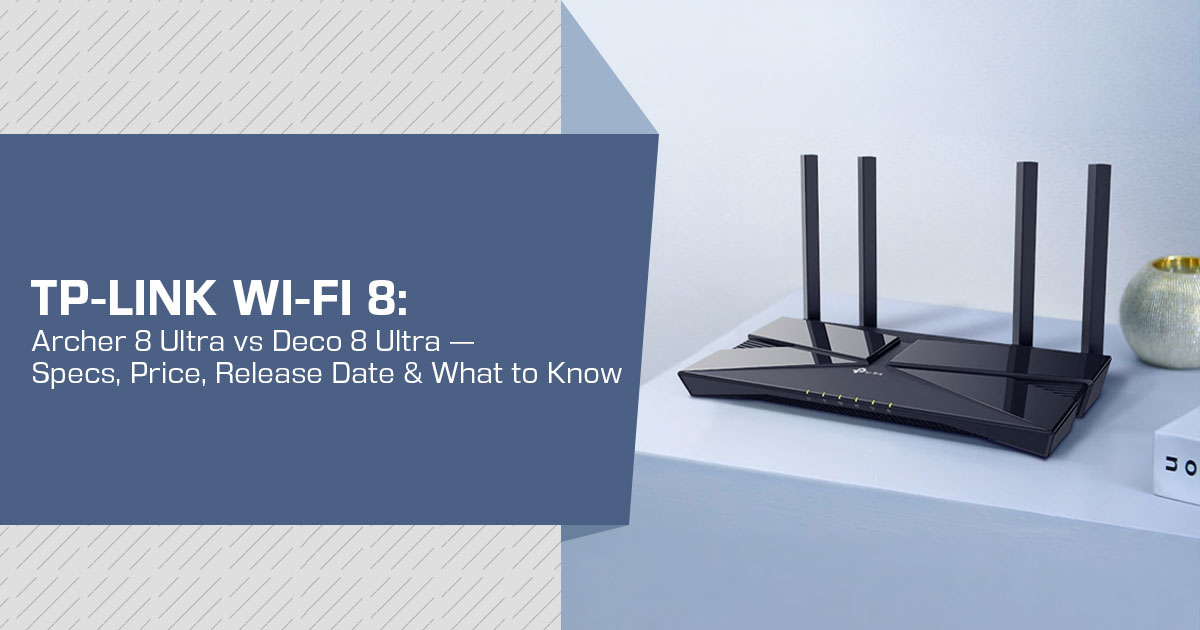
On September 1, 2026, TP-Link said it had unveiled the world’s first complete Wi-Fi 8 lineup at IFA 2026 in Berlin: the Archer 8 Ultra router and Deco 8 Ultra mesh system. Pre-orders for the Archer 8 Ultra are set to open on September 30, 2026, in select regions, while TP-Link has not yet announced pricing.
If you’re considering Wi-Fi 8, there is an important point to understand: this generation is not simply about faster speeds. Wi-Fi 8 is focused on improving reliability, responsiveness, coverage, and performance when many devices are connected at once.
That is why we put this guide together. We reviewed TP-Link’s official IFA 2026 materials, its Wi-Fi 8 product information, IEEE 802.11bn documents, and independent reporting to build a source-checked Wi-Fi 8 fact sheet. The goal is simple: separate confirmed specifications, manufacturer claims, technical targets, and information that remains uncertain.
Our team has more than 20 years of experience in hardware and application research and development. We look beyond specifications to consider real-world use, reliability, value, and long-term usability. Our recommendations are based on technical research, specification analysis, published testing where available, real-world usability considerations, and industry expertise. This guide is written for home users, families, gamers, remote workers, content creators, smart-home owners, and technology enthusiasts who want to understand whether Wi-Fi 8 is worth waiting for — and what the Archer 8 Ultra and Deco 8 Ultra could offer.
We distinguish between confirmed facts, manufacturer claims, technical targets, and information that is not yet available.
- One important note: we have not tested the Archer 8 Ultra or Deco 8 Ultra Neither product is generally available yet. Whenever a specification or performance figure comes from TP-Link, we identify it as a TP-Link claim rather than presenting it as independently verified performance. Where information is still unknown, we say so.
- The standard: Wi-Fi 8, formally IEEE 11bn / Ultra High Reliability (UHR), is still a draft. IEEE’s current timeline points to completion in 2028. Early hardware may receive additional features through firmware, but final feature support can depend on the hardware and region.
- The catch: there are no widely available Wi-Fi 8 phones or laptops yet. Broader Wi-Fi 8 client support is expected as the ecosystem develops, so buying a Wi-Fi 8 router in 2026 is an early-adopter purchase rather than a guaranteed speed upgrade.
The US catch: US availability of these specific models was not confirmed as of September 2, 2026, amid an unresolved FCC authorization issue reported by independent outlets.
Our read: consider pre-ordering if you have a large, dense home and a 2027–2028 device refresh planned. For everyone else, a Wi-Fi 7 router remains the sensible buy in 2026.
Two products were unveiled at IFA 2026, and both carry model codes worth knowing. The Archer 8 Ultra is listed as BN19000 in TP-Link’s materials and appears as the Archer BN800 in some regions. The Deco 8 Ultra is BN22000, or Deco BN85 regionally. A few outlets have used the name “Archer 9 Ultra,” but TP-Link’s official announcement calls the product the Archer 8 Ultra.
| Product | What It Is | Planned Availability |
|---|---|---|
| Archer 8 Ultra (BN19000) | Tri-band Wi-Fi 8 router | Pre-orders planned from September 30, 2026, in select regions |
| Deco 8 Ultra | Wi-Fi 8 mesh system designed for broader whole-home wireless coverage | Q1 2027 |
| Roam 8 | Portable Wi-Fi 8 travel router | Q2 2027 |
| Wi-Fi 8 Range Extenders & Adapters | Wi-Fi 8 accessories for expanding coverage and upgrading compatible devices | Q2 2027 |
TP-Link says the Wi-Fi 8 lineup will use chipsets from Broadcom, Qualcomm, and MediaTek. The IFA announcement does not specify that every model uses all three vendors’ chipsets.
Full Specifications: Archer 8 Ultra vs Deco 8 Ultra
These dates are TP-Link’s roadmap and can change; the company says regional availability and specifications will vary. TP-Link says full details for the Archer 8 Ultra and Deco 8 Ultra are due at the global online launch event on September 30, 2026.
| Specification | Archer 8 Ultra | Deco 8 Ultra (3-Pack) |
|---|---|---|
| Product Type | Tri-band Wi-Fi 8 router | Tri-band Wi-Fi 8 mesh system |
| Model Codes | BN19000 / Archer BN800 | BN22000 / Deco BN85 |
| Wireless Standard | Wi-Fi 8 (draft IEEE 802.11bn) | Wi-Fi 8 (draft IEEE 802.11bn) |
| Wireless Bands | 2.4GHz / 5GHz / 6GHz | 2.4GHz / 5GHz / 6GHz |
| Maximum Aggregate Wireless Speed | Up to 19 Gbps (TP-Link claim) | Up to 22 Gbps* (regional rating may vary) |
| Wired Connectivity | Up to 10 Gbps | Up to 10 Gbps |
| Antennas / Nodes | 18 internal antennas | 3 mesh nodes included in the 3-pack |
| Coverage | Up to 3,600 sq. ft. in reported U.S. specifications; regional figures may vary | Up to 9,800 sq. ft. (TP-Link claim) |
| Connected Devices | Not separately rated | Supports 200+ devices (TP-Link claim) |
| Proprietary Technology | Wi-Fi 8 StabilityEngine | Wi-Fi 8 StabilityEngine |
| Status (September 2, 2026) | Pre-orders scheduled to begin September 30, 2026 | Expected in Q1 2027 |
| Price | Not announced | Not announced |
Note: TP-Link says the Deco 8 Ultra’s model designation and rated speed vary by region.
What the “Up to” Numbers Mean
What Wi-Fi 8 Means for Your Home (Plain-English Version)
Each Wi-Fi generation has pushed peak speed and capacity forward. Wi-Fi 8 — formally IEEE 802.11bn and focused on Ultra High Reliability (UHR) — takes a different direction. TP-Link describes it as a standard that prioritizes steady connections, stronger coverage, and smoother roaming in busy networks, under interference, and at the edges of coverage. TP-Link’s comparison keeps the same headline ceiling it lists for Wi-Fi 7: 46 Gbps maximum PHY rate, 320 MHz maximum channel bandwidth, and 4096-QAM modulation.
Two sets of improvement numbers circulate, and they answer different questions:
The IEEE’s UHR targets (technical goals under defined test conditions, not measured results for every product):
- 25% higher throughput under at least one defined poor-SINR condition
- 25% lower 95th-percentile latency
- 25% lower MPDU loss in a defined scenario, especially during transitions between access points
TP-Link’s own lab figures, from its Wi-Fi 8 page, report up to 30% higher throughput at the same signal strengths, up to 24% better interference handling, and up to 15% stronger mesh performance between two access points under interference compared with Wi-Fi 7. TP-Link says these are its own lab results and are not guaranteed in real networks. Treat them as vendor test results, not expected home performance.
The working-group features behind those targets, with their official names, in buyer language:
- ELR (Enhanced Long Range) and DRU (Distributed Resource Units) — target better performance at the edges of a home and for distant, low-power TP-Link says these technologies can improve uplink performance for devices such as cameras and sensors.
- UEQM (Unequal Modulation) and new MCS (Modulation and Coding Schemes) — are intended to keep throughput more consistent when signal quality varies across spatial
- DSO (Dynamic Sub-band Operation) and NPCA (Non-Primary Channel Access) — are designed to improve channel use when many devices are TP-Link says DSO allocates channel resources according to device needs, while NPCA can use non-primary channel space when the primary channel is occupied.
- Coordinated TWT (Target Wake Time) — a coordinated scheduling approach intended to help devices remain in low-power states between transmissions, compared with restricted TWT in Wi-Fi 7.
- Multi-AP coordination — a major Wi-Fi 8 change. TP-Link lists Co-BF (Coordinated Beamforming), Co-SR (Coordinated Spatial Reuse), and Co-TDMA (Coordinated Time-Division Multiple Access) among the technologies associated with Wi-Fi These mechanisms are intended to let multiple access points coordinate transmissions and manage airtime more efficiently.
TP-Link bundles its implementation of these technologies under the name Wi-Fi 8 StabilityEngine, which the company says is used in both the Archer 8 Ultra and Deco 8 Ultra.
The status caveat, plainly stated. As of September 2, 2026, 802.11bn is still a draft. IEEE’s current project timeline shows publication targeted for 2028. Some certification and client products may appear before final publication, but exact timing can change. Early devices may receive additional features through firmware, depending on the hardware and region. Treat any framing of a 2026 Wi-Fi 8 router as finished-standard hardware with care — the standard is still a draft, and TP-Link notes that availability and specifications can vary by device and region.
Performance: What We Can and Can’t Verify Yet
As of this writing, we have not found published independent lab results for the Archer 8 Ultra or Deco 8 Ultra. Three points of context are worth having before you judge the launch:
- The silicon arrived before the Industry reporting has documented Wi-Fi 8-class silicon from Broadcom and MediaTek before the final standard is published. This is not unusual: wireless chipsets can reach products before a standard is finalized, but it also means early Wi-Fi 8 hardware is being built against a specification that can still change.
- There is also a public Wi-Fi 8 demonstration from At CES 2026, ASUS showed the ROG NeoCore concept and reported its own figures for mid-range throughput and worst-case latency. Those are ASUS demonstration results from a concept system, not independent benchmarks of a shipping consumer router.
- Your existing devices will still connect. TP-Link describes the Archer 8 Ultra and Deco 8 Ultra as backward compatible with Wi-Fi 4 through 7, and says some congestion and interference-management features can benefit devices that do not support Wi-Fi Some UHR features, such as coordinated multi-AP behavior, require compatible Wi-Fi 8 clients to deliver their full benefit.
The practical takeaway: a 2026 purchase buys a network foundation that may become more useful as compatible Wi-Fi 8 devices arrive, rather than an immediate, guaranteed speed gain over a current Wi-Fi 7 router.
Design and Build
The Archer 8 Ultra takes a minimalist, architectural approach: a dual-tone grille with fine micropatterns, and a single soft white light that shows device status in place of the usual cluster of colored LEDs. TP-Link says both products were designed in California.
The Deco 8 Ultra follows the familiar Deco silhouette — compact footprint, organic edges, a matte body with a glossy top plate — tuned to sit on a shelf rather than hide in one.
Why we think the design matters for a router: coverage depends on placement, and TP-Link recommends keeping networking equipment in open spaces rather than enclosed cabinets. TP-Link’s own industrial-design argument is that a router people are willing to display is more likely to be placed where it can perform well. The design may help with placement, but actual coverage still depends on the home, radio conditions, and device position.
Wi-Fi 8 vs Wi-Fi 7: The Factual Comparison
| Feature | Wi-Fi 7 (802.11be) | Wi-Fi 8 (802.11bn) |
|---|---|---|
| Maximum PHY Rate | 46 Gbps | 46 Gbps |
| Maximum Channel Bandwidth | 320 MHz | 320 MHz |
| Modulation | 4096-QAM | 4096-QAM |
| Standardized Multi-AP Coordination | Not part of 802.11be in this form | Introduced as part of the 802.11bn project |
| DRU / ELR Mechanisms | Not part of 802.11be | DRU and ELR mechanisms introduced through the 802.11bn project |
| DSO / NPCA Mechanisms | Not part of 802.11be | DSO and NPCA mechanisms introduced through the 802.11bn project |
| Target Wake Time (TWT) | Uses the existing Target Wake Time framework | Adds further coordinated mechanisms as part of the 802.11bn development work |
| Primary Focus | Higher peak throughput and network capacity | Ultra High Reliability (UHR) |
| Standard Status (September 2026) | Ratified, with certified products already shipping | Draft stage, with publication targeted for 2028 |
| Client Device Support | Wi-Fi 7 devices are widely available | Wi-Fi 8 client devices are not yet widely available |
| Launch Pricing | Current Wi-Fi 7 pricing varies considerably by router model and performance class | Pricing has not yet been announced for the Archer 8 Ultra / Deco 8 Ultra |
Rate, bandwidth, modulation, and feature rows are based on TP-Link’s comparison material and IEEE project information. Feature availability can vary by device and region. The client-support and pricing rows are contextual, not forecasts of exact launch dates or product prices.
For a deeper technical breakdown, see our separate Wi-Fi 8 vs. Wi-Fi 7 comparison guide. The short version: Wi-Fi 7 focuses more on peak throughput and capacity, while Wi-Fi 8 adds mechanisms aimed at keeping connections more reliable through walls, at range, and under network load.
How This Compares to the Rest of the Wi-Fi 8 Field
Context helps, because the consumer Wi-Fi 8 market in 2026 is still at an early stage. TP-Link says its September 2026 announcement is the world’s first complete consumer Wi-Fi 8 lineup.
- Chipset layer: TP-Link says its Wi-Fi 8 lineup will use chipsets from Broadcom, Qualcomm, and That gives the company access to multiple silicon platforms, but it is too early to say whether this will reduce firmware or compatibility issues.
- Direct competitor: ASUS is another name to watch. Its CES 2026 Wi-Fi 8 show unit was a concept, while more consumer Wi-Fi 8 hardware may arrive as the market The timing and scope of competing products remain uncertain.
- Buy-now alternative: TP-Link’s Wi-Fi 7 lines and competing products remain the practical choice for most buyers in 2026, with options across a wide range of prices.
What this means for a buyer: TP-Link’s announced family spans routers, mesh, travel networking, extenders, and adapters. Early buyers should be comfortable with a draft standard and the possibility of firmware changes.
Pros and Cons (Based on the Announced Materials)
| Archer 8 Ultra / Deco 8 Ultra — Strengths | Archer 8 Ultra / Deco 8 Ultra — Limitations |
|---|---|
| ✔ Part of the first announced consumer Wi-Fi 8 family spanning routers, mesh systems, travel networking, range extenders, and wireless adapters. | ✖ Based on a draft Wi-Fi 8 standard; final IEEE publication is currently targeted for 2028. |
| ✔ Both products provide 10 Gbps wired connectivity, helping reduce Ethernet bottlenecks in high-performance networks. | ✖ Pricing has not yet been announced, making it difficult to assess overall value compared with established Wi-Fi 7 hardware. |
| ✔ The Archer 8 Ultra features 18 antennas, while a three-pack Deco 8 Ultra system is rated to cover up to 9,800 sq ft. | ✖ No published independent performance testing is available yet to validate real-world range, throughput, latency, or reliability claims. |
Three major chipset partners (Broadcom, Qualcomm, MediaTek)Wi-Fi 8 phones and laptops are not yet widely available; broader client support is expected as the ecosystem developsBackward compatible with Wi-Fi 4–7 devicesUS availability not confirmed as of Sep. 2, 2026Full family planned through 2027 (mesh, travel router, adapters)Full feature availability may vary by device and region
Who Should Buy It — and Who Should Wait
| If You Are a… | Our Research-Based Recommendation |
|---|---|
| Wi-Fi 6 / 6E user with an acceptable network | Wait. If your existing Wi-Fi 6 or Wi-Fi 6E network performs reliably, there is little reason to upgrade immediately. Wi-Fi 7 or a better-positioned mesh system may deliver more noticeable benefits today. |
| Already using Wi-Fi 7 | Wait. The upgrade case remains weak until Wi-Fi 8 client devices become widely available and router pricing settles. |
| Large, dense, multi-floor home with many connected devices | Consider the Deco 8 Ultra once pricing is confirmed, particularly if you are planning a major phone, laptop, or smart-device refresh during 2027–2028. Installing the network infrastructure first could make sense for this type of household. |
| US buyer | Wait until the FCC situation is resolved. Pre-orders open on September 30 in select regions, but US availability of these models remained unconfirmed as of September 2, 2026. |
| Smart-home builder dealing with Wi-Fi dead zones | Consider buying once pricing is announced and confirmed to fit your budget. Features such as ELR and DRU specifically target connectivity challenges involving distant and low-power devices. |
| Early adopter seeking one of the first consumer Wi-Fi 8 routers | Consider the Archer 8 Ultra when the purchase window opens on September 30. Keep in mind that it is draft-standard hardware, and long-term firmware support for future standard changes is not guaranteed. |
A note on pricing strategy. Wi-Fi 8 pricing is still unknown, so any claim about a likely launch premium is an estimate, not a confirmed price trend. If the decision is not urgent, waiting for more products and certified hardware in 2027–2028 should give buyers a clearer picture of value.
For current alternatives, see our best Wi-Fi 7 routers 2026 guide.
Frequently Asked Questions
Is Wi-Fi 8 faster than Wi-Fi 7?
Not on paper. Both generations are listed at a 46 Gbps maximum PHY rate, with 320 MHz maximum channel bandwidth and 4096-QAM in TP-Link’s comparison. The improvement target is consistency: the 802.11bn project defines UHR modes targeting 25% higher throughput in at least one poor-SINR condition, 25% lower 95th-percentile latency, and 25% lower MPDU loss in defined scenarios. These are standard targets, not guarantees for a home network.
When will Wi-Fi 8 be available?
The first announced consumer products are scheduled to launch before the standard is final. Regional pre-orders for the Archer 8 Ultra open September 30, 2026. The IEEE 802.11bn project remains in draft status, with publication targeted for 2028. Wi-Fi 8 client devices are expected to arrive as the ecosystem develops, but exact launch dates vary by manufacturer.
What will the TP-Link Archer 8 Ultra cost?
TP-Link had not announced a Wi-Fi 8 price for the Archer 8 Ultra as of September 2, 2026. The company says full product details will be revealed at the global launch event on September 30, 2026. Until pricing is known, compare the launch price with current Wi-Fi 7 options before committing.
Will my Wi-Fi 7 (or older) devices work with the Archer 8 Ultra?
Yes. TP-Link describes both products as backward compatible with Wi-Fi 4 through 7, and says some congestion and interference features can benefit devices that do not support Wi-Fi 8. The full benefit of Wi-Fi 8-specific client and multi-AP features depends on compatible Wi-Fi 8 devices.
Does the TP-Link Archer 8 Ultra work in the US?
That was not confirmed as of September 2, 2026. Independent reporting said TP-Link was seeking a regulatory path for new products in the US and that the Archer 8 Ultra’s US launch remained uncertain. Pre-orders on September 30 are limited to select regions, so US buyers should check TP-Link’s official regional availability before ordering.
What is the difference between the Archer 8 Ultra and the Deco 8 Ultra?
The Archer 8 Ultra (BN19000) is a single tri-band Wi-Fi 8 router rated for up to 19 Gbps of aggregate wireless speed. The Deco 8 Ultra (BN22000 in some markets) is a tri-band Wi-Fi 8 mesh system rated for up to 22 Gbps in markets where that configuration is offered. TP-Link says a three-pack covers up to 9,800 sq ft and supports more than 200 devices. Choose the router for a single-router setup; choose the mesh system for larger or multi-floor coverage.
Final Verdict
As of September 2, 2026, the Archer 8 Ultra and Deco 8 Ultra form TP-Link’s announced consumer Wi-Fi 8 lineup, backed by a roadmap through 2027 and chipset partnerships with Broadcom, Qualcomm, and MediaTek. The reliability focus — stronger edge performance, steadier connections, and better coordination in busy networks — addresses problems that can make home Wi-Fi frustrating. The announced hardware also includes 18 internal antennas on the Archer 8 Ultra and 10 Gbps wired connectivity on both products.
The honest counterweight: the standard is still a draft, prices are unknown, compatible client devices are not yet widely available, and US availability remains uncertain. None of that makes the products bad, but it does make them early-adopter hardware.
Our verdict, in one line: consider pre-ordering the Archer 8 Ultra on September 30, 2026 if you have a large, dense home and a device refresh planned for 2027–2028. For everyone else, wait for pricing and independent testing — or buy a solid Wi-Fi 7 router now and revisit Wi-Fi 8 as certified hardware and compatible devices become available.
Check Current Prices and Pre-Order Options
Pricing and regional pre-orders are due at TP-Link’s launch event on September 30, 2026. Because availability is region-specific and pricing is not yet public, check TP-Link’s regional store and authorized retailers when the pre-order window opens.
- Amazon US — Check the official listing and pre-order status if the Archer 8 Ultra becomes available in the US.
- Amazon India — Check the official listing and availability when regional pre-orders open.
- TP-Link official store — Check the TP-Link Wi-Fi 8 page and your regional TP-Link store for confirmed pre-order details.
Prices and availability can change between pre-order and general release. Re-check the seller, region, model number, and included hardware before buying.
Have questions about Wi-Fi 8, the Archer 8 Ultra, or the Deco 8 Ultra? Leave a comment below and tell us what you want us to investigate. If you find this guide useful, follow us for more carefully researched technology guides, product comparisons, and buying advice. We’ll keep updating this guide as TP-Link reveals more details and the products become available for testing.
***Disclaimer***
This blog post reflects our research, analysis, and opinions based on the product information and sources available as of September 2, 2026. It should not be taken as the official position of any brand, manufacturer, or company mentioned here. Product specifications, pricing, availability, and regulatory status may change after publication. We recommend checking official product pages and local availability before making a purchase.
Some links in this article may be affiliate links. If you choose to buy through these links, we may earn a small commission at no extra cost to you. Affiliate relationships do not influence our recommendations.
Opinions expressed by readers are their own and do not necessarily reflect ours. We are not responsible for outcomes resulting from the use of information on this site. Please seek professional advice where appropriate.
All product names, logos, and brands mentioned are the property of their respective owners. These names are used for identification and informational purposes only and do not imply endorsement.