
Editorial status: Research-based product analysis; not a hands-on review
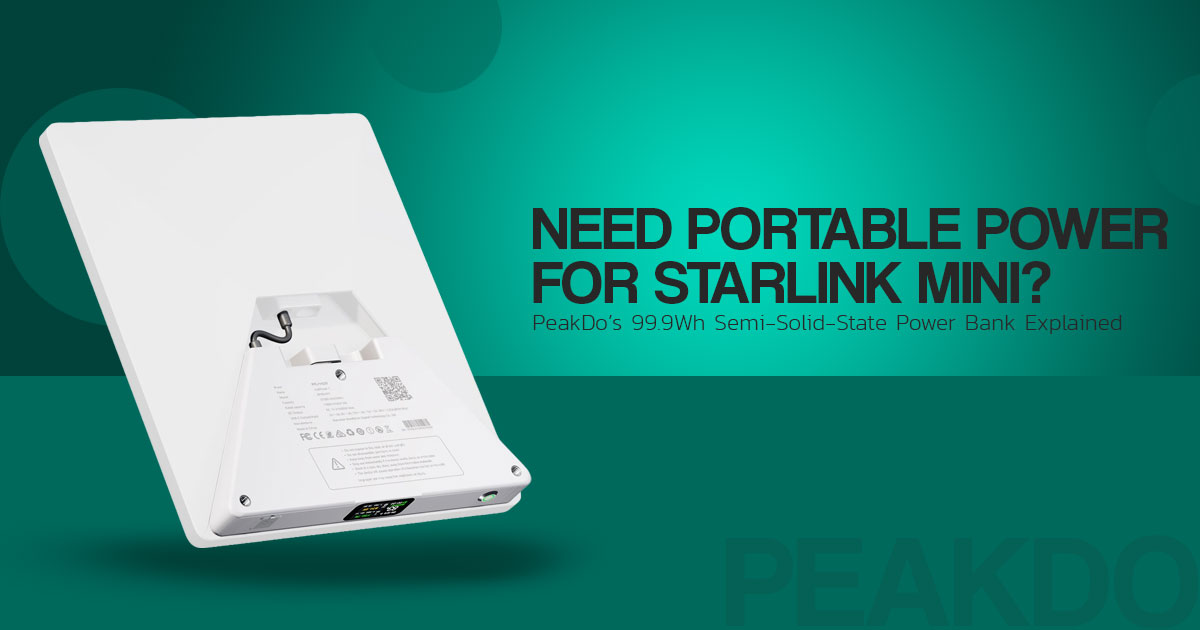
PeakDo is working on a 99.9Wh power bank for Starlink Mini, with semi-solid-state battery technology at its core. The company has teased the product but has not confirmed its final name, price, launch date, size, weight, or battery runtime.
That leaves several important questions for Starlink Mini users. How much extra runtime could a 99.9Wh battery provide? How portable will the power bank be? And will the use of semi-solid-state battery technology offer a practical advantage over conventional portable power banks?
For now, this is an upcoming PeakDo product, not a finished product review. The available information comes from PeakDo and reporting by Notebookcheck, and there is no independent testing of its performance, battery life, or safety.
This could be relevant to Starlink Mini owners, campers, travelers, remote workers, van-life users, outdoor enthusiasts, and people who need internet access away from a fixed power supply. But battery capacity is only one part of the equation. The final price, weight, charging options, output, efficiency, and real-world runtime will matter just as much.
As technology experts with over 20 years of experience in hardware and application research and development, we analyze products based on real-world performance, durability, and value for money. Our goal is to help you find the right product based on budget, performance, reliability, and long-term use. Our recommendations are based on extensive research, component analysis, real-world usability, and industry expertise.
In this article, we look at what is known about the PeakDo 99.9Wh Starlink Mini power bank, what the semi-solid-state battery could mean for users, and which details you should check before deciding whether it is worth buying.
What is the PeakDo Starlink Mini power bank?
The teased device is intended to provide portable power for Starlink Mini, SpaceX’s compact satellite-internet terminal. The product appears designed for people who want Starlink Mini portable power away from a conventional wall outlet, including campers, mobile workers, vehicle users, and people building an off-grid internet setup.
PeakDo’s reported focus is the battery chemistry. Instead of relying solely on a conventional lithium-ion design, the company says the pack will use semi-solid-state cells. The reported target is a battery that can hold substantial energy while potentially reducing the size, weight, and certain safety risks associated with a comparable lithium-ion pack.
That description should be treated as a company claim. The source does not confirm whether the finished pack will achieve those goals, and it does not show a completed independent test of the battery-powered Starlink Mini setup.
Bottom line: PeakDo has teased an unnamed 99.9Wh semi-solid-state power bank for Starlink Mini, but buyers still do not have confirmed information about price, availability, runtime, or final specifications.
Verified facts about the teased PeakDo battery
The following fact sheet is the basis for this article. It separates reported information from details that remain unknown.
| Product detail | What is currently reported | What it means for buyers |
| Intended device | Starlink Mini | The pack is aimed at satellite-internet users rather than general phone charging. |
| Reported capacity | 99.9Wh | This suggests a relatively high-capacity portable power accessory, but actual usable energy has not been tested. |
| Battery type | Semi-solid-state cells | PeakDo presents this as a possible efficiency, size, weight, and safety improvement. |
| Release date | Not announced | There is no confirmed buying date. |
| Price | Not announced | Any price estimate would be speculation. |
| Runtime | Not independently tested | The battery cannot yet be assigned a reliable number of Starlink Mini operating hours. |
| Weight and dimensions | Not announced | The claimed size and weight advantage cannot yet be evaluated. |
| Ports and charging | Not confirmed in the source | Buyers should wait for a final specification sheet. |
| Weather protection | Not confirmed for this teaser | It should not be described as waterproof or weatherproof. |
| Official product name | Not announced | It should not automatically be called LinkPower 1, LinkPower 2, LinkPower 3, or LinkPower Pod 1. |
This table matters because earlier PeakDo products and unrelated semi-solid-state power banks have different capacities, features, and test results. Their specifications should not be transferred to this product without confirmation.
What semi-solid-state battery technology means
A conventional lithium-ion battery typically uses a liquid electrolyte to move ions between its electrodes. In broad technical usage, a semi-solid-state design refers to a cell that combines a solid or gel-like component with a more conventional battery structure, although the exact chemistry can vary by manufacturer. The label does not describe one universal battery design.
In theory, a semi-solid-state battery may offer some benefits associated with solid-state research while retaining manufacturing and charging characteristics closer to conventional batteries. Potential benefits include higher energy density, lower liquid content, and more flexibility in how the cells are packaged.
However, a semi-solid-state battery should not be treated as a guarantee of superior safety or longer life. Those outcomes depend on the cell design, battery-management system, enclosure, charger, temperature, and quality control. PeakDo’s teaser describes potential advantages, but the supplied evidence does not include cycle-life testing, thermal testing, certification, or a controlled comparison with a lithium-ion pack.
For buyers, the practical question is not simply whether the chemistry sounds newer. The useful questions will be:
- How much energy is actually available at the output?
- How efficiently does it power Starlink Mini?
- How quickly can it be recharged?
- How much does the finished unit weigh?
- What protections are built into the battery-management system?
- Does PeakDo publish safety certifications and warranty terms?
Until those answers appear, the chemistry is an interesting specification, not a reason to buy immediately.
Why a 99.9Wh capacity could matter for Starlink Mini
A 99.9Wh battery capacity is a nominal stored-energy rating. It does not determine how long Starlink Mini will run because usable output depends on conversion losses and the terminal’s power draw. Any transport decision should
also follow the carrier’s current battery rules.
Starlink says the Mini typically uses 20–40W on average, with power use varying by temperature, location, and use. Conversion losses also reduce the energy that reaches the terminal, so a 99.9Wh rating should not be converted directly into a promised number of operating hours.
The capacity could still be useful for buyers who need off-grid internet at a campsite, work site, vehicle stop, or temporary field location. A dedicated pack may also be more convenient than combining a general power station with multiple cables and adapters. That convenience will depend on the final design and whether the battery connects to Starlink Mini directly or needs separate conversion hardware.
The missing information is still significant. PeakDo has not confirmed the new pack’s output voltage, maximum output power, conversion efficiency, charging input, pass-through behavior, or compatibility with the Starlink Mini power system. Starlink says the Mini accepts 12–48V DC, up to 60W, and requires a 100W USB PD source (20V/5A) for optimal operation. The new PeakDo pack’s final implementation has not been confirmed.
What PeakDo claims—and what remains unverified
The teaser presents three main reasons to use semi-solid-state cells: higher energy density, a smaller and lighter pack for the same capacity, and lower risk from leakage or short circuits compared with traditional lithium-ion construction.
Those claims are plausible areas for comparison, but they are not test results. A careful article should use language such as “PeakDo says”, “the company claims”, or “the teaser suggests.” It should not state that the finished battery is safer, lighter, or smaller until independent measurements or a complete technical sheet support those conclusions.
| Claim or expectation | Current evidence status |
| The pack will use semi-solid-state cells | Reported from PeakDo’s teaser; independent chemistry confirmation is unavailable. |
| The pack will offer 99.9Wh | Reported teaser specification; usable output has not been independently measured. |
| It may be smaller or lighter than a comparable lithium-ion pack | Company-stated potential benefit; final dimensions and weight are unknown. |
| It may reduce leakage or short-circuit risk | Company-stated potential benefit; no independent safety test is supplied. |
| It will provide a specific Starlink Mini runtime | Not established. |
| It is weatherproof or waterproof | Not established. |
| It is available to buy | Not established. |
The important point is to separate PeakDo’s claims from results that have been independently measured.
How it compares with earlier PeakDo LinkPower products
PeakDo’s official site lists separate products as PeakDo LinkPower 1 Battery for Starlink Mini, PeakDo LinkPower 2 Battery for Starlink Mini, PeakDo LinkPower 3 Battery for Starlink Mini, and PeakDo LinkPower Pod 1 Battery for Starlink Mini. The official LinkPower 2 page lists that predecessor as a 99Wh/27,500mAh battery with a 5-hour-plus stated runtime, Bluetooth control, bypass charging, an LCD display, a tripod mount, and a 21700 lithium battery.
These products provide useful context, but they do not establish the specifications of the new teaser. The teaser reports
99.9Wh and a different battery-technology approach. Neither Notebookcheck nor PeakDo’s checked product pages give the teased semi-solid-state pack an official model name.
| Product or category | What is known | Editorial interpretation |
| Unnamed PeakDo teaser | 99.9Wh, semi-solid-state design, Starlink Mini target | Wait for an official model name, specifications, and availability. |
| PeakDo LinkPower 2 Battery for Starlink Mini | Official page lists 99Wh/27,500mAh, a 5-hour-plus stated runtime, Bluetooth, bypass charging, and 21700 lithium battery cells | A documented predecessor, not proof of the teased model’s features. |
| General portable power station | Often provides several outputs and broader device compatibility | May be more flexible, but can be larger and require more cables. |
| Conventional lithium-ion power bank | Mature and widely available technology | Easier to compare and buy, but it may not offer a dedicated Starlink Mini connection. |
The key buying question is whether PeakDo’s new pack will provide a meaningful reduction in weight and setup complexity without sacrificing output, safety documentation, or service support.
Who might benefit from this Starlink Mini battery?
The product could be relevant to readers who need a compact portable Starlink Mini battery for temporary or mobile connectivity.
Camping and remote work
A dedicated pack could simplify a temporary remote-work power setup. It may help users place the terminal where it has a clearer view of the sky while keeping the power source nearby. The benefit will depend on the final cable length, mounting design, and wireless range of the Starlink Mini system.
Vehicles and mobile installations
People working from vans, trucks, boats, or field vehicles may value a battery that could avoid the need for a large mains inverter. The final product would still need suitable charging options and physical protection for this use. The teaser does not confirm either point.
Emergency or temporary connectivity
A high-capacity battery could be useful when grid power is unavailable. Buyers should still check whether the battery can be safely stored, transported, and recharged in the temperatures expected at the site.
Users who should wait
Readers who need a working solution now should not buy based on a teaser. An available power station or a documented PeakDo product may be easier to evaluate because its price, compatibility, and specifications can be checked.
What to check before buying
When PeakDo publishes a product page, buyers should check the following details rather than relying on the semi-solid-state battery label alone:
- Confirmed product name and model number
- Continuous output power and voltage
- Connector type and cable length
- Measured usable capacity, not only nominal capacity
- Charging input, charging time, and pass-through support
- Starlink Mini compatibility across hardware revisions
- Battery-management protections
- Safety certifications for the sales region
- Operating and storage temperature ranges
- Weight, dimensions, and mounting points
- Warranty length and replacement process
- Availability of spare cables or adapters
- Return policy and seller identity
The unnamed PeakDo 99.9Wh Starlink Mini power bank should be easier to evaluate once these details are published. Until then, the lack of information is an important buying factor.
Pricing and availability
The Notebookcheck article does not report a launch price or release date for the teased semi-solid-state Starlink Mini power bank. PeakDo’s website lists PeakDo LinkPower 1 Battery for Starlink Mini, PeakDo LinkPower 2 Battery for Starlink Mini, PeakDo LinkPower 3 Battery for Starlink Mini, and PeakDo LinkPower Pod 1 Battery for Starlink Mini, as separate products, but the checked pages do not identify any of them as the new semi-solid-state teaser. Any article that gives a definite price or purchase date for the teaser at this stage would add information that the available sources do not establish.
Battery prices can change by region and may exclude shipping, taxes, adapters, or mounting accessories. Buyers should also verify whether a retailer is selling the final product or accepting an unfulfilled preorder.
Amazon US: check current availability
The teased Starlink Mini power bank does not have a confirmed Amazon US listing under an official model name in the checked sources. Amazon search results may show earlier PeakDo products, so a result is not confirmation that the semi-solid-state model is available. Readers can check Amazon US for a current listing after PeakDo publishes the model name and specifications:
Check Amazon US for current PeakDo Starlink Mini power-bank listings
Before ordering, compare the seller, delivery date, return policy, warranty, capacity, output connector, and whether the listing describes the new semi-solid-state model rather than an earlier LinkPower product.
Amazon India: check regional listings
The checked sources do not confirm an Amazon India price, launch date, or official listing for the teased model. Availability may differ from the United States because battery shipping, import requirements, and regional distribution can affect listings.
Check Amazon India for current PeakDo Starlink Mini power-bank listings
If a listing appears, confirm that it is sold by a reputable seller and that the warranty applies in India. Do not assume that a product listed under a similar name is the teased 99.9Wh model.
Pros and limitations based on the available evidence
| Potential advantages | Current limitations |
| Dedicated focus on Starlink Mini portable power | No confirmed release date or availability |
| Reported 99.9Wh capacity | No independently measured usable capacity |
| Semi-solid-state chemistry may reduce size or weight | Final dimensions and weight are unknown |
| Could simplify mobile or off-grid Internet setups | Runtime, output, charging, and cable details are unknown |
| Addresses a clear use case for campers and mobile workers | No confirmed price, warranty, certification, or weather rating |
| May offer an alternative to a larger general-purpose power station | Product name and final design are not confirmed |
Final verdict: an unverified concept, not yet a buying recommendation
PeakDo’s teaser addresses a practical problem: powering Starlink Mini in places where a wall outlet is unavailable. A reported 99.9Wh semi-solid-state battery could be useful if the finished unit is compact, efficient, adequately protected, and simple to connect.
The available evidence does not yet justify stronger conclusions. There is no confirmed price, release date, runtime, final design, output specification, or independent test. The semi-solid-state label may eventually bring a measurable advantage, but buyers will need technical documentation and real-world testing before they can judge whether the advantage is meaningful.
Readers who need Starlink Mini portable power immediately should choose an available solution with published compatibility, output, safety information, warranty coverage, and return terms. Readers who can wait may find the PeakDo teaser worth watching, but it should not yet be treated as a product ready for purchase.
Frequently asked questions
What is PeakDo’s new Starlink Mini power bank?
It is an unnamed PeakDo 99.9Wh Starlink Mini power bank that the company has teased and reportedly uses semi-solid-state battery cells. The final name, price, design, and release timing have not been confirmed in the available sources.
How much capacity will the PeakDo battery have?
PeakDo’s teaser reportedly states 99.9Wh. That is a reported nominal figure, not an independently measured amount of usable energy.
Is the PeakDo semi-solid-state power bank available now?
Availability is not confirmed. The source describes a teaser rather than a completed retail launch.
Has PeakDo announced a price or release date?
No price or release date is reported in the supplied Notebookcheck article.
What benefits does PeakDo claim for semi-solid-state cells?
PeakDo presents higher energy density, a potentially smaller and lighter design, and reduced leakage or short-circuit risk as possible benefits. These claims have not been independently verified for the teased product.
Has the battery’s Starlink Mini runtime been tested?
No independent runtime test for the teased 99.9Wh battery capacity is supplied. Runtime will depend on the Starlink Mini’s power draw, conversion losses, temperature, and network conditions.
Is this the same as PeakDo LinkPower 1 Battery for Starlink Mini or PeakDo LinkPower 2 Battery for Starlink Mini?
That has not been confirmed. The named LinkPower products are useful for context, but the teased battery should not be assigned an existing model name without confirmation from PeakDo.
Is semi-solid-state safer than lithium-ion?
It may offer safety advantages depending on the cell design and battery-management system, but the term alone does not prove that a particular product is safer. Buyers should look for independent testing and recognized certifications.
Have questions about the PeakDo 99.9Wh Starlink Mini power bank or want us to look into a specific detail? Leave a comment below and share what you would like to know. If you found this article useful, follow us for more technology news, product analysis, and buying guides. We’ll keep tracking the product as PeakDo reveals more details.
Disclaimer

This article is based on our research, analysis, available product information, user feedback, and industry knowledge. It is not an official statement from any brand or manufacturer mentioned in the article. Product specifications, prices, software features, and availability can change. We do our best to keep the information up to date, but please check the latest details with the manufacturer or retailer before making a purchase.

Some links in this article may be affiliate links. If you buy something through one of these links, we may earn a small commission at no extra cost to you. These commissions help support the site and our work. They do not affect how we assess or discuss products. Comments and opinions shared by readers belong to the people who post them and do not necessarily represent our views. Information on this site is provided for general purposes, and we cannot guarantee a particular result from using it. Where professional advice is needed, consult a qualified professional.

All product names, logos, and trademarks belong to their respective owners. We use them only to identify the products and companies discussed and do not imply endorsement or affiliation.