
| Quick Answer for Busy Readers & Overview
Information checked: October 20, 2026 Price |
|
|
Best For Local-file listeners, commuters, IEM and portable over-ear users who want a phone-free player. |
Key Advantage
Quad-DAC balanced output (425mW) at 83 grams, plus wheel navigation after Q2 Pod. |
Main Trade-off Stock wheel only adjusts volume; no internal storage; battery trails larger DAPs. |
01 — Introduction: What This Review Covers and Why It Matters
Many pocket DAPs ask buyers to choose between Android-based streaming features and a simpler, distraction-free player with dedicated audio hardware. That trade-off matters when you want to listen on a crowded commute, power a pair of over-ear headphones without a dongle, or keep your phone in your pocket during an album. A player that looks the part should also feel right in daily use.
This review examines how the Shanling Q2 approaches that challenge, what it does well, and where the out-of-box experience falls short. We look at its listed hardware (four CS43131 DAC chips, 4.4mm balanced output, and Bluetooth 5.2 with LDAC), the stock MTouch firmware, and the practical changes offered by the free Q2 Pod community project. The Q2 is compared with the HiBy M300, Innioasis Y1, and Shanling M1 Plus. We also consider the questions that matter when buying: how the wheel works, how much power the balanced output provides, and whether the hardware justifies the extra firmware step.
At NGXP Tech, a good buying decision starts with more than a specification sheet. We assess products through hardware research, component analysis, real-world usability, durability, and value for money to help readers look past marketing claims. Our aim is to make the choice clearer for local-file collectors, commuters, students, IEM enthusiasts, and anyone who wants a pocket-sized player that fits how they listen. By the end of this review, you will have a clearer picture of the Q2’s strengths, compromises, and suitability for your needs.
02 — Product Overview: What the Shanling Q2 Actually Is
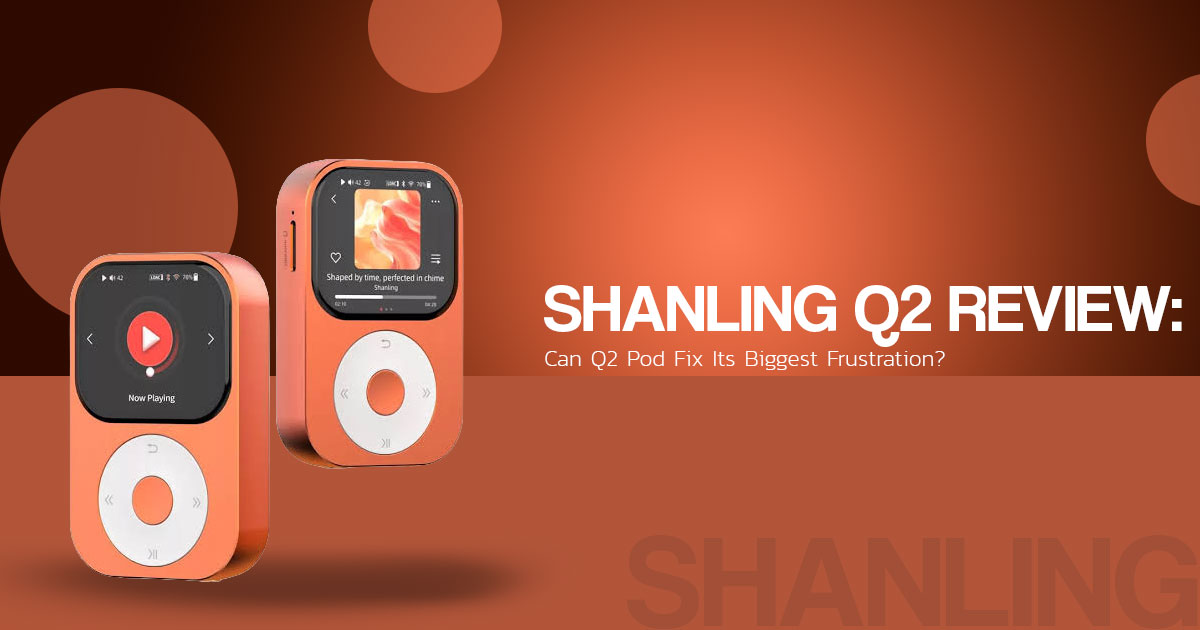
The Q2 is a pocket-sized digital audio player (DAP) running a Linux-based OS rather than Android. It is designed primarily for local music playback and does not offer the same native app ecosystem as an Android player. It weighs 83 grams and has an aluminum frame. There is no built-in music storage, so you need a microSD card. Q2 Pod adds optional network features, including Spotify Connect support with separate setup, but it is not a replacement for the full Google Play Store experience.
What it saves you from is a specific set of modern annoyances: phone battery drain from a USB-C dongle, pop-up notifications interrupting playback, and the maintenance cost of keeping a 15-year-old vintage iPod running with replacement batteries and flash-storage mods. It is built for listeners who maintain a local library and want tactile navigation rather than another glass slab.
Official Manufacturer Page: View the Official Shanling Q2 Product Page
03 — Core Hardware: Official Specifications and What They Mean
The table below translates the Q2’s listed components into their practical effect on daily listening. DAC, amplifier and battery figures are taken from Shanling’s official documentation and cross-checked with Q2 Pod release notes.
| Component | What It Means / Specification |
| DAC / Decoding | 4 × CS43131 DAC array with two independent crystal oscillators; supports native playback up to 32-bit/768kHz PCM and DSD512; USB DAC mode up to 32-bit/384kHz. |
| Headphone Outputs | 3.5mm single-ended (120mW @ 32Ω) and 4.4mm balanced (425mW @ 32Ω). |
| Navigation | 2.09-inch LCD (375 × 320) plus a front capacitive touch wheel with a physical center button. On stock firmware the wheel controls volume only; Q2 Pod enables full menu scrolling. |
| Build / Weight | CNC-machined aluminum chassis; 83 grams; physical power and playback buttons on the edge; USB-C, microSD slot (up to 2TB), and both headphone jacks along the bottom. |
| Battery / Charging | 1850mAh internal cell; manufacturer-rated up to 13.5h via 3.5mm and up to 12.5h via 4.4mm balanced; USB-C charging. Q2 Pod adds an optional 80% charge limiter for desktop use. |
| Wireless | Bluetooth 5.2 with LDAC, aptX HD, aptX, AAC and SBC; works in both transmitter and receiver modes. |
| USB Audio | Bi-directional USB-C: the Q2 can act as a USB DAC for a laptop/tablet/phone. |
| Storage | No built-in storage; microSD card required (officially up to 2TB). |
| Equalizer (Q2 Pod) | 30-band parametric EQ; Q2 Pod documents support for importing AutoEQ and Equalizer APO presets. |
| Colors | Smoky Grey, Moonlight Silver, Twilight Orange; verify availability with your retailer. |
Sources: Shanling official product documentation and Q2 Pod release notes; manufacturer-stated battery life measured at factory test conditions; real-world runtime varies with headphone load, gain and screen use. Native playback supports PCM up to 32-bit/768kHz and DSD512; USB DAC mode supports up to 32-bit/384kHz.
Shanling notes that DSD512 playback may stutter if the device is used during playback.
04 — Design and Build: Light Enough That You’ll Actually Carry It
At 83 grams, the Shanling Q2 is light enough to carry comfortably in a shirt pocket or a small sling bag. For comparison, the HiBy M300 sits in the same pocketable class, while an Android phone plus a USB-C DAC/amp dongle adds a separate device and cable to manage.
- Pocketability: It fits where larger DAPs do At roughly 95 mm tall, the Q2 rides easily in a jeans coin pocket or clipped inside a gym bag alongside headphones.
- Materials: CNC aluminum gives the frame a dense, rigid feel without adding There is no plastic flex when the device is squeezed, which matters when it is sharing bag space with keys.
- Wheel feel: The front wheel is capacitive, not Your thumb glides across its surface, and only the center button physically clicks. Buyers expecting the detent of a 2000s iPod click wheel should adjust expectations — the gesture is similar, but the haptic feedback is not.
- Port layout: The jacks, USB-C port and microSD slot are all on the bottom edge. That keeps the sides clean and lets a lanyard or clip attach without blocking cables, but it does mean cables hang below the device in your pocket.
The Display
The 2.09-inch LCD (375 × 320) is for music navigation only — it is not a video screen and was not designed to be. On stock firmware, a thick status bar consumes a noticeable portion of the small display, limiting how many track titles fit on screen at once. Q2 Pod shrinks that bar, exposing a few extra lines of text and making the Cover Flow album view readable at a glance.
05 — The Firmware Story: Why Q2 Pod Matters
This section matters because the hardware and the out-of-box software offer different experiences. The player ships with Shanling’s Linux-based MTouch OS, which is lean but has one notable limitation for buyers drawn to its wheel design.
What shipped from the factory
On stock MTouch, the front capacitive wheel controls volume and nothing else. To browse artists, albums or playlists, you use the touchscreen. Selecting an artist may present a flat track list rather than the album-focused browsing experience some buyers expect. For a device whose design evokes a classic wheel-navigated player, that mismatch can feel unintuitive.
What Q2 Pod changes
DiamondBond, an independent developer, maintains Q2 Pod, an open-source firmware modification that adds an iPod-style interface and other features. The update process is usually quick, though preparation and restart time can vary. You copy the supplied update.tar file to the root of a microSD card and use the player’s standard update menu. The project documents a route back to Shanling’s stock firmware, but any firmware update carries some risk; back up important card contents and follow the current instructions before proceeding.
| Feature | Stock Firmware | Q2 Pod (Current Release) |
| Touch Wheel Function | Volume only | Full menu and list scrolling across every screen |
| Home Layout | Icon grid MTouch | Split-screen classic layout (single-column and legacy UI options available) |
| Artist Browsing | Flat list of all tracks | Albums grouped, with a 3D Cover Flow carousel |
| Equalizer | Basic graphic presets | 30-band parametric EQ with AutoEQ and Equalizer APO preset import support |
| Audiobooks / Podcasts | Treated as ordinary music files | Dedicated resume memory per file |
| Reversibility | Factory default | Stock firmware can be restored using Shanling’s documented update process; firmware flashing still carries risk. |
How to install Q2 Pod (four steps)
- Visit the DiamondBond Q2 Pod GitHub page and download the latest release archive. Choose the legacy build if you prefer a look closer to Shanling’s original interface.
- Extract tar. Unzip the archive and copy update.tar to the root of the microSD card, not inside a folder. Back up important files first, and do not remove the card during the update.
- Run System Update. Fully charge the Q2, then shut it down before inserting or removing the card. Restart it, open System Settings → System Update → TF Card Update, and Leave the card in place until the player restarts.
- Restore stock To return to Shanling’s firmware, download the official update package and follow Shanling’s current instructions. If the player fails to start, use the recovery steps documented by the Q2 Pod project.
06 — Sound Performance: Why Four DACs Matter
Software shapes how enjoyable a player is to use; the audio circuitry determines its technical capabilities. The Q2 uses four CS43131 DAC chips and two independent crystal oscillators. On the 4.4mm balanced output, the design uses two DAC chips per channel. The chip count alone does not guarantee better sound; headphone matching, implementation, and listening preference also matter.
- For IEM users: A low noise floor can matter with sensitive in-ear monitors, especially during quiet Results depend on the IEM and listening level, so avoid treating this as a guaranteed advantage over every USB-C dongle.
- For full-size headphone users: The 5mm output is rated at 120mW at 32Ω, while the 4.4mm balanced output is rated at 425mW at 32Ω. The balanced output therefore offers substantially more power, but whether it can drive a particular headphone depends on its sensitivity, impedance, and the volume you prefer.
- Real-world ceiling: The Q2 is not a replacement for a desktop amplifier driving difficult full-size Most portable over-ears and IEMs are well within its comfort zone, but a flagship planar will still benefit from a desktop stack at home.
07 — Battery Life and Charging
The 1850mAh cell is rated for up to 13.5 hours of playback through the 3.5mm jack and up to 12.5 hours through the 4.4mm balanced output under Shanling’s test conditions. Actual endurance depends on the headphones, gain, screen use, and other settings.
- Daily-use expectation: Runtime depends on output, headphone load, gain, screen brightness, and Shanling’s rated figures are useful for comparison, but they should not be treated as a guarantee of how many days a charge will last.
- Charge limiter: Q2 Pod offers an optional 80% charge limit for users who keep the Q2 connected to power at a desk. A charge limit can help reduce battery wear over time, although the effect depends on charging habits and operating conditions.
Practical tip: If you mainly use the balanced output, plan around the shorter rated runtime and allow for variation from gain, headphone load, screen use, and browsing.
08 — Connectivity, Bluetooth and USB DAC
A modern pocket player needs to work with both wired headphones and wireless gear. Bluetooth 5.2 on the Q2 supports transmitter and receiver modes:
- Transmitter mode: Pair the player with compatible wireless headphones using a supported codec such as LDAC, aptX HD, aptX or SBC. Choose LDAC when both devices support it and you want to prioritise a higher-bitrate Bluetooth connection; actual performance depends on the devices and connection conditions.
- Receiver mode: Stream audio from a compatible phone to the Q2 over Bluetooth while keeping wired headphones connected to the player. This lets the Q2 act as a Bluetooth receiver for wired headphones.
- USB DAC mode: The bi-directional USB-C port lets the Q2 act as an external sound card for a laptop or At a desk, it replaces a basic USB dongle; on the go it is still a standalone player.
09 — Pros and Cons
To help you make a balanced decision on the Shanling Q2, we have summarized the verified strengths and limitations below:
| Pros (Why It Stands Out) | Cons (What to Consider) |
| CNC aluminum build weighs only 83 grams and fits easily in any pocket. | Stock factory firmware limits the touch wheel to volume until Q2 Pod is installed. |
| Four CS43131 DAC chips and a 4.4mm balanced output rated at 425mW at 32Ω. | Battery life varies by output and use; some larger players offer longer rated runtimes. |
| Free Q2 Pod firmware adds wheel scrolling, Cover Flow, parametric EQ and audiobook bookmarking. | The capacitive wheel does not provide the mechanical click of a vintage iPod ring. |
| Two-way Bluetooth 5.2 (LDAC) and USB DAC functionality for desktop and wireless flexibility. | No built-in storage — a microSD card is required before you can load music. |
10 — Competitor Comparison: How Does It Stack Up?
When shopping for a compact DAP or iPod-style player in 2026, buyers typically weigh the Q2 against three close alternatives. Here is how the Shanling Q2 compares with the HiBy M300, Innioasis Y1, and its larger sibling the Shanling M1 Plus.
Feature / MetricShanling Q2HiBy M300Innioasis Y1Shanling M1 PlusApprox. Price$259–$269$169–$199$50–$65$199–$209DAC4 × CS43131 Quad DAC1 × CS43131Basic integrated IC1 × ESS ES9069QHeadphone Ports3.5mm + 4.4mm balanced (425mW)3.5mm only3.5mm only3.5mm + 4.4mm balanced (660mW)Operating SystemLinux MTouch (+ Q2 Pod firmware)Android 13 (with Play Store)Basic custom firmwareLinux MTouchNavigation2.09-inch touchscreen + capacitive wheel4.0-inch smartphone-style touchscreenMechanical click wheel only3.2-inch touchscreen + side wheelBest Suited ForLocal-file listeners wanting wheel navigation and balanced powerUsers who need native streaming apps (Spotify, Apple Music, Tidal)Casual listeners on a strict budgetListeners wanting a larger screen without a front wheel
Shanling Q2 vs. HiBy M300
The M300 is a compact Android player without cellular connectivity. It runs Android 13 and supports apps through Google Play, making it the more straightforward option if you rely on native streaming apps and offline downloads. The Q2 is designed around local-file playback; Q2 Pod adds optional features such as Spotify Connect, but that requires separate setup and does not provide the same app flexibility as Android. Choose based on how you listen rather than DAC count alone.
Shanling Q2 vs. Innioasis Y1
The Y1 is a lower-cost option aimed at casual listeners who want an iPod-style player. Its capabilities, ports, and sound output differ from the Q2, so compare the current model specifications and local prices before buying. It is best treated as a budget MP3 player rather than a like-for-like alternative for buyers who specifically need balanced output.
Shanling Q2 vs. Shanling M1 Plus
Both use Shanling’s Linux-based MTouch system and include 4.4mm balanced outputs. The M1 Plus has a larger 3.2-inch screen and a higher listed output rating (660mW), while the Q2 is smaller and lighter and gains front-wheel navigation with Q2 Pod.
11 — Who Should Buy the Shanling Q2 (and Who Shouldn’t)
| Buyer Profile | Recommendation | Reasoning |
| Local-File Collectors & IEM Enthusiasts | Consider It (Q2 Pod Optional) | If you own a microSD card filled with FLAC or MP3 files and are comfortable installing community firmware, the Q2 combines a compact body, wheel navigation through Q2 Pod, and balanced output. Whether it offers the best value depends on your headphones, software preferences, and current local pricing. |
| Stock-Only Casual Buyers | Proceed with Caution | If you refuse to download firmware from GitHub, remember that the stock touch wheel only controls volume. You will browse menus entirely from the 2.09-inch touchscreen — a usable but distinctly less compelling experience. |
| Streaming-App Listeners | Skip (Consider an Android DAP) | If you rely on native offline downloads from Apple Music, Spotify, or Qobuz, an Android-based player such as the HiBy M300 is the more straightforward choice. Q2 Pod offers selected network features, but not the same breadth of native apps. |
12 — Pricing and Value Assessment
The Shanling Q2 has been listed around $259–$269 in the United States and ₹23,990–₹26,999 in India, though prices can change with retailer, import costs, and bundles. Check current listings before comparing value.
- Vintage iPod route: The cost of buying and refurbishing a 7th-generation iPod Classic varies widely with condition, replacement parts, and Compare current listings and repair costs rather than assuming a refurbished unit will exceed a particular price; an original iPod also lacks the Q2’s 4.4mm balanced output and modern Bluetooth codec support.
- DAC dongle route: Quad-DAC USB-C dongles vary considerably in price and implementation. Compare current models and prices, and remember that a dongle still relies on a connected phone or computer for playback and power.
The Q2 combines quad-DAC hardware, balanced output, bidirectional Bluetooth, USB DAC functionality, and standalone playback in an 83-gram metal body. Q2 Pod adds navigation and library features that may make the interface more appealing. The update is free, and the project documents a way to restore stock firmware, though firmware flashing always carries some risk.
13 — Frequently Asked Questions
Does the Shanling Q2 touch wheel work for scrolling through menus?
Out of the box, the capacitive touch wheel adjusts volume only. After installing Q2 Pod, it can scroll through menus, song lists, and Cover Flow album views.
Does installing custom firmware prevent me from returning to stock?
Q2 Pod uses the player’s standard microSD-card update process, and the project documents how to restore Shanling’s stock firmware. As with any firmware update, there is some risk; follow the current instructions and keep a backup of important files.
Does the Shanling Q2 come with built-in internal storage?
No. You need to insert a microSD card (supported up to 2TB) loaded with your music, podcasts or audiobooks.
Can the Shanling Q2 drive high-impedance headphones?
The 3.5mm jack is rated at 120mW at 32Ω and the 4.4mm balanced jack at up to 425mW at 32Ω. Those figures suggest useful output for many portable headphones, but they do not by themselves establish compatibility with every high-impedance or planar model. Check headphone sensitivity and independent measurements where available.
14 — Final Verdict: Is the Shanling Q2 Worth Buying?
The Shanling Q2 is an interesting portable player because its hardware and software offer different experiences. Its listed features include four CS43131 DAC chips, balanced output rated at 425mW at 32Ω, Bluetooth 5.2 with LDAC, USB DAC functionality, and an 83-gram aluminum body. On stock firmware, the front wheel is limited to volume control.
Q2 Pod addresses that limitation. After installation, the wheel can navigate menus, album art can be browsed in Cover Flow, the firmware adds a parametric EQ, and audiobook or podcast playback can resume where you stopped. Features and installation steps may change between releases, so check the project’s current documentation before updating.
The Q2 is best suited to listeners with a local music library who want a dedicated player and are comfortable installing community firmware. Buyers who want a fully stock experience or need a broad selection of native streaming apps should think twice. Q2 Pod adds selected network features, but an Android-based player remains more flexible for app-led listening.
The decision comes down to how you listen: choose the Q2 if local-file playback and community-firmware features suit you; consider an Android player if native streaming apps or stock software are priorities.
15 — Where to Buy and Official Resources
Use the manufacturer, firmware, and retailer links below to check current specifications, stock, colour availability, and pricing. Availability and retailer listings can change.
Manufacturer and firmware resources
- Official product page: Shanling Q2 Official Specifications & Overview
- Official Shanling direct store: Shanling Official Online Store — Q2 Listing
- Stock firmware and manuals: Shanling Q2 Support & Download Center
- Q2 Pod custom firmware (free): DiamondBond Q2 Pod GitHub Repository
United States
- Amazon product listing: Check Latest Price and Availability for Shanling Q2 on Amazon US
- Shanling’s Amazon storefront: Visit the Official Shanling Store on com
India
- Amazon India listing: Check Current Shanling Q2 Listings and Offers on in
Still have a question about the Shanling Q2 or portable music players in general? Drop it in the comments. Whether it is about sound quality, firmware updates, battery life, or choosing the right player for your needs, feel free to ask. No question is too small, and you don’t have to make a decision with doubts still on your mind. We’re here to help you make sense of the technology.
Follow us for more honest, research-backed technology reviews and practical buying advice. And if there is a product you’d like us to look into, let us know. We’d love to hear from you.
***Disclaimer***

This article is based on our research, analysis, available product information, user feedback, and industry knowledge. It is not an official statement from any brand or manufacturer mentioned in the article. Product specifications, prices, software features, and availability can change. We do our best to keep the information up to date, but please check the latest details with the manufacturer or retailer before making a purchase.

Some links in this article may be affiliate links. If you buy something through one of these links, we may earn a small commission at no extra cost to you. These commissions help support the site and our work. They do not affect how we assess or discuss products. Comments and opinions shared by readers belong to the people who post them and do not necessarily represent our views. Information on this site is provided for general purposes, and we cannot guarantee a particular result from using it. Where professional advice is needed, consult a qualified professional.

All product names, logos, and trademarks belong to their respective owners. We use them only to identify the products and companies discussed and do not imply endorsement or affiliation.