
Introduction
Most E Ink phones are excellent for reading, but they fall short once color comes into play. The Hisense A10 tries something smarter. A magnetic color LCD that you snap on when you need it, and leave off when you don’t. No extra bulk in your pocket unless you want it. We analyzed the available specifications, industry reports, previous Hisense E Ink devices, and the underlying hardware to evaluate how the A10 is likely to perform in everyday use. This review is for readers, students, writers, professionals, and anyone considering an E Ink phone for everyday use. Everything here is based on announced specifications, component research, previous Hisense devices, and expected real-world usability.
TLDR: The Hisense A10 has a 6.13-inch E Ink display and a magnetic detachable color LCD. Hisense says it will ship with Android 16, uses the Qualcomm QCM6690, supports magnetic wireless charging, and is expected to launch in China in August 2026 for around 3,999 CNY, roughly $590.
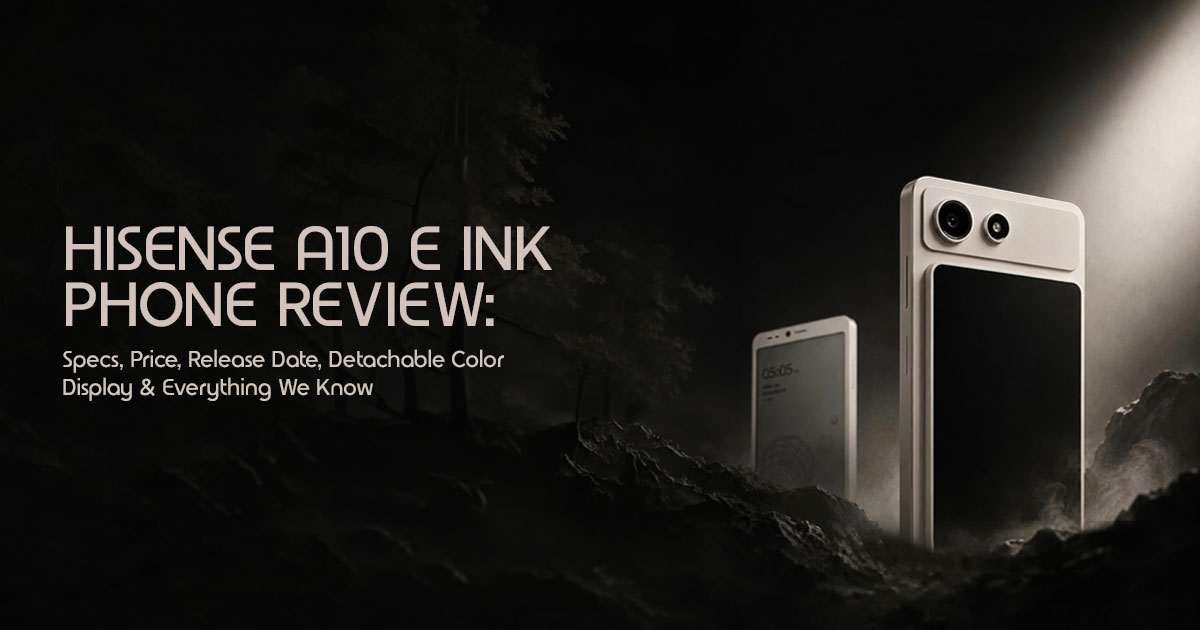
The detachable screen means you only carry the extra display when you actually need it.
Hisense A10 Specifications at a Glance
| Specification | Details |
|---|---|
| Model | Hisense A10 |
| Primary Display | 6.13-inch monochrome E Ink display designed for comfortable reading with low power consumption. |
| Secondary Display | Magnetic detachable color LCD module (display specifications have not yet been officially confirmed). |
| Processor | Qualcomm QCM6690 (also known as Dragonwing Q-6690), built on a 4nm process with an octa-core CPU. |
| Estimated AnTuTu Score | Approximately 690,000, placing it in a similar performance tier to the Unisoc T9100. |
| Operating System | Android 16 out of the box. |
| Connectivity | 5G, Wi-Fi 6, NFC, and a built-in infrared (IR) blaster for remote-control functionality. |
| Charging | Magnetic wireless charging with MagSafe-style magnetic alignment. |
| Expected Price (China) | CNY 3,999 (approximately $590 USD / £465). |
| Detachable Color LCD | Expected to cost around CNY 3,000 (approximately $440 USD / £345) and sold separately. |
| Expected Launch | August 2026, with China expected to be the first launch market. |
| Global Availability | Not officially confirmed at the time of writing. |
Hisense A10 Detachable Magnetic Color Display: Features and Benefits
This is the part that separates the A10 from every other E Ink phone with a color screen on the market right now.
How the Magnetic Attachment Works
The back of the Hisense A10 has a magnetic ring built into the body. This ring does two things:
- Holds the detachable color LCD — The secondary screen snaps on securely using No clips, no adhesive, no fiddly mechanism. Just place it and it sticks.
- Enables magnetic wireless charging — The same magnetic ring supports magnetic wireless charging and appears compatible with MagSafe-style magnetic This allows chargers like the Anker Prime 3-in-1 MagSafe station to work directly with the phone, even without the secondary display attached.
Why Detachable Beats Fixed
The Bigme HiBreak Dual 2—the closest competitor—has a color LCD permanently fixed to the back. Because it is always attached, the phone is heavier, thicker, and more likely to consume additional power, even if all you’re doing is reading a book.
With the A10, when the color screen is not needed, it stays in a bag or on a desk. The phone remains slim and light. When color is needed — for photos, comics, maps, or video — the screen snaps into place in seconds.
This follows the same idea that helped smartphones replace feature phones: carry one device instead of two. The A10 just takes that logic and applies it to the screen itself.
Can the Detachable Display Be Bought Separately?
Yes — according to Trusted Reviews, Hisense will sell the detachable LCD panel as a standalone accessory for roughly CNY 3,000 (~$440 / £345). That is a significant extra cost on top of the base phone, so buyers need to think carefully about whether they need the color screen at all.
For someone who primarily reads and rarely needs color, the phone alone could be enough. For anyone who wants the full dual-display E Ink experience, the total bundle could run close to CNY 7,000 (~$1,030 / £810).
Performance — What the Qualcomm QCM6690 Actually Means for You
The Hisense A10 runs on the Qualcomm QCM6690, a chip most people have never heard of. Here’s what that means in practice.
Not Your Typical Smartphone Chip
The QCM6690 is part of Qualcomm’s Dragonwing lineup — an enterprise-grade IoT processor, not a consumer Snapdragon. It’s built on a 4nm manufacturing process, which is modern and power- efficient. The same chip powers the Boox Note X6 E Ink tablet that launched in May 2026.
Real-World Performance Expectations
AnTuTu scores around 690,000, putting it in the same ballpark as the Unisoc T9100. Translated into plain English: this is a mid-range processor. It will handle reading apps, note-taking, web browsing, messaging, and light multitasking without issues.
What it will not do well:
- Heavy gaming — this is not a gaming phone, and it was never meant to be
- Intensive video editing or 3D rendering
- Running multiple demanding apps simultaneously
The bigger point is — E Ink phones are not built for those tasks. The A10’s chip is well-matched to what the device is actually designed for: reading, note-taking, light app usage, and occasional multimedia on the detachable LCD.
One advantage of this chip is its focus on power efficiency. Combined with an E Ink display, it should help reduce power consumption during extended reading sessions.
Display — Reading First, Color When You Need It
The Front: 6.13-Inch E Ink Panel
The main display is a 6.13-inch monochrome E Ink screen. For anyone who has used a Kindle, the experience is similar — paper-like text, zero backlight glare, and readability in direct sunlight that no LCD or OLED can match.
Who benefits most from this display:
- Readers who spend hours on e-books, articles, and long-form content
- Students taking notes and studying for extended periods
- People with eye strain or sensitivity to PWM flicker and blue light from OLED screens
- Digital minimalists who want a phone that encourages reading over doomscrolling
The limitation: E Ink refresh rates are inherently slow. Scrolling through social media, watching video, or any task with fast motion will feel sluggish on this screen. That is exactly why the detachable LCD exists.
The Back: Detachable Color LCD
The secondary display is a color LCD panel that magnetically attaches to the rear. It handles everything the E Ink screen cannot — photos, comics, charts, social media apps, navigation, and video playback.
Hisense has not confirmed the exact resolution or refresh rate of this panel yet. Based on the Bigme HiBreak Dual 2 using a 5-inch LCD on its back, the A10’s detachable screen is likely in a similar size range.
Battery Life — E Ink’s Biggest Advantage Holds Strong
Hisense has not disclosed the exact battery capacity. But here is what we know from the technology itself:
E Ink displays only consume power when the screen content changes. A static page — like an open book or a note — draws essentially zero energy. This is the core advantage of every E Ink smartphone, and the A10 inherits it fully.
When the detachable LCD is not attached, the phone should deliver multi-day battery life with typical reading and light app usage. Previous Hisense E Ink phones, such as the A9, typically delivered around 3–5 days of battery life under moderate use, although actual results varied depending on usage.
With the color LCD attached and actively used, battery life will drop significantly — LCD screens are power-hungry. But since the LCD is optional and detachable, users control the trade-off. Want longer battery? Take the color screen off. Need color? Snap it on and charge more often.
The magnetic wireless charging support is a welcome addition. Placing the phone on a MagSafe-style magnetic charger means no cables to fumble with, which is especially convenient for a device meant to be picked up and set down frequently during reading sessions.
Software — Android 16 on an E Ink Phone
Hisense says the A10 will ship with Android 16, which is notable for two reasons:
- Most E Ink phones lag behind on Android The Hisense A9 launched with Android 11. The Bigme HiBreak Pro runs Android 14. Android 16 puts the A10 on the current generation.
- Android 16 brings better app compatibility and security patches. Banking apps, productivity tools, and communication apps are more likely to work properly on a recent Android version.
Hisense has historically included E Ink optimization features — multiple refresh modes (clear, balanced, speed) that let users trade between display clarity and performance on a per-app basis. Expect the A10 to continue this approach.
One caveat: The QCM6690’s IoT pedigree raises questions about long-term software support.
Consumer Snapdragon chips often receive longer software support, although update policies ultimately depend on the device manufacturer. Enterprise IoT chips may follow a different support cadence. This is worth watching as Hisense provides more details.
Connectivity — More Complete Than Expected
| Feature | Details |
|---|---|
| 5G Connectivity | Supported, with 5G capability confirmed through the Qualcomm QCM6690 chipset for faster mobile data speeds. |
| Wi-Fi | Supports Wi-Fi 6, delivering faster wireless performance, improved efficiency, and lower latency. |
| NFC | Confirmed support for NFC, enabling contactless payments, quick device pairing, and secure data transfers. |
| Infrared (IR) Blaster | Built-in IR transmitter allows the phone to control compatible TVs, air conditioners, set-top boxes, and other home appliances. |
| Magnetic Wireless Charging | Confirmed support for magnetic wireless charging, providing convenient alignment and cable-free charging. |
The inclusion of NFC and an infrared blaster is interesting. NFC enables contactless payments and quick pairing — features that matter for daily usability. The IR remote turns the phone into a universal remote control, which is a surprisingly practical feature in Asian markets where IR-controlled appliances are common.
These are not headline features, but they signal that Hisense is treating the A10 as a real smartphone, not just a novelty e-reader with a SIM slot.
Hisense A10 vs Bigme HiBreak Dual 2 — Which Dual-Screen E Ink Phone Makes More Sense?
This is the comparison most buyers will be making. Both devices launched within weeks of each other and target the same niche.
| Feature | Hisense A10 | Bigme HiBreak Dual 2 |
|---|---|---|
| Primary Display | 6.13-inch monochrome E Ink display optimized for reading and battery efficiency. | 6.13-inch Kaleido 3 color E Ink display for reading and color content without additional accessories. |
| Secondary Display | Detachable magnetic color LCD that can be attached only when needed. | Fixed color LCD permanently integrated into the dual-screen design. |
| Processor | Qualcomm QCM6690 (approximately 690K AnTuTu) focused on efficiency. | MediaTek Dimensity 8300 offering significantly higher CPU and GPU performance. |
| Operating System | Android 16 | Android 16 |
| Stylus Support | Not officially confirmed. | Supported, making it suitable for note-taking and sketching. |
| Weight (Without Optional LCD) |
Lighter in everyday use because the color display can be detached. | Heavier since the secondary display is permanently attached. |
| Phone Price | Approximately $590. | Approximately $519+. |
| Total Cost with Color Display | Around $1,030 after purchasing the optional LCD module. | Color display is included in the standard purchase price. |
| Buying Model | Modular approach with the phone sold separately from the optional LCD accessory. | Complete all-in-one dual-screen package. |
| Availability | Officially launching in China, with international buyers relying on imports. | Initially available through Kickstarter, with broader global availability expected afterward. |
The Core Trade-Off
Fixed screen (Bigme): Always available, no extra cost, no risk of losing the accessory. But adds permanent bulk and weight.
Detachable screen (Hisense): Flexible, lighter when reading, avoids paying for color if it is not needed. But the total cost is higher if the LCD is purchased separately, and there is a real risk of leaving the screen behind when it is actually needed.
Neither approach is objectively better. It depends entirely on how someone plans to use the device.
Hisense A10 vs Hisense A9 — Worth the Upgrade?
The A9 launched in 2022 at CNY 1,799. The A10 arrives four years later at roughly double the price. Is the jump justified?
| Feature | Hisense A9 | Hisense A10 |
|---|---|---|
| Display | 6.1-inch E Ink display with 300 PPI resolution. | 6.13-inch E Ink display designed for an improved paper-like reading experience. |
| Color Display | Not available. | Optional detachable magnetic LCD display for full-color content when required. |
| Processor | Qualcomm Snapdragon 662. | Qualcomm QCM6690 built on an efficient 4nm process. |
| Operating System | Android 11. | Android 16, offering newer features, security updates, and software support. |
| NFC | No. | Yes, enabling contactless payments and NFC-based connectivity. |
| IR Blaster | No. | Yes, allowing the phone to function as a remote control for compatible devices. |
| Wireless Charging | Not supported. | Magnetic wireless charging for easier everyday charging. |
| Approx. Price | ~$250–$350 (typically imported). | Approximately $590 (phone only). |
The A9 remains one of the best pure E Ink phones for reading. But it has no color option, runs an outdated Android version, and lacks modern connectivity features. The A10 addresses every one of those gaps — but at a significantly higher price point.
For A9 owners who are happy with a monochrome-only reading experience, the upgrade is not essential. For anyone who has been waiting for an E Ink phone that can also handle color, the A10 is the first Hisense device that delivers.
The E Ink Phone Landscape in 2026 — Where the A10 Fits
The E Ink phone market is small but growing. Here is how the main options stack up:
| Device | Display Type | Approx. Price (USD) | Best For |
|---|---|---|---|
| Hisense A10 | E Ink display with an optional detachable color LCD module. | ~$590+ | Readers who primarily want an E Ink experience but occasionally need a full-color display. |
| Bigme HiBreak Dual 2 | Dual-screen design with a fixed E Ink display and LCD screen. | ~$519+ | Users who want instant access to color without attaching a separate display. |
| Bigme HiBreak Pro | Single E Ink display. | ~$439 | Users looking for one of the best dedicated single-screen E Ink smartphones. |
| BOOX Palma 2 | Compact E Ink reader (no cellular calling support). | ~$280 | Readers who want a pocket-sized companion device alongside their primary smartphone. |
| Mudita Kompakt | Minimalist E Ink smartphone. | ~$399–$549 | Digital detox enthusiasts seeking a distraction-free experience without a traditional app ecosystem. |
| Light Phone III | OLED display with a minimalist monochrome interface. | ~$799 | Users focused on essential calling and texting with minimal digital distractions. |
The A10 carves out a unique position: At the time of writing, the A10 appears to be the only E Ink phone with a detachable color display. That modularity is its defining feature and its biggest selling point.
Who Should Buy the Hisense A10?
This phone is not for everyone, and that is fine. Here are the people most likely to get the most value from it:
⬛ Avid readers who spend 2+ hours daily on e-books, articles, or documents and want a single device for reading and communication
⬛ Students and note-takers who prioritize eye comfort during long study sessions
⬛ People with screen sensitivity — migraines, eye strain, or PWM-related discomfort from OLED displays
⬛ Digital minimalists who want a phone that naturally discourages mindless scrolling but still offers color when genuinely needed
⬛ Tech enthusiasts who have been waiting for an E Ink phone that does not force a permanent compromise
Who Should Look Elsewhere
+ Mainstream smartphone buyers who need fast refresh rates, great cameras, and full app experiences — the A10 is not designed to replace a Galaxy or iPhone
+ Budget-conscious buyers — at ~$590 for the phone alone and potentially ~$1,030 with the detachable LCD, this is a premium niche device
+ People outside China — import costs, Chinese ROM limitations, and limited warranty support make this a challenging purchase for international buyers
+ Heavy social media or video consumers — the E Ink main display is not suited for fast-scrolling or video content, and relying on the detachable LCD for those tasks adds bulk
Pricing and Availability — What Buyers Need to Know
| Region / Product | Expected Price | Availability |
|---|---|---|
| China (Hisense A10 E Ink Phone) | CNY 3,999 (approximately $590 USD) | Officially scheduled to launch in August 2026. |
| Detachable Color LCD Display (Optional Accessory) |
CNY 3,000 (approximately $440 USD) | Available separately and sold as an optional accessory, rather than being included with the smartphone. |
Important notes for international buyers:
- Hisense has not announced global Based on the A9’s history and Hisense’s previous releases, the A10 is expected to remain China-exclusive.
- Importing through AliExpress or eBay is possible but comes with risks: Chinese ROM software, limited English localization, no local warranty, and potentially no Google Play Services pre-installed.
- Pricing on import channels will likely be higher than the Chinese retail price due to shipping, duties, and seller margins.
- The detachable LCD may not be available through all import channels, so buyers should confirm availability before purchasing.
Pros and Cons
| Pros | Cons |
|---|---|
| The detachable color LCD display eliminates the bulk of traditional dual-screen smartphones while providing color only when needed. | The combined price of the phone and optional LCD module is relatively high at approximately $1,030. |
| Its 6.13-inch E Ink display offers an excellent paper-like reading experience with reduced eye fatigue during long reading sessions. | Global availability has not been confirmed, meaning most buyers may need to import the device. |
| Ships with Android 16, making it one of the most up-to-date E Ink smartphones currently announced. | The mid-range 4nm processor is optimized for efficiency rather than intensive multitasking or gaming. |
| Magnetic wireless charging adds everyday convenience and simplifies charging. | The inherent E Ink refresh rate remains too slow for fast-moving apps, gaming, and multimedia. |
| Built-in NFC and an IR blaster improve daily usability for payments and remote-control functions. | The detachable color LCD is an optional accessory and is not included with the phone. |
| Its modular design allows users to purchase only the accessories they actually need. | Users may occasionally leave the detachable display behind when it is unexpectedly needed. |
| The efficient 4nm chipset helps maximize battery life during reading and productivity tasks. | The Chinese software version may require additional setup or modifications for international users. |
| The paper-like E Ink screen remains highly readable outdoors with virtually no eye strain in bright sunlight. | Camera specifications remain unconfirmed and are expected to be relatively basic compared with mainstream flagship smartphones. |
Frequently Asked Questions
What makes the Hisense A10 different from other E Ink phones?
The detachable magnetic color LCD is the key differentiator. Other dual-screen E Ink phones like the Bigme HiBreak Dual 2 have the color screen permanently attached. The A10 lets users remove it entirely, keeping the phone light for reading and attaching color only when needed.
Can the Hisense A10 play videos?
Yes, but only on the detachable color LCD. The main E Ink display has an inherently slow refresh rate that makes video playback impractical. The color LCD handles video, social media, and any app that benefits from a faster, full-color screen.
Is the Hisense A10 available in the US, UK, or India?
Not officially. Hisense has only confirmed a China launch in August 2026. International buyers will need to import through AliExpress, eBay, or specialized E Ink retailers. Import pricing and software experience will vary.
Will the detachable display be sold separately?
Yes. According to Trusted Reviews, the detachable LCD will be sold as a standalone accessory for approximately CNY 3,000 (~$440 / £345). This means buyers can purchase the phone first and add the color screen later, or replace it if damaged.
How does the Hisense A10 compare to the Hisense A9?
The A9 is a single-screen E Ink phone running Android 11 with a Snapdragon 662, priced around $250–350 on import. The A10 adds the detachable color LCD, Android 16, NFC, IR remote, magnetic wireless charging, and a more modern 4nm processor — but at roughly double the price. The A9 is the better choice for pure reading on a budget. The A10 is the pick for anyone who needs both reading and color.
Is an E Ink phone a good replacement for a regular smartphone?
For most people, no. E Ink phones work best as a secondary device or a primary phone for users who have deliberately chosen to reduce screen time. The slow refresh rate makes many common smartphone tasks — social media scrolling, maps, video — frustrating on the E Ink display. The A10’s detachable LCD helps, but it is still a compromise compared to a standard smartphone.
Does the Hisense A10 support Google Play Services?
Hisense has not confirmed this. Previous Hisense E Ink phones sold in China shipped without Google Play Services pre-installed. International buyers typically need to sideload Google apps or install alternative app stores. Buyers should expect a similar experience unless Hisense confirms otherwise.
What is the Qualcomm QCM6690 processor?
The QCM6690 — also marketed as the Dragonwing Q-6690 — is a 4nm octa-core chip from Qualcomm’s enterprise IoT lineup. Early benchmark reports place it at around 690,000 on AnTuTu, positioning it as a capable mid-range processor. The chip is designed for power-efficient workloads, making it well suited for devices such as E Ink phones and tablets. The same chip powers the Boox Note X6 E Ink tablet.
Final Verdict — Should You Wait for the Hisense A10?
Here’s what matters: the Hisense A10 E Ink phone isn’t trying to be everything to everyone. It’s trying to fix the one thing that makes dual-screen E Ink phones annoying—you’re stuck carrying both screens whether you need them or not.
Hisense figured out something surprisingly obvious: make the color screen optional. Reading for hours? Leave the LCD at home. Need navigation or photos? Click it on. This isn’t revolutionary tech—it’s just smart design that respects how people actually use their devices.
But let’s be clear about the compromises.
At roughly $1,030 with the detachable LCD module, you’re paying flagship money for a mid-range processor and a concept that’s still finding its footing. You’ll need to import it from China when it launches in August 2026. And yes, there may be times when you wish you had brought the detachable screen with you.
The A10 works if you’re the kind of person who reads obsessively, values eye comfort over bleeding-edge specs, and doesn’t mind the logistics of buying gray-market tech. For everyone else? It’s fascinating, but probably not practical.
Important: The A10 Isn’t Available Yet
Hisense announced full specs in July 2026, with China launch scheduled for August 2026. Global availability? Unknown. If you need an E Ink device now, you’ve got options:
Alternatives Available Today:
- Bigme HiBreak Pro 5G — Permanent dual-screen, no modularity, but it ships now
- BOOX Palma 2 — Compact E Ink reader with phone DNA (worldwide)
- BOOX (India) — Regional availability for Indian buyers
The A10 addresses a genuine limitation of current dual-screen E Ink phones. Whether it’s worth waiting for depends on how much you value choosing when to carry the extra weight—not just accepting that you always will.
***Disclaimer***
This blog post reflects our research, analysis, and opinions based on available product information, user feedback, and industry knowledge. It should not be taken as the official position of any brand, manufacturer, or company mentioned here. While we aim to keep information accurate and up to date, product details, pricing, and availability can change. We recommend double-checking important details before making a purchase.
Some links in this article may be affiliate links. If you choose to buy through these links, we may earn a small commission at no extra cost to you. This helps support our work and allows us to keep publishing in-depth, unbiased reviews. Our recommendations are never influenced by affiliate partnerships.
Comments shared by readers reflect their own views and not ours. We are not responsible for outcomes resulting from the use of information on this site. Please seek professional advice where appropriate.
All product names, logos, and brands mentioned are the property of their respective owners. These names are used for identification and informational purposes only and do not imply endorsement.