
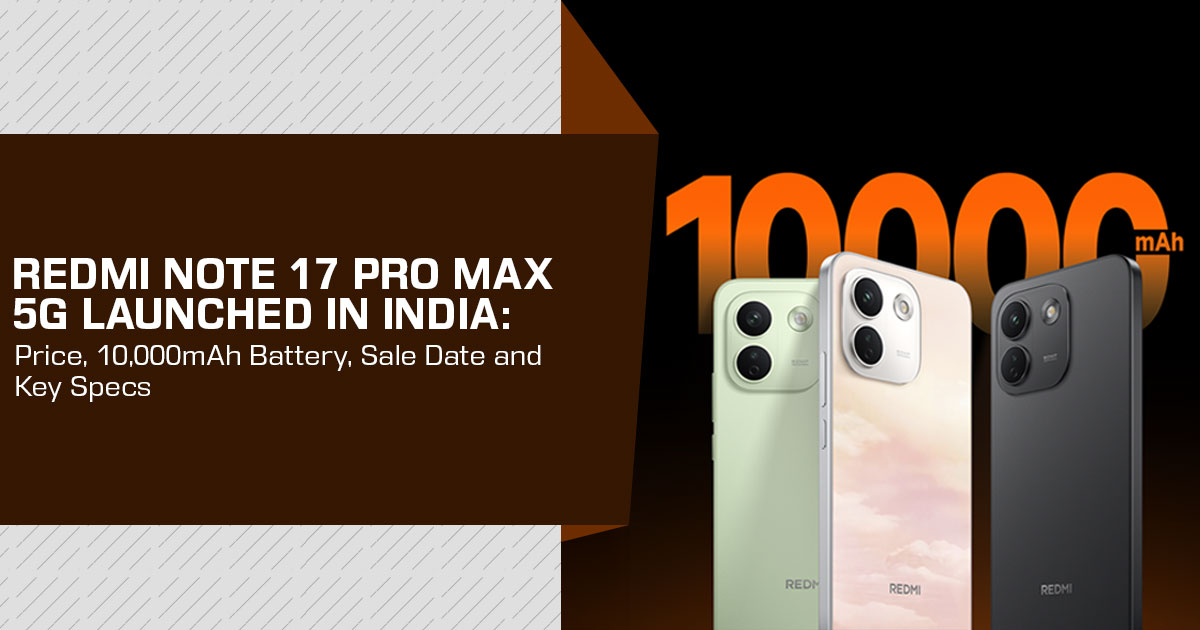
Redmi Note 17 Pro Max 5G India launch: the short answer
The Redmi Note 17 Pro Max 5G India launch brings a battery-focused smartphone with a 10,000mAh silicon-carbon battery, 100W HyperCharge, and a 6.83-inch 120Hz AMOLED display. Xiaomi lists the starting
price at ₹49,999, with sales in India scheduled to begin on 23 September 2026.
For buyers who spend long hours on their phones, battery life is likely to be the biggest reason to consider the Redmi Note 17 Pro Max 5G. Xiaomi claims up to four-plus days of battery life under a light-use laboratory scenario, but that figure should not be treated as a promise for heavy gaming, camera use, streaming, or mobile data.
As technology experts with over 20 years of experience in hardware and application research and development, we deeply analyse each product based on real-world performance, durability, and value for money. Our goal is to help you find the right product for your needs across budget, performance, reliability, and long-term usage. This guide is aimed at smartphone buyers, mobile enthusiasts, students, professionals, and anyone looking for a long-lasting 5G phone without having to charge it through the day.
Our recommendations are based on extensive research, component analysis, real-world usability, and industry expertise. If battery endurance, fast charging, display quality, and everyday reliability matter more to you than having the fastest processor or the most advanced camera system, the Redmi Note 17 Pro Max 5G deserves a closer look.
Redmi Note 17 Pro Max 5G price in India and availability
The Redmi Note 17 Pro Max 5G price in India starts at ₹49,999 for the 8GB RAM and 256GB storage version, according to launch coverage; Xiaomi’s India product page confirms the model and specifications. A 12GB RAM and 256GB storage variant is reported at ₹55,999.
The phone is scheduled to go on sale in India from 23 September 2026. This date matters because the phone was announced in India on 15 September, while retail availability begins later. Current India launch coverage reports 23 September as the sale date.
| Configuration | Price | Availability |
|---|---|---|
| 8GB RAM + 256GB Storage | ₹49,999 | Sale begins on 23 September 2026. |
| 12GB RAM + 256GB Storage | ₹55,999 | Final sale availability and launch offers should be confirmed at the time of purchase. |
Prices, bank offers, and stock can change. Readers should check the final listing before placing an order.
Redmi Note 17 Pro Max 5G specifications at a glance
| Specification | Details |
|---|---|
| Battery | 10,000mAh silicon-carbon battery |
| Wired Charging | 100W HyperCharge |
| Reverse Charging | 27W wired reverse charging |
| Processor | Qualcomm Snapdragon 6 Gen 5, 4nm |
| Display | 6.83-inch 1.5K AMOLED, up to 120Hz refresh rate |
| Peak Brightness | Up to 3,500 nits |
| Rear Cameras | 50MP main camera with OIS + 8MP ultrawide |
| Selfie Camera | 32MP |
| Software | Android 16 with HyperOS 3 |
| Protection | IP66, IP68, IP69, and IP69K ratings, subject to specified test conditions |
| Software Updates | 4 OS upgrades and 6 years of security updates, according to Xiaomi India |
| Starting Price in India | ₹49,999 |
The 10,000mAh battery is the reason to consider this phone
The Redmi Note 17 Pro Max 5G has an unusually large 10,000mAh battery for a mainstream smartphone. Xiaomi uses a silicon-carbon battery design and lists the phone at 8.57mm thick on its India product page. The available sources do not establish how much of that thickness is attributable to the battery design alone.
For buyers, the practical benefit is simple: the phone is likely to require fewer charging sessions during long journeys, workdays, or extended periods away from a power outlet. It may also suit users who keep a phone connected to 5G, navigation, video streaming, or social media for much of the day.
Xiaomi says the battery can provide up to four-plus days of light use in its internal testing. The wording matters. Light use is not the same as continuous gaming, maximum-brightness video playback, or constant camera recording. Network strength, screen brightness, temperature, applications, and usage patterns all affect battery life.
The company also says the battery retains 80% capacity after 1,600 charge cycles under its testing conditions. This is a useful durability claim, but it is not a promise that every unit will behave identically over several years.
What does 100W charging mean for the buyer?
The Redmi Note 17 Pro Max 5G supports 100W charging. Xiaomi says its India configuration can reach 36% in 20 minutes and a full charge in about 70 minutes under specified laboratory conditions.
A large battery normally takes longer to fill than a smaller one, even when both phones use the same charging speed. The 100W system helps reduce that disadvantage. A short charging session before leaving home should add a meaningful amount of battery, while a complete charge remains a longer process than the headline wattage alone might suggest.
The India page also lists 27W wired reverse charging. This allows the phone to supply power to compatible accessories or another device through a cable. It is useful for emergencies, but frequent reverse charging will reduce the battery available for the phone itself.
Display: large, bright and suited to media use
The Redmi Note 17 Pro Max 5G AMOLED display measures 6.83 inches and uses a 1.5K resolution with a refresh rate of up to 120Hz. A higher refresh rate can make scrolling and supported games look smoother than a conventional 60Hz panel.
Xiaomi lists peak brightness of up to 3,500 nits. Peak brightness is a limited-condition figure and should not be read as the screen’s sustained brightness across the entire panel. Even so, the display specification suggests that outdoor readability is a major design priority.
The large panel should benefit people who read documents, watch video, use maps, or play games. The trade-off is size: this is not a compact phone, and users who prefer one-handed operation may find the 6.83-inch body less convenient.
Performance: efficient mid-range hardware, not a gaming flagship
The phone uses the Snapdragon 6 Gen 5 processor on a 4nm manufacturing process. Xiaomi positions it for multitasking, AI features, and everyday productivity. Published specifications list an octa-core design and Adreno graphics.
For normal tasks such as messaging, browsing, video streaming, navigation, and office applications, the processor should be adequate on paper. The large battery also gives the phone a useful advantage for long sessions away from a charger.
The more cautious conclusion concerns demanding games and sustained workloads. The Snapdragon 6 Gen 5 is a mid-range platform rather than one of Qualcomm’s premium Snapdragon 8-series chips. Buyers who prioritise the highest frame rates, advanced graphics, or heavy video editing should compare benchmark results and independent reviews before choosing the Redmi Note 17 Pro Max 5G.
The Redmi Note 17 Pro Max 5G gaming experience may be satisfactory for casual and moderate gaming, but battery capacity should not be mistaken for unlimited performance. A bigger battery extends the time available between charges; it does not automatically make the processor faster.
Cameras: sensible hardware with a clear trade-off
The rear camera system combines a 50MP OIS camera with an 8MP ultrawide camera. Optical image stabilisation can help reduce the effect of small hand movements in still images and video. The phone also has a 32MP front camera.
This setup gives the phone the basic tools expected at its price, including a main camera for everyday photographs and an ultrawide camera for wider scenes. However, the camera setup is more focused on everyday photography than dedicated long-range zoom. There is no separate telephoto camera, so buyers should not expect the same zoom flexibility offered by phones with dedicated telephoto hardware.
The right buying question is not whether 50MP is a large number. It is whether the main sensor, processing, stabilisation, and software produce results that meet the buyer’s needs. Those details require independent camera testing and cannot be established from the megapixel count alone.
Durability and water resistance: useful protection with limits
The handset carries IP66, IP68, IP69 and IP69K protection ratings. Xiaomi also lists three-metre drop resistance under specific testing conditions.
These ratings can provide additional protection against dust and water exposure under specified laboratory conditions, but they do not make the phone indestructible. Xiaomi warns that water resistance can deteriorate with wear, physical damage, or repair, and that liquid damage outside the test conditions may not be covered by warranty.
Therefore, the phone may be a practical option for commuters, travellers, and outdoor users, but it should not be deliberately submerged or used as an underwater camera without following Xiaomi’s restrictions.
Software and long-term support
The phone ships with Android 16 and HyperOS 3. Xiaomi says it will receive four OS upgrades and six years of security updates.
Long software support matters because it can extend the useful life of the phone and reduce the pressure to replace it quickly. It also makes the ₹49,999 starting price easier to evaluate over several years rather than only by the launch-day specification sheet.
The main uncertainty is how software updates will affect battery consumption and performance over time. Long support is valuable, but actual update quality, timing, and regional rollout remain important parts of the ownership experience.
Redmi Note 17 Pro Max 5G versus Redmi Note 15 Pro+
The most relevant internal comparison is with the previous Redmi Note 15 Pro+. Published launch coverage describes the Redmi Note 17 Pro Max 5G as an endurance-focused upgrade rather than a straightforward improvement in every category.
| Feature | Redmi Note 17 Pro Max | Previous-Generation Model | What It Means for Buyers |
|---|---|---|---|
| Battery | 10,000mAh | 6,500mAh reported in comparison coverage | The Pro Max has a substantial advantage in rated battery capacity. |
| Wired Charging | 100W | 100W | Charging power is similar on paper, although the newer phone has a considerably larger battery to recharge. |
| Battery Endurance | Primary focus, alongside durability | More balanced previous-generation positioning | The newer model places greater emphasis on long battery endurance. |
| Processor Positioning | Snapdragon 6 Gen 5 | Snapdragon 7s Gen 4 reported by 91mobiles | A newer-generation device is not automatically faster in every workload, so real-world and benchmark performance should be compared separately. |
| Camera Positioning | 50MP main + 8MP ultrawide | Higher-resolution 200MP main camera reported for the Pro+ | Compare actual camera samples, sensor characteristics, and zoom hardware rather than relying on megapixel counts alone. |
| Price Context | Starts at ₹49,999 | Previous-generation pricing and current offers may vary | Discounts and promotions can significantly change the relative value of each model. |
The Redmi Note 17 Pro Max 5G vs Redmi Note 15 Pro+ decision depends on priorities. The newer model focuses more heavily on battery capacity, durability features and long-term support. The older model remains relevant if its camera hardware, processor tier or discounted price better matches the intended use.
How it compares with the Redmi Note 17 Pro
The standard Redmi Note 17 Pro is the lower-priced alternative within the same series. 91mobiles reports a 9,000mAh battery, 67W charging, and a starting price of ₹36,999.
| Feature | Model 1 | Model 2 |
|---|---|---|
| Starting Price | ₹49,999 | ₹36,999 |
| Battery | 10,000mAh | 9,000mAh |
| Wired Charging | 100W | 67W |
| Main Processor | Snapdragon 6 Gen 5 | Snapdragon 6s Gen 4 |
| Front Camera | 32MP | 16MP |
| Best Suited To | Buyers prioritizing maximum battery endurance, faster charging, and stronger specifications. | Buyers seeking a lower starting price while retaining a very large battery. |
The Pro Max offers 1,000mAh more battery capacity and 100W charging instead of 67W, but the additional ₹13,000 should be weighed against those differences. Buyers who mainly want a long-lasting phone may find that the standard Pro already provides enough battery for their routine.
Who should buy the Redmi Note 17 Pro Max 5G?
The phone is a logical candidate for readers who:
- Need a smartphone with a 10,000mAh battery for travel, field work, commuting, or long shifts.
- Prefer charging less often and accept a large phone in return.
- Want a bright 120Hz AMOLED screen for reading, streaming, and navigation.
- Need reverse charging for accessories or an emergency top-up.
- Value dust and water protection, while understanding its testing limits.
- Plan to keep the phone for several years and value Xiaomi’s stated update policy.
Who should compare other phones first?
A different model may make more sense for readers who:
- Want the strongest camera system possible near ₹50,000.
- Mainly play demanding games and need premium graphics performance.
- Prefer a light or compact handset.
- Do not need more than one or two days of ordinary battery life.
- Can purchase a discounted previous-generation model with stronger camera or processor hardware.
Is the Redmi Note 17 Pro Max 5G worth buying?
Whether the Redmi Note 17 Pro Max 5G is the right battery-focused phone under ₹50,000 depends on what you value beyond battery capacity. The phone has a clear advantage in battery size, charging, durability ratings, and long-term support. Those strengths are relevant to people who regularly worry about running out of power.
The trade-offs are equally clear. The phone is large, the Snapdragon 6 Gen 5 is a mid-range platform, and the dual rear camera system appears more practical than ambitious. The “four-plus days” figure comes from Xiaomi’s light-use testing, not from a universal real-world guarantee.
The published specifications make the Redmi Note 17 Pro Max 5G a clear option for endurance-focused buyers. It is less convincing as a default recommendation for camera enthusiasts or demanding gamers. Checking launch offers and comparing the Redmi Note 17 Pro, Redmi Note 15 Pro+, and other phones around ₹50,000 should be part of the buying decision.
Check the latest Redmi Note 17 Pro Max 5G offers
Amazon India
If the Redmi Note 17 Pro Max 5G price in India fits the budget, check the latest Amazon India listing for the correct RAM and storage variant, launch discounts, bank offers, warranty information, and delivery date before ordering.
Check the Redmi Note 17 Pro Max 5G price and latest offers on Amazon India
Amazon US
US availability, network compatibility, warranty coverage, and regional battery or software configurations may differ from the Indian version. Check the product listing carefully before buying an imported unit.
Check Amazon US for availability and current pricing
These are purchase-check prompts rather than fixed price claims. Retail pricing and stock can change after launch.
Frequently asked questions
When did the Redmi Note 17 Pro Max 5G launch in India?
The phone was launched in India on 15 September 2026. Current India launch coverage reports retail sales beginning on 23 September 2026.
What is the Redmi Note 17 Pro Max 5G price in India?
The starting price is ₹49,999 for the reported 8GB RAM and 256GB storage version. A 12GB RAM and 256GB version is reported at ₹55,999.
Does the Redmi Note 17 Pro Max 5G have a 10,000mAh battery?
Yes. Xiaomi lists a 10,000mAh silicon-carbon battery with 100W HyperCharge and 27W wired reverse charging.
How long does the Redmi Note 17 Pro Max 5G battery last?
Xiaomi claims up to four-plus days under its light-use testing conditions. Actual battery life depends on screen brightness, network conditions, gaming, video playback, camera use, and other factors.
Is the Redmi Note 17 Pro Max 5G waterproof?
It has IP66, IP68, IP69, and IP69K ratings listed for specified conditions. These ratings do not mean the phone is immune to liquid damage, and Xiaomi says protection can deteriorate with wear or physical damage.
Is the Redmi Note 17 Pro Max 5G good for gaming?
Its Snapdragon 6 Gen 5 processor is positioned for everyday use and gaming, but buyers seeking sustained high-graphics performance should check independent gaming tests. A 10,000mAh battery improves endurance; it does not itself guarantee flagship-level frame rates.
Final verdict
The Redmi Note 17 Pro Max 5G India launch introduces a phone built around a specific idea: reduce battery anxiety by combining a 10,000mAh cell with 100W charging. Its large AMOLED display, durability ratings, reverse charging, and stated software support strengthen that use case.
It is aimed at buyers who value endurance more than camera hardware or top-tier gaming performance. Buyers with different priorities should compare it with the Redmi Note 17 Pro, Redmi Note 15 Pro+, and other phones in the same price range before purchasing.
The most accurate summary is straightforward: the Redmi Note 17 Pro Max 5G is a battery-first mid-range 5G phone, not an all-purpose flagship replacement.
Have questions about the Redmi Note 17 Pro Max 5G, its battery life, performance, price, or features? Share your thoughts or doubts in the comments—we’d be happy to help.
If you find our reviews and buying guides useful, follow us for more honest, practical technology coverage, product comparisons, and advice that helps you make a more informed choice.
Disclaimer

This blog post reflects our research, analysis, and opinions based on available product information, user feedback, and industry knowledge. It should not be taken as the official position of any brand, manufacturer, or company mentioned here. We make every effort to keep this guide accurate, but product specifications, pricing, and availability may change after publication. We recommend double-checking important details before making a purchase.

Some links in this article may be affiliate links. If you choose to buy through these links, we may earn a small commission at no extra cost to you. This helps support our work and allows us to keep publishing in-depth, unbiased reviews. Affiliate partnerships never influence our recommendations.

Opinions expressed by readers are their own and do not necessarily reflect ours. We are not responsible for outcomes resulting from the use of information on this site. Please seek professional advice where appropriate. All product names, logos, and brands mentioned are the property of their respective owners. These names are used for identification and informational purposes only and do not imply endorsement.