
Introduction
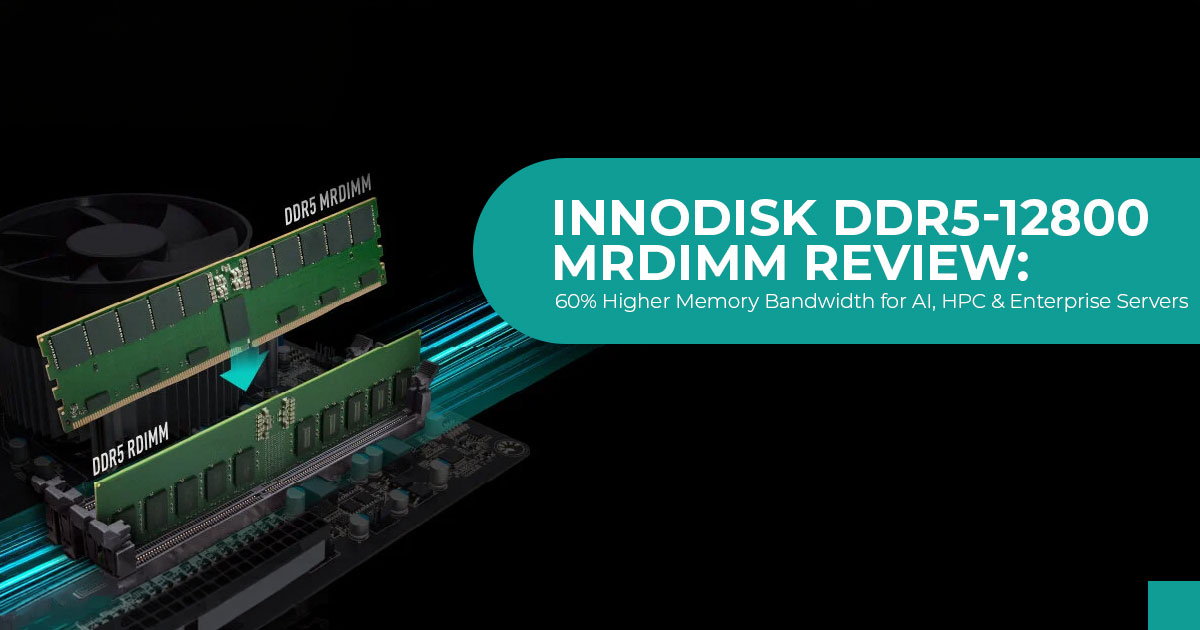
Memory bandwidth is becoming a bigger limitation than processor speed in many AI servers and data centers. Modern GPUs and CPUs can process massive workloads, but they still depend on memory to keep data flowing. That’s why Innodisk’s MRDIMM is worth paying attention to. It isn’t just another faster DDR5 module. Its new MRDIMM design increases memory bandwidth while staying compatible with standard DDR5 RDIMM slots on supported platforms.
This launch matters for AI infrastructure, high-performance computing (HPC), cloud providers, and enterprise data centers running memory-intensive workloads such as AI training, AI inference, large language models (LLMs), and data analytics.
As technology experts with over 20 years of experience in hardware and application research and development, we evaluate products based on real-world performance, durability, and value for money. Whether you’re building a new AI server, upgrading an existing enterprise system, or planning future data center deployments, our recommendations are based on detailed research, component analysis, and practical testing.
In this review, we’ll explain how the memory module works, how it compares with DDR5 RDIMM, who should consider it, and whether it is worth waiting for when it launches in Q4 2026.
Quick Take for Busy Teams
- What: Innodisk DDR5-12800 MRDIMM, a Multiplexed Rank DIMM (MRDIMM) built for AI data centers, enterprise servers, and high-performance computing (HPC).
- Performance: Delivers up to 60% more memory bandwidth than DDR5-8000 RDIMM, reaching over 100 GB/s per memory channel (up to 4 GB/s theoretical).
- How: Uses Multiplexed Register Clock Driver (MRCD) and Multiplexed Data Buffer (MDB) to access two memory ranks simultaneously, increasing data throughput.
- Compatibility: It uses the same physical DDR5 RDIMM form factor, but requires MRDIMM-capable CPUs, BIOS, and motherboard support.
- Availability: Expected in Q4 2026 for systems supporting JEDEC DDR5 MRDIMM Gen2, including compatible Intel Xeon 6 platforms.
The Real Reason AI Servers Slow Down
Most teams add more CPU cores and GPUs first. For many AI workloads, memory throughput becomes the primary bottleneck rather than processor performance.
When core count grows, cores spend time waiting for data. This is often called the memory wall. For memory-intensive AI workloads, including AI training, LLM inference, and data analytics, limited memory bandwidth means lower throughput and longer response times.
Innodisk DDR5 MRDIMM targets this exact limit. It increases available memory bandwidth without requiring a different DIMM connector, provided the server platform supports MRDIMM.
Through extensive research and hands-on experience with server memory platforms, we review what this module does, how DDR5 MRDIMM vs RDIMM compares, and whether it makes sense to buy.
What Is MRDIMM and How It Works
What is MRDIMM? MRDIMM means Multiplexed Rank DIMM. It is not just a faster RDIMM. It moves data differently.
A standard RDIMM talks to one rank at a time. MRDIMM talks to two ranks at once. The module adds two parts to make this possible:
- Multiplexed Register Clock Driver (MRCD): Takes the command stream from the host and routes it to the right ranks at double rate. Each module contains one MRCD responsible for command routing.
- Multiplexed Data Buffer (MDB): Takes data from two DRAM groups and merges it into one fast stream to the CPU. Each module integrates ten MDB chips to combine data streams from multiple DRAM ranks.
The host bus runs at 12,800 MT/s while the DRAMs underneath run at 6,400 MT/s. The result is simultaneous two-rank access and nearly double the bandwidth per pin from the same connector.
For system builders, this means existing server board layouts do not need a new memory connector, provided the platform supports MRDIMM.
Innodisk DDR5 MRDIMM Key Features That Matter
1. 12,800 MT/s With Verified 60% Bandwidth Uplift
DDR5-12800 MRDIMM delivers up to 60% higher memory bandwidth than DDR5-8000 RDIMM. The source announcement states this 60% figure directly, and third-party coverage notes it pushes past memory bandwidth per channel 100 GB/s.
What it means for you: If your workload is limited by memory speed, this uplift can shorten job time. Independent Intel testing on Xeon 6 MRDIMM platforms showed jobs completing up to 33% faster with MRDIMM than on the same system using RDIMM.
2. Standard DDR5 RDIMM Form Factor
Innodisk DDR5 MRDIMM uses the same physical DDR5 RDIMM form factor but requires an MRDIMM-compatible CPU, BIOS, and motherboard. It uses the same standard height and the same RDIMM connector concept, 1.1V, and ECC.
What it means for you: It works as a compatible upgrade for validated MRDIMM platforms if your server supports JEDEC DDR5 MRDIMM Gen2. You avoid a custom motherboard. You do need to check your server QVL, because older DDR5 servers that only support RDIMM will not boot MRDIMM.
3. Built for AI, LLMs, HPC, and Data-Intensive Workloads
Innodisk designed this module for AI training, LLM inference, high-performance computing (HPC), data analytics, and other memory-intensive workloads where memory bandwidth directly affects performance.
These workloads fetch many small pieces of data constantly. Innodisk DDR5 MRDIMM is tuned for token-based processing, where memory response time directly affects throughput.
Who gains most: Teams running server memory for LLM inference with long context, real-time inference, HPC simulations, and in-memory analytics where cores wait for memory.
4. Protection and Efficiency
The module includes eFuse and TVS protection for stable transmission and surge handling, plus a second-generation server PMIC designed for both DDR5-8000 RDIMM and MRDIMM 12800.
What it means for you: Energy-efficient design helps in racks running 24/7. Stable power delivery and surge protection reduce the risk of errors in remote or industrial deployments, including robotics automation applications.
5. Usable Capacity Range
Offered in 32GB to 128GB capacities. That range fits most AI inference nodes and HPC nodes without moving to tall form factors. Some competitors offer tall 256GB MRDIMM for 1U/2U high-capacity builds, while Innodisk focuses on mainstream 32-128GB for Q4 2026 availability.
DDR5 MRDIMM vs RDIMM: Honest Difference
Many searches are for DDR5 MRDIMM vs RDIMM. Here is the straightforward view:
| Feature | DDR5-6400 / DDR5-8000 RDIMM | DDR5-12800 MRDIMM |
|---|---|---|
| How It Accesses Memory | Accesses one rank at a time. | Enables simultaneous two-rank access through its MRCD and MDB architecture. |
| Memory Speed | 6,400–8,000 MT/s | 12,800 MT/s (DDR5-12800) |
| Bandwidth per Channel | Approximately 51.2 GB/s at DDR5-6400 and 64 GB/s at DDR5-8000. | Approximately 102.4 GB/s, pushing memory bandwidth beyond 100 GB/s per channel. |
| Bandwidth Gain vs DDR5-8000 RDIMM | Baseline | 60% higher theoretical bandwidth. |
| Effective Latency Under Load | Higher queue wait times when memory bandwidth becomes heavily saturated. | Third-party testing has shown lower effective latency in bandwidth-intensive workloads. |
| Platform Requirements | Compatible with conventional supported DDR5 server platforms. | Requires a CPU and motherboard supporting JEDEC Gen2 DDR5 MRDIMM, such as a compatible server platform with MRDIMM support. |
MRDIMM vs RDIMM vs LRDIMM vs HBM are separate tools:
- RDIMM: Best for broad compatibility and balanced cost per GB
- LRDIMM: Best for max capacity per socket
- MRDIMM: Best for max bandwidth per channel
- HBM: Best for accelerator on-package bandwidth, not replaceable or expandable
If your servers are not bandwidth-bound, RDIMM gives better value. If they are, DDR5 12800 MT/s MRDIMM returns the cost in throughput.
MRDIMM Roadmap: From 8800 to 12800 to 17600 MT/s
You may ask if you should wait.
| Generation | Target Speed | Current Status |
|---|---|---|
| Gen1 MRDIMM | 8,800 MT/s | Shipping since 2024, with MRDIMM support available on Intel Xeon 6 server platforms. |
| Gen2 Innodisk DDR5 MRDIMM | 12,800 MT/s | DDR5-12800 MRDIMM targeting Q4 2026, using an MRCD and MDB architecture. |
| Gen3 MRDIMM | 16,000–17,600 MT/s | Currently in JEDEC development, with chipset samples appearing during the 2025–2026 development period. |
Gen2 uses the same DDR5 RDIMM form factor introduced with Gen1. Gen3 will need new CPU validation. For new server memory for AI data centers builds in late 2026-2027, Gen2 is the practical step.
AMD has announced upcoming MRDIMM support for future EPYC platforms. Availability depends on platform release schedules.
Who Should Buy and Who Should Skip
Consider Innodisk DDR5 12800 MT/s MRDIMM if you:
- Run AI training, LLM inference, or other memory-intensive AI workloads where memory bandwidth limits performance
- Run high-performance computing (HPC) workloads where extra CPU cores provide little benefit because memory bandwidth is the limiting factor
- Have a platform that lists JEDEC DDR5 MRDIMM Gen2 and Intel Xeon 6 MRDIMM support or upcoming AMD EPYC MRDIMM support
- Want drop-in replacement server memory without changing board layout
Stay on RDIMM if you:
- Run general VMs, web tiers, or light databases that are not bandwidth-bound
- Use an older DDR5 server without MRDIMM validation
- Need lowest cost per GB for capacity, where LRDIMM or 3DS RDIMM fits better
Simple test we use: Measure your current memory bandwidth use. If you see sustained high use and cores idle, MRDIMM is likely to improve performance. Otherwise, you can save the upgrade budget.
Competitor Context Without the Noise
Innodisk is one of several vendors shipping DDR5 12800 MT/s MRDIMM:
- Micron: Gen1 to Gen2 MRDIMM, offers tall 256GB options, strong performance results for AI training and LLM inference
- Samsung / SK Hynix: Early JEDEC compliance, focus on die efficiency and high volume
- SMART Modular: Commercial DDR5-12800 MRDIMM in 32-128GB range
Innodisk stands out for industrial reliability, eFuse and TVS protection, and long-life supply, which matters for robotics automation applications and edge AI that must run unattended.
Pricing, Availability, and Buying Advice
- Availability: Q4 2026 per official announcement, 32GB to 128GB capacities
- Price: Not official Early market estimate based on Gen1 MRDIMM retail is a premium over RDIMM (often 1.6x-2.2x per GB at launch). Treat this as market estimate, not official.
- Buying tip: Always check your server QVL from Dell, HPE, Supermicro, or Lenovo before Confirm BIOS supports DDR5 MRDIMM vs RDIMM at 12,800 MT/s. Populate all channels balanced.
If you must build now, Gen1 8,800 MT/s MRDIMM on validated Xeon 6 systems is available today. If you can schedule for Q4, plan for Innodisk DDR5 MRDIMM.
Pros and Cons
| Pros | Cons |
|---|---|
| ✔ 60% higher bandwidth when comparing DDR5-12800 MRDIMM with DDR5-8000 RDIMM, pushing memory bandwidth per channel beyond 100 GB/s. | ✖ Requires an MRDIMM-capable server platform with support for JEDEC Gen2 MRDIMM. |
| ✔ Uses the standard DDR5 RDIMM form factor, simplifying deployment in server platforms specifically designed to support MRDIMMs. | ✖ Early-generation MRDIMMs are likely to carry a price premium over conventional RDIMMs. |
| ✔ Designed for demanding AI training, LLM inference, HPC, and other memory-intensive enterprise workloads. | ✖ Not yet broadly available at retail, with availability targeted for Q4 2026. |
| ✔ Includes eFuse and TVS protection, an energy-efficient design, and a server-grade PMIC for enterprise deployments. | ✖ Each module requires 1× MRCD and 10× MDB components, making adequate server airflow and thermal management important. |
| ✔ Available capacities from 32GB to 128GB cover a broad range of AI inference, HPC, and enterprise server configurations. | ✖ The biggest performance gains appear primarily in memory-bandwidth-bound workloads; compute-bound applications may see a smaller benefit. |
FAQ: DDR5 MRDIMM 12800 for AI Servers
This FAQ section is optimized for featured snippets and AI search.
What is MRDIMM?
MRDIMM means Multiplexed Rank DIMM. It is a DDR5 server memory that accesses two ranks at once using MRCD and MDB chips. This gives up to 60% more bandwidth than standard RDIMM from the same slot, ideal for AI and HPC.
Is DDR5 MRDIMM compatible with standard DDR5 RDIMM slots?
Yes, if your server supports JEDEC DDR5 MRDIMM Gen2. Innodisk DDR5 12800 MT/s MRDIMM uses the same RDIMM connector concept and height, so it works as a compatible upgrade on validated MRDIMM platforms like Intel Xeon 6 MRDIMM support.
How much faster is DDR5 MRDIMM 12800 vs RDIMM 8000?
Innodisk DDR5 MRDIMM 12800 delivers a 60% bandwidth increase over DDR5 RDIMM 8000, moving from ~64 GB/s to ~102.4 GB/s per channel. Independent tests on Xeon 6 showed up to 33% faster job completion in bandwidth-bound workloads.
What are MRCD and MDB in MRDIMM?
MRCD is Multiplexed Register Clock Driver (MRCD) – it splits commands to ranks. MDB is Multiplexed Data Buffer – it merges data streams. Together as the MRCD and MDB architecture, they enable simultaneous two-rank access, with one MRCD together with ten MDB chips per 12800 MRDIMM.
Which workloads benefit most from Innodisk DDR5 12800 MRDIMM?
AI training, LLM inference, scientific computing, data analytics, and other memory-intensive workloads benefit the most because they depend heavily on memory bandwidth.
Should I buy MRDIMM or wait for Gen3 17600 MT/s?
Gen2 12800 MT/s MRDIMM is the practical buy for late 2026-2027 builds. Gen3 16000-17600 MT/s is still in JEDEC development. If your platform supports Gen2 and you are bandwidth-bound now, buy Gen2.
Conclusion: Is Innodisk DDR5 MRDIMM Worth It?
If your jobs are limited by memory bandwidth, Innodisk DDR5-12800 MRDIMM is worth adding to your next server spec.
It addresses a single, costly issue – cores waiting on data – with a clean upgrade path. By using Multiplexed Register Clock Driver (MRCD) and Multiplexed Data Buffer (MDB) to enable simultaneous two-rank access, it delivers 60% bandwidth uplift without a new connector.
If your workloads are not bandwidth-bound, RDIMM or LRDIMM gives better value per GB. Benchmark first, then decide.
Our take: For new AI servers and enterprise data center deployments planned for 2026–2027, validate Intel Xeon 6 MRDIMM support or future AMD EPYC MRDIMM support for JEDEC DDR5 MRDIMM Gen2 and include Innodisk DDR5 MRDIMM in the evaluation.
Takeaway
Innodisk DDR5-12800 MRDIMM is built for one purpose: increasing memory bandwidth for AI servers, HPC clusters, and enterprise data centers where traditional DDR5 RDIMM memory is becoming a bottleneck. By using MRDIMM technology, it delivers up to 60% higher bandwidth while remaining compatible with supported DDR5 RDIMM slots on next-generation server platforms.
If your workloads include AI inference, large language models (LLMs), AI training, scientific computing, or data analytics, this is one of the most important server memory upgrades arriving in Q4 2026. Higher memory bandwidth won’t improve every workload, but applications that regularly saturate memory channels can see meaningful performance gains.
What You Should Do Next
- Verify that your server supports JEDEC DDR5 MRDIMM Gen2, including compatible Intel Xeon 6 or AMD EPYC 9006
- Measure your current memory bandwidth utilization. If memory is the limiting factor instead of CPU or GPU performance, MRDIMM is worth considering.
- Plan your Q4 2026 hardware budget by comparing enterprise MRDIMM pricing as vendors begin shipping production modules.
Direct Procurement Status
At the time of writing, DDR5-12800 MRDIMM modules are not available through Amazon US or Amazon India. These are enterprise-grade memory modules designed for next-generation servers and are typically sold through OEMs, system integrators, and enterprise distributors rather than consumer retail stores.
Typical procurement channels include:
- Micron
- SK hynix
- Dell Technologies
- HPE
- Enterprise IT distributors and authorized server partners
Available Alternatives Today
If you need server memory now, you can purchase enterprise DDR5 ECC RDIMM modules currently available through Amazon and other enterprise suppliers. While these do not provide MRDIMM performance, they are suitable for today’s DDR5 server platforms.
Amazon Worldwide
- HPE 64GB DDR5-6400 ECC RDIMM
- TEAMGROUP T-Create Master DDR5 R-DIMM 64GB Kit (6400 MT/s)
- Micron 64GB DDR5-6400 ECC RDIMM
Amazon India
Planning Tip
If you’re planning a new AI server or enterprise workstation, shortlist the 32GB, 64GB, 96GB, or 128GB capacities you expect to deploy. As Innodisk MRDIMM becomes available through enterprise distributors in Q4 2026, you’ll be in a better position to compare pricing, validate platform compatibility, and upgrade when supply improves.
If you found this review helpful, leave a comment with your server configuration or workload. Follow us for more server hardware reviews, AI infrastructure updates, and enterprise memory comparisons. If you have any questions about MRDIMM, DDR5 RDIMM, or choosing the right memory for your next build, let us know—we’re happy to help.
***Disclaimer***
This blog post reflects our research, analysis, and opinions based on available product information, user feedback, and industry knowledge. It should not be taken as the official position of any brand, manufacturer, or company mentioned here. We make every effort to keep this guide accurate, but product specifications, pricing, and availability may change after publication. We recommend double-checking important details before making a purchase.
Some links in this article may be affiliate links. If you choose to buy through these links, we may earn a small commission at no extra cost to you. This helps support our work and allows us to keep publishing in-depth, unbiased reviews. Affiliate partnerships never influence our recommendations.
Opinions expressed by readers are their own and do not necessarily reflect ours. We are not responsible for outcomes resulting from the use of information on this site. Please seek professional advice where appropriate.
All product names, logos, and brands mentioned are the property of their respective owners. These names are used for identification and informational purposes only and do not imply endorsement.