
Introduction: Servers Have a Memory Problem, and This Chip Attacks It Directly
Modern AI models, cloud platforms, enterprise databases, and high-performance computing workloads all share the same bottleneck: memory capacity. Today’s CPUs continue to gain more cores and higher processing power, but the amount of DDR5 memory they can directly support is still limited by the number of physical memory slots on the motherboard. As workloads grow larger, simply adding another server is often expensive, power-hungry, and inefficient.
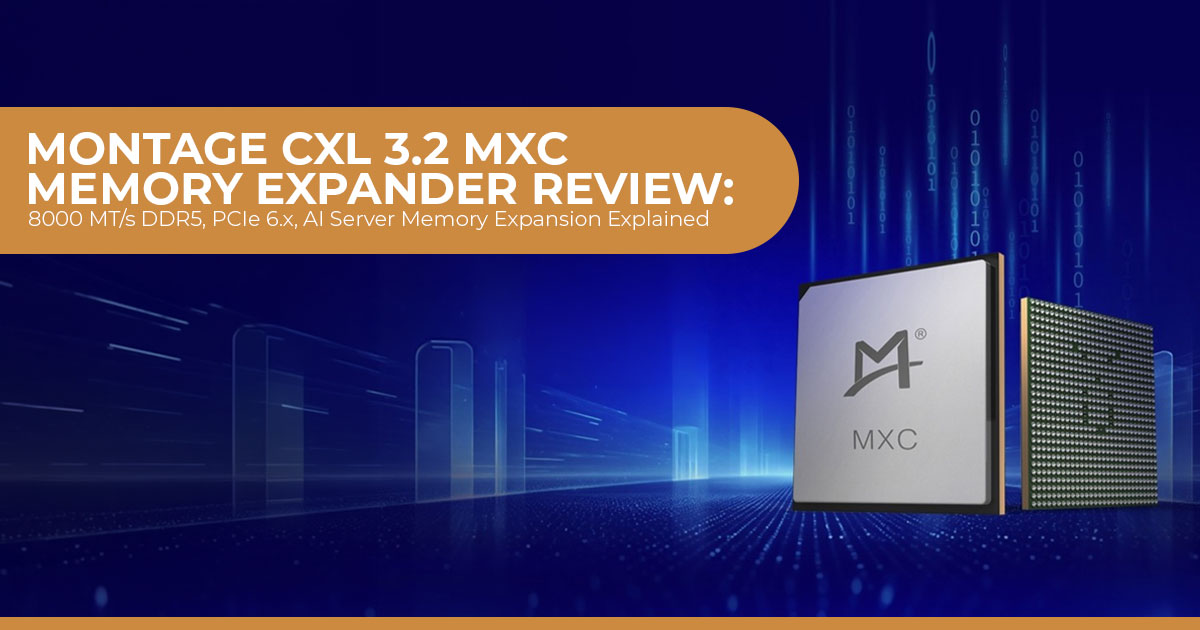
That is why Montage Technology’s latest announcement deserves attention. According to Montage Technology, the company has entered trial production of what it describes as the industry’s first CXL 3.2 MXC (Memory eXpander Controller), which is designed to expand server memory capacity by connecting additional DDR5 memory running at up to 8000 MT/s over a CXL interface. Announced in Hengqin, China, on July 31, 2026, the chip introduces a new approach to scaling server memory for AI, cloud, and enterprise workloads.
Before going further, one important disclosure: this product is only in trial production. We have not tested the chip, and neither have any independent reviewers outside Montage Technology and its validation partners. Everything in this article is based on the company’s published specifications, technical documentation, statements from partners including Samsung, SK hynix, Intel, and AMD, and broader industry reporting. Even so, sufficient public information is available to explain how the technology works, where it could have the biggest impact, and what questions remain before commercial deployment.
Our analysis is based on published technical documentation, vendor announcements, industry reporting, and experience evaluating enterprise hardware platforms. Where independent testing is unavailable, we’ve clearly identified those limitations. Whether you’re an enterprise IT decision-maker, data center architect, cloud infrastructure engineer, AI researcher, system integrator, hardware enthusiast, or business evaluating future server investments, our goal is to help you understand what truly matters—not just what’s written on a specification sheet. This analysis focuses on publicly available technical information, practical deployment considerations, and the current state of the enterprise memory ecosystem.
The announcement is significant for reasons beyond introducing another server chip. More importantly, CXL memory expansion could change how future servers are designed. Instead of replacing CPUs every time applications demand more memory, organizations may eventually expand memory much like adding storage today—more flexible, potentially more cost-effective, and better suited for increasingly memory-hungry AI workloads.
In the sections ahead, we’ll explain what the CXL 3.2 MXC chip actually does, why each specification matters, how it compares with traditional server memory architectures, who stands to benefit the most, and whether this technology is worth watching before it reaches mass production.
What Is the CXL 3.2 MXC Chip?
CXL (Compute Express Link) is an open interconnect standard built on top of PCI Express. It lets a processor, memory, and accelerators share data coherently instead of keeping memory locked to one CPU.
An MXC (Memory eXpander Controller) is the chip that makes this useful in practice. It sits between the host processor and external DDR5 memory. When the CPU requests data, the MXC converts that CXL memory request into DDR commands in real time and returns the data. To the processor, the additional DDR5 memory appears as a larger shared memory pool without exposing its physical location.
Confirmed specifications
| Specification | Details |
|---|---|
| Standard | CXL 3.2, designed as a CXL Type 3 memory device |
| Protocols | CXL.mem + CXL.io |
| Host Interface | PCIe 6.x, supporting speeds of up to 64 GT/s |
| Memory Support | Dual DDR5 memory controllers supporting up to DDR5-8000 (8,000 MT/s) |
| On-Chip Processing | Dual RISC-V processing subsystems |
| Integrated PHYs | Integrated PCIe 6.x PHY and DDR5 PHY |
| Form Factors | PCIe AIC cards and EDSFF modules |
| Target Workloads | Memory expansion, memory pooling, and tiered memory deployments |
| Software | Full SDK with analysis and testing tools |
| Validation Status | Integrated into next-generation CXL products from Samsung and SK hynix, with alignment for Intel Xeon and AMD EPYC server platforms |
[Suggested image: diagram of a server connected to a CXL memory pool. Alt text: “Montage Technology CXL 3.2 MXC chip connecting Intel Xeon and AMD EPYC servers to 8000 MT/s DDR5 memory pools”]
Why Servers Keep Hitting the Memory Wall
Modern AI workloads increasingly depend on large memory capacity. Large language models, recommendation systems, and scientific simulations all need fast access to datasets that keep growing.
The problem is architectural. In a conventional server, all usable memory sits in DIMM slots wired directly to the CPU. Sockets have a fixed number of channels. Once those slots are full, the only way to add memory is to add another server — buying a second CPU, motherboard, power draw, and rack space just to get its memory slots.
This is often called the memory wall: CPU performance keeps improving, but memory capacity cannot scale at the same pace, increasing infrastructure costs.
This architecture creates three major infrastructure challenges:
- Data centers overbuy CPUs they do not need, purely to access more memory slots.
- Installed memory sits stranded inside underused Industry simulations suggest CXL memory pooling can cut memory power consumption by 20–30% and raise utilization by up to 50%.
- AI training and inference jobs stall on capacity rather than compute.
CXL-based memory expansion is designed to address all three challenges. CXL allows additional memory to be attached over PCIe, pooled across systems, and allocated where workloads need it most.
Key Features — and What Each One Means for Buyers
8000 MT/s DDR5 Support
Most server DDR5 in production today runs between 4800 and 6400 MT/s. Supporting 8000 MT/s DDR5 means the MXC is not the bottleneck for the next two memory generations. For buyers, this translates to longer platform life: modules purchased against this controller will not be speed-limited by the controller itself.
PCIe 6.x at 64 GT/s
The host link runs at up to 64 GT/s — double the per-lane rate of PCIe 5.0. Additional memory is only useful if the interconnect can deliver enough bandwidth. Otherwise, the bottleneck simply shifts from capacity to data transfer. This link speed keeps CXL-attached memory usable for real workloads. In Samsung’s public testing of CXL-attached memory, pooled configurations retained roughly 92% of direct-attached DRAM performance in 8-GPU setups. That is the number that makes pooling practical rather than theoretical.
CXL Type 3 with CXL.mem and CXL.io
CXL Type 3 is the device class built specifically for memory expansion. CXL.mem handles coherent memory access; CXL.io handles configuration and management. Support for both means the MXC plugs into existing server management stacks instead of requiring custom tooling — a detail that decides real deployments more often than raw speed does.
Dual RISC-V Subsystems and Integrated PHYs
Two integrated RISC-V processor subsystems handle protocol translation and management tasks locally. Integrated PCIe 6.x and DDR5 PHYs remove external components from the board design. For module makers like Samsung and SK hynix, this shortens development time. For system designers, fewer external components can simplify board design and may reduce potential points of failure.
EDSFF and PCIe AIC Form Factors
The controller supports both EDSFF modules and PCIe add-in cards. EDSFF matters because it is the form factor data centers are standardizing on for hot-swappable, serviceable storage and memory. A CXL module that fits existing EDSFF bays slots into procurement plans without chassis redesign.
SDK and Validation Tools
Montage ships a full software development kit with analysis and testing tools. This is aimed at module manufacturers, not end users — but it signals how quickly partner products can reach qualification. A controller with weak tooling takes years to appear in shipping products. Trial production with a complete SDK shortens that path.
Why This Announcement Matters Beyond the Specifications
The broader industry context explains why this announcement matters.
On July 20, 2026—11 days before this announcement—reporting from South Korea confirmed that Samsung, SK hynix, and Micron had all halted in-house CXL controller development. SK hynix reassigned its controller engineers to processing-in-memory research. Micron moved to external sourcing. Samsung kept its design as an internal R&D project only.
The reason is structural: the three memory giants wanted to bundle proprietary controllers with their DRAM in premium integrated modules. Hyperscalers refused. Locked-in modules kill their ability to switch DRAM suppliers and squeeze their negotiating power. Selling integrated modules also cannibalizes the standard DIMM business that generates the giants’ volume.
The exit leaves the controller market to fabless specialists — Montage Technology, Astera Labs, Marvell, and PrimeMass were the names cited by analysts.
Taken together, these developments suggest: Montage’s CXL 3.2 MXC entered trial production at almost the exact moment the three largest DRAM makers vacated the controller business, with two of them — Samsung and SK hynix — already named as validation partners. That could position Montage Technology as a leading supplier to the same companies that just stopped competing with it. Based on publicly available announcements, no competing CXL 3.2 memory expander controller with 8000 MT/s DDR5 support has been reported to have reached trial production.
The broader CXL memory pooling market also supports the significance of this announcement. Valued at roughly $1.39 billion in 2026, it is projected to grow at about 31% CAGR to $5.42 billion by 2031 (Mordor Intelligence). Controllers are the fastest-moving segment inside it.
CXL 3.2 vs CXL 3.1: What Actually Changed
Buyers evaluating Montage’s earlier CXL 3.1 MXC — which already carried AMD and Intel platform backing — will ask this first. Here is the honest picture:
| Feature | CXL 3.1 MXC (Previous Generation) | CXL 3.2 MXC (This Chip) |
|---|---|---|
| Specification Level | CXL 3.1 | CXL 3.2 — adds protocol-level refinements for memory pooling, tiered memory, security, and management. |
| Platform Backing | Support confirmed for AMD and Intel platforms. | Aligned with Intel Xeon and AMD EPYC platforms, with named Samsung and SK hynix product integration. |
| DDR5 Speed Ceiling | Earlier DDR5 speed grades | Supports DDR5 speeds of up to 8,000 MT/s. |
| Host Interface | PCIe 5.x-class interface | PCIe 6.x interface operating at up to 64 GT/s. |
| Current Status | Established previous-generation technology | Trial production, positioned as an industry-first implementation at this specification level. |
One caution: Montage has not published full silicon-level comparisons of the two generations, and some 3.1 figures were never disclosed publicly. We flag gaps rather than fill them with guesses.
[Suggested image: side-by-side comparison graphic. Alt text: “CXL 3.2 vs CXL 3.1 MXC controller comparison — 8000 MT/s DDR5 and PCIe 6.x upgrades”]
Competitor Context: Montage vs Astera Labs vs Marvell
The CXL controller field is narrow, and buyers should know the players:
| Vendor | CXL position | Status as of August 2026 |
| Montage Technology | CXL 3.2 MXC memory expander, 8000 MT/s DDR5, PCIe 6.x | Trial production — first publicly announced at this spec; Samsung/SK hynix validated |
| Astera Labs | Established CXL controller and switch product lines | Shipping earlier-generation controllers; named by analysts as a primary beneficiary of the memory giants’ exit |
| Marvell | Mature CXL controller portfolio | Shipping current-generation products; expanding through acquisition and partnerships |
| Memory giants’ in-house designs | Samsung, SK hynix, Micron controllers | Halted or internal-only, per July 2026 reporting |
No independent benchmarks compare these controllers head-to-head yet. The fair statement is this: Montage holds the public lead at the CXL 3.2 specification tier, while Astera and Marvell hold broader shipping histories. Both facts matter in a procurement decision.
Pros and Cons — Assessed From Specifications and Reporting
| Strengths | Limitations |
|---|---|
| ✔ Among the first CXL 3.2 memory expanders at this tier to enter trial production. | ✖ Trial production is not the same as mass production, and commercial shipping timelines have not yet been announced. |
| ✔ Support for DDR5-8000 (8,000 MT/s) provides substantial memory-performance headroom across multiple server memory generations. | ✖ There are currently no independent performance or latency benchmarks available. |
| ✔ PCIe 6.x at 64 GT/s provides enough host-link bandwidth to reduce the risk of the interconnect becoming the primary bottleneck. | ✖ This is an enterprise component with no conventional retail channel or publicly announced pricing. |
| ✔ Support for EDSFF and PCIe add-in card (AIC) form factors makes it practical for real-world data center deployment plans. | ✖ Industry adoption of advanced CXL 3.2 capabilities remains at an early stage. |
| ✔ Validation with Samsung and SK hynix, alongside alignment with Intel Xeon and AMD EPYC platforms, strengthens its enterprise ecosystem positioning. | ✖ Current validation claims primarily come from industry partners rather than independent third-party testing. |
| ✔ Arrives as major memory manufacturers reduce their focus on standalone CXL controllers, potentially creating more room for specialized controller vendors. | ✖ Established competitors such as Astera Labs and Marvell have longer track records with shipping data-center connectivity products. |
Who Should Act Now, and Who Should Wait
Act now — track this closely:
- Data center architects planning 2027 platform refreshes
- AI infrastructure teams blocked on memory capacity, not compute
- Procurement teams evaluating CXL memory module vendors for qualification
- Anyone comparing Montage Technology vs Astera Labs controllers for upcoming designs
Wait:
- Buyers who need shipping, independently benchmarked hardware this quarter
- Workloads still on CXL 0-capable platforms — the 3.2 feature set will not be accessible until platform refresh
Not the target at all:
Consumer desktop builders. This chip has no direct impact on consumer desktop PCs. What it signals — DDR5 at 8000 MT/s entering enterprise validation — does confirm that high-speed DDR5 is now the industry’s center of gravity, which is useful context if you are speccing a workstation today.
Montage will demonstrate the MXC at CXL Mini DevCon on August 3 and at FMS 2026, August 4–6 (booth #845) in Santa Clara this week. Expect interoperability demos and partner announcements to follow; those are the milestones that turn a trial-production chip into orderable products.
Pricing and Availability: What Is Actually Known
- Status: trial production as of July 31, Mass production timing was not announced.
- Channel: enterprise and OEM You will not find this controller on a shelf; it ships inside CXL memory modules from partners like Samsung and SK hynix.
- Pricing: CXL modules have historically carried a premium over standard RDIMMs; expect that to hold through early adoption.
- Realistic product window: module-level products built on new controllers typically follow validation by roughly two to four Partner products could reasonably begin appearing between late 2026 and 2027, although no launch schedule has been confirmed.
Buying advice in one line: if your roadmap includes memory pooling or tiered memory, start vendor qualification conversations now so the hardware has somewhere to land when it ships — and buy for today’s platforms with that direction in mind.
What You Can Buy Today
The controller is enterprise silicon, but the memory standard behind its headline speed is available retail right now:
- DDR5-8000 desktop kits — the same 8000 MT/s speed grade the MXC validates, shipping today for enthusiast and workstation platforms
- DDR5 ECC RDIMM server memory — the current DDR5 server memory generation for existing Intel Xeon and AMD EPYC platforms, and the baseline that CXL-attached pools will be benchmarked against
Check current prices — Amazon US
If you are speccing workstations or small-cluster nodes, DDR5-8000 kits and DDR5 server memory are worth pricing now — speeds at this grade historically drop as enterprise validation widens supply.
→ [View DDR5-8000 memory kit prices on Amazon US]
→ [View DDR5 ECC RDIMM server memory on Amazon US]
Check current prices — Amazon India
For buyers in India, server-grade DDR5 availability varies by seller and import cycle, so checking live listings is the only reliable way to compare DDR5 server memory pricing today.
→ [View DDR5-8000 memory kit prices on Amazon India]
→ [View DDR5 ECC RDIMM server memory on Amazon India]
(Prices and stock change daily; the links above show current listings.)
FAQ: CXL 3.2 and the Montage MXC
What is CXL 3.2, and how is it different from CXL 3.1?
CXL 3.2 is the latest revision of the Compute Express Link specification. Against 3.1, it refines memory pooling, tiered memory support, security, and device management. For memory expansion products, the practical jump is pairing those features with PCIe 6.x link speeds.
What does Montage Technology’s MXC chip do?
It converts a host CPU’s CXL memory requests into DDR5 commands in real time, letting one server use large external DDR5 pools as if the memory were locally attached.
How fast is 8000 MT/s DDR5?
8,000 megatransfers per second. Per 64-bit channel, that works out to 64 GB/s of raw bandwidth — roughly 25% above the 6400 MT/s ceiling common in current server DDR5.
How does CXL memory pooling work in a data center?
Multiple servers share a common pool of CXL-attached memory, and capacity is allocated per workload. Simulations cited in market research show pooling cutting memory power draw 20–30% and improving utilization up to 50%.
Does the CXL 3.2 MXC work with Intel Xeon and AMD EPYC servers?
According to Montage Technology and statements from both Intel’s chief I/O architect and AMD’s enterprise AI leadership, the MXC is designed to align with both platforms. Production deployments will depend on each platform’s CXL 3.x support generation.
Why did Samsung, SK hynix, and Micron stop developing CXL controllers?
Per July 2026 reporting, hyperscalers rejected proprietary integrated modules, the designs cannibalized standard DIMM sales, and the economics favored external fabless suppliers like Montage, Astera Labs, and Marvell.
When will CXL 3.2 MXC products reach the market?
Montage is in trial production now with Samsung and SK hynix validation complete. Based on typical controller-to-module timelines, partner products in late 2026 through 2027 is a reasonable expectation — not a confirmed schedule.
Final Verdict
The CXL 3.2 MXC marks one of the biggest steps forward in server memory expansion we’ve seen in recent years. With support for DDR5 speeds up to 8000 MT/s, PCIe 6.x (64 GT/s), CXL Type 3, and EDSFF, it addresses many of the performance and scalability concerns that limited earlier CXL memory solutions. Just as importantly, validation work with Samsung and SK hynix, along with public support from Intel and AMD, suggests the broader ecosystem is moving in the same direction.
That said, it’s important to keep expectations realistic. This is still trial-production hardware. There are no independent performance benchmarks, no confirmed pricing, and no commercial availability yet. Until those details are available, the CXL 3.2 MXC should be viewed as an important indicator of where the server industry is headed rather than a product that’s ready to buy today.
If you’re an enterprise IT team, data center operator, or AI infrastructure planner preparing hardware refreshes for 2027 and beyond, this CXL 3.2 MXC deserves a place on your enterprise hardware evaluation shortlist. For everyone building or upgrading systems today, the practical takeaway is straightforward: DDR5-8000 has now emerged as the industry’s validated high-speed memory tier, making today’s DDR5-8000 kits and DDR5 server memory the smartest choices for current production platforms.
We’d Love to Hear From You
What do you think about CXL memory expansion? Could it reshape the future of AI servers, cloud infrastructure, and enterprise computing, or do you think traditional server memory architectures will continue to dominate?
Share your thoughts in the comments below—we read every comment and are happy to answer your questions.
If this review helped you, follow us for more in-depth hardware analysis, honest product reviews, and buying guides based on real research rather than marketing claims. And if there’s a topic or product you’d like us to cover next, let us know. We’d be glad to help.
***Disclaimer***
This blog post reflects our research, analysis, and opinions based on available product information, user feedback, and industry knowledge. It should not be taken as the official position of any brand, manufacturer, or company mentioned here. We make every effort to keep this guide accurate, but product specifications, pricing, and availability may change after publication. We recommend double-checking important details before making a purchase.
Some links in this article may be affiliate links. If you choose to buy through these links, we may earn a small commission at no extra cost to you. This helps support our work and allows us to keep publishing in-depth, unbiased reviews. Affiliate partnerships never influence our recommendations.
Opinions expressed by readers are their own and do not necessarily reflect ours. We are not responsible for outcomes resulting from the use of information on this site. Please seek professional advice where appropriate.
All product names, logos, and brands mentioned are the property of their respective owners. These names are used for identification and informational purposes only and do not imply endorsement.