
1. Introduction
Demand for portable retro gaming devices continues to grow as players look for compact, everyday gaming options. Most retro handheld owners say the same thing after a few weeks: it’s great at home, but I don’t carry it anymore. It’s either too big, too heavy, or too awkward to throw in a pocket. And that defeats the whole point of a pocket-friendly gaming device.
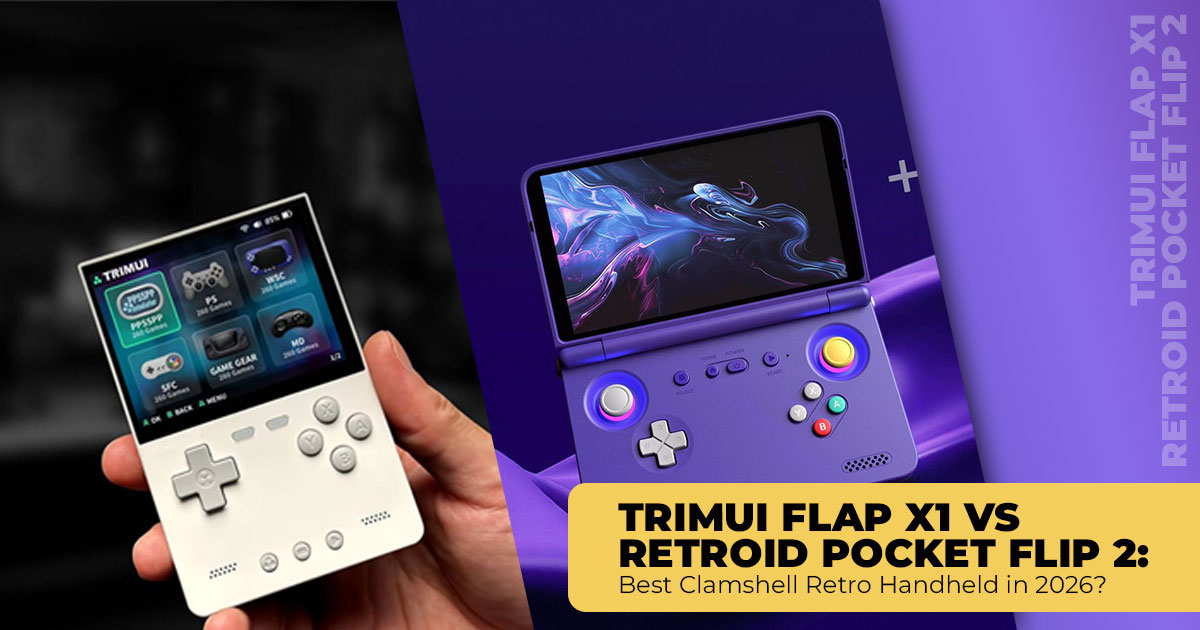
That’s why the buzz around the TrimUI Flap X1 matters.
Clamshell designs have always had a quiet advantage. They protect the screen. They fold down small. They feel nostalgic in your hands. Now leaks suggest that TrimUI is working on what could be the smallest clamshell retro handheld in its class — possibly even undercutting the Retroid Pocket Flip 2 in size.
But size alone doesn’t win. Performance, battery life, software support, and comfort matter just as much.
This article breaks it all down clearly — what’s confirmed, what’s rumored, what it means for real players, and whether this retro gaming handheld is worth waiting for.
Click here to buy from Amazon
1.1 Why This Category Still Matters
The retro handheld gaming space keeps growing because people want something simple: access to classic games without dragging around a full console. Devices like the Retroid Pocket Flip 2 proved that a single-screen clamshell handheld still has demand.
But many modern models are getting larger and more powerful — and less portable. The TrimUI Flap X1 seems to target a different crowd: players who care more about easy carry and quick sessions than raw horsepower.
1.2 Why User Reviews Matter Before You Buy
Specs only tell part of the story. Real-world feedback reveals:
- How comfortable the controls feel after an hour
- Whether the hinge holds up over time
- If the battery actually lasts during a commute
- How well the OS handles emulation setup
A retro handheld console might look perfect on paper, but disappoint in daily use. That’s why early impressions and long-term testing matter more than marketing claims.
As technology experts with over 20 years of experience in hardware and application research and development, we deeply analyze each product based on real-world performance, durability, and value for money. Our goal is to help you find the best product in every category—budget, performance, reliability, and long-term usage.
Whether you’re a retro gaming enthusiast, a daily commuter who wants a compact gaming console, or someone comparing the TrimUI Flap X1 vs Retroid Pocket Flip 2, our recommendations are based on extensive research, component analysis, real-world usability, and industry expertise.
And here’s the new angle: smaller might actually be smarter this time.
1.3 Why This Breakdown Matters Right Now
Rumors move fast in the retro gaming handheld world. But most coverage focuses on leaks without explaining what they mean for real players.
What actually matters?
- How a 7-inch display changes usability
- Whether a thinner body means weaker battery life
- If a smaller shell improves portability but hurts comfort
- Whether Linux vs Android affects your emulator options
In a market filled with bulkier devices pushing high-end chips, the TrimUI Flap X1 appears to focus on pocketability first. That alone makes it different.
1.4 What Readers Walk Away With
By the end of this guide, you’ll understand:
- Confirmed and rumored details about the TrimUI Flap X1 hardware
- How it stacks up directly against the Retroid Pocket Flip 2
- Who this clamshell retro handheld is ideal for
- Who should wait for something stronger
- What updates to track before pre-ordering
No hype. Just clarity.
2. Technical Specifications at a Glance
Leaks give us a partial picture. Some important details are still unknown.
Here’s a side-by-side snapshot for context:
| Feature | TrimUI Flap X1 (Rumored) | Retroid Pocket Flip 2 (Confirmed) |
| Form Factor | Single-screen clamshell retro handheld | Single-screen clamshell handheld |
| Screen | 4.7-inch 16:9 (~1334×750) | 5.5-inch AMOLED 1920×1080,
60Hz, 500 nits |
| Dimensions | ~125–130 × 75–80 × 15mm | 140.5 × 89.5 × 24mm, 300g |
|
Controls |
Dual lower analog sticks, D-pad,
ABXY, shoulders, 4 extra function buttons |
Dual analog sticks, D-pad, ABXY, analog triggers, hall-effect sticks |
| Ports/Audio | USB-C, headphone jack, stereo
bottom speakers |
USB-C, headphone jack, stereo
speakers |
| Cooling | No fan (passive) | Active cooling + vibration |
| Processor / RAM | Unknown | Snapdragon 865 or Dimensity 1100 / 8GB |
| Storage /
Battery |
Unknown | 128GB + microSD / 5000mAh |
| OS | Likely Linux (based on brand pattern) | Android 13 |
What stands out immediately:
- The TrimUI Flap X1 is clearly slimmer.
- The screen is smaller.
- Performance details are still available.
- Battery capacity remains unknown — and that’s a big factor in a portable retro gaming device.
3. Quick Summary
If you just want the essentials:
- The TrimUI Flap X1 may be the most compact clamshell retro handheld available.
- Its 7-inch display favors portability over immersion.
- It could be ideal for lighter emulation — think up to Dreamcast and possibly early GameCube, depending on the chipset.
- Processor, RAM, battery life, and final OS remain unconfirmed.
- Best suited for daily carry gamers, not performance-focused power users.
Key takeaway: If your priority is a truly pocket-friendly clamshell retro handheld, the TrimUI Flap X1 could fit into your routine better than larger devices.
3.1 Who Should Be Paying Attention
This device may suit:
- Gamers who want a compact gaming console for commuting
- Players who value screen protection from a clamshell design
- Retro fans who don’t need heavy PS2 or advanced GameCube performance
- Minimalists who prefer lighter hardware
It may not suit:
- Players chasing high-end Android performance
- Users who want large AMOLED displays
- Anyone prioritizing maximum emulation power over portability
3.2 What Still Needs Answering
Before anyone rushes to pre-order, key questions remain:
- What processor powers the TrimUI Flap X1?
- How large is the battery?
- Will Linux limit emulator flexibility?
- How durable is the hinge?
- What’s the expected price?
These answers will determine whether this becomes a smart everyday device — or just another interesting concept.
Clamshell devices aren’t just nostalgia. They solve a real problem: protecting your screen while staying small enough to carry everywhere. If the TrimUI Flap X1 delivers decent performance in that slim body, it could quietly become one of the most practical retro gaming handhelds of the year.
And that’s worth watching closely.
Click here to buy from Amazon
4. TrimUI Flap X1 Design and Build: What Do the Leaks Actually Confirm?
Early sketches shared across Chinese forums and retro handheld communities show consistent dimensions and layout. While still unofficial, the repeated alignment across sources suggests the physical design is largely locked in.
This section focuses on what appears reliable — and why it matters for real-world use.
4.1 Is the TrimUI Flap X1 Really That Compact?
Leaked measurements suggest:
- 125–130mm length
- 75–80mm width
- 15mm closed thickness
At 15mm thick, the TrimUI Flap X1 could become one of the slimmest clamshell retro handhelds available.
That changes daily usability. Many so-called portable consoles still feel bulky once they’re in your pocket. A thinner chassis makes a difference when you carry it on a commute or slip it into a small bag.
The clamshell form factor also protects the display when closed. That removes the need for a case and reduces screen scratches over time.
Why it matters:
- Easier everyday carry
- Lower risk of screen damage
- More discreet pocket fit
4.2 TrimUI Flap X1 Controls and Layout: Is It Comfortable for 3D Games?
Leaked renders show:
- Dual analog sticks (lower placement)
- Traditional D-pad and ABXY buttons
- Shoulder triggers
- Four additional function buttons
Why Stick Placement Matters
Lower-positioned sticks often improve comfort during 3D gameplay. For systems like PSP and Dreamcast, this layout can reduce thumb strain.
The four extra buttons suggest shortcut functionality. Likely uses include:
- Quick save and load states
- Emulator switching
- Performance profile toggling
- Menu access
These features improve usability for players running multiple systems.
The in-line trigger design keeps the body slim. However, smaller dimensions may feel tighter for users with larger hands. That balance between compact size and comfort will only be clear after hands-on testing.
4.3 TrimUI Flap X1 Ports and Hardware: What Connectivity Is Confirmed?
Based on current visuals, the device includes:
- USB-C port (charging and data transfer)
- 5mm headphone jack
- Bottom-facing stereo speakers
- Physical toggle switch
- No visible cooling fan
Does the TrimUI Flap X1 Have Active Cooling?
There is no indication of a fan. Passive cooling supports:
- Silent operation
- Lower power consumption
- Slimmer device profile
However, passive designs may limit sustained high-performance emulation if thermal throttling occurs.
What Could the Toggle Switch Do?
The physical toggle may allow:
- Switching between performance and power-saving modes
- Boot mode changes
- System-level adjustments
If implemented correctly, it could extend battery life during lighter emulation workloads.
4.4 TrimUI Flap X1 Specifications: What’s Still Unknown?
Several critical speciffcations remain unconffrmed:
- Processor
- RAM
- Battery capacity
- Internal storage
- Display resolution
- Operating system
Why the Processor Is the Key Variable
Chipset selection determines whether the device handles:
- Stable PSP emulation
- Smooth Dreamcast gameplay
- Playable GameCube emulation
Without confirmed silicon, performance predictions remain cautious.
Battery Life in a 15mm Body
Thin devices typically house smaller batteries. If the capacity drops below 4,000mAh, expect shorter sessions compared to devices like the Retroid Pocket Flip 2.
Estimated battery life may range between 4 and 6 hours, depending on load and efficiency.
Linux or Android: Why OS Choice Matters
TrimUI has historically favored Linux-based systems.
If that continues:
Pros
- Faster boot times
- Lightweight UI
- Strong modding community
Cons
- Limited Android app ecosystem
- Fewer high-end emulator builds
OS direction directly impacts flexibility and long-term support.
The CAD renders first appeared in early February 2026 on Baidu forums and Reddit’s r/SBCGaming.
5. TrimUI Flap X1 vs Retroid Pocket Flip 2: Which Is Better for Daily Use?
Comparisons go beyond numbers. Size, display, and performance shape everyday experience.
5.1 Size and Portability: Which Clamshell Retro Handheld Fits Better in a Pocket?
| Feature | TrimUI Flap X1 | Retroid Pocket Flip 2 |
| Closed Thickness | ~15mm | 24mm |
| Weight | Estimated ~200g | 300g |
| Pocket Carry | Highly discreet | Noticeable bulk |
The TrimUI Flap X1 appears to lead in portability. It may be the stronger option for commuters seeking a true pocket-sized retro console.
The Retroid Pocket Flip 2 offers more grip space, which benefits extended gaming sessions.
5.2 Display Comparison: 4.7-Inch vs 5.5-Inch Screen
The rumored 4.7-inch display supports a compact design and may scale older 4:3 systems cleanly.
The Flip 2’s 5.5-inch AMOLED 1080p display provides:
- Higher brightness
- Sharper image scaling
- Better immersion for widescreen systems
For couch gaming, larger displays improve comfort. For travel, smaller screens reduce overall device footprint.
5.3 Performance Gap: Can TrimUI Compete with Snapdragon 865?
The Retroid Pocket Flip 2 uses Snapdragon 865 or Dimensity 1100 with 8GB RAM.
That supports:
- Strong GameCube emulation
- Select PS2 titles
- Android app flexibility
If the TrimUI Flap X1 uses a mid-tier processor, expect reliable performance up to PSP and Dreamcast, with limited GameCube capability.
Confirmed performance specs remain the biggest deciding factor.
6. Predicted Emulation Performance: What Systems Will It Likely Run?
Based on prior TrimUI hardware trends:
6.1 Expected Strong Performance
- NES
- SNES
- Genesis
- PS1
- Dreamcast
- Likely PSP
6.2 Possible but Uncertain
- GameCube (lighter titles)
6.3 Unlikely Without High-End Chip
- PS2 at stable frame rates
This positions the device as a capable compact retro emulator, not a performance flagship.
7. Why Clamshell Retro Handhelds Still Matter in 2026
Foldable handhelds solve everyday problems:
- Built-in screen protection
- Reduced scratch risk
- Safer pocket carry
- Compact closed footprint
Unlike fixed designs, clamshell models protect their own displays. That adds practical value beyond nostalgia.
8. Who Should Buy the TrimUI Flap X1? Target Audience Breakdown
Not every retro gaming handheld is built for the same kind of player. Some people want maximum power for GameCube and PS2. Others just want a compact retro console they can carry every day without thinking about it.
This section breaks down exactly who the TrimUI Flap X1 makes sense for — and who might be better off with something like the Retroid Pocket Flip 2. If portability, quiet operation, and classic system support matter more to you than raw performance, this is where the decision becomes clear.
8.1 Best For
- Commuters seeking a pocket-friendly retro handheld
- Casual players focused on classic systems
- Linux-friendly users who enjoy customization
- Buyers looking for a likely budget clamshell handheld
8.2 Not Ideal For
- Performance-heavy emulation users
- PS2-focused gamers
- Large-screen preference players
For beginners entering the retro emulator device space, this may offer a balanced starting point.
9. TrimUI Flap X1 Release Date and Price: What to Watch
Key areas to monitor:
- Confirmed processor details
- Battery capacity
- Real-world benchmark results
- Display panel quality
- Official pricing
Expected pricing may fall between $100 and $150, positioning it as a potential affordable Retroid alternative.
Staying informed means tracking official announcements and early reviewer testing before committing to purchase.
Click here to buy from Amazon
10. Frequently Asked Questions (FAQ) About TrimUI Flap X1
If you’re researching the TrimUI Flap X1 release date, screen size, operating system, or how it compares to the Retroid Pocket Flip 2, these quick answers cover the most searched questions. Each response is concise, factual, and focused on what buyers actually want to know before deciding on a pocket-friendly retro handheld.
Q. When will the TrimUI Flap X1 release?
- There is no official release date yet. Current leaks suggest a possible Q2 2026 launch window, but this remains unconfirmed. For accurate updates, monitor official TrimUI announcements and trusted retro handheld news sources.
Q. How big is the TrimUI Flap X1 screen?
- Leaks indicate a 4.7-inch 16:9 display, designed to keep the device compact. This screen size supports portable retro gaming while maintaining a slim clamshell form factor.
Q. Will the TrimUI Flap X1 run Android or Linux?
- Based on TrimUI’s previous devices, it is expected to run a Linux-based operating system. Linux typically offers fast boot times and strong community emulator support, though it may not provide full Android app access.
Q. How does TrimUI Flap X1 performance compare to Retroid Pocket Flip 2?
- The Retroid Pocket Flip 2, powered by Snapdragon 865 or Dimensity 1100, is built for heavier emulation like GameCube and some PS2 titles. The TrimUI Flap X1 is expected to target lighter retro systems, making it a potential budget alternative to Retroid Pocket Flip 2 for users focused on portability.
Q. What is the TrimUI Flap X1?
- The TrimUI Flap X1 is a leaked clamshell retro handheld console designed as a compact, affordable device for running classic retro emulators in a pocket-sized format.
11. Conclusion: Should You Wait for the TrimUI Flap X1 or Buy Now?
The TrimUI Flap X1 stands out for one clear reason: size. If the leaked dimensions hold true, this could be one of the slimmest clamshell retro handhelds released in recent years. For players who care more about true pocketability than maxed-out performance, that matters.
That said, the device is still in the “leaked” stage. Information about the Flap X1 first began circulating in early February 2026 after CAD renders and sketches surfaced on platforms like Baidu and Reddit (r/SBCGaming). Until TrimUI confirms final specs — especially the processor and battery — everything remains provisional.
If performance lands in the mid-range, the TrimUI Flap X1 could become a practical daily carry device for classic systems like SNES, PS1, Dreamcast, and possibly PSP. But if you want guaranteed power for GameCube or PS2, waiting for benchmarks is the safer move.
Buy Now or Wait?
Wait for the TrimUI Flap X1 if:
- You want a truly pocket-sized retro console
- You prefer a slim clamshell handheld design
- You are comfortable waiting for confirmed specs
Buy Now if:
- You want stable performance today
- You plan to emulate GameCube or heavier systems
- You prefer Android flexibility over Linux simplicity
Strong Alternatives Available Now (Amazon Worldwide & India)
If you do not want to wait for leaks to turn into real hardware, here are reliable options already available:
Amazon Worldwide Options
- Retroid Pocket Flip 2 – Strong Snapdragon 865 performance, Android support, larger AMOLED display
- Anbernic RG35XX Plus – Budget-friendly Linux handheld for classic systems
- Ayn Odin 2 – High-performance Android handheld for advanced emulation
Amazon India Options
- Anbernic RG35XX / RG40XX series – Good entry-level retro emulator devices
- Retroid Pocket 3+ – Compact Android-based retro gaming handheld
- Powkiddy X55 – Affordable large-screen Linux handheld
Availability and pricing may vary, so always check seller credibility and warranty support before buying.
The TrimUI vs Retroid handheld comparison ultimately comes down to priorities. If compact design wins over raw performance, the Flap X1 looks promising. If power and proven hardware matter more, established devices like the Retroid Pocket Flip 2 remain safer choices.
Now it’s your turn.
Are you waiting for the next compact breakthrough, or sticking with proven hardware?
Share your handheld gaming console experiences, wishlist picks, or pricing questions below. Real- world stories help everyone make better choices.
***Disclaimer***
This blog post reflects our own research, testing, and personal opinions. It should not be taken as the official position of any brand, manufacturer, or company mentioned here. While we aim to keep information accurate and up to date, product details, pricing, and availability can change. We recommend double-checking important details before making a purchase.
Some links in this article may be affiliate links. If you choose to buy through these links, we may earn a small commission at no extra cost to you. This helps support our work and allows us to keep publishing in-depth, unbiased reviews. Our recommendations are never influenced by affiliate partnerships.
Comments shared by readers reflect their own views and not ours. We are not responsible for outcomes resulting from the use of information on this site. Please seek professional advice where appropriate.
All product names, logos, and brands mentioned are the property of their respective owners. These names are used for identification and informational purposes only and do not imply endorsement.