
Overview
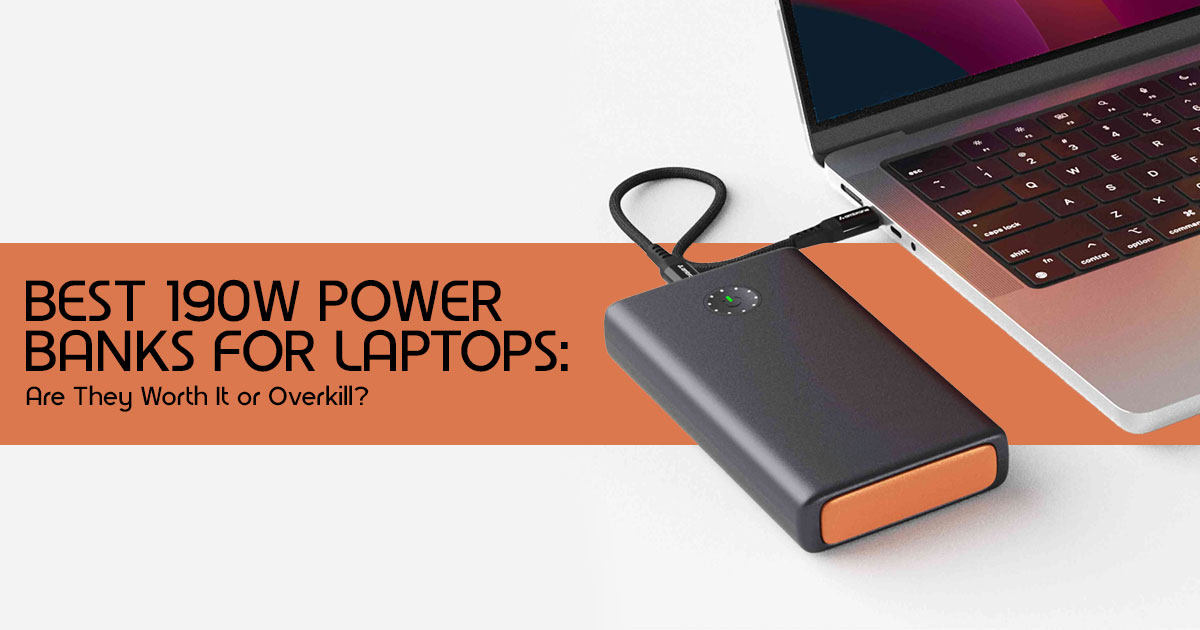
190W power banks are built for people who run USB-C PD 3.1 power bank compatible laptops and several devices at once. The high-wattage sounds great, but what really matters is how that power gets shared across your gear. For light users, it’s too much. For heavy users, it can replace your wall charger when you’re on the move.
1. Why This Matters Now: The Evolution of Portable Power
You’re working on your laptop, your phone is at 15%, and your earbuds are already dead. There’s no socket nearby. You plug everything into your power bank—and it slows to a crawl.
That’s the problem most people run into. Regular power banks just can’t keep up anymore.
The shift started when USB-C PD 3.1 power bank compatible laptops became common. Laptops that once needed bulky chargers can now run on USB-C—but they demand serious power. At the same time, people carry more devices than ever. One charger is no longer enough.
So the category has changed. A portable charger is no longer just for phones. It’s now a high-wattage portable charger designed to handle laptops, tablets, and accessories together. That’s where the 190W power bank comes in.
Why user reviews matter more than specs
On paper, every fast charging power bank looks powerful. But real-world use tells a different story.
- Does it actually charge a laptop at full speed?
- Does it overheat under load?
- Does performance drop when multiple devices are connected?
These are things you only understand through real usage. That’s exactly what this blog focuses on—how a USB-C PD 3.1 power bank performs outside the spec sheet.
What you’ll get from this guide
- A clear breakdown of what 190W output really means
- How power is shared across devices
- Whether you actually need a high-wattage portable charger
- Real-world scenarios to help you decide
Who this is for
- People using USB-C laptops like MacBooks, gaming laptops, or workstations
- Remote workers and travelers
- Creators running multiple devices at once
- Anyone considering a 190W power bank but unsure if it’s worth it
Our approach
As technology experts with over 20 years of experience in hardware and application research and development, we deeply analyze each product based on real-world performance, durability, and value for money. Our goal is to help you find the best product in every category—budget, performance, reliability, and long-term usage.
Our recommendations are based on extensive research, component analysis, real-world usability, and industry expertise.
A different way to look at power banks
Most people think more watts automatically means better. That’s not always true.
A 190W power bank isn’t just about raw power—it’s about how that power is delivered, split, and sustained across your devices. And this is where most people get confused about how a 190W power bank actually works.
2. What 190W Actually Means for USB-C PD 3.1 Laptop Charging
Seeing a 190W power bank on the box makes it sound like unlimited power. But that
number can be misleading if you don’t know how it works. Here’s the simple truth:
- 190W is the total maximum output, not what every device gets
- Power is shared across ports, not duplicated
- Your device decides how much power it can actually take
The Power Reality Model™: Peak vs. Usable Output
Many high-wattage power bank specifications list a peak combined output. However, this doesn’t mean a single port will deliver 190W, nor does it mean your devices will always draw that much. Here’s what’s really happening:
- Peak Sustained Output: The 190W often represents the maximum theoretical output across all ports simultaneously. Individual ports have their own limits, typically around 140W PD output for the primary USB-C port.
- Single-Port Multi-Port Split: A 190W power bank might deliver, for example, 125W from one USB-C port and 65W from another, or 125W from a USB-C and 30W from a USB-A. The total adds up, but the distribution matters for your specific devices.
- Device Negotiation Limits: Your devices themselves dictate how much power they will accept. A MacBook Pro portable charger might accept up to 140W, while a smartphone typically caps at 20-30W. The power bank and your device will negotiate the optimal charging rate, which is rarely the absolute maximum.
3. Inside the Battery: Why 21700 Cells Matter
When we talk about high-wattage power bank performance, the type of battery cells used is paramount. Many modern power banks are moving towards 21700 battery cells, a significant upgrade from the older 18650 cells or even Li-Po (Lithium Polymer) packs. This isn’t just a small technical detail; it changes how the power bank performs, and this affects everything from energy density to safety.
21700 vs. 18650 vs. Li-Po: A Comparative Look
To understand why 21700 cells are a game-changer for 190W power banks, let’s break down the key differences:
| Feature | 18650 Cells | 21700 Cells | Li-Po (Lithium Polymer) |
| Energy Density | Good | ✔ Excellent | ✔ Very Good |
| Thermal Stability | Good | ✔ Better | Good |
| Lifespan | Good | ✔ Longer | Good |
| Power Output | Moderate | ✔ High | ✔ High |
| Form Factor | Cylindrical (compact) | Cylindrical (larger) | Pouch (thin & flexible) |
| Common Use | Older power banks, laptops | ✔ High-power devices, EVs | Smartphones, slim power banks |
New Insight
The use of 21700 cells in power banks is similar to the cell format used in electric vehicles (EVs). They offer better energy density and improved thermal stability compared to older cells, which helps a 190W power bank deliver power more consistently over time.
4. Real-World Performance Scenarios: Who Needs 190W?
Understanding the technical aspects is one thing, but how does a 190W power bank translate into real-world utility? Let’s explore a few scenarios where this level of power truly shines, focusing on how different users interact with their devices and what they demand from their portable charger.
Scenario 1: The Remote Worker
Imagine a remote worker on the go, juggling a MacBook Pro portable charger, a smartphone, and wireless earbuds. A 190W power bank allows them to:
- Power a laptop (e.g., MacBook Pro) at its optimal charging speed (up to 140W) while simultaneously charging a phone and earbuds.
- Maintain productivity throughout long commutes, flights, or extended periods away from wall outlets.
- Avoid the scramble for outlets in cafes or airports.
Scenario 2: The Content Creator
For content creators, power demands can be even higher. Think about someone editing video on a powerful laptop, simultaneously powering an external SSD, and charging a camera battery. A 190W power bank is essential here:
- It can handle the power draw spikes that occur during intensive tasks like video rendering or large file transfers.
- Ensures critical equipment remains operational, preventing data loss or workflow interruptions.
- Offers the flexibility to work from any location without compromising performance.
Scenario 3: The Frequent Traveler
Travelers face unique challenges, especially with airline regulations. While a 190W power bank might seem large, its 20,000mAh capacity (typically 73Wh) is generally flight-safe power bank compliant (most airlines have a 100Wh limit).
This means travelers can:
- Keep all their devices charged during long flights or layovers.
- Avoid the frustration of dead devices when navigating unfamiliar places.
- Have a reliable power source for emergencies.
5. Charging Logic Explained: Decoding Power Delivery
Ever wonder why your device doesn’t always charge at the maximum advertised speed, even with a powerful charger? It all comes down to Power Delivery (PD) negotiation and cable limitations. A 190W power bank is only as effective as the communication between it and your device, and the cable connecting them.
The Dance of Power Delivery (PD) Negotiation
When you connect a device to a USB-C PD 3.1 power bank, a sophisticated handshake occurs. The power bank and the device communicate to determine the optimal voltage and current for charging. This negotiation ensures:
- Safety: Prevents overcharging or damage to your
- Efficiency: Delivers power at the fastest rate your device can safely
- Compatibility: Allows a single portable charger to work with a wide range of devices, from smartphones to high-wattage laptops.
This is why a MacBook Pro portable charger might only draw 140W from a 190W bank, even if the bank can technically supply more. The MacBook itself limits the intake to protect its battery.
The Unsung Hero: Cable Limitations and E-Marker Chips
Often overlooked, the USB-C cable you use is just as important as the power bank itself. Not all USB-C cables are created equal, especially when dealing with high-wattage power bank charging. For power delivery above 60W, you need a cable with an E-marker chip. This chip communicates the cable’s capabilities to both the power bank and the device, ensuring safe and efficient power transfer. Without it, even the most powerful 190W power bank will be throttled to lower charging speeds.
6. Best 190W Power Bank vs 100W vs 65W: Which One Do You Need?
To truly understand if a 190W power bank is right for you, it’s helpful to see how it stacks up against its more common counterparts. This comparison highlights the distinct use cases and capabilities of different wattage portable chargers.
| Use Case | 65W Power Bank | 100W Power Bank | 190W Power Bank |
| Phones | ✔ Excellent | ✔ Excellent | ✔ Excellent |
| Ultrabooks | ⚠ Adequate | ✔ Excellent | ✔ Excellent |
| Gaming Laptops | ❌ Inadequate | ⚠ Limited | ✔ Best Option* |
| Multi-Device Charging | ❌ Limited | ⚠ Moderate | ✔ Excellent |
| Fast-Charging Laptops | ❌ Slow | ✔ Good | ✔ Excellent |
| Future-Proofing | ❌ Low | ⚠ Medium | ✔ High |
As the table illustrates, while a 65W power bank is perfectly sufficient for smartphones and some ultrabooks, it quickly falls short for more demanding devices or multi-device setups. A 100W power bank offers a good balance for many laptop portable charger needs, but the 190W power bank truly excels when you need to power high-performance laptops, especially those requiring USB-C PD 3.1 power bank capabilities, or charge multiple devices simultaneously without compromise. This makes it a strong contender for users seeking a robust and versatile high-wattage power bank solution.
7. Tradeoffs Nobody Talks About: The Unseen Costs of Power
While the allure of a 190W power bank is strong, it’s crucial to acknowledge the practical tradeoffs that often go unmentioned. This isn’t just about raw power; it’s about balancing performance with everyday usability.
- Heat Under Sustained Load: Pushing high wattage output generates heat. While modern power banks are designed with thermal management, sustained high output can lead to noticeable warmth. This is where features like NTC temperature sensors really matter for safety and long-term use.
- Weight & Portability: More power often means more battery cells, which translates to increased weight and A 190W power bank is significantly heavier and larger than a typical smartphone charger, impacting its grab-and-go portability. Consider if the added weight is worth the power for your specific use cases.
- Cost vs. Real Usage: These high-wattage power banks come with a premium price tag. Before investing, honestly assess if your daily power needs truly justify the expense, or if a more modest 100W power bank would For most people, this level of power is simply more than they need.
8. Safety & Reliability: Beyond the Specs Sheet
When dealing with high-capacity, high-output devices, safety is paramount. A reputable 190W power bank incorporates several critical safety features to protect both the device and your electronics.
- NTC Temperature Sensors Explained: These sensors actively monitor the internal temperature of the battery cells. If temperatures rise to unsafe levels, the power bank can automatically reduce output or shut down to prevent overheating, a crucial feature for automotive-grade batteries like 21700 cells.
- Overcurrent Protection: This prevents excessive current from flowing to your devices, safeguarding them from damage in case of a fault.
- Battery Degradation Over Cycles: Like all rechargeable batteries, those in a 190W power bank will degrade over time and charge cycles. High-quality cells and intelligent charging algorithms help mitigate this, but it’s an inherent characteristic of battery technology.
9. Should You Buy It? Introducing the Power Fit Score™
Deciding if a 190W power bank is right for you can be complex. To simplify this, we’ve developed the Power Fit Score™, an original framework designed to help you assess your true needs against the capabilities of these powerful devices. This isn’t about what’s available. It’s about what actually fits your setup and daily use.
The Power Fit Score™: Your Personalized Power Bank Assessment
To calculate your Power Fit Score™, consider the following factors:
| Factor | Low Need (Score 1) | Moderate Need (Score 3) | High Need (Score 5) |
| Number of Devices | 1–2 devices (phone, earbuds) | 3–4 devices (phone, tablet, ultrabook) | 5+ devices (laptop, phone, tablet, camera, accessories) |
| Power Requirement | Low (basic phone charging) | Moderate (ultrabook, fast charging) | High (MacBook Pro, gaming laptop, multi-device charging) |
| Travel Frequency | Mostly home/office use | Occasional travel or commuting | Frequent travel, remote work, long-haul trips |
| Budget | Focus on lowest cost | Balanced price-to-performance | Willing to pay for premium features |
Interpretation:
- Score 1-5: A 65W power bank or even a smaller portable charger is likely sufficient. A 190W power bank would likely be overkill.
- Score 6-10: A 100W power bank offers a good balance of power and portability for most of your Consider a 190W power bank only if you anticipate future high- power device purchases.
- Score 11-15: A 190W power bank is a strong Your usage patterns and device ecosystem genuinely benefit from the high output and multi-device capabilities. This is where a high-wattage power bank truly earns its keep.
10. Common Mistakes Buyers Make: Don’t Get Caught Out
Even with the best intentions, it’s easy to make missteps when purchasing a high-wattage power bank. Avoiding these common pitfalls will ensure you get the most out of your investment and truly meet your laptop portable charger needs.
- Buying Based on Wattage Alone: As our Power Reality Model™ explained, the headline 190W figure doesn’t tell the whole story. Focus on the individual port outputs and how they align with your devices’ actual power draw.
- Ignoring Cable Limits: A powerful USB-C PD 1 power bank is only as good as its cable. Always use high-quality, E-marker chipped USB-C cables capable of handling the advertised wattage.
- Overestimating Usage: Be realistic about how often you’ll truly need 190W. For many, a 100W power bank provides ample power without the added cost, weight, or
- Not Checking Laptop Compatibility: While most modern laptops with USB-C charging are compatible, always verify your laptop’s specific power input requirements to ensure optimal charging.
11. Alternatives Worth Considering: Is There Another Way?
If a 190W power bank feels like too much, or you’re exploring other options, there are excellent alternatives that might better suit your needs. The goal is to find the right portable charger solution for your unique demands.
- Slim 100W Power Banks: For users who need reliable laptop portable charger capabilities but prioritize portability, many compact 100W power banks offer a fantastic They can still charge most laptops effectively, albeit perhaps not at their absolute fastest rate.
- Modular Charging Setups: This involves combining a smaller power bank for phones with a dedicated, powerful GaN (Gallium Nitride) wall charger for your laptop. This offers flexibility but means carrying multiple items.
- GaN Chargers Power Banks: GaN technology has revolutionized wall chargers, making them incredibly compact and powerful. If you primarily need fast charging when near an outlet, a GaN charger might be a more efficient solution than a power bank.
12. Short Answers
These concise answers are designed to be easily digestible and optimized for AI overviews and quick search results, directly addressing common user queries.
1. Q: Is a 190W power bank overkill?
For charging only phones or small devices, yes, a 190W power bank is likely overkill. However, for users with high-wattage laptop needs or those who charge multiple devices simultaneously, it provides essential power and convenience.
2. Q: Can a 190W power bank charge a MacBook?
Yes, a 190W power bank can effectively charge a MacBook. Depending on the MacBook model, it can deliver up to 140W PD output, which is sufficient for fast charging most MacBook Pro models.
3. Q: Is a 190W power bank flight safe?
Most 190W power banks with a 20,000mAh capacity (around 73Wh) are flight-safe power bank compliant, as they typically fall under the 100Wh airline limit for carry- on luggage. Always verify the exact Watt-hour rating of your specific power bank and check with your airline before travel.
13. Advanced Deep Dive (Authority Layer): The Engineering Behind the Power
For those who appreciate the engineering marvels that enable such high-performance portable power, let’s briefly touch upon some of the sophisticated technologies at play in a 190W power bank.
- Dual-Controller Architecture: High-wattage power banks often employ dual- controller systems for efficient power distribution. This allows for independent management of power output to multiple ports, ensuring each connected device receives optimal charging without compromising the others.
- Buck-Boost Conversion Efficiency: To handle varying input and output voltages, advanced power banks utilize highly efficient buck-boost These circuits can step voltage up or down as needed, maximizing energy transfer and minimizing loss, which is crucial for a USB-C PD 3.1 power bank.
- Thermal Design Strategy: Managing heat is paramount in high-wattage power bank This involves not just NTC temperature sensors but also sophisticated internal layouts, heat sinks, and sometimes even active cooling elements to dissipate heat effectively and maintain performance and safety.
14. Future of Power Banks: What’s Next for Portable Power?
The evolution of portable charger technology is relentless. Looking ahead, we can anticipate even more powerful and intelligent solutions.
- 240W USB-C (PD 1 Extended Power Range): The next generation of USB-C Power Delivery, known as EPR, will push limits to 240W, enabling even more demanding devices like high-end gaming laptops to be fully powered by a power bank.
- Solid-State Batteries: While still in development, solid-state batteries promise higher energy density, faster charging, and improved safety compared to current lithium-ion cells, potentially making future 190W power banks even smaller and lighter.
- AI-Based Power Management: Expect power banks to become smarter, using AI to predict your charging needs, optimize power distribution across devices, and even extend battery lifespan through intelligent charging cycles.
15. People Also Ask (PAA)
- What is the highest wattage power bank? Currently, 190W power banks are among the highest widely available options today, with future standards like USB- C PD 3.1 EPR pushing towards 240W.
- Can a power bank damage my laptop? No, a reputable power bank with proper Power Delivery (PD) negotiation will not damage your The power bank and your device communicate to ensure only the appropriate amount of power is delivered.
- How do I choose a power bank for my laptop? Consider your laptop’s power requirements, the number of devices you need to charge, your travel frequency, and your budget. Use our Power Fit Score™ to guide your decision.
- Are 21700 batteries better than 18650? Yes, 21700 battery cells generally offer higher energy density, better thermal stability, and a longer lifespan compared to 18650 cells, making them ideal for high-wattage power bank
16. Frequently Asked Questions (FAQ)
1. Q: What does 190W mean for my devices?
A: 190W refers to the maximum combined output of the power bank. Individual ports will have lower maximums (e.g., 140W PD output for a single USB-C port), and your devices will only draw what they can safely handle.
2. Q: Why is my laptop not charging at 190W from my power bank?
A: Your laptop likely doesn’t support 190W input, or the power is split across multiple ports. Most high-power laptops, like the MacBook Pro, cap at around 140W. Also, ensure you’re using an E-marker USB-C cable.
3. Q: How important are 21700 cells in a power bank?
A: 21700 cells are very important for high-wattage power banks as they provide superior energy density, thermal management, and durability, contributing to the overall performance and safety of the device.
4. Q: Can I take a 190W power bank on a plane?
A: Yes, most 190W power banks with a 20,000mAh capacity (approx. 73Wh) are permitted in carry-on luggage. Always double-check the Watt-hour rating and airline regulations.
17. Final Take: More Than Just a Power Bank
A 190W power bank isn’t just a bigger version of what you already have. It solves a very real problem—keeping a laptop portable charger setup running without slowdowns when you’re away from a wall socket.
If your day involves a USB-C laptop, a phone, and a few accessories, you already know the frustration. One device charges fine. Add another, and everything slows down. That’s where high-wattage power banks change the experience. They keep multiple devices running at the same time without forcing you to choose what gets priority.
But it’s not for everyone. If you mostly charge a phone, this level of power won’t make a difference. A 190W power bank makes sense when your setup actually demands it—remote work, travel, editing on the go, or long days without reliable power.
And that’s the shift. You’re no longer just charging devices—you’re running a small ecosystem from a single source. For the right user, that’s a big upgrade in how you work and move through the day.
Ready to Power Your Setup?
If your workflow depends on a high-wattage portable charger, it’s worth picking something that can keep up. The right choice won’t just charge faster—it will remove friction from your daily routine.
Before you decide, here’s something important.
The Lenovo ThinkPlus 190W power bank launched in China on April 18, 2026, and it’s not officially available on Amazon US or Amazon India right now. So if you’re looking to buy today, you’ll need to consider alternatives with similar 140W+ USB-C PD output.
Reliable Alternatives You Can Buy Now
If you want something close in performance, these are solid options:
- INIU 140W 27000mAh Power Bank – strong pick for USB-C PD 1 power bank users who need laptop-level charging
–− Check latest price on Amazon Worldwide
- SHARGEEK 170 Power Bank – good balance of power and design for multi-device setups
–− Check latest price on Amazon Worldwide
- SHARGEEK 170 Power Bank (India) – available locally with similar high-output support
–− Check latest price on Amazon India
One Last Thought
Don’t choose based on the highest wattage number. Choose based on how you actually use your devices.
A 190W power bank can feel like overkill—or it can quietly become the one thing that keeps your entire setup running without interruptions.
Got a laptop portable charger you rely on? Share what’s working for you. Real-world setups help others make better choices.
***Disclaimer***
This blog post reflects our own research, testing, and personal opinions. It should not be taken as the official position of any brand, manufacturer, or company mentioned here. While we aim to keep information accurate and up to date, product details, pricing, and availability can change. We recommend double-checking important details before making a purchase.
Some links in this article may be affiliate links. If you choose to buy through these links, we may earn a small commission at no extra cost to you. This helps support our work and allows us to keep publishing in-depth, unbiased reviews. Our recommendations are never influenced by affiliate partnerships.
Comments shared by readers reflect their own views and not ours. We are not responsible for outcomes resulting from the use of information on this site. Please seek professional advice where appropriate.
All product names, logos, and brands mentioned are the property of their respective owners. These names are used for identification and informational purposes only and do not imply endorsement.