
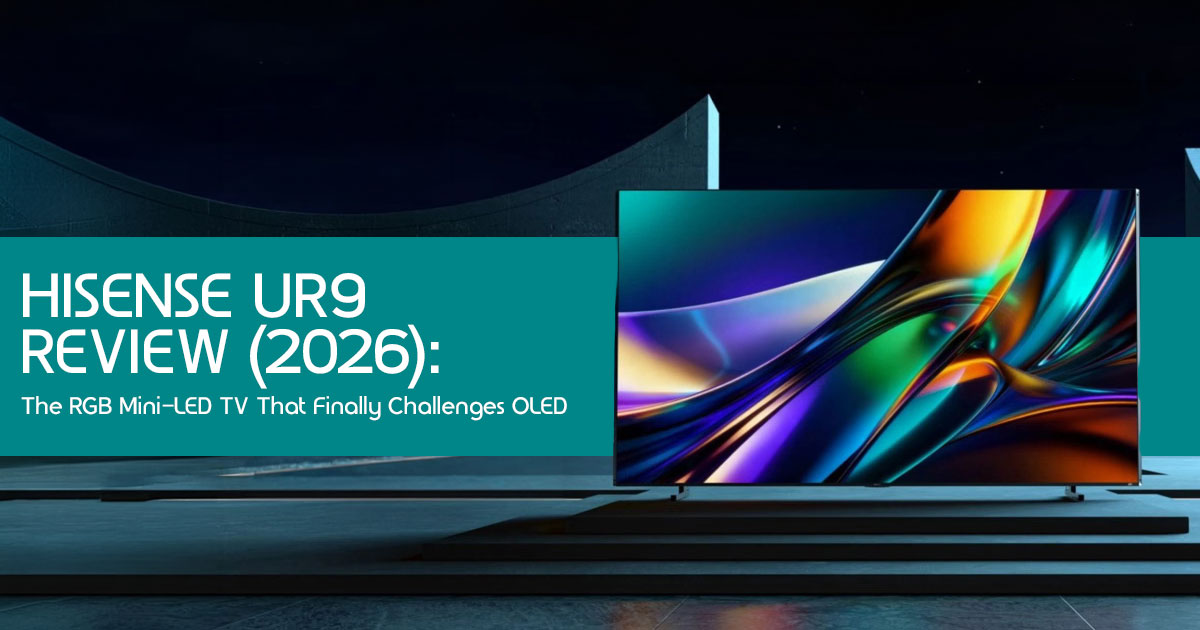
Buying a premium TV these days is tricky. Do you choose an OLED for those perfect blacks and movie- like contrast, or a bright Mini-LED that works great in sunny rooms but can struggle with light bleeding and color?
Hisense wants to give you the best of both worlds with the UR9. It’s their top RGB Mini-LED model built to go head-to-head with OLEDs from Samsung, LG, and Sony. The big difference? Instead of regular white LEDs with color filters, this one uses separate red, green, and blue LEDs. The goal is brighter pictures, richer colors, and strong HDR without the usual OLED drawbacks like burn-in risk.
But marketing alone does not make a great TV. Real-world performance matters more than spec sheets, especially in the premium category where expectations are high and prices are even higher.
Click here to buy from Amazon
In this Hisense UR9 review, we take a grounded look at what this RGB Mini-LED TV actually does well, where it still falls behind OLED TVs, whether RGB Mini-LED technology is truly the next step forward, and most importantly — whether this TV is genuinely worth your money in 2026. Sorting through flagship TV options has become more confusing than ever.
Our Research & Testing Approach
As technology experts with over 20 years of experience in hardware and application research and development, we deeply analyze each product based on real-world performance, durability, and value for money.
Our goal is to help readers find the best product in every category — whether that means budget value, flagship performance, long-term reliability, or the best balance between all three.
For premium TVs like the Hisense UR9, that means looking beyond launch hype and focusing on:
- component-level technology,
- display behavior in real environments,
- gaming responsiveness,
- software experience,
- long-term usability,
- thermal efficiency,
- and what living with the TV is actually like long term
Our recommendations are based on extensive research, component analysis, real-world usability, and years of industry expertise — not marketing promises.
Who Should Read This Review?
This review is especially useful for:
- Buyers comparing Mini-LED vs OLED TVs
- Gamers looking for the best TV for PS5, Xbox, or PC gaming
- Users upgrading from older LED or QLED TVs
- Sports fans who need excellent brightness and motion handling
- Families with bright living rooms where OLED brightness can feel limiting
- Buyers concerned about OLED burn-in risks
- Anyone searching for a premium TV with strong HDR performance without paying ultra- premium OLED prices
The UR9 does not completely replace OLED. What it does is make the gap between Mini-LED and OLED TVs much smaller than before — and that alone makes it one of the most important TV launches of the year.
Quick Verdict: The Short Version
Don’t have time to read everything? Here’s the straight answer:
| AT A GLANCE | DESCRIPTION |
| Best For | Bright living rooms, sports, gaming, HDR shows |
| Refresh Rate | Up to 180Hz – one of the fastest in its class |
| Color Gamut | ~93% BT.2020 – excellent HDR color volume |
| vs. OLED | Much brighter; OLED still better for deep blacks |
| Burn-in Risk | No known permanent burn-in concerns with traditional LED-based panels |
| Skip It If | You mainly watch movies in a completely dark room |
1. What Makes the Hisense UR9 Different From Regular Mini-LED TVs?
What Makes the Hisense UR9 Different?
Regular Mini-LED TVs use white backlights that go through color filters. It works well, but some brightness and color accuracy get lost along the way.
The UR9 does it differently. It uses individual red, green, and blue LEDs straight away. No heavy filtering means you get brighter, more vibrant colors and better efficiency. That’s why HDR content really stands out on this TV.
One thing that becomes clear during this RGB Mini-LED review is how much cleaner and brighter HDR colors can look compared to traditional Mini-LED TVs.
2. Hisense UR9 Specifications at a Glance
Before evaluating real-world performance, here is a full look at the technical specifications that define the Hisense UR9 Google TV:
| Feature | Specification |
| Sizes Available | 65-inch, 75-inch, 85-inch, 100-inch |
| Display Technology | RGB Mini-LED |
| Resolution | 4K UHD (3840 x 2160) |
| Refresh Rate | Up to 180Hz |
| HDMI Ports | Supports up to 4K 120Hz officially, with higher refresh-rate modes available under specific resolutions and configurations. |
| HDR Formats | Dolby Vision, HDR10+, HDR10, HLG |
| Gaming Features | VRR, ALLM, FreeSync Premium Pro |
| Operating System | Google TV |
| Color Gamut | Hisense claims up to ~93% BT.2020 color coverage |
3. Design & Build Quality: Does the UR9 Feel Premium?
For a TV at this price, build quality expectations are high — and the UR9 largely delivers. The chassis presents a modern, minimal aesthetic that integrates well into most living room setups. Bezels are impressively thin, drawing focus directly to the screen. The stand on larger 75-inch and 85-inch models is reassuringly sturdy.
One honest caveat: the UR9 will not sit as flush against a wall as an LG OLED G-series, and the rear plastics do not quite match Sony’s premium tactile feel. Wall mounting is straightforward, though cable management is slightly less refined compared to Samsung’s top competitors. These are minor points, not dealbreakers.
Real Living Room Impressions
In real-world use, the UR9 handles reflections remarkably well. The anti-glare coating — combined with the panel’s extreme peak brightness — keeps the picture clear and vibrant even with large windows or bright overhead lights directly in the room. It makes a strong visual statement as a living room centerpiece.
4. Picture Quality Breakdown
Picture Quality – Does It Deliver?
This is where the UR9 really starts to impress. The UR9 brings real improvements over normal LED TVs in several areas.
Brightness Performance
It gets extremely bright. If you are searching for the best TV for bright rooms, the UR9 immediately stands out. Sunlight coming through windows or bright living rooms is far less of a problem here than on many OLED TVs.
Black Levels & Contrast
The local dimming works well. You might notice a little blooming around bright objects on dark backgrounds if you sit really close and look for it, but it’s not distracting in normal use. Still, in a pitch- black room, OLED TVs still have the edge with perfect blacks.
Color Accuracy & Color Volume
The color volume is where RGB Mini-LED technology makes its case most persuasively. At claimed
~93% BT.2020 coverage, HDR movies and vibrant HDR scenes look spectacular. Animation, sports, and nature documentaries benefit enormously from the pure, saturated colors this panel produces. Out of the box, colors may lean slightly exaggerated — but switching to Filmmaker Mode immediately brings them to a natural, accurate baseline.
Motion Handling
For sports and fast-paced action, motion handling is solid. Blur reduction is effective, and 24p movie judder is managed cleanly. One important note: leaving motion smoothing settings at default can produce an unnatural “soap opera effect.” Turning them down results in a clean, natural-looking image — this is a setting adjustment most buyers will want to make during initial setup.
Upscaling & Lower-Quality Content
Many buyers still regularly watch YouTube, cable, and compressed streams. The UR9 does a commendable job upscaling lower-resolution content, cleaning up compression artifacts and noise reasonably well. Sony retains a slight edge in pure processing for sub-1080p sources, but the UR9 holds its own for daily viewing.
5. Gaming Performance: Built for Next-Gen Consoles and PC
If you are searching for the best gaming TV of 2026, the Hisense UR9 deserves serious attention. The gaming features here cover almost everything most players could ask for.
Gaming Features That Actually Matter
- HDMI 1 — full bandwidth for 4K @ 120Hz and 180Hz connections
- VRR (Variable Refresh Rate) — eliminates screen tearing dynamically
- ALLM (Auto Low Latency Mode) — automatically switches to Game Mode when a console is detected
- FreeSync Premium Pro — AMD sync technology for smoother PC gaming
- Incredibly low input lag — responsive feel for competitive shooters and racing games
For buyers looking for a premium 4K gaming TV for PS5 and Xbox Series X, the experience here feels smooth, responsive, and genuinely premium. The high brightness and strong contrast also help the UR9 stand out as one of the best HDR TVs for gaming right now. Dark areas look dark, explosions feel intensely bright and impactful, and the overall contrast makes high-stakes gameplay feel more immersive.
Is 180Hz Actually Useful?
The 180Hz refresh rate sounds impressive in marketing material, but there is important nuance here. Current-generation consoles (PS5, Xbox Series X) cap out at 120fps. To push 4K at 180 frames per second, you would need an exceptionally high-end PC with a top-tier GPU. For the vast majority of buyers, 180Hz is a useful future-proofing feature rather than an immediately tangible benefit — which is worth understanding before it becomes a primary purchase driver.
6. Google TV Experience: Smart Platform Done Right
As a Google TV experience, the UR9 gets most things right. The Google TV platform feels fast and easy to use day to day, App support is virtually limitless, and voice control via Google Assistant works reliably for content search and smart home commands. Streaming reliability across Netflix, Disney+, Prime Video, and YouTube is rock solid.
Two limitations worth acknowledging honestly: the home screen includes ads and content recommendations that some users find intrusive, and long-term software support timelines remain a standard concern for all smart TV platforms. Neither is a dealbreaker, but both are worth knowing upfront.
Day-to-day usability matters more than spec sheets, and thankfully the UR9 mostly feels easy to live with.
7. Audio Performance: Can You Skip a Soundbar?
The built-in audio system performs better than expected for a flat-panel display. Dialogue clarity is excellent, bass response is decent, and Atmos virtualization adds a satisfying sense of width to the soundstage for movie and gaming content.
That said, let’s be direct: anyone investing at this price level should pair the UR9 with a dedicated soundbar or surround sound system. The built-in speakers work well for casual news and TV viewing, but they don’t do justice to the visual spectacle the panel itself delivers. The audio does not hold back the experience, but it is the one area where the package clearly invites an upgrade.
8. Hisense UR9 vs. OLED TVs: The Most Important Buying Decision
For most buyers comparing Mini-LED vs OLED, the real question is simple: which TV actually fits the way you watch every day?
Here is the honest, practical breakdown:
- OLED contrast: OLED wins Pixel-level perfect blacks and infinite contrast are not matchable by any LCD-based technology today.
- Burn-in risk: The UR9 does not carry the same long-term burn-in concerns commonly associated with OLED Modern OLED TVs carry a low but still possible long-term burn- in risk, especially for static HUDs in games or news channel tickers.
- Brightness: The UR9 is significantly brighter than OLED — this is a decisive advantage for bright-room viewing and HDR impact.
- Sports viewing: The UR9’s brightness and color pop give it a clear edge for daytime sports watching.
The practical decision framework: If your primary use case is watching movies in a fully darkened room, an OLED is the better tool. If you watch in a bright environment or game heavily, the UR9 is the more practical and better-performing choice.
Click here to buy from Amazon
9. Hisense UR9 vs. TCL, Samsung, LG & Sony Alternatives
How does the UR9 stack up across the competitive landscape? The table below summarizes the key differentiators across the main alternatives buyers typically consider:
| Metric | Hisense UR9 | TCL QM8 | Samsung Neo QLED | LG OLED C-Series |
| Technology | RGB Mini-LED | Mini-LED | Mini-LED | OLED |
| Best Brightness | ✓ Exceptional | Strong | Very Good | Moderate |
| Color Volume | ~93% BT.2020 | High | High | Lower |
| Black Levels | Very Good | Good | Good | ✓ Perfect |
| Gaming (HDMI 2.1) | ✓ 180Hz + VRR | 120Hz + VRR | 144Hz + VRR | 120Hz + VRR |
| Burn-in Risk | None (LED) | None (LED) | None (LED) | Low but possible |
| Bright Room | ✓ Best choice | Great | Great | Adequate |
| Dark Room | Very Good | Good | Good | ✓ Best choice |
| Value | Strong | Excellent | Moderate | Premium pricing |
Hisense UR9 vs. TCL QM8: The TCL QM8 is a formidable value rival with strong brightness. The UR9’s RGB Mini-LED technology gives it a measurable edge in pure color volume and saturation.
Hisense UR9 vs. Samsung Mini-LED: Samsung’s processing is excellent, but their flagship models often carry a “brand tax.” The UR9 offers comparable or slightly superior color performance at a more competitive price.
Hisense UR9 vs. LG OLED C-Series: LG OLED wins in dark rooms. In bright rooms and for HDR impact, the UR9 wins decisively.
Hisense UR9 vs. Sony Mini-LED: Sony leads in image processing and upscaling for low-quality sources. For pure 4K HDR performance and a complete gaming feature set, the UR9 is highly competitive.
10. Honest Pros & Cons: No Spin
Every product has trade-offs. Here is a balanced view of what the UR9 gets right — and where it genuinely falls short:
| ✓ Pros | ✗ Cons |
| Extremely high brightness — excellent for bright rooms | OLED still wins for pitch-black contrast |
| RGB Mini-LED hits ~93% BT.2020 color coverage | First-generation tech — unforeseen quirks possible |
| 180Hz + HDMI 2.1 for next-gen gaming | Aggressive out-of-box motion processing (needs tuning) |
| VRR, ALLM, FreeSync Premium Pro — full gaming suite | Long-term reliability less proven vs Sony/LG |
| No known burn-in concerns with traditional LED panels — safer for news channels and static gaming HUDs | At $3,500 for 65-inch, pricing is no longer budget |
| Google TV: snappy, vast app ecosystem | Possible panel variance (dirty screen effect) |
| Handles daytime reflections brilliantly | Higher real-world power consumption |
| Solid built-in audio for casual viewing | Ads/recommendations on Google TV home screen |
11. Who Should Actually Buy the Hisense UR9?
Matching a TV to the right buyer matters more than any single spec. Here is a clear, honest guide to whether the UR9 fits your specific situation:
| Buy It If You Are… | Skip It If You Are… |
| ✓ Bright living room owners | ✗ Dark-room cinephiles (choose OLED) |
| ✓ Sports fans & casual viewers | ✗ Buyers on a tight budget |
| ✓ Gamers (PS5, Xbox, PC) | ✗ Those requiring proven long-term reliability |
| ✓ HDR streaming enthusiasts | ✗ Viewers who watch mostly low-quality cable |
| ✓ Large-room installs (9+ ft viewing) | ✗ Minimalist-decor setups (chassis depth) |
12. Best Hisense UR9 Size to Buy: Viewing Distance Guide
Choosing the wrong screen size is one of the most common TV buying mistakes. Here is the practical size- to-distance guide based on the available UR9 configurations:
| SIZE GUIDE | |
| 65-inch | Sweet spot for most living rooms. Ideal for viewing distances of 7–9 feet. |
| 75-inch | Better immersion for 9–12 foot viewing distances. Recommended for larger rooms. |
| 85-inch | Dedicated media rooms with 12+ feet of viewing distance. Overwhelming in small spaces. |
| 100-inch | Purpose-built home theater TV setups. Requires significant room depth and ambient light control. |
13. Energy Efficiency & Eye Comfort
An often-overlooked factor: a display this bright consumes real power. Real-world power consumption on the UR9 is higher than standard LED TVs — that is the trade-off for extreme luminance. The efficiency of the RGB LED architecture does mitigate this somewhat compared to what equivalent brightness would demand from older panel designs.
For late-night viewing, the UR9 includes blue light reduction settings that are worth using. Sustainability- conscious buyers should factor the higher power draw into their long-term cost assessment.
Click here to buy from Amazon
14. What Still Requires Long-Term Independent Testing
In the interest of full transparency, there are areas the community and reviewers still need time to verify:
- Panel consistency: risk of “dirty screen effect” varies across units
- Sustained brightness: real output after hundreds of hours of use
- HDR tone mapping accuracy: behavior over multiple firmware cycles
- Input lag at all VRR ranges: real measurements across varied refresh conditions
- Dolby Vision update quality: how Hisense maintains long-term format support
- Software stability: behavior across multiple major Google TV updates
15. Should You Buy the Hisense UR9 Now or Wait?
The timing of a premium TV purchase can have a real impact on cost. Here is the honest assessment:
| BUY vs. WAIT | |
| Buy Now If | You need a TV today and your room is bright. The UR9 is a genuinely excellent choice right now. |
| Consider Waiting | Black Friday and holiday sales could bring meaningful price reductions — potentially hundreds of dollars. |
| Future Tech | Second-generation RGB Mini-LED panels may refine the formula. First-gen always carries adoption risk. |
| Our Verdict | If you need it now, buy with confidence. If you can wait 3–4 months, patience may be rewarded. |
16. Final Verdict: Is the Hisense UR9 Worth Buying in 2026?
The Hisense UR9 is not the “best TV ever made” — and no TV is perfect, and buyers should always be careful with overhyped claims. What it is, though, is a genuinely disruptive television that makes a compelling argument for RGB Mini-LED as a legitimate OLED alternative for the right buyer.
It excels in areas where OLED TVs still struggle: extreme brightness, outstanding daytime visibility, rich HDR color performance, fewer long-term burn-in concerns than OLED, and a premium gaming feature set that checks nearly every modern box. For bright living rooms, sports streaming, and high-refresh-rate gaming, the UR9 often feels more practical than many premium OLED models.
That said, OLED still retains a real advantage in completely dark rooms where perfect blacks, pixel- level contrast, and cinematic shadow detail matter most. Movie enthusiasts who primarily watch films in low-light environments may still prefer OLED’s more refined contrast performance.
But Hisense is clearly targeting a different kind of buyer — someone who wants flagship HDR performance, vibrant color volume, excellent gaming support, and fewer long-term panel concerns without paying ultra-premium OLED pricing.
The bigger story is what the UR9 represents for the TV market moving forward. RGB Mini-LED technology no longer feels like a niche experiment or a marketing gimmick. The UR9 makes a serious argument for being one of the best Mini-LED TVs of 2026, especially for buyers who care more about brightness, gaming, and daytime viewing than perfect dark-room blacks.
Hisense deserves credit for trying something different instead of repeating the same TV formula again. The Hisense UR9 challenges larger competitors on brightness, gaming performance, HDR impact, and overall value in a way that feels genuinely legitimate — not aspirational.
Availability & Where to Buy
Currently, the primary retail partner for the Hisense UR9 in the United States is Best Buy, where the TV launched with exclusive pre-order bonuses and early availability incentives.
The UR9 series has also started appearing on Amazon in the US, although listings, regional inventory, and pricing are still stabilizing as the rollout expands.
India Launch Expectations
At the time of writing, the Hisense UR9 series has not officially launched in India. Hisense typically introduces its flagship TVs to the Indian market several months after their US and European releases.
That means Indian buyers may still need to wait for:
- Official Indian pricing
- Regional warranty support
- Streaming app certifications
- Local retailer availability
- India-specific software optimization
Until then, premium Mini-LED TV alternatives from brands like TCL, Samsung, and Sony may remain more practical options depending on budget, availability, and gaming needs.
In the end, the Hisense UR9 may not replace OLED for everyone — but it absolutely changes the conversation around what premium Mini-LED TVs are capable of in 2026.
Bottom Line: The Hisense UR9 is a genuinely impressive RGB Mini-LED television that earns its price for bright-room viewers, sports fans, and gamers. If that sounds like the kind of TV you have been waiting for, the UR9 is absolutely worth a closer look. If you are a dark-room cinephile, save your budget for OLED.
***Disclaimer***
This blog post reflects our research, analysis, and opinions based on available product information, user feedback, and industry knowledge. It should not be taken as the official position of any brand, manufacturer, or company mentioned here. While we aim to keep information accurate and up to date, product details, pricing, and availability can change. We recommend double-checking important details before making a purchase.
Some links in this article may be affiliate links. If you choose to buy through these links, we may earn a small commission at no extra cost to you. This helps support our work and allows us to keep publishing in-depth, unbiased reviews. Our recommendations are never influenced by affiliate partnerships.
Comments shared by readers reflect their own views and not ours. We are not responsible for outcomes resulting from the use of information on this site. Please seek professional advice where appropriate.
All product names, logos, and brands mentioned are the property of their respective owners. These names are used for identification and informational purposes only and do not imply endorsement.