
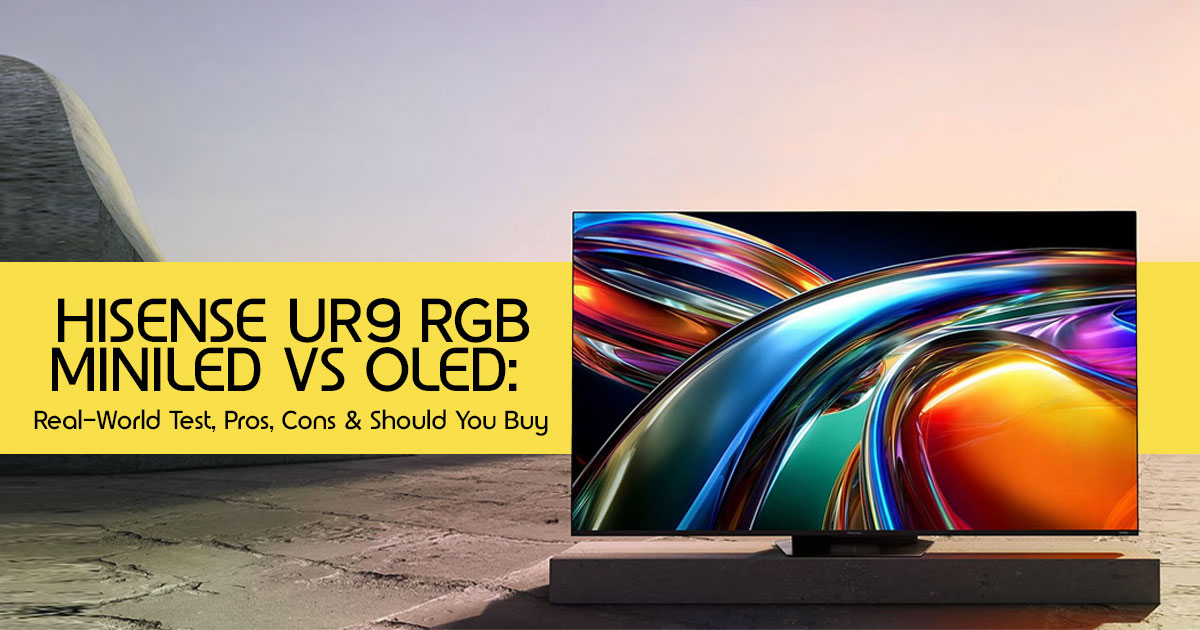
Quick Take
The Hisense UR9 RGB MiniLED TV brings a clear upgrade over standard MiniLED TVs by improving both color accuracy and brightness control. With up to 5000 nits peak brightness and a 180Hz refresh rate, it’s built for bright rooms, sports, and competitive gaming.
It still doesn’t match OLED TVs when it comes to true black levels, but for most people— especially in real living rooms—it delivers a more practical, punchy viewing experience.
Introduction
Most people don’t watch TV in a pitch-dark room.
There’s daylight, reflections, and lights turned on. And that’s exactly where many TVs
struggle—washed-out colors, dull highlights, and poor visibility.
That’s where RGB MiniLED TV technology comes in.
The Hisense UR9 RGB MiniLED TV is part of a new wave of MiniLED TVs that focus less on just panel type and more on how light is controlled behind the screen. Instead of relying on traditional white backlighting, it uses RGB-based MiniLED, which allows for better color precision and higher brightness without losing detail.
And that shift impacts real-world viewing more than most spec upgrades ever will.
Who This Is For
This guide is written for:
- Gamers who want high refresh rate and low input lag
- Sports fans who need smooth motion and bright visuals
- Home users dealing with bright rooms and reflections
- Buyers comparing MiniLED vs OLED TVs
Our Testing Approach
As technology experts with over 20 years of experience in hardware and application research and development, we deeply analyze each product based on real-world performance, durability, and value for money. Our goal is to help you find the best product in every category—budget, performance, reliability, and long-term usage.
Our recommendations are based on extensive research, component analysis, real-world usability, and industry expertise.
Why This Review is Essential
Choosing a new television in today’s market can be overwhelming. With so many terms and specs, it’s easy to get lost in the details. This review cuts through the jargon, moving beyond just specs to help you make an informed decision.
We understand that you’re not just buying a screen; you’re investing in an experience that impacts your daily life, from movie nights to gaming sessions. Our goal is to provide a human-centric perspective, addressing real-life usage scenarios and common buyer concerns.
What You Will Learn From This Review
By the end of this comprehensive guide, you will have a clear understanding of:
- The fundamental advantages of RGB MiniLED technology and how it differs from conventional displays.
- The core features of the Hisense UR9 RGB MiniLED TV that directly impact your viewing and gaming experience.
- How the Hisense UR9 performs in various real-world scenarios, including gaming, movie watching, and sports.
- A detailed comparison of RGB MiniLED vs OLED vs QD-OLED to help you weigh your options.
- Insights into the Hisense UR9 price, value proposition, and potential tradeoffs.
- Who should consider buying the Hisense UR9 and who might be better served by other technologies.
- A glimpse into the future of RGB MiniLED and what’s next in display innovation.
This review is designed to be informative, educational, and transactional, helping both beginners and skeptical buyers navigate the complexities of high-end television purchases. We aim to fill the gaps left by other blogs, providing unique insights and a balanced perspective to ensure you make the best choice for your home.
1. Why This TV Actually Matters in 2026
The Shift: Beyond Panel Wars
For years, the television market has been dominated by debates over panel technologies— LCD, LED, OLED. However, 2026 marks a pivotal shift, with innovation increasingly focusing on backlight technology. This is where the Hisense UR9 RGB MiniLED TV steps in, representing a significant leap forward.
Hisense is actively leading the adoption of RGB MiniLED, moving beyond traditional white backlights to a system that generates color directly at the source. This fundamental change promises a more vibrant and accurate picture, setting a new benchmark for display quality.
Market Context: Bridging the Gap
While OLED technology has long been lauded for its perfect blacks and infinite contrast, it has faced limitations in peak brightness. Traditional MiniLEDs offered higher brightness but often struggled with color purity and blooming.
RGB MiniLED sits right between traditional LED and OLED—it gives you higher brightness without losing too much contrast.
This strategic move by Hisense aims to get ahead of the competition with the UR9 MiniLED TV, offering consumers a powerful new option that addresses the shortcomings of existing technologies.
2. The RGB MiniLED Advantage (Explained Simply) What Changed?
Historically, LED televisions have relied on a white LED backlight, with color filters then used to create the full spectrum of colors we see on screen. This approach, while effective, inherently introduces compromises in color purity and brightness.
The Hisense UR9 RGB MiniLED TV fundamentally alters this paradigm. Instead of a white backlight, it utilizes independent red, green, and blue Mini-LED light sources that generate color directly. This innovative approach means that the colors you see are created at their source, leading to a more accurate and vibrant representation.
Why It Matters: Unlocking True Color and Contrast
This shift to direct color generation with RGB MiniLED technology brings several significant advantages:
- Wider Color Gamut (approaches BT.2020): By generating colors directly, the Hisense UR9 covers a much wider color range and gets close to the BT.2020 standard. This translates to more lifelike and nuanced colors, making everything from lush landscapes to vibrant movie scenes pop with realism.
- Better Contrast Control: With individual RGB Mini-LEDs, the television gains far more precise control over local This results in deeper, more uniform blacks and brighter, more impactful highlights, enhancing the overall contrast and depth of the image.
- Reduced Color Filtering Loss: Eliminating the need for white backlight filtering means less light is lost in the process. This contributes to the Hisense UR9‘s impressive peak brightness, ensuring that images remain vivid and clear even in brightly lit The result is a picture that is not only more colorful but also more dynamic and engaging.
3. Core Features That Actually Impact You
The true measure of a television lies not just in its underlying technology, but in how those innovations translate into a tangible improvement in your daily viewing experience. The Hisense UR9 RGB MiniLED TV is packed with features designed to do just that.
Picture Performance: Unrivaled Brightness and Clarity
One of the most striking aspects of the Hisense UR9 is its picture performance. With an astonishing up to 5000 nits peak brightness, this TV delivers bright, clear visuals—even in tricky lighting.
This high brightness, combined with an anti-glare panel, ensures that your viewing experience remains uncompromised, whether you’re watching a thrilling movie in a darkened room or catching a sports match on a sunny afternoon.
The advanced Hi-View AI Engine RGB processor intelligently optimizes every frame, balancing brightness, contrast, and color temperature to deliver a consistently stunning image.
Motion & Gaming: A New Era of Responsiveness
For gamers and sports enthusiasts, the Hisense UR9 offers a truly transformative experience. Its native 180Hz refresh rate provides ultra-smooth motion, drastically reducing blur and lag in fast-paced scenes.
This is complemented by HDMI 2.1 connectivity, VRR (Variable Refresh Rate), and a dedicated Game Bar, all working in concert to deliver an incredibly responsive and immersive gaming environment.
Whether you’re navigating complex virtual worlds or tracking a rapidly moving ball, the Hisense UR9 ensures every movement is rendered with precision and fluidity.
Audio: Immersive Soundscapes
Beyond its visual prowess, the Hisense UR9 also excels in audio. Featuring a Devialet-tuned 4.1.2 system, this television delivers dynamic, multidirectional sound that fills your room. Dialogue remains crisp and clear, while effects move around you with remarkable accuracy, drawing you deeper into the on-screen action.
This sophisticated audio setup ensures that the sound experience is as captivating as the visuals, creating a truly holistic entertainment package.
Smart Experience: Intuitive and Intelligent
At the heart of the Hisense UR9‘s user interface is Google TV with AI integration. This smart platform provides seamless access to a vast array of streaming services, apps, and content, all presented in an intuitive and personalized manner.
The integration of AI further enhances the experience, offering intelligent recommendations and making content discovery effortless. The Hisense UR9 is not just a display; it’s a central hub for your digital entertainment, designed for ease of use and intelligent interaction.
4. Real-World Performance Scenarios
Understanding the technical specifications is one thing, but how does the Hisense UR9 RGB MiniLED TV actually perform in the situations that matter most to you? We’ve put it through its paces to see how it stands up to various real-world demands.
Gaming Setup: Unlocking Competitive Edge
For the avid gamer, the Hisense UR9 is a revelation. The 180Hz native refresh rate translates directly into incredibly smooth gameplay, significantly reducing motion blur and input lag. This is particularly crucial for fast-paced competitive titles where every millisecond counts.
When paired with a high-end PC or the latest generation consoles, the Hisense UR9 delivers an immersive and responsive gaming experience that can genuinely enhance your performance. The inclusion of HDMI 2.1 and VRR ensures compatibility with the most advanced gaming hardware, making it a solid choice for current high-end gaming setups.
The dedicated Game Bar provides quick access to essential settings, allowing for on-the-fly adjustments to optimize your gaming session.
Movie Nights: A Cinematic Spectacle (with a caveat)
When it comes to movie nights, the Hisense UR9 RGB MiniLED TV offers a truly cinematic spectacle. Its up to 5000 nits peak brightness allows for stunning HDR highlights, bringing out incredible detail and vibrancy in compatible content. Explosions gleam, sunlight glistens, and colors pop with a realism that draws you into the story.
However, for purists who demand absolute black levels, there remains a slight limitation compared to OLED technology. While the RGB MiniLED delivers impressive contrast and deep blacks, OLED still holds the edge in achieving perfect, inky blackness.
This is a nuanced distinction, and for the vast majority of viewers, the Hisense UR9 will provide an outstanding movie-watching experience, especially in rooms with some ambient light.
Sports & Live TV: Clarity in Motion
Sports and live television broadcasts are another area where the Hisense UR9 truly shines. The combination of its exceptional brightness and superior motion clarity makes it a standout choice for watching fast-moving action.
Whether it’s the rapid movements of a football match, the intricate plays of basketball, or the subtle nuances of a golf swing, the Hisense UR9 renders every detail with remarkable precision. The high refresh rate ensures that there’s minimal blurring, allowing you to follow the action without distraction.
This makes the Hisense UR9 a great choice for anyone who wants to feel like they’re right there in the stadium, experiencing every moment with crystal-clear fidelity.
5. RGB MiniLED vs OLED vs QD-OLED: A Head-to-Head Comparison
To truly understand where the Hisense UR9 RGB MiniLED TV stands in the current display landscape, it’s essential to compare it against its primary competitors: traditional OLED and the newer QD-OLED technologies. Each offers a unique set of advantages and disadvantages, catering to different viewer priorities.
| Feature | RGB MiniLED (Hisense UR9) | OLED | QD-OLED |
|---|---|---|---|
| Brightness | Very High (up to 5000 nits) | Medium | High |
| Black Levels | Good | Perfect | Near-perfect |
| Color Gamut | Excellent (wide coverage, near BT.2020) | Very Good | Excellent |
| Contrast | Excellent | Exceptional | Exceptional |
| Burn-in Risk | No burn-in risk | Possible over long-term use | Possible over long-term use |
| Daylight Viewing | Excellent | Average | Good |
| Viewing Angles | Very Good | Excellent | Excellent |
| Price | Premium | Premium+ | Premium |
This table highlights the core strengths of each technology. The Hisense UR9 RGB MiniLED TV distinguishes itself with its unparalleled brightness and robust performance in well-lit environments, making it a formidable contender.
While OLED still reigns supreme in absolute black levels, the advancements in RGB MiniLED significantly narrow the gap, offering a compelling alternative for those prioritizing brightness and color volume.
6. The “RGB Value Matrix” (Original Framework)
To simplify your decision-making process, we’ve developed the “RGB Value Matrix,” a quick guide to help you determine if the Hisense UR9 RGB MiniLED TV is the right fit for your specific viewing habits and environment. This framework prioritizes your needs over technical jargon, focusing on how different user types benefit from the unique strengths of RGB MiniLED technology.
| User Type | Best Choice |
|---|---|
| Bright Room Viewer | RGB MiniLED |
| Cinema Purist | OLED |
| Gamer | RGB MiniLED |
| Mixed Usage | RGB MiniLED |
–− If brightness and versatility matter most to you, the Hisense UR9 wins. Its ability to deliver stunning visuals in any lighting condition, coupled with its exceptional gaming performance, makes it a highly adaptable choice for diverse households.
–− If cinematic blacks and absolute contrast in a dark room are your top priority, OLED still leads. For those who primarily watch movies in a dedicated home theater environment, the perfect black levels of OLED remain unmatched.
This matrix underscores that the Hisense UR9 RGB MiniLED TV excels in scenarios where high brightness, vibrant colors, and smooth motion are paramount, offering a compelling value proposition for a broad audience.
7. Pricing, Value & Deal Breakdown
The Hisense UR9 RGB MiniLED TV enters the market with a premium flagship pricing structure, reflecting its advanced technology and performance capabilities. The Hisense UR9 price starts at approximately $3,499.99 for the 65-inch model, with larger sizes like the 100- inch variant reaching up to $8,999.99.
While these figures place it firmly in the high-end segment, Hisense is actively working to make this cutting-edge technology accessible.
For early adopters, Hisense has introduced an enticing pre-order deal: a free 55-inch Canvas TV with the purchase of a Hisense UR9. This offer, valued at around $600, significantly enhances the overall value proposition, effectively subsidizing early adoption and making the initial investment more appealing.
The pre-order window, typically from late March to late April 2026, provides a strategic opportunity for consumers to acquire this innovative display with added benefits.
Hidden Insight:
This aggressive bundling strategy suggests that Hisense is subsidizing early adoption of its Hisense UR9 RGB MiniLED TV range. By offering a valuable secondary product, they are not only incentivizing immediate purchases but also aiming to rapidly expand the footprint of their new RGB MiniLED technology in homes.
This move shows Hisense is serious about pushing RGB MiniLED into mainstream homes.
8. Tradeoffs & Mistakes to Avoid
While the Hisense UR9 RGB MiniLED TV offers a compelling vision for the future of display technology, it’s crucial to approach any significant purchase with a balanced perspective. Understanding its limitations and common pitfalls can help ensure your investment aligns with your expectations.
Downsides to Consider:
- No HDMI 2.2 (may affect future upgrades): It currently uses HDMI 2.1, which is great for today—but it may miss out on future upgrades like HDMI 2. This is only a concern if you plan to keep the TV for many years.
- Early-Gen Tech Risk: As with any nascent technology, there’s an inherent “early- gen tech risk.” While RGB MiniLED shows immense promise, the long-term performance, software stability, and potential for unforeseen issues are still being established. Early adopters are often at the forefront of innovation, but they also bear the brunt of any initial teething problems.
- Overkill for Small Rooms: The immense brightness and large screen sizes (65-inch, 75-inch, 85-inch, 100-inch) of the Hisense UR9 can be overkill for smaller viewing environments. In a compact room, the sheer luminosity might be overwhelming, and the benefits of a large display might be lost due to limited viewing distance.
Common Buyer Mistakes:
- Buying for Movies Only (OLED Better): If your primary use case is watching movies in a dedicated, darkened home theater, and you prioritize absolute black levels above all else, an OLED television might still be a superior While the Hisense UR9 excels in HDR highlights, OLED’s perfect blacks offer an unmatched cinematic experience in those specific conditions.
- Ignoring Viewing Distance: The size of your television should always be proportional to your viewing Purchasing a massive Hisense UR9 for a small room can lead to a less immersive experience, where individual pixels become noticeable, and the entire screen is difficult to take in at once. Always measure your viewing space and consult recommended viewing distance guidelines.
- Not Calibrating Picture Settings: Out-of-the-box picture settings are rarely Failing to calibrate your Hisense UR9 can mean you’re not experiencing its full potential. Investing a little time in adjusting settings or even hiring a professional calibrator can unlock significantly better picture quality, ensuring you get the most out of your Hisense UR9 RGB MiniLED TV.
9. Who Should Buy (and Who Should Skip)
Deciding if the Hisense UR9 RGB MiniLED TV is the right investment for you boils down to your specific viewing habits, environment, and priorities. This section provides a clear breakdown to help you determine if the Hisense UR9 with RGB MiniLED transforms your home entertainment in the way you desire.
Buy if:
- You watch in bright rooms: If your primary viewing area is often bathed in natural light or has significant ambient lighting, the Hisense UR9’s exceptional brightness (up to 5000 nits) and anti-glare panel make it an unparalleled choice. You’ll experience vivid, punchy images without the washed-out look that can plague less luminous displays.
- You game competitively: For serious gamers, the combination of a native 180Hz refresh rate, HDMI 2.1, and VRR offers a distinct advantage. The ultra-smooth motion and low input lag ensure a highly responsive and immersive gaming experience, giving you the edge in fast-paced titles.
- You want large screen immersion: The Hisense UR9 RGB MiniLED TV is available in large formats (65-inch, 75-inch, 85-inch, 100-inch), making it ideal for creating a truly immersive cinematic or gaming experience in spacious living areas. The sheer scale, combined with its vibrant picture, delivers a captivating visual feast.
Skip if:
- You’re a film purist: If your viewing consists primarily of cinematic content in a dark room, and your absolute top priority is perfect black levels and infinite contrast, an OLED television might still offer a more satisfying While the Hisense UR9 delivers excellent contrast, OLED’s self-emissive pixels provide an unmatched depth in shadows.
- You watch mostly at night: In a consistently dark viewing environment, the extreme brightness of the Hisense UR9 might be more than necessary, and the subtle advantages of OLED’s perfect blacks could become more apparent. While the Hisense UR9 performs admirably in dark scenes, its primary strength lies in overcoming bright room challenges.
- You want absolute black levels: As mentioned, if the deepest, most inky blacks are your non-negotiable requirement, OLED technology currently holds the crown. The Hisense UR9 RGB MiniLED TV comes incredibly close, but the fundamental difference in pixel illumination means OLED still has a slight edge in this specific
10. Future of RGB MiniLED (What’s Coming Next)
The introduction of the Hisense UR9 RGB MiniLED TV is not an endpoint but a significant milestone in display technology. The innovation in backlighting is accelerating, and we can anticipate several exciting developments in the near future that will further refine and enhance the RGB MiniLED experience.
Emerging Technologies:
- RGBY (adding a fourth yellow light): Beyond the current RGB MiniLED, research and development are already exploring RGBY (Red, Green, Blue, Yellow) LED configurations. The addition of a yellow sub-pixel aims to further expand the color gamut and enhance brightness, particularly in yellow and gold tones, leading to even more vibrant and lifelike images. This evolution could push the boundaries of color accuracy even further.
- MicroLED Still Too Expensive: While MicroLED technology promises the ultimate in display performance—self-emissive pixels like OLED but with inorganic materials for superior brightness and longevity—it remains prohibitively expensive for consumer televisions. However, the advancements in MiniLED, particularly RGB MiniLED, are paving the way for more cost-effective, high-performance alternatives that bridge the gap until MicroLED becomes more mainstream.
Intensifying Competition:
The success and potential of RGB MiniLED are not going unnoticed. We can expect competition from Samsung, TCL, and LG to intensify in this segment. As more manufacturers adopt and refine similar technologies, innovation will be driven even faster, leading to better performance, more features, and potentially more competitive pricing. This healthy competition will ultimately benefit consumers, offering a wider array of advanced display options. The Hisense RGB UR8, UR9, and 116UXS lineup demonstrates Hisense’s commitment to this technology, and it’s likely other brands will follow suit with their own flagship RGB MiniLED offerings.
11. Quick Answers (AI Snippet Optimized)
This section addresses common questions about the Hisense UR9 RGB MiniLED TV, optimized for quick answers and AI-driven search snippets.
1. Is RGB MiniLED better than OLED?
-
- RGB MiniLED is generally brighter and offers superior performance in well-lit rooms, but it is not inherently better in absolute black levels compared to OLED. Each technology excels in different areas.
2. Is 180Hz useful?
-
- Yes, a 180Hz refresh rate is highly useful for competitive gaming, providing significantly smoother motion and reduced blur. For movies and standard TV content, the benefits are less pronounced.
3. Is it worth upgrading to the Hisense UR9?
-
- Upgrading to the Hisense UR9 RGB MiniLED TV is worthwhile if you prioritize extreme brightness, vibrant colors, and a top-tier gaming If you primarily watch content in a dark room and demand perfect blacks, an OLED might be a more suitable upgrade.
12. Implementation Guide (Setup That Actually Works)
Acquiring a cutting-edge television like the Hisense UR9 RGB MiniLED TV is just the first step. To truly unlock its potential and ensure you’re getting the best possible experience, proper setup and calibration are crucial. This guide provides practical advice to optimize your Hisense UR9 for various uses.
Ideal Setup:
- Screen Size for Immersion: For optimal immersion, especially in larger living spaces, consider the 75-inch or 100-inch A 75–100 inch screen size is ideal for large rooms, providing a truly cinematic scale that complements the Hisense UR9’s vibrant picture.
- Mounting and Glare: Given its exceptional brightness and anti-glare panel, a wall mount can be highly beneficial. This allows for precise positioning to minimize reflections from windows and lights, maximizing the anti-glare advantage and ensuring consistent picture quality throughout the day.
- Audio Enhancement: While the Devialet-tuned 4.1.2 system offers impressive built-in audio, for a truly immersive home theater experience, consider pairing your Hisense UR9 with a high-quality soundbar or a dedicated surround sound system. This will elevate the audio to match the stunning visuals, creating a cohesive and captivating entertainment environment.
Calibration Tips:
- Filmmaker Mode for Movies: For movie enthusiasts, activate Filmmaker Mode. This picture preset is designed to preserve the director’s creative intent, disabling unnecessary post-processing and ensuring a more accurate and natural cinematic presentation.
- Disable Motion Smoothing for Films: While motion smoothing can be appealing for sports, it often introduces an unnatural “soap opera effect” in movies. For a more authentic film experience, disable motion smoothing (often labeled as motion interpolation or similar settings) to see films as they were intended.
- Enable Game Mode for Low Latency: When gaming, always ensure Game Mode is This setting bypasses certain image processing features to reduce input lag, providing a more responsive and enjoyable gaming experience. The Hisense UR9’s 180Hz refresh rate, combined with Game Mode, offers a significant advantage for competitive play.
13. Conclusion
Most TVs force you to choose—brightness or color accuracy. The Hisense UR9 RGB MiniLED TV doesn’t play that trade-off game the same way.
It pushes brightness higher without washing out colors, and that changes how movies, sports, and games actually look in a normal living room—not just in a dark demo setup. You still get deep contrast, but with more punch in highlights and better visibility during the day.
It doesn’t fully replace OLED—especially for dark-room movie watching. But it closes the gap enough that a lot of people will stop chasing OLED altogether and feel satisfied here.
For gaming, it’s just as convincing—fast response, strong brightness, and consistent performance across different lighting conditions. That matters more than spec sheets when you’re actually using it every day.
Availability and Pricing
The Hisense UR9 RGB MiniLED TV is currently in pre-order and is set for release on
April 23, 2026.
Available sizes and pricing:
- 65-inch (65UR9SG) — $3,499.99
- 75-inch (75UR9SG) — $4,999.99
- 85-inch (85UR9SG) — $5,999.99
- 100-inch (100UR9SG) — $8,999.99
Should You Buy It?
If you want a TV that:
- Handles bright rooms without losing picture quality
- Delivers strong HDR performance
- Works well for both movies and gaming
Then this is an easy recommendation.
But if you mainly watch in a dark room and care about absolute black levels above everything else, OLED still holds an edge.
A Practical Alternative to Consider
If you’re comparing options, take a look at the Sony BRAVIA 9 Mini LED QLED TV K- 65XR90. It’s another strong Mini LED option with excellent processing and reliable performance across different content types. Amazon Worldwide and Amazon India.
Final Thought
This TV stands out because it focuses on what people actually notice—brightness, color, and consistency—not just specs.
And that’s why it feels like a real step forward, not just another yearly upgrade.
If you’re considering it, check availability and current pricing while pre-orders are open. And if you’ve already tried it or are planning to, share your experience—those real insights help others make better choices.
***Disclaimer***
This blog post reflects our own research, testing, and personal opinions. It should not be taken as the official position of any brand, manufacturer, or company mentioned here. While we aim to keep information accurate and up to date, product details, pricing, and availability can change. We recommend double-checking important details before making a purchase.
Some links in this article may be affiliate links. If you choose to buy through these links, we may earn a small commission at no extra cost to you. This helps support our work and allows us to keep publishing in-depth, unbiased reviews. Our recommendations are never influenced by affiliate partnerships.
Comments shared by readers reflect their own views and not ours. We are not responsible for outcomes resulting from the use of information on this site. Please seek professional advice where appropriate.
All product names, logos, and brands mentioned are the property of their respective owners. These names are used for identification and informational purposes only and do not imply endorsement.