
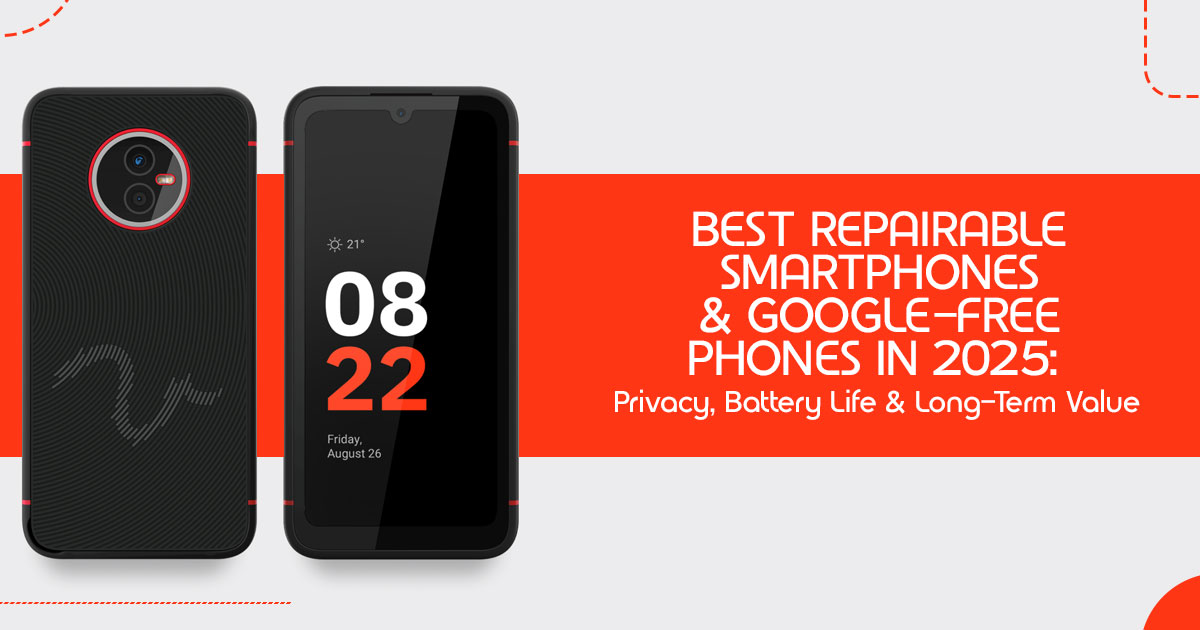
) TL;DR — Why This Guide Matters

Tired of expensive phones that die after two years and trap you in a walled garden? You are not alone. Demand for repairable smartphones and Google-free smartphones is surging in 2025.
These devices deliver a replaceable battery design, robust data privacy, and genuine freedom from surveillance capitalism. The long-term savings, extended device lifespan, and full data control make them a strong alternative for privacy advocates, outdoor workers, and tech minimalists.
Introduction: The Broken Smartphone Model — And the Fix
The average smartphone owner now replaces their device far sooner than they expected — not because the phone completely fails, but because the battery life drops, repairs become expensive, and software support slowly fades away. What starts as a fast, premium device often turns into a frustrating daily experience within just a few years.
You probably know the feeling. A phone that once lasted all day suddenly struggles to survive a few hours. The screen cracks, the battery swells, or performance slows down after updates. Then comes the repair quote — often so high that replacing the entire device feels easier than fixing it. That cycle has turned modern smartphones into disposable products, even when most hardware is still perfectly usable.
And people are getting tired of it.
A growing number of users are now searching for repairable smartphones, replaceable battery phones, and Google-free Android devices that give them more control over how long their phones last, how their data is handled, and how much money they spend over time. This shift is no longer limited to privacy enthusiasts or tech hobbyists. Everyday users, travelers, outdoor workers, digital minimalists, and budget- conscious buyers are starting to ask a simple question:
Why are smartphones becoming harder to own, harder to repair, and more expensive to keep?
That question is driving interest in a new category of devices focused on long-term usability, repairability, privacy, and sustainable smartphone design. These phones challenge the idea that upgrading every two years is normal. Instead, they focus on long-term usability — batteries you can replace yourself, hardware designed to last longer, and software that gives users more freedom.
But there’s also confusion around these devices.
Can a de-Googled Android phone actually work as a daily driver? Will your banking apps still function?
Can a waterproof phone still be repairable?
And are these products genuinely better for users, or are they just another marketing trend?
This article answers those questions with a clear, real-world approach based on actual usability, ownership costs, durability, and long-term value — not just specifications copied from a product page.
As technology experts with over 20 years of experience in hardware and application research and development, we deeply analyze each product based on real-world performance, durability, and value for money. Our goal is to help readers find the best product in every category — whether that means budget smartphones, privacy-focused phones, rugged Android devices, or long-lasting repairable smartphones built for years of use. Our recommendations are based on extensive research, component analysis, real-world usability, and industry expertise.
This guide is especially useful for:
- Users frustrated with expensive smartphone upgrades
- Buyers looking for a sustainable smartphone that lasts longer
- Privacy-conscious users exploring Google-free phones
- Travelers and outdoor users needing durable hardware
- People who want better long-term value instead of yearly upgrades
- Anyone curious about the future of repairable electronics and right-to-repair smartphones
Most reviews only talk about specs. This one looks at ownership reality — what works, what breaks, what becomes annoying over time, and whether these phones actually make sense for everyday people.
Because the bigger story here is not just about one phone.
It’s about whether consumers are finally starting to push back against a smartphone industry built around replacement instead of longevity.
Summary
- Modern smartphones are becoming harder and more expensive to repair.
- Many users are now looking for repairable phones, replaceable battery smartphones, and privacy-focused Android devices that last longer.
- A new generation of Google-free phones is challenging the upgrade-heavy smartphone model by focusing on durability, sustainability, and user control.
- This guide examines real-world usability, app compatibility, repairability, ownership costs, and long- term value — not just specs.
- We also explain who these phones are actually for, where they fall short, and whether they are practical for everyday use.
Technical Specifications at a Glance
| Feature | Standard Smartphone | Repairable, Google-Free Smartphone |
| Operating System | iOS or Android (Google Services) | GrapheneOS / LineageOS (privacy-focused Android) |
| Battery | Glued-in, professional service required | Replaceable battery design — user-swappable in 30 sec |
| App Store | Apple App Store / Google Play Store | F-Droid, Aurora Store, APK sideloading |
| Durability | Fragile glass, requires a protective case | Ruggedized, built for real-world impact |
| Water Resistance | IP68 (sealed with glue) | IP68 — achieved with modular parts |
| Data Privacy | Extensive cloud integration and data collection | Privacy-focused smartphones — minimal tracking |
| Long-Term Cost | Replace every 2–3 years ($800–$1,200+) | One device for 5+ years — save $1,500+ |
1. Why Consumers Are Abandoning Mainstream Smartphones
Modern smartphones are engineering marvels, yet they are also often designed in ways that make long-term repairability difficult and expensive. Paying $1,000+ for a device that becomes a burden within 24 months is not value — it is a subscription in disguise.
The double frustration of forced upgrades and pervasive data surveillance is exactly why the market for Google-free smartphones is exploding. People want technology they can truly own and keep for years.
2. What Makes a Repairable, Google-Free Smartphone Different?
A Google-Free Operating System
The software stack is a Google-free operating system — typically GrapheneOS or LineageOS. These open-source Android builds strip out all background tracking and data harvesting, giving you the familiar Android experience with significantly reduced tracking and greater user control over data collection. Independent security audits confirm these OSes are hardened against exploits.
Repair-First Hardware Philosophy
Standard screws replace industrial adhesive. The headline feature is a replaceable battery design — swap a fresh cell in under 30 seconds. Despite this modular openness, the device is designed to meet IP68 water and dust resistance standards through precision gasket sealing. You get rugged durability and easy access to user-serviceable components.
3. Living Without Google: The Honest Day-to-Day Reality
Switching to a de-googled phone requires a short adjustment period — and the benefits far outweigh the friction for the right user.
App Installation Alternatives
- Aurora Store — Download standard Android apps anonymously, no Google account required.
- F-Droid — A curated repository of free, open-source, audited software.
- APK Sideloading — Install apps directly from verified developer websites.
Apps That Generally Work Well
- Signal, WhatsApp, Telegram — messaging apps work reliably for most users.
- Web browsers (Firefox, Brave) — full functionality.
- Social media — most major platforms available via Aurora Store.
- Spotify, Netflix, YouTube — accessible via sideloading or browser-based.
Areas Requiring Alternatives
- Banking apps — some may flag custom OS; workarounds exist.
- Google Maps — replace with Magic Earth or OsmAnd (excellent offline routing).
- Push notifications — slight delays possible; most apps have built-in workarounds.
- Google Pay — not available; use physical card or alternative payment apps.
4. Why the Replaceable Battery Design Is a Game-Changer
Lithium batteries inevitably degrade — roughly 20% capacity loss after 500 cycles (about two years). On a sealed phone, that means a new device. On a repairable smartphone, it means a $30–$50 battery replacement that takes 30 seconds.
 Beyond finances, the replaceable battery design transforms your reliability. Travelers can carry spare charged batteries and never fear running out of power in remote areas. Heavy users eliminate charger dependency entirely.
5. The Engineering Behind IP68 + Modular Parts
Manufacturers told us for years that water resistance required permanent sealing. Repairable smartphones prove this was a design choice, not a physical constraint. Advanced gasket sealing systems around the battery compartment and reinforced internal frames deliver a genuine IP68 water resistance rating — designed to withstand water exposure under certified IP68 testing conditions — while keeping user- serviceable components fully accessible. The result is rugged durability meets owner-friendly repairability.
6. Repairability Score: Real-World Comparison
| Repair Feature | Repairable Phone ✅ | iPhone | Samsung Galaxy | Google Pixel | Fairphone |
| Battery Replacement | Easy — 30 sec | Difficult — glued | Difficult — glued | Difficult — glued | Easy — screws |
| Screen Replacement | Moderate — screws | Difficult — glued | Difficult — glued | Difficult — glued | Moderate — modular |
| Spare Parts | Excellent | Good | Good | Good | Excellent |
| DIY Friendliness | HIGH ★★★★★ | LOW ★ | LOW ★ | LOW ★ | HIGH ★★★★★ |
| Estimated Repair Cost | LOW — $30–$80 | HIGH — $200+ | HIGH — $150+ | HIGH — $150+ | LOW — $30–$80 |
7. Who Should Buy a Repairable, Google-Free Smartphone?
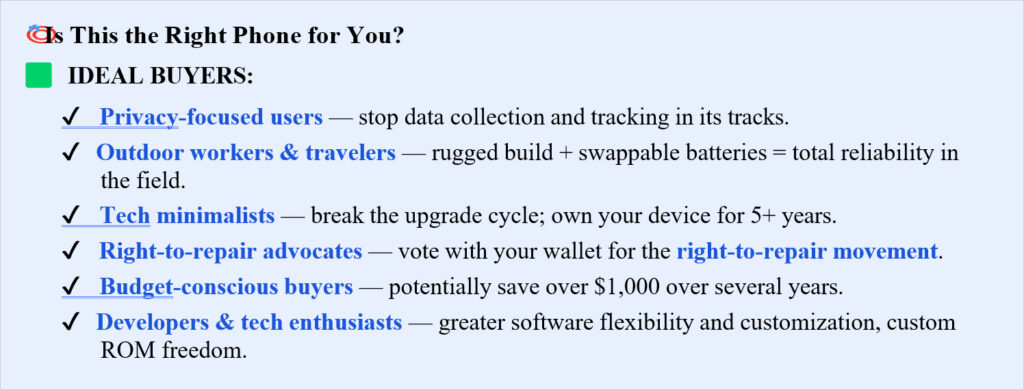
Who Should Skip It: If you are deeply embedded in Google Workspace, demand flagship-class computational photography, or prefer a zero-setup experience, this will require patience. These phones reward users who value user freedom over convenience.
8. The Honest Trade-Offs (Because Transparency Builds Trust)
No product is perfect. Here is what you need to know before purchasing:
- Learning curve — Alternative app stores and navigation tools require a one-time setup investment.
- Some banking app friction — A minority of banking apps flag custom OS; most work via Aurora Store or browser-based access.
- Camera performance — Excellent for everyday photography; does not match the computational photography of $1,200 flagships.
- No Google Pay — Physical card or alternative payment app required.
- Smaller AI feature set — Fewer on-device AI gimmicks, though core features perform on-device without data harvesting.
- Lower resale value — Niche positioning means lower secondary market prices.
Bottom line: These trade-offs are real, manageable, and far outweighed by the privacy, longevity, and financial benefits for the target user.
9. Privacy vs. Convenience: Making the Right Choice
At its heart, choosing a de-googled phone is a decision about data privacy versus short-term convenience. Mainstream smartphones collect location data, app usage, voice commands, and browsing behaviour — constantly. This data fuels advertising profiles worth billions.
A privacy-focused smartphone inverts this relationship. You stop being the product. Your digital footprint shrinks dramatically, and your device works for you, not for advertisers.
10. The Bigger Picture: Regulation, E-Waste & the Repair Revolution
-
Right-to-repair movement — Global legislation (US and EU) is mandating access to parts, tools, and repair manuals.
- EU Repairability Regulations — New rules require manufacturers to provide replaceable batteries and components — the market is moving in this direction.
- E-waste reduction — Over 50 million tonnes of e-waste generated annually; repairable smartphones are a direct, actionable solution.
- Consumer fatigue — Smartphone upgrade excitement has peaked; buyers want devices that last a decade, not two years.
- Sustainable hardware brands — A growing ecosystem of manufacturers building long-term support, modular design, and ethical sourcing into their DNA.
11. Long-Term Value: What Happens After 3–5 Years?
Real-World Scenarios
| User Type | 5-Year Outcome |
| Heavy User | One phone for 5 years — two battery swaps ($60 total) vs. two new phones ($1,600+). |
| Traveler | Carries spare charged batteries — never stranded without power, even off-grid. |
| Budget Buyer | Higher upfront cost paid back within 18 months; pure savings thereafter. |
| Privacy User | Continued robust data privacy without needing yearly updates — security patches maintained by open-source communities. |
12. Is This the Future or a Niche? Our Verdict
Repairable smartphones and Google-free smartphones are not a passing trend — they are the early stage of a mainstream shift. EU regulations, consumer pressure, and growing e-waste reduction awareness are all pushing the industry towards this model. The question is not “will this go mainstream?” — it is “how soon?”
Early adopters who buy now get the full benefit of long-term value, maximum savings, and a device philosophy that will look increasingly prescient as regulations tighten.
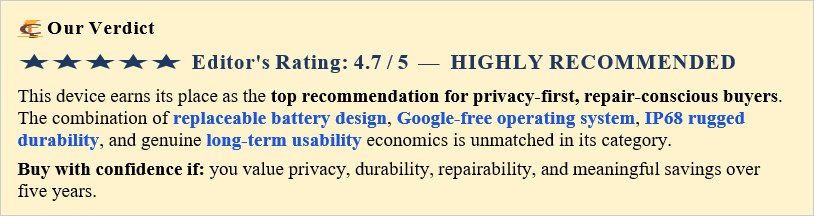
13. Final Verdict & Buying Recommendation

Key Takeaways
-
Repairable smartphones deliver a compelling alternative to disposable, planned-obsolescence technology.
- Google-free smartphones provide enhanced data privacy — with manageable trade-offs in app ecosystem.
- Replaceable battery design extends device lifespan from 2 years to 5+ years and saves $1,000+ over time.
- The right-to-repair movement and EU repairability regulations are accelerating mainstream adoption.
- Long-term e-waste reduction and sustainable hardware choices start with your next phone purchase.
People Also Ask (PAA)
Are Google-free phones secure?
Yes — Some privacy-focused operating systems like GrapheneOS are widely respected for their strong security architecture and rapid patching. Open-source code is publicly audited, and the absence of Google’s background processes reduces the attack surface significantly. GrapheneOS is independently rated as one of the most hardened mobile OSes available.
What are the best alternatives to the Google Play Store?
Aurora Store (anonymous access to standard Android apps) and F-Droid (audited open-source apps) are the two primary alternatives. Both are free and actively maintained.
How long do replaceable phone batteries last?
A quality replaceable battery lasts approximately 2–3 years under normal use. Crucially, you can swap it out for $30–$50 rather than replacing the entire device — extending your phone’s life to 5 years or more.
Do repairable phones have good cameras?
Cameras are excellent for everyday use and travel photography. They do not match the computational photography algorithms of $1,200 flagship devices — a fair trade-off for most users who prioritise longevity over Instagram filters.
Is it hard to switch to a de-googled phone?
Moderate effort is required in the first week — installing F-Droid, Aurora Store, and preferred navigation apps. Most users report the transition is straightforward and well-documented online, with active community support.
Frequently Asked Questions (FAQ)
Q1: Can I use my existing Android apps on a Google-free phone?
Many Android apps work perfectly, especially those that do not rely on Google Play Services. Install them via Aurora Store or APK sideloading. A minority of banking and payment apps may require workarounds or browser-based access.
Q2: How does a replaceable battery benefit me financially?
A replaceable battery design means a $30–$50 swap instead of an $800+ new phone every 2–3 years. Over five years this represents a potential saving exceeding $1,400, while also contributing meaningfully to e- waste reduction.
Q3: What about security updates on Google-free phones?
GrapheneOS is widely respected for its strong security model and rapid patching. LineageOS support quality can vary depending on the device and the maintainer community.
Q4: Will I lose access to Google Maps or YouTube?
You lose the proprietary Google apps, not the functionality. Magic Earth and OsmAnd replace Google Maps with excellent offline routing. NewPipe provides ad-free YouTube access. Some users prefer these alternatives because they offer fewer ads, more customization, and stronger privacy controls.
Q5: Is a repairable phone truly more durable?
Consistently yes. Repairable smartphones are engineered with rugged durability as a design priority — reinforced frames, modular components, and the ability to replace damaged parts instead of discarding the entire device. Minor drops and screen cracks become a $50 fix, not a $900 replacement.
Conclusion: Technology That Serves You
Choosing a smartphone is no longer just a tech decision — it is a values statement. In a world defined by disposable electronics and pervasive data surveillance, repairable smartphones and Google-free smartphones offer a profoundly different path: device control, genuine privacy, and technology built to last.
The economics are compelling. The privacy gains are real. The engineering is proven. And with the right-to- repair movement gaining legislative momentum worldwide, buying into this category today means you are not just getting a great phone — you are choosing the right side of the future.
Make the Switch Today

Find the best repairable smartphones and privacy-focused smartphones on Amazon. Compare models, read verified buyer reviews, and claim the best price available right now.

Shop Repairable & Privacy Smartphones
And if this guide helped you better understand the future of sustainable smartphones and repairable technology, consider sharing it with friends, family, or anyone frustrated with today’s upgrade-heavy smartphone market. More awareness around repairability, device control, and privacy helps push the industry toward better products for everyone.
***Disclaimer***
This blog post reflects our own research, testing, and personal opinions. It should not be taken as the official position of any brand, manufacturer, or company mentioned here. While we aim to keep information accurate and up to date, product details, pricing, and availability can change. We recommend double-checking important details before making a purchase.
Some links in this article may be affiliate links. If you choose to buy through these links, we may earn a small commission at no extra cost to you. This helps support our work and allows us to keep publishing in- depth, unbiased reviews. Our recommendations are never influenced by affiliate partnerships.
Comments shared by readers reflect their own views and not ours. We are not responsible for outcomes resulting from the use of information on this site. Please seek professional advice where appropriate.
All product names, logos, and brands mentioned are the property of their respective owners. These names are used for identification and informational purposes only and do not imply endorsement.