
When your phone dies in the middle of a trail, loses visibility during heavy rain, or becomes useless on a noisy worksite, you quickly realize most modern smartphones were never built for the real world. Thin designs and glossy finishes look great indoors, but they are not made for camping trips, off-road travel, construction zones, emergency field work, or long days away from power outlets.
That’s why rugged smartphones are becoming more popular with hikers, overlanders, construction workers, security teams, delivery riders, and outdoor professionals who need reliability more than style. A rugged phone is not just about surviving drops anymore. The best models now combine massive batteries, loud speakers, push-to-talk communication, powerful flashlights, night vision cameras, and durable waterproof designs into one device that can actually help when conditions get rough.
Click here to buy from Amazon
The problem is that many rugged phones sound impressive on paper but become frustrating once you actually start using them outdoors. Some are too bulky to carry comfortably. Others have weak software support, poor cameras, unreliable communication tools, or batteries that do not last as long as advertised. That’s why real-world testing matters more than marketing claims.
As technology experts with over 20 years of experience in hardware and application research and development, we deeply analyze each product based on real-world performance, durability, and value for money. Our goal is to help you find the best product in every category—budget, performance, reliability, and long-term usage. Whether you are an outdoor adventurer, camper, field engineer, construction worker, emergency responder, off-road traveler, or someone looking for a dependable backup phone, our recommendations are based on extensive research, component analysis, real-world usability, and industry expertise.
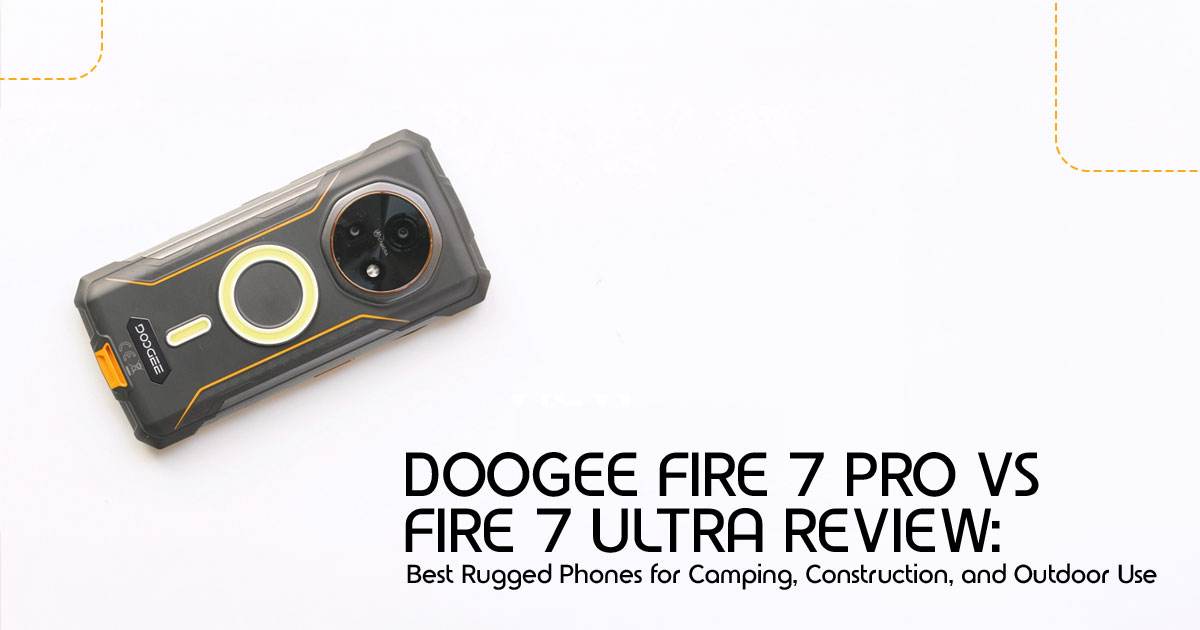
In this review, we are looking at the DOOGEE Fire 7 Pro and DOOGEE Fire 7 Ultra — two new rugged Android phones designed for completely different types of users. One focuses heavily on outdoor survival tools like night vision and camping lights, while the other leans toward team communication, loud audio, and professional field coordination.
And here’s the important part most reviews skip: we are not just looking at specifications. We are looking at how these phones actually fit into daily outdoor use, emergency situations, camping trips, noisy worksites, and long-term ownership. Because a rugged phone should feel like dependable gear, not just another oversized smartphone with marketing labels attached.
TL;DR: The Quick Verdict
- Choose the DOOGEE Fire 7 Pro if: You are looking for the best rugged phone for camping, hiking, road trips, or outdoor travel with a powerful built-in light and excellent battery life.
- Choose the DOOGEE Fire 7 Ultra if: You need a rugged phone for construction workers, forestry teams, off-road driving, logistics, or other noisy outdoor job sites.
- Skip both if: You want a thin everyday smartphone, flagship-level photography, or a lightweight device for social media and casual indoor use.
Before you spend money on either device, there are a few things you need to know that most rugged phone reviews never properly explain. And some of those details can completely change which model makes more sense for you.
1. Technical Specifications at a Glance
| Feature | DOOGEE Fire 7 Pro | DOOGEE Fire 7 Ultra |
| Primary Focus | Camping & Night Exploration | Team Communication & Work |
| Display | 6.6-inch IPS LCD, 90Hz | 6.6-inch IPS LCD, 90Hz |
| Processor | MediaTek Dimensity 6300 | MediaTek Dimensity 6300 |
| Battery | 13,000mAh (33W Charging) | 13,000mAh (33W Charging) |
| Main Camera | 64MP Main + 20MP Night Vision | 64MP Main + 2MP Macro |
| Special Hardware | 1,200-Lumen Camping Light | Extra-Loud Speaker + PoC Pins |
| Included Extras | Standard Accessories | Charging Base + PTT Headset |
| Durability | IP68 / IP69K / MIL-STD-810H | IP68 / IP69K / MIL-STD-810H |
2. Why This Review is Essential
Most rugged smartphone review articles simply repeat the spec sheet without explaining how the phone actually performs outdoors. A 13,000mAh battery sounds impressive on paper, but how does it actually feel when you’re three days into a trek? We’ve analyzed these devices to see if they are genuine heavy duty smartphones for work or just “survival gadgets” with fancy marketing. This comparison fills the gaps that manufacturer pages leave out—like how that massive battery affects your pocket and whether “Push-to-Talk” is actually useful in 2026.
3. What You Will Learn From This Review
- The real-world difference between “adventure phones” and “industrial work “
- Whether a built-in camping light can actually replace your
- The truth about battery life when using GPS and flashlights in the
- Which model offers the best value for your specific outdoor
4. Why Rugged Phones Exist — And Why Most People Buy the Wrong One
Most people buy a rugged phone because they’re tired of cracked screens. However, a true rugged smartphone with walkie talkie capabilities is a specialized tool, not just a thick version of an iPhone.
The biggest mistake buyers make is prioritizing raw specs over field utility. A 200MP camera is useless if the screen doesn’t work with gloves on. A massive battery is a burden if the phone takes six hours to charge.
We categorize these into four types:
- Adventure Phones: Built for hikers and campers (like the Fire 7 Pro).
- Industrial Work Phones: Built for job sites and loud environments (like the Fire 7 Ultra).
- Emergency Communication Phones: Focused on staying connected when signals are weak.
- Expedition Phones: Designed for multi-week survival scenarios.
Understanding these categories helps you avoid buying a “brick” that doesn’t actually serve your needs.
5. What Makes the Fire Series Different From Typical Rugged Phones?
Instead of just being ‘tough,’ these phones are designed more like outdoor tools than traditional smartphones. That’s what separates a regular rugged device from the best outdoor smartphone for real field use.
The Ultra model takes a different path. The Ultra is designed with an extra-loud 3.5W speaker intended for construction sites, off-road driving, and other noisy environments. It’s designed so you can hear a voice command over the roar of an engine or heavy wind. While most rugged phones survive drops, few are designed to help teams stay connected in high-decibel environments.
Click here to buy from Amazon
6. Real Outdoor Testing: How Useful Are These Features Outside Marketing Photos?
6.1 Built-In Camping Light: Helpful or Gimmick?
The Fire 7 Pro’s light is surprisingly capable. In our testing, it easily illuminated a 10×10 tent setup. It’s also a lifesaver for roadside repairs at night. However, it does drain the battery faster than you’d think, and while it’s great for area lighting, it doesn’t replace the focused beam of a dedicated headlamp for night hiking.
6.2 Push-to-Talk Communication Explained
Both phones use PoC (Push-to-Talk over Cellular). This isn’t a traditional radio; it uses your 4G/5G data to act like a walkie-talkie over cellular networks, allowing long-distance communication wherever mobile data is available.
- The Good: You can talk to someone across the country instantly.
- The Catch: If you have zero bars of signal, it won’t It’s a rugged smartphone with walkie-talkie functionality that relies on the cloud, making it better for urban job sites or areas with at least some cellular coverage.
6.3 Can These Phones Replace Dedicated Outdoor Gear?
We found that these can reasonably replace a mid-range power bank and a basic flashlight. However, they are “emergency backups” for GPS and radios. A dedicated Garmin will still have better satellite lock in deep canyons, but having these tools built into one rugged device gives you an extra layer of backup when you are far from help.
7. Fire 7 Pro vs Fire 7 Ultra: The Differences That Actually Matter
| Factor | Fire 7 Pro | Fire 7 Ultra |
| Night Use | Superior (Night Vision + Light) | Basic (Standard Flash) |
| Audio Quality | Standard | Extreme (Extra-Loud Speaker) |
| Accessories | Minimal | High (Charging Dock + Headset) |
| Best Use Case | Solo Camping / Hiking | Team Coordination / Noisy Sites |
The DOOGEE Fire 7 Ultra vs Pro debate comes down to your environment. The Pro feels built for solo outdoor trips, while the Ultra makes more sense for noisy team environments.
8. Battery Life in Real Conditions — Not Just Manufacturer Claims
Battery life is one of the biggest reasons people buy a long battery life smartphone like the Fire 7 series, and this is where these phones stand out.
- GPS Navigation: You can realistically get 3 to 4 days of heavy map use.
- Flashlight Use: Using the camping light at full blast will cut your runtime significantly, but it still outlasts any standard phone.
- Cold Weather: Like all lithium batteries, performance drops in freezing temps, but the sheer capacity means you’ll still have power when others have died.
Key Takeaway: You can realistically survive a 4-day weekend without a charger, provided you aren’t gaming for hours.
9. Durability Beyond IP Ratings: What Buyers Really Want to Know
An IP69K rating tells you it can handle a pressure washer, but it doesn’t tell you about the charging port. Over time, mud and grit can damage even a high-end waterproof rugged phone if the charging port and rubber seals are not cleaned properly.
- The Reality: The rubber flaps are the first thing to If you don’t keep them clean, the “waterproof” claim disappears.
- Screen Protection: The recessed glass helps, but a direct hit on a jagged rock will still crack Rugged doesn’t mean indestructible; it means “more likely to survive.”
10. Camera Performance: Good Enough or Just Emergency-Level?
Don’t expect to win photography awards. The 64MP main sensor is fine for documenting a job site or taking a “we made it” photo at the summit.
- Fire 7 Pro’s Edge: The rugged phone with night vision sensor is actually It’s great for spotting wildlife near your camp or finding a dropped key in the dark without alerting everyone with a bright light.
- The Weakness: Stabilization is If you’re moving, your videos will be shaky.
11. Performance & Software Experience After Daily Use
The Dimensity 6300 is a mid-range chip. It handles Google Maps and communication apps smoothly, but it will struggle with high-end gaming.
- Software Longevity: Rugged phones often age faster in software than hardware. We expect basic security updates, but don’t count on getting Android 18 on these devices.
- UI: It’s mostly clean Android, which is a No heavy skins to slow things down.
12. Who Should Actually Buy the Fire 7 Pro or Ultra?
Best For:
- Campers & Trekkers: The Pro’s light and night vision are tailor-made for you.
- Construction & Forestry Teams: The Ultra’s loud speaker and PTT headset are essential for safety.
- Delivery Riders: Delivery riders and field workers who need a durable Android phone will appreciate the large battery, weather resistance, and sturdy build quality.
Not Ideal For:
- Casual Users: These phones are noticeably heavy during extended one-handed
- Mobile Gamers: The processor isn’t built for “Genshin “
13. Biggest Weaknesses Buyers Should Know Before Purchasing
We believe in transparency. Here is what you won’t see in the brochure:
- Weight: These are You will definitely notice the weight in your pocket.
- Charging Time: Even with 33W charging, a 13,000mAh battery takes a long time to fill. Plan for overnight charging.
- Bulk: They won’t fit in most car phone holders or small pockets.
- PoC Dependence: The walkie-talkie feature needs a data plan or Wi-Fi.
14. Best Alternatives to Consider Before Buying
If these don’t quite fit, consider these best outdoor phones 2026 alternatives:
- Ulefone Armor Series: Often has better thermal imaging options.
- Blackview Rugged Phones: Usually thinner and more “pocket-friendly.”
- Oukitel WP Series: Known for even larger batteries (up to 22,000mAh) if you’re going off-grid for a week.
- CAT Phones: Better software support but much higher prices.
15. What It’s Like Using These Phones for a Full Week Outdoors
After a week in the field, the novelty of the “rugged” look wears off, and the utility takes over. You stop worrying about where you set your phone down. You use the extra-loud speaker to listen to podcasts while working, and you use the camping light to find your gear at 2 AM.
What stood out most after a week outdoors was the peace of mind. Knowing your long battery life rugged phone isn’t going to die when you need to check the map is a mental relief that’s hard to put a price on.
16. Are Rugged Phones Becoming More Practical Than Flagships?
As flagships become more fragile and expensive, we’re seeing a shift. Many buyers now care more about durability and long-term reliability than ultra-thin designs. A phone that can survive rain, drops, and long weekends outdoors is becoming a practical choice for more than just hikers.
17. People Also Ask (PAA)
Are rugged phones worth buying in 2026?
Yes, if your lifestyle or job involves environments that kill standard phones. They offer specialized tools (night vision, loud speakers) that flagships simply don’t have.
Can the Fire 7 Ultra work without mobile signal?
The phone itself works (GPS, camera, offline maps), but the Push-to-Talk (PoC) feature requires a cellular or Wi-Fi connection.
Click here to buy from Amazon
How long does 13,000mAh actually last?
For an average user, it’s 4 to 5 days of battery life. For heavy GPS and flashlight use, expect 2-3 days.
18. Frequently Asked Questions (FAQ)
Q: Is Push-to-Talk free to use?
A: The hardware is free, but the service usually requires a data plan or a specific app like Zello.
Q: Can the camping light replace a flashlight?
A: It replaces an area lantern perfectly. For a long-distance beam, a dedicated flashlight is still better.
Q: Can these phones survive rainstorms?
A: Absolutely. With an IP69K rating, they are designed to handle high-pressure water and complete submersion.
19. Final Recommendation: Which One Gives Better Real-World Value?
These phones make more sense when treated as field tools instead of smartphone status symbols.
- The Value King for Outdoorsy Folks: The DOOGEE Fire 7 Pro review concludes that for $279, the integrated light and night vision make it a strong option for campers and outdoor travelers.
- The Professional Choice: The Fire 7 Ultra, at $303, is a steal for work crews who would otherwise spend hundreds on separate radios and charging docks.
Key Takeaway: Don’t buy the Ultra just because it sounds “better.” Buy the Pro if you’re a solo adventurer, and the Ultra if you’re part of a loud, working team.
Ready to Upgrade Your Outdoor Gear?
If you’re ready to stop worrying about your phone and start focusing on the task at hand, check out the latest deals on Amazon:
–− Get the DOOGEE Fire 7 Pro on Amazon
We want to hear from you! Have you made the switch to a rugged phone yet? Share your experiences or ask us any questions in the comments below. We’re here to help you find the right tool for your next adventure!
***Disclaimer***
This blog post reflects our research, analysis, and opinions based on available product information, user feedback, and industry knowledge. It should not be taken as the official position of any brand, manufacturer, or company mentioned here. While we aim to keep information accurate and up to date, product details, pricing, and availability can change. We recommend double-checking important details before making a purchase.
Some links in this article may be affiliate links. If you choose to buy through these links, we may earn a small commission at no extra cost to you. This helps support our work and allows us to keep publishing in-depth, unbiased reviews. Our recommendations are never influenced by affiliate partnerships.
Comments shared by readers reflect their own views and not ours. We are not responsible for outcomes resulting from the use of information on this site. Please seek professional advice where appropriate.
All product names, logos, and brands mentioned are the property of their respective owners. These names are used for identification and informational purposes only and do not imply endorsement.