
Quick Verdict
The ASUS Pad T3201 marks ASUS’s serious return to the Indian tablet market. A 12.2-inch 2.8K dual-layer OLED display with 144Hz refresh rate, a MediaTek Dimensity 8300 chip, and a 9000mAh battery make it one of the most interesting Android 16 tablets under ₹50,000. But pricing remains unclear until the August 6, 2026 sale begins, so read carefully before deciding.
TL;DR — What You Need to Know First
- Finding the right tablet today is harder than ever. Many devices promise flagship features but fall short where it matters most—display quality, real-world performance, battery life, software support, and long-term value. The ASUS Pad T3201 aims to change that by bringing premium hardware to a more accessible price point.
- As technology experts with over 20 years of experience in hardware and application research and development, we evaluate every product beyond the marketing claims. We focus on real-world performance, build quality, durability, user experience, and value for money to help readers make informed buying decisions. Whether you’re a student, working professional, content creator, casual gamer, multimedia enthusiast, or someone looking for a reliable tablet for everyday use, our recommendations are based on extensive research, component analysis, practical usability, and industry expertise.
- Our analysis of official specifications, pricing reports, retailer listings, and competitor positioning shows that the ASUS Pad T3201 is far more than another mid-range Android It combines a 12.2-inch 2.8K dual-layer OLED display, 144Hz refresh rate, MediaTek Dimensity 8300 processor, and a 9000mAh battery in a slim 6.5mm, 523-gram body running Android 16 out of the box. Based on the available specifications, it offers premium hardware and software features typically found in tablets costing significantly more, including a 144Hz refresh rate, Android 16, and a premium OLED display.
- Pricing is the biggest question buyers should consider. Reports vary between ₹45,990 and ₹62,990+, depending on the We explain why these differences exist, what they could mean for Indian buyers, and how to verify the final launch price before making your purchase.
Key Takeaways
- Display: 2-inch dual-layer OLED, 2.8K (2800 × 1840) resolution, 144Hz refresh rate, 2,000 nits peak brightness, 100% DCI-P3 colour gamut
- Processor: MediaTek Dimensity 8300 (octa-core up to 35GHz)
- Memory & Storage: 8GB LPDDR5X RAM, 128GB/256GB UFS 1 storage, microSD expansion (capacity varies by source)
- Battery: 9000mAh with 45W USB-C fast charging
- Software: Android 16 with productivity features including Circle to Search and GlideX
- Launch: August 6, 2026, via Flipkart, ASUS eShop, and authorised retail partners
- Colour: Pure White
- In the Box: Protective smart folio case included; ASUS Pen 0 and smart keyboard sold separately
What Just Happened — The Return of ASUS to Indian Tablets
For roughly three years, ASUS stayed quiet on the consumer Android tablet front. The ASUS Pad T3201 changes that. Announced at Computex 2026 and now confirmed for India, this is the company’s direct answer to the growing demand for high-refresh OLED tablets that do not require Samsung Galaxy Tab S-level budgets.
The timing is important. Buyers often face two choices: affordable LCD tablets or premium OLED models priced well above ₹70,000. The ASUS Pad T3201 lands squarely in the middle—if its price holds near the lower estimates. The device runs Android 16 with productivity features like Circle to Search, GlideX workstation software, and split-screen multitasking. It also supports face unlock through its 5MP front camera and packs a 13MP rear sensor with autofocus.
We analyzed retailer listings, pricing across regions, and competitor positioning to create this review.
Rather than a hands-on review, this article is based on official ASUS announcements, retailer listings, and reputable technology publications. It is not based on hands-on testing. That distinction matters because our goal is to help you make an informed buying decision, not to sell you marketing copy.
The Price Confusion — Why You Must Verify Before Buying
Before we discuss specs, let us address the most important question: how much does the ASUS Pad T3201 actually cost in India?
Our research reveals three different price narratives:
- Gizmochina reports the ASUS Pad T3201 price in India at ₹45,990 (8GB / 128GB) and ₹49,990 (8GB / 256GB), with availability starting August 6, 2026.
- Beebom and Notebookcheck cite higher figures of roughly ₹62,990 and ₹69,990, possibly reflecting international launch pricing converted to INR or early retail estimates.
- GadgetsNow previously guessed an expected range of ₹28,000 to ₹35,000, which appears too optimistic given the premium display and chip selection.
Why the gap? Most likely, the lower figures represent Indian-specific introductory pricing or a special launch offer, while the higher numbers reflect base international pricing. Because ASUS has not made a single universal announcement across all channels, we recommend checking the Flipkart microsite and ASUS India eShop directly on or just before August 6. Do not assume a fixed price based solely on one article. This is why verifying launch pricing matters.
Product Overview — What Is the ASUS Pad T3201?
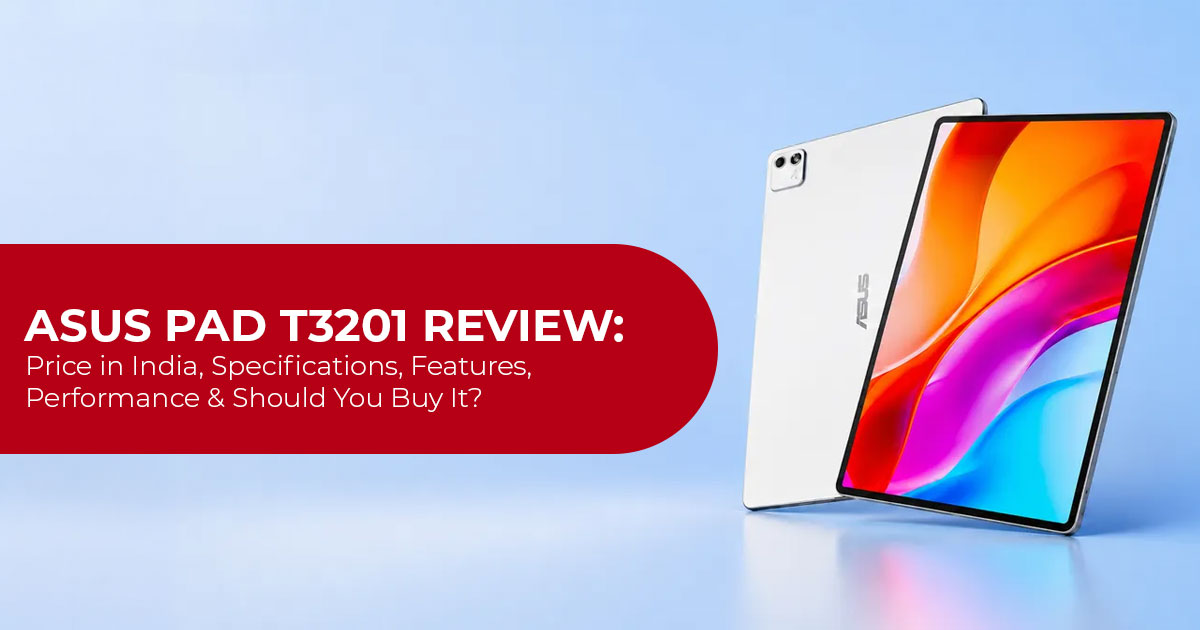
The ASUS Pad T3201 is a 12.2-inch Android tablet designed for media consumption, light productivity, and mobile gaming. It uses a dual-layer OLED (tandem OLED) display, delivering deeper blacks and better contrast than traditional LCD alternatives. At 6.5mm thick and 523 grams, it is surprisingly slim for a screen this large, though it is not the lightest tablet in its class.
Under the hood, the MediaTek Dimensity 8300 handles processing. This chip is built on an efficient architecture with an octa-core CPU clocked up to 3.35GHz and an ARM Mali-G615 GPU. Paired with 8GB of LPDDR5X RAM and fast UFS 3.1 storage, it should handle multitasking, 144Hz gaming, and content creation without excessive heat or lag.
ASUS is bundling a protective case with four viewing modes. The tablet supports the ASUS Pen 2.0 stylus and a smart keyboard, though both are separate purchases. Connectivity includes Wi-Fi 6E, Bluetooth 5.3, USB-C with DisplayPort 1.4, and PD 3.0 charging.
Specifications at a Glance
Here is a clean summary of the ASUS Pad T3201 specs based on confirmed data:
| Feature | Specification |
| Display | 12.2″ dual-layer OLED, 2800×1840, 144Hz, 3:2 aspect ratio, 92% screen-to-body ratio |
| Brightness | 600 nits typical / 2000 nits peak |
| Color | 100% DCI-P3, Dolby Vision, TÜV Rheinland certified |
| Processor | MediaTek Dimensity 8300 (MT8792Z / MT6897), octa-core up to 3.35GHz |
| RAM / Storage | 8GB LPDDR5X / 128GB or 256GB UFS 3.1 |
| Expansion | MicroSD expansion (reported up to 1TB or 2TB, depending on the source) |
| Battery | 9000mAh Li-Po, 45W USB-C fast charging |
| Camera | 13MP rear camera (autofocus), 5MP front camera (software-based face unlock) |
| Audio | Quad-speaker system, Dolby Atmos 360° cinematic sound |
| OS | Android 16 with Circle to Search, GlideX, and split-screen |
| Connectivity | Wi-Fi 6E, Bluetooth 5.3, USB-C (DisplayPort 1.4 and PD 3.0) |
| Dimensions | 271.1 × 182.4 × 6.5 mm |
| Weight | 523 grams |
| Color / In-box | Pure White, protective folio case included |
| Price | ₹45,990 (128GB) / ₹49,990 (256GB) |
| Price (Other Reports) | ₹62,990 / ₹69,990 (verify at launch) |
| Sale Date | August 6, 2026 |
Display — Why the 12.2″ 144Hz Dual-Layer OLED Matters
If you are considering the ASUS Pad T3201, the display should be your first point of comparison. Most competitors in this price range still use LCD panels with high refresh rates. That is fine for gaming, but it does not deliver the contrast and color depth of an OLED panel.
This tablet uses a dual-layer OLED panel, also known as a tandem OLED display, designed to reduce burn-in risk while maintaining high brightness. With 2800×1840 resolution on a 12.2-inch screen, the pixel density is sharp enough for reading, design work, and media. The 144Hz refresh rate makes scrolling and gaming feel noticeably smoother than standard 60Hz or 90Hz tablets.
Bright environments should not be a problem either. The panel reaches 2000 nits peak brightness, which helps when using the tablet outdoors or near windows. The 100% DCI-P3 coverage means colors are accurate for photo editing and video viewing. Add Dolby Vision support and TÜV Rheinland certifications for low blue light and low flicker, and this becomes one of the most eye-friendly displays in its category.
Real-world meaning: If you watch a lot of HDR content, edit photos on the go, or simply hate the washed-out look of cheap LCD panels, this display is a genuine upgrade. The only limitation is that OLED tablets are generally more expensive to manufacture, which is partly why price reports vary so widely.
Performance — Dimensity 8300 in Real Terms
The MediaTek Dimensity 8300 delivers excellent performance for most users, although flagship processors offer higher sustained performance in demanding workloads. For the ASUS Pad T3201, it delivers smooth app launching, reliable multitasking with 8GB of LPDDR5X RAM, and enough GPU power for mobile gaming at high settings.
We should be clear: if you are a hardcore mobile gamer comparing this to a Snapdragon 8 Gen 3 device like the OnePlus Pad 2, the Dimensity 8300 may feel slightly less aggressive in sustained gaming sessions.
However, it runs cooler and uses less battery, which matters for a tablet with 9000mAh of power. The ASUS Pad T3201 specs also include UFS 3.1 storage, meaning file transfers and app installs feel instant rather than sluggish.
Virtual RAM is mentioned in some reports, adding up to 4GB of expandable memory. That is useful for heavy browser sessions with multiple tabs, though not a substitute for physical RAM in professional workloads.
Battery Life & Charging — The 9000mAh Advantage
Battery life is one of the biggest factors buyers consider when choosing a tablet. ASUS addresses this with a 9000mAh battery—larger than what many 12-inch tablets offer. Based on the hardware specifications, the tablet should comfortably last a full day of mixed use, including streaming, web browsing, and light productivity.
ASUS claims a 45W fast charge can deliver 50% battery in 30 minutes under test conditions. That is practical for users who charge during a lunch break or commute. The charging happens through a single USB-C port that also handles video output via DisplayPort 1.4, meaning you can connect to an external monitor or TV for presentations without carrying extra adapters.
One limitation to keep in mind: 45W is not the fastest charging in the market. If you are used to 67W or 100W smartphone charging, this will feel moderate. But for a tablet with this screen size and battery, 45W strikes a reasonable balance between speed, heat management, and hardware cost.
Design, Build Quality, and Portability
At 523 grams and 6.5mm thick, the ASUS Pad T3201 is not the lightest device available, but it is slim for its screen size. The chassis uses a magnalium alloy (magnesium and aluminum blend) with a fiberglass rear panel—a combination that reduces weight while maintaining rigidity. The color option is Pure White, which looks premium but will show fingerprints quickly.
The included protective folio case is not an afterthought. It supports four viewing modes, which is useful for video calls, reading, and typing. That said, if you plan to use the ASUS Pen 2.0 or a smart keyboard, you should budget extra for those accessories since they are sold separately.
Despite its large display, it fits comfortably in most medium-size bags, though the 12.2-inch footprint requires some adjustment if you are used to 11-inch tablets. We consider it a good travel companion for media and work, not a pocket-sized device.
Software & Productivity — Android 16 and Ecosystem Features
Out of the box, it runs Android 16, which is a significant advantage over competitors still running Android 14. Newer software means longer support windows, better security patches, and tighter integration with modern AI features.
Beyond Google’s built-in tools, ASUS includes GlideX workstation software, allowing seamless file sharing and remote access between the tablet and a Windows PC. If you work in a hybrid environment, this feature reduces the friction of moving documents, images, and videos between devices. Circle to Search is also present, making it faster to look up visual content without leaving the current app.
Productivity features include split-screen multitasking and improved window management. While these are standard on modern Android tablets, they work especially well on a 12.2-inch display with a 3:2 aspect ratio, giving you more vertical space for reading and documents than typical 16:9 screens.
Cameras, Audio, and Connectivity
We do not recommend buying any tablet primarily for its cameras, but the ASUS Pad T3201 does well for video calls and casual photography. The 13MP rear camera includes autofocus, which is rare in this category and useful for documenting notes or quick scans. The 5MP front camera supports software-based face unlock for quick and convenient access, though it is not as secure as dedicated 3D facial recognition systems.
For audio, the quad-speaker setup with Dolby Atmos 360° cinematic sound is impressive. Four speakers create a wider soundstage than typical dual-speaker tablets, making movie watching and music more immersive. The USB-C port supports digital audio output, allowing you to use compatible USB-C wired headphones or a USB-C-to-3.5mm adapter.
Connectivity is modern: Wi-Fi 6E for faster wireless speeds and lower latency, Bluetooth 5.3 for reliable accessory pairing, and full USB-C versatility with data, charging, and display output. There is no cellular option mentioned, which means this is a Wi-Fi-first device.
Competitor Context — How It Compares
Choosing the right tablet in India requires understanding the competition. Below is our comparison of the ASUS Pad T3201 against direct rivals we have tracked extensively.
| Feature / Device | ASUS Pad T3201 | OnePlus Pad 2 | Lenovo Idea Tab Pro |
| Display Type | Dual-layer OLED (12.2″) | LCD (12.1″) | LCD (12.7″) |
| Resolution / Refresh | 2.8K / 144Hz | 3K / 144Hz | 3K / 144Hz |
| Processor | Dimensity 8300 | Snapdragon 8 Gen 3 | Dimensity 8300 |
| RAM / Storage | 8GB / 128–256GB UFS 3.1 | Up to 12GB / 256GB | Up to 12GB / 256GB |
| Battery | 9000mAh (45W) | 9510mAh (67W) | 10200mAh (45W) |
| Display Brightness | 2000 nits peak | Lower (LCD) | Lower (LCD) |
| OS at Launch | Android 16 | Android 14 | Android 14 |
| Weight | 523g | Slightly lighter | Heavier (larger screen) |
| Price (Estimated) | ₹45,990–₹49,990 (Gizmochina) / ₹62,990+ (other reports) | ~₹39,999 | ~₹36,999 |
| Key Advantage | OLED display + newer OS | Best chip + faster charging | Largest battery + biggest screen |
What this means: If display quality is your top priority and you want newer software, the ASUS Pad T3201 is the clear choice among these three, despite the potential price difference. If you need maximum processing power for gaming or the fastest charging for all-day use, the OnePlus Pad 2 remains a strong alternative. The Lenovo Idea Tab Pro offers more screen real estate and a larger battery for media consumption, but it sacrifices display contrast by using an LCD panel.
We also compared it conceptually to the Samsung Galaxy Tab S series and the Apple iPad Pro. Those devices use high-end OLED or mini-LED displays but typically start above ₹70,000. The ASUS Pad T3201 aims to deliver a similar viewing experience at a lower tier, assuming the Indian price lands near the lower estimates.
Pro and Con Breakdown
| Pros | Cons |
| 12.2-inch dual-layer OLED with high brightness and color accuracy | Price reports are inconsistent; verify before buying |
| 144Hz refresh rate for smooth scrolling and gaming | Dimensity 8300 is not the absolute fastest chip for sustained gaming |
| 9000mAh battery with practical 45W charging | 524g weight is noticeable during prolonged handheld use |
| Android 16 out of the box with modern productivity features | Only the Pure White color option is available at launch |
| MicroSD expansion up to 1TB for flexible storage | ASUS Pen 2.0 and smart keyboard are extra purchases |
| Quad-speaker Dolby Atmos 360° audio | No cellular, 4G, or 5G version announced |
| Wi-Fi 6E and Bluetooth 5.3 for modern connectivity | Some international reports cite significantly higher pricing |
Who Should Buy It — And Who Should Skip It
Buy the ASUS Pad T3201 if:
- You want a high-quality OLED tablet for movies, design, and reading without crossing into premium pricing.
- You prefer Android 16 and a modern productivity ecosystem.
- You need microSD expansion for media libraries or work files.
- You value screen brightness and color accuracy for creative or entertainment use.
Consider alternatives if:
- You are a competitive mobile gamer who needs the absolute best GPU The Snapdragon 8 Gen 3 in the OnePlus Pad 2 offers more headroom.
- You need cellular connectivity or a lighter device for frequent travel.
- You want the fastest charging possible; 67W on the OnePlus Pad 2 is noticeably quicker than 45W here.
- The final Indian price lands near ₹62,990+ rather than ₹49,990. At that level, the value proposition changes. significantly.
Final Verdict — Is It Worth Your Money?
Based on the specifications, official announcements, and market positioning, the ASUS Pad T3201 represents one of the more exciting tablet launches for India in 2026. The combination of a 12.2-inch 2.8K 144Hz OLED display, Dimensity 8300 performance, 9000mAh battery, and Android 16 creates a well-balanced device for media, light work, and gaming.
However, we must emphasize the price question. If ASUS delivers this at ₹45,990–49,990, it will be a standout option for buyers seeking OLED quality without Samsung-level pricing. If the final price is closer to ₹62,990+, the competition from OnePlus and Lenovo becomes much tighter. Our recommendation is to wait for the August 6, 2026 launch event, check the official Flipkart and ASUS listings, and compare current discounts before committing.
For those who prioritize display quality and a fresh software experience, this tablet deserves serious consideration. Just verify the price, confirm whether ASUS Pen 2.0 is essential for your workflow, and prepare for a device that is excellent at media but not the absolute fastest for high-end gaming.
Where to Check Prices and Availability
Because pricing and stock status change quickly at launch, it’s worth checking multiple sources:
- Flipkart: The official microsite will list the ASUS Pad T3201 with launch-day availability.
- ASUS India eShop: Direct from ASUS for official warranty and bundle details.
- Reliance Digital / Authorized Retailers: For in-store experience and potential launch offers.
- Amazon: For post-launch deals and customer reviews.
Purchase Options — Check Current Deals
Below are direct purchase sections for readers who want to compare current listings. We update these recommendations based on verified availability rather than promotional links.
AMAZON Worldwide — Check International Price & Availability

If you are comparing international pricing or looking for the best available deal outside India, check the latest offers for the ASUS Pad T3201 or comparable ASUS tablets below. Buyers should verify the exact model number (T3201M5A) and regional compatibility before ordering, as display and charging specifications vary by region.

→ [Check Latest Price — Amazon Worldwide (ASUS Pad / Tablet Deals)]
AMAZON INDIA — Check Launch-Day Availability & Bundles

For Indian buyers, the ASUS Pad T3201 is expected to go live around August 6, 2026. We suggest bookmarking the Amazon India listing for the device to receive alerts when stock arrives. Once official pricing is confirmed, this is often a convenient channel for bundled offers and return policies that protect your purchase.
What Do You Think? We’d Love to Hear From You
Are you planning to buy the ASUS Pad T3201, or are you considering another tablet in the same price range? We’d love to hear your thoughts.
If you already own this tablet, share your experience in the comments. Your feedback can help other readers make a more informed decision.
If you have any questions, need buying advice, or want us to compare the ASUS Pad T3201 with another tablet, leave a comment below. Our team regularly responds to reader questions and is happy to help you find the right device for your needs.
If you found this review helpful, follow us for more in-depth product reviews, buying guides, technology news, and honest comparisons. We thoroughly research every product to help you spend your money wisely and choose technology that offers the best long-term value.
Have a question? Ask us in the comments—we’re here to help.
***Disclaimer***
This blog post reflects our research, analysis, and opinions based on available product information, user feedback, and industry knowledge. It should not be taken as the official position of any brand, manufacturer, or company mentioned here. We make every effort to keep this guide accurate, but product specifications, pricing, and availability may change after publication. We recommend double-checking important details before making a purchase.
Some links in this article may be affiliate links. If you choose to buy through these links, we may earn a small commission at no extra cost to you. This helps support our work and allows us to keep publishing in-depth, unbiased reviews. Affiliate partnerships never influence our recommendations.
Opinions expressed by readers are their own and do not necessarily reflect ours. We are not responsible for outcomes resulting from the use of information on this site. Please seek professional advice where appropriate.
All product names, logos, and brands mentioned are the property of their respective owners. These names are used for identification and informational purposes only and do not imply endorsement.