
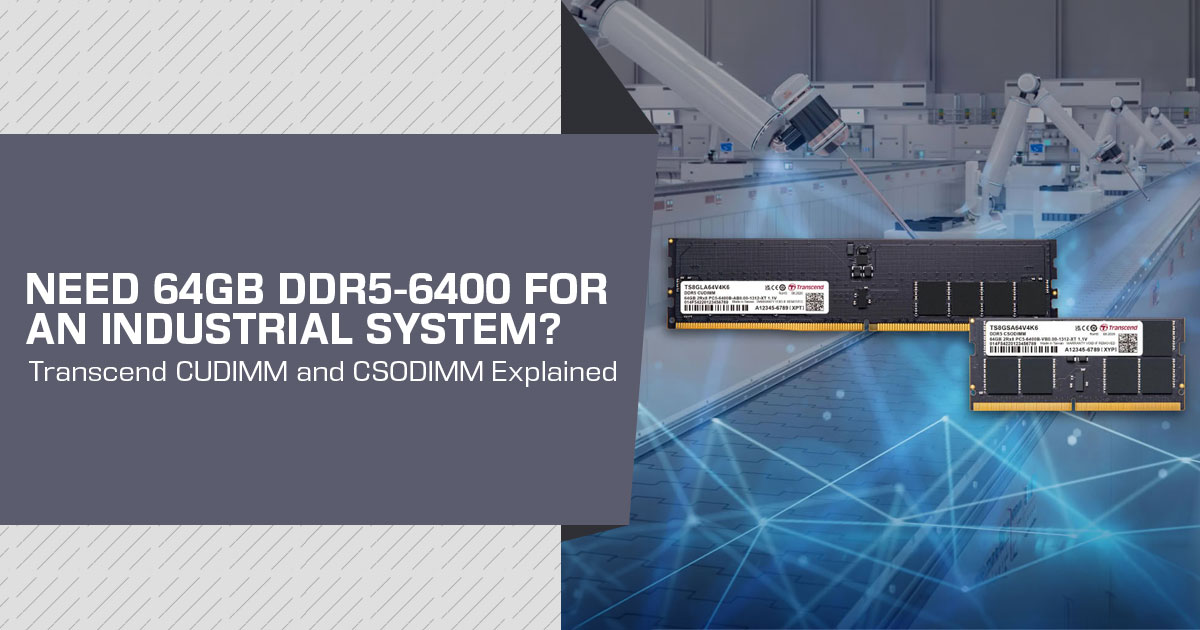
Introduction: Is Transcend’s DDR5-6400 CUDIMM and CSODIMM memory worth considering?
Transcend has announced DDR5-6400 CUDIMM and CSODIMM memory modules with capacities of up to 64GB per module. The new memory is aimed at industrial computers, edge AI systems, smart manufacturing, industrial automation, and embedded systems, rather than standard desktop PCs or gaming upgrades.
The main feature is the built-in Client Clock Driver (CKD), which helps maintain clock-signal stability at DDR5-6400 speeds. The modules also support 1.1 V operation, include an onboard power-management integrated circuit (PMIC), and offer temperature monitoring, transient-voltage protection, and On-Die ECC.
For system builders, the key question is not just speed or capacity. CUDIMM and CSODIMM support depends on the processor, motherboard, firmware, and system design. Transcend has not yet provided retail pricing, independent benchmarks, full platform compatibility details, or gaming performance comparisons, so there is not enough information to assess these modules as a consumer upgrade.
With over 20 years of experience in hardware and application research and development, we assess products through performance, durability, compatibility, and value for money. For these Transcend DDR5-6400 CUDIMM and CSODIMM modules, the focus is on industrial PC builders, embedded-system developers, edge AI system designers, automation engineers, and businesses that need high-capacity DDR5 memory for demanding systems. Our assessment considers component specifications, real-world usability, system requirements, and long-term use.
Bottom line: Transcend’s DDR5-6400 CUDIMM and CSODIMM memory is worth considering for compatible industrial and embedded platforms that need high-speed, high-capacity DDR5 memory. It should not be viewed as a direct replacement for standard desktop memory or server RDIMMs. Checking platform compatibility should come before any purchase.
Verified fact sheet for Transcend DDR5-6400 CUDIMM and CSODIMM embedded DRAM modules
The following fact sheet is the single reference point used throughout this article.
| Specification | Verified Information | What It Means for a Buyer |
|---|---|---|
| Manufacturer | Transcend Information, Inc. | The modules come from an established manufacturer specializing in memory and storage products. |
| Product Type | Embedded DDR5 DRAM modules | Primarily aimed at system integrators, industrial computers, and embedded equipment rather than conventional retail PC upgrades. |
| Maximum Capacity | Up to 64GB per module | A compatible platform can add substantial memory capacity without requiring multiple lower-capacity modules. |
| Transfer Rate | DDR5-6400 (6,400 MT/s) | The figure represents the effective data-transfer rate and should not be interpreted as a 6.4GHz physical memory clock. |
| Full-Size Format | CUDIMM | Designed for compatible full-size desktop, workstation, and industrial motherboard platforms. |
| Compact Format | CSODIMM | Designed for compatible compact systems, mini PCs, laptops, and embedded computing equipment. |
| Clocking Component | Client Clock Driver (CKD) | Buffers and regenerates the clock signal to help maintain signal integrity and stability at higher memory speeds. |
| Operating Voltage | 1.1V | The low-voltage design can help manage power consumption and heat, although actual results depend on the overall platform configuration. |
| Power Regulation | Integrated PMIC | Allows power regulation and distribution to be handled locally on the memory module. |
| Monitoring | SPD chip with integrated temperature sensor | Compatible firmware or monitoring software may use module-temperature data to support thermal management. |
| Electrical Protection | Transient Voltage Suppressor (TVS) | Helps protect the module against voltage transients, but does not replace appropriate power supplies, grounding, filtering, or board-level protection. |
| Error Handling | On-Die ECC | Provides internal error detection and correction within the DRAM chips. It should not be confused with full system-level ECC memory. |
| Target Applications | Edge AI, industrial automation, smart manufacturing, industrial PCs, and high-performance embedded systems | Optimized around sustained, predictable operation in professional and industrial environments rather than gaming-focused features. |
| Pricing | Not disclosed in the reviewed launch materials | Buyers should check current distributor or retailer pricing before making a purchasing decision. |
| Independent Testing | No independent benchmark data was provided in the reviewed materials | Real-world performance should not be assumed from the specification sheet alone; independent testing is needed to quantify actual gains. |
What are CUDIMM and CSODIMM?
CUDIMM stands for Clocked Unbuffered Dual In-Line Memory Module. It is the full-size version of this newer DDR5 memory design. CSODIMM stands for Clocked Small Outline DIMM. It is the smaller format intended for compact systems.
The letter “C” refers to clocked operation. A conventional UDIMM or SODIMM sends the clock signal through the platform without the same type of client clock driver. A CUDIMM or CSODIMM adds the CKD to help regenerate that signal closer to the memory devices.
The two formats are not interchangeable simply because both use DDR5 technology. A CUDIMM is physically different from a CSODIMM, and the motherboard or embedded system must have the correct socket and firmware support.
CUDIMM vs CSODIMM
| Category | CUDIMM | CSODIMM |
|---|---|---|
| Full Name | Clocked Unbuffered DIMM | Clocked Small Outline DIMM |
| Physical Format | Full-size desktop-style memory module | Compact memory module designed for space-constrained systems |
| Typical System Type | Desktops, workstations, and industrial motherboards | Laptops, mini PCs, compact industrial computers, and embedded devices |
| Main Technical Feature | Integrated Client Clock Driver (CKD) | Integrated Client Clock Driver (CKD) |
| Capacity in This Launch | Up to 64GB per module | Up to 64GB per module |
| Main Buyer Concern | Verify processor, motherboard, BIOS, and memory-layout compatibility before purchasing. | Verify memory socket, processor, firmware, thermal clearance, and supported capacity before purchasing. |
Why does the Client Clock Driver matter at DDR5-6400?
A memory module does not transfer data through an ideal electrical path. Traces on the motherboard, connectors, electrical loading, noise, and timing variation can all affect signal quality. These issues become more important as the transfer rate rises.
The Client Clock Driver buffers and regenerates the memory clock signal. In practical terms, it is intended to provide a cleaner and more stable timing reference for the memory devices. That can help a compatible system maintain reliable operation at DDR5-6400 under demanding workloads.
This feature should be interpreted carefully. A CKD is not a guarantee that every computer will run at 6,400 MT/s. The processor’s memory controller, motherboard layout, firmware training, memory configuration, and BIOS support still matter.
What does 64GB per module mean for system builders?
A 64GB module can be useful when a system needs more memory but has limited DIMM or SO-DIMM slots. This is relevant to compact industrial computers, edge-computing appliances, machine-vision equipment, robotics controllers, and other embedded platforms where motherboard space is limited.
However, the maximum module capacity does not automatically equal the maximum system capacity. A platform may impose limits based on the number of slots, memory ranks, processor support, firmware, thermal design, or the number of modules installed.
For that reason, buyers should confirm all of the following before ordering:
- The processor supports the intended DDR5-6400 CUDIMM or DDR5-6400 CSODIMM
- The motherboard or embedded computer lists the clocked module type as supported
- The latest BIOS or firmware can identify and train the memory correctly
- The platform supports the desired 64GB module capacity
- The system’s thermal design is suitable for sustained high-load operation
- The required form factor is CUDIMM or CSODIMM, not the other format.
- The supplier can provide the required product revision, operating-temperature range, and long-term availability.
1.1 V operation, PMIC, temperature sensing, and TVS protection
Transcend lists a 1.1 V low-voltage design for these modules. Lower operating voltage can help reduce power consumption and heat compared with higher-voltage memory designs, but the actual system-level result depends on the memory controller, workload, cooling, and firmware settings.
The integrated power-management integrated circuit (PMIC) regulates and distributes power on the module. Local power management can improve voltage-control precision, which is important in systems expected to run continuously or inside space-constrained enclosures.
The SPD chip includes a temperature sensor. This can give the system access to real-time module-temperature information, allowing thermal-management software or firmware to respond to changing conditions where the platform supports that function.
A transient-voltage suppressor (TVS) provides an additional protection component against voltage transients. It should not be described as complete protection from every power-quality problem. Industrial system designers still need appropriate power supplies, grounding, filtering, and board-level protection.
Does On-Die ECC make these modules suitable as server memory?
No. On-Die ECC is an internal error-correction feature built into the DDR5 DRAM chips. It can help detect and correct certain errors within the memory devices.
That is different from full system-level ECC memory, where the memory subsystem and platform work together to provide broader error detection and correction. It is also different from registered DIMM technology used in many servers.
The distinction matters because some buyers may see “ECC” and assume that the module is an RDIMM replacement. The reviewed launch materials do not support that conclusion. Buyers who need server-grade memory should check whether the system requires RDIMM, LRDIMM, or another qualified memory type.
Transcend CUDIMM and CSODIMM vs standard DDR5 and RDIMM
The most useful comparison is not a simple speed contest. Each memory type serves a different platform requirement.
| Memory Type | Main Advantage | Typical Environment | Important Limitation |
|---|---|---|---|
| Standard DDR5 UDIMM / SODIMM | Broad availability and familiarity across mainstream DDR5 platforms | Consumer desktops, laptops, and general-purpose computing systems | Lower-speed standard UDIMM/SODIMM modules may not use the same CKD-based architecture. At DDR5-6400 and above, the relevant clocked module architecture and platform support are required. |
| Transcend CUDIMM | Full-size clocked DDR5 memory with capacities of up to 64GB per module | Compatible desktops, workstations, industrial PCs, and embedded computing platforms | Requires compatible platform and firmware support; it is not a universal drop-in DDR5 upgrade. |
| Transcend CSODIMM | Compact clocked DDR5 memory with capacities of up to 64GB per module | Compatible mini PCs, laptops, and compact industrial or embedded systems | Both physical compatibility and platform-level firmware support must be verified before installation. |
| DDR5 RDIMM | Registered memory architecture designed for supported server platforms | Enterprise servers and data-center systems | Not interchangeable with CUDIMM or CSODIMM modules. |
| Gaming-Focused DDR5 Kit | Consumer-oriented tuning, broad availability, and potentially tighter memory timings | Gaming desktops and enthusiast PC builds | May not provide the same industrial qualification, validation, or long-term supply commitments as industrial memory products. |
Is this memory suitable for gaming PCs?
The answer depends on the platform, but the launch is not aimed primarily at gaming buyers. The reviewed materials do not include gaming benchmarks, latency comparisons, overclocking results, or retail pricing.
A compatible desktop might recognize a CUDIMM, but that does not mean every motherboard will operate it at its advertised transfer rate. Some systems may need specific processor and chipset support, while others may use a fallback mode or fail to train the memory correctly.
For a gaming build, a conventional DDR5 kit may be easier to source and verify. A CUDIMM becomes more interesting when the platform explicitly supports clocked DDR5 and the buyer values higher capacity, signal stability, or a system-builder supply program more than gaming-oriented timings and decorative features.
Transcend CUDIMM and CSODIMM vs competing industrial memory
Transcend is part of a broader CUDIMM and CSODIMM market. Micron and other memory suppliers also offer or discuss industrial DDR5-6400, DDR5 CSODIMM for embedded systems, 64GB CUDIMM, and Client Clock Driver technology.
| Buying Factor | Transcend Launch | What Buyers Should Compare With Competitors |
|---|---|---|
| Maximum Stated Capacity | Up to 64GB per module | Confirm whether a competitor’s advertised capacity refers to each module or the complete memory kit. |
| Transfer Rate | DDR5-6400 | Check whether the speed is specified in MT/s and confirm that the target platform supports the advertised transfer rate. |
| Form Factors | CUDIMM and CSODIMM | Verify the required physical form factor, memory socket, and platform compatibility before purchasing. |
| Signal-Management Feature | Client Clock Driver (CKD) | Confirm that the target platform has been validated for the module’s specific clock-driver implementation. |
| Industrial Features | PMIC, temperature sensor, TVS protection, and On-Die ECC | Compare the exact monitoring, protection, power-management, and error-handling features instead of relying on the broad “industrial” label. |
| Long-Term Deployment | Transcend states Taiwan manufacturing, quality controls, technical support, and a limited lifetime warranty. | Request details on revision control, long-term availability, environmental ratings, regional support, and warranty terms for the intended deployment. |
| Independent Evidence | No independent benchmark data was included in the reviewed launch materials. | Look for platform qualification results, compatibility testing, and sustained-load benchmarks before large-scale deployment. |
| Price | Not disclosed in the reviewed launch materials. | Compare authorized-distributor pricing, volume-purchase terms, regional availability, and replacement-stock availability. |
Independent and manufacturer sources also emphasize that CUDIMM and CSODIMM require platform support and are not server RDIMM replacements. That practical context is more useful to buyers than a list of component names without explaining their limits.
Real-world performance: what can and cannot be concluded
The DDR5-6400 specification indicates a high transfer rate, and the 64GB capacity may help workloads that keep large datasets in memory. Potentially relevant workloads include edge inference, industrial vision, simulation, real-time analytics, automation software, and embedded virtual machines.
Still, no independent benchmark results were found for these modules. It is not possible to state that they will outperform every standard DDR5 kit, reduce application latency by a fixed amount, or improve a particular AI workload without testing the complete system.
Performance will depend on memory-channel configuration, timings, processor architecture, software behavior, sustained thermal conditions, and whether the platform operates the modules at the advertised rate. The most defensible expectation is that these modules are designed to provide higher capacity and clock-signal support for compatible systems.
Pros and cons of Transcend DDR5-6400 CUDIMM and CSODIMM embedded DRAM modules
| Potential Advantages | Important Limitations |
|---|---|
| Supports capacities of up to 64GB per module. | Pricing was not disclosed in the reviewed materials. |
| Available in both full-size CUDIMM and compact CSODIMM form factors. | Compatibility cannot be assumed from the DDR5 designation alone; platform support should be verified before purchase. |
| Integrated Client Clock Driver (CKD) is designed to improve signal integrity and stability at higher DDR5 data rates. | Performance and stability benefits depend on support from the processor, motherboard, and system firmware. |
| 1.1V operating voltage may help improve power efficiency and thermal management. | Actual power consumption and operating temperatures depend on the complete system configuration and workload. |
| Includes PMIC, temperature sensing, TVS protection, and On-Die ECC for power management, monitoring, electrical protection, and internal error correction. | On-Die ECC should not be confused with full system-level ECC or registered server memory. |
| Designed for demanding industrial, edge-AI, and embedded computing deployments. | No independent performance benchmarks or gaming comparisons were identified in the reviewed material. |
| Manufacturer states that the modules include technical support and a limited lifetime warranty. | Buyers should confirm regional warranty conditions and long-term supply arrangements for their specific deployment. |
Who should buy Transcend DDR5-6400 CUDIMM or CSODIMM?
These modules may be a good fit for the following buyers:
- System integrators building industrial computers or embedded platforms.
- Engineers designing edge AI memory configurations for machine vision, automation, or local inference.
- Manufacturers that need high-capacity memory in a compact system enclosure.
- Buyers whose platform documentation specifically lists CUDIMM or CSODIMM support.
- Organizations that value monitoring, controlled qualification, and long-term technical support over gaming-oriented styling.
They may not be the right choice for:
- Buyers seeking a universal plug-and-play DDR5 upgrade.
- Server owners whose systems require RDIMM or LRDIMM.
- Gaming buyers who have not confirmed CUDIMM support on their processor and motherboard.
- Readers who need independent benchmark data before choosing a memory kit.
- Anyone who expects a 64GB module to guarantee a particular total system capacity.
Pricing and availability
Transcend’s launch materials reviewed for this article do not provide a retail price or a complete availability schedule. Industrial memory is often sold through distributors, integrators, or business channels rather than through the same retail listings used for consumer gaming memory.
Before purchasing, check the exact part number, module format, supported temperature range, warranty terms, minimum order conditions, and regional availability. A lower listed price is not necessarily better if the module revision, support terms, or qualification documentation do not match the deployment.
Amazon US purchase check
Check Amazon US for current Transcend DDR5-6400 CUDIMM and CSODIMM listings:
View current Amazon US offers
Use the link only after verifying that the listing shows the correct CUDIMM or CSODIMM form factor, the advertised 64GB module capacity, the required speed, and an acceptable seller and return policy. If no matching listing is available, an authorized industrial distributor may be a more appropriate source.
Amazon India purchase check
Check Amazon India for current Transcend DDR5-6400 CUDIMM and CSODIMM listings:
View current Amazon India offers
Availability may differ by region, and industrial modules may not appear in ordinary consumer search results. Confirm the exact part number, warranty coverage in India, seller authorization, delivery terms, and compatibility with the intended platform before ordering.
Frequently asked questions
What is Transcend’s 64GB DDR5-6400 CUDIMM?
It is a full-size clocked DDR5 memory module with a stated capacity of up to 64GB per module and a transfer rate of 6,400 MT/s. It includes a Client Clock Driver and is intended for compatible industrial, embedded, workstation, and other high-performance systems.
What is a DDR5-6400 CSODIMM?
A CSODIMM is the compact clocked form of DDR5 memory. Transcend’s announced module reaches up to 64GB per module and targets compact systems, embedded equipment, and industrial computers that support the format.
What does a Client Clock Driver do?
A Client Clock Driver buffers and regenerates the memory clock signal. It is intended to reduce the effect of noise and jitter during high-speed operation, but the system must support the technology to receive its full benefit.
Is CUDIMM the same as RDIMM?
No. CUDIMM is clocked unbuffered memory, while RDIMM is registered memory commonly used in supported servers. A CUDIMM should not be purchased as a presumed RDIMM replacement.
Does DDR5-6400 mean the memory runs at 6.4 GHz?
No. DDR5-6400 refers to 6,400 megatransfers per second. The physical clock frequency is different, and actual application performance depends on the complete memory platform.
Is On-Die ECC the same as ECC server memory?
No. On-Die ECC operates inside the DRAM chips. It should not be treated as proof that the module provides the same system-level error correction or server compatibility as a qualified ECC RDIMM.
Should a gaming PC buyer choose these modules?
Only after confirming explicit CUDIMM support from the processor, motherboard, and firmware. Buyers who do not need the industrial features may find a conventional, well-supported DDR5 kit easier to source and validate.
Final verdict
Transcend’s launch is relevant because it brings 64GB DDR5-6400 CUDIMM and CSODIMM memory into a clear industrial and embedded-system context. The combination of high capacity, a Client Clock Driver, low-voltage operation, PMIC, temperature monitoring, TVS protection, and On-Die ECC gives system builders several features to evaluate.
The product is not automatically suitable for every DDR5 computer. The decisive question is platform support. Buyers should confirm the processor, motherboard or embedded system, BIOS, module format, capacity limit, thermal design, warranty, and supply terms before ordering.
For industrial integrators and edge-computing designers with a validated platform, these modules appear worth investigating. For ordinary gaming or server upgrades, a conventional DDR5 kit or qualified RDIMM may be more appropriate unless the system documentation specifically supports CUDIMM or CSODIMM.
Have questions about CUDIMM, CSODIMM, DDR5-6400, or compatibility with your system? Leave a comment below. If you have experience with these memory modules, share it with us and other readers. Follow us for more hardware reviews, product analysis, and practical buying advice, and let us know if there is a product or technology you would like us to cover.
Disclaimer

This blog post reflects our research, analysis, and opinions based on available product information, user feedback, and industry knowledge. It should not be taken as the official position of any brand, manufacturer, or company mentioned here. We make every effort to keep this guide accurate, but product specifications, pricing, and availability may change after publication. We recommend double-checking important details before making a purchase.

Some links in this article may be affiliate links. If you choose to buy through these links, we may earn a small commission at no extra cost to you. This helps support our work and allows us to keep publishing in-depth, unbiased reviews. Affiliate partnerships never influence our recommendations.

Opinions expressed by readers are their own and do not necessarily reflect ours. We are not responsible for outcomes resulting from the use of information on this site. Please seek professional advice where appropriate.

All product names, logos, and brands mentioned are the property of their respective owners. These names are used for identification and informational purposes only and do not imply endorsement.