
How we reviewed this: We did not receive a review unit. This article is built from NVIDIA’s official COMPUTEX 2026 announcements, leaked and confirmed specification sheets, independent benchmark data, and our years of experience testing ARM laptops, discrete RTX graphics, and local-AI hardware. We’re telling you what the specs mean for real buyers — and where to stay skeptical — so you can pre-order or wait with confidence.
Quick Verdict
As technology experts with over 20 years of experience in hardware and application research and development, we evaluate every product beyond benchmark scores and marketing claims. Our recommendations are based on extensive research, component-level analysis, real-world performance, long-term reliability, and overall value for money, helping you choose the right product for your needs—not just the most advertised one.
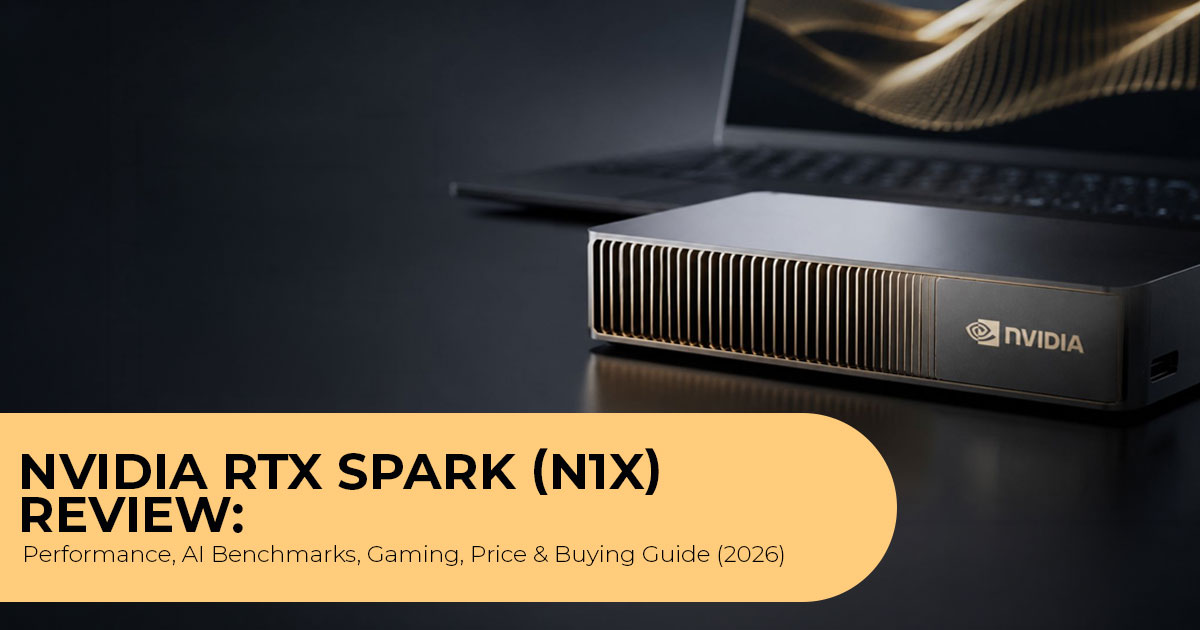
The NVIDIA RTX Spark, powered by the N1X Superchip, is one of the most ambitious Windows computing platforms NVIDIA has introduced for consumers. By combining GPU performance comparable to an RTX 5070-class GPU (according to NVIDIA), up to 128 GB of unified memory, and the complete CUDA ecosystem into a thin-and-light design, NVIDIA isn’t just releasing another Windows laptop. It’s bringing together AI acceleration, RTX graphics, and unified memory in a way that hasn’t been available in a consumer Windows system before.
- Buy it if you want one machine that can handle AAA gaming, video editing, 3D rendering, AI development, and running local LLMs or AI agents without paying for cloud
- Wait or skip if your workload depends on the fastest single-core CPU performance available today—where Apple’s M-series chips still lead—or if you’re looking for the lowest-cost gaming You may also want to wait if you need a new system before the expected Fall 2026 release.
Bottom Line
For AI developers, machine learning engineers, content creators, software professionals, researchers, and anyone looking for one powerful Windows laptop for work, creativity, and gaming, RTX Spark has the potential to become the standout Windows computer of 2026.
If your focus is purely budget gaming, a conventional RTX 50-series gaming laptop will still deliver better value for the money.
→ Check RTX Spark availability & pre-order pricing
What Is the NVIDIA RTX Spark (N1X Chip)?
RTX Spark is NVIDIA’s first consumer computing platform built around the N1X Superchip, designed for premium laptops and compact desktop systems.
Unlike traditional PCs that use a separate CPU and discrete graphics card, the N1X combines the processor, graphics engine, memory controller, and AI hardware into a single ARM-based System-on-Chip (SoC). Manufactured using TSMC’s advanced 3 nm process and containing roughly 70 billion transistors, the chip was co-developed with MediaTek, while Microsoft helped optimize Windows to take full advantage of the new architecture.
Simply put, RTX Spark is NVIDIA’s answer to Apple Silicon, but with a distinctly different focus. It delivers the efficiency of a modern ARM platform while retaining a dedicated RTX-class GPU and full support for the CUDA ecosystem—the software platform trusted by developers working in artificial intelligence, machine learning, scientific computing, 3D design, and professional content creation.
Instead of forcing users to choose between a lightweight productivity laptop, a powerful gaming machine, or an AI workstation, RTX Spark aims to combine those roles into a single Windows computer. If NVIDIA delivers on that promise, it could reshape expectations for what a high-performance laptop can do.
What the N1X Specifications Mean in Real-World Use
| Specification | NVIDIA RTX Spark (N1X) | What It Means in Practice |
|---|---|---|
| CPU | 20-core ARM Grace processor (10 Performance + 10 Efficiency cores) | Designed for smooth multitasking and strong performance in content creation, software development, and heavily parallel workloads. |
| GPU | Blackwell GPU with 6,144 CUDA cores (roughly equivalent to a desktop RTX 5070) | Capable of AAA gaming, GPU-accelerated rendering, video production, and AI workloads on a single laptop platform. |
| AI Performance | Up to 1 PFLOP FP4 (approximately 1,000 TOPS) | Enables large AI models to run locally without relying on cloud services or subscription-based inference. |
| Memory | Up to 128GB unified LPDDR5X memory | Large unified memory pool allows massive AI models, datasets, creative applications, and games to coexist without frequent swapping. |
| Memory Bandwidth | ~300 GB/s | Very high bandwidth for a laptop, though it remains one of the primary limits during sustained AI inference workloads. |
| Manufacturing Process | TSMC 3nm | Improves power efficiency, lowers heat output, and helps deliver longer battery life in thinner notebook designs. |
| Software Stack | Complete CUDA, RTX, and TensorRT support on Windows | Represents the first Windows-on-ARM platform offering NVIDIA’s full CUDA ecosystem for AI development, GPU computing, and accelerated creative software. |
The 3 Features That Actually Change Your Buying Decision
1. Full CUDA on Windows — the real differentiator
This is the single biggest reason RTX Spark exists. Neither Apple Silicon nor Qualcomm Snapdragon X supports NVIDIA’s full CUDA software ecosystem on Windows. RTX Spark, powered by the N1X Superchip, is designed to provide that capability. If you work in machine learning, scientific computing, or any CUDA-accelerated creative tool, this is the first laptop that lets you prototype and deploy on the same architecture used in NVIDIA’s data centers — TensorRT, PyTorch CUDA backends, llama.cpp, ComfyUI, all native.
Who this serves: AI/ML engineers, data scientists, researchers, and independent developers who are tired of renting cloud GPUs.
3. 128 GB unified memory = local AI without the cloud
A 70-billion-parameter model quantized to 4-bit needs roughly 40 GB. With up to 128 GB of unified memory, the platform should be capable of running 70B-class models locally, depending on the model architecture, quantization level, software stack, and context length. A 32 GB discrete GPU like an RTX 5090 can’t do this; it has to offload to slower system RAM.
Who this serves: Anyone who values privacy, wants to reduce or eliminate recurring cloud AI costs, or needs offline inference.
3. RTX 5070-class gaming in a ~14 mm chassis
NVIDIA says the platform is designed to deliver around 100 FPS at 1440p in supported titles, although independent testing will ultimately determine real-world performance.
Who this serves: Gamers who refuse to choose between portability and performance.
Honest caveat: Because the N1X is ARM, older x86 Windows games run through Microsoft’s Prism translation layer. Most native titles are fine, but some anti-cheat-protected multiplayer games have historically been problematic on Windows-on-ARM. Verify your must-play list before committing.
→ See which RTX Spark models are gaming-optimized
RTX Spark vs. the Competition: Where It Wins and Loses
| Need | Best Choice | Why It Stands Out |
|---|---|---|
| Windows, Gaming, and AI in One Machine | NVIDIA RTX Spark (N1X) | The only platform combining Windows, CUDA, RTX graphics, and AI acceleration in a single system. |
| Maximum Unified Memory Available Today | Apple Mac Studio (up to 192GB) | Available now with a mature MLX and Ollama ecosystem while remaining exceptionally quiet. |
| Best Single-Core CPU Performance | Apple M5 Series | Delivers industry-leading single-core performance, with the N1X architecture estimated to trail by roughly two generations. |
| Budget AAA Gaming (Under $1,500) | RTX 5060 / RTX 5070 Gaming Laptop | Provides more gaming GPU performance per dollar without the compatibility overhead of an ARM-based platform. |
| 24/7 Linux AI Development & Fine-Tuning | NVIDIA DGX Spark | Purpose-built for AI workloads with optimized thermals, higher-quality silicon, and continuous inference performance. |
| Most Affordable 128GB Local AI System | AMD Strix Halo Mini PC (around $1,499) | Offers significantly more unified memory for the price, although it lacks NVIDIA’s CUDA software ecosystem. |
Bottom line: RTX Spark isn’t trying to beat Apple on CPU benchmarks or beat budget laptops on price-per-frame. It isn’t designed to outperform every competitor in every category. Instead, its strength lies in combining Windows, CUDA, RTX graphics, and high-capacity unified memory into a single platform.
Pros & Cons
⬛ Pros
- Full CUDA + RTX developer stack on a Windows laptop (unique)
- Up to 128 GB unified memory for large local AI models
- GPU performance comparable to an RTX 5070-class GPU, according to NVIDIA
- Up to 1 petaflop FP4 AI performance, according to NVIDIA’s published specifications
- Thin, power-efficient, all-day battery designs (~14 mm chassis)
- Strong OEM lineup (ASUS, Dell, HP, Lenovo, Microsoft, MSI)
+ Cons
- CPU single-core performance trails Apple’s M-series
- ~300 GB/s memory bandwidth caps sustained AI inference speed
- Expected premium pricing (industry estimates: $2,500–$3,500); NVIDIA has not announced official retail prices
- Pre-release: no independent benchmarks yet
- Windows-on-ARM compatibility gaps for some legacy/anti-cheat games
Which RTX Spark Laptop Should You Buy? (OEM Guide)
First-wave RTX Spark systems ship Fall 2026 from six brands. Here’s how to choose based on who you are:
| User Profile | Recommended Choice | Why It Stands Out |
|---|---|---|
| Content Creator / Designer | ASUS ProArt P14 / ProArt P16 | Offers factory-calibrated, color-accurate displays along with creator-focused ports and workflow features. |
| Premium Productivity & AI User | Microsoft Surface Laptop Ultra | Combines a tandem OLED display, G-SYNC support, and an ultra-thin 14mm premium chassis for flagship AI computing. |
| Business / Enterprise | HP OmniBook or Dell | Strong enterprise management tools, reliable support, security features, and balanced hardware configurations. |
| Gamer / Performance Enthusiast | MSI | Known for aggressive performance tuning, robust cooling systems, and gaming-oriented optimizations. |
| Value-Oriented All-Round User | Lenovo | Traditionally delivers one of the best price-to-feature ratios with well-balanced hardware for everyday workloads. |
Keep in mind that performance, battery life, cooling, display quality, and noise levels will vary between manufacturers, even though they all use the same N1X platform.
→ Compare all RTX Spark models & current prices
Configuration advice: how much memory do you really need?
- 16 GB: Everyday use + light gaming + small models Minimum viable.
- 32–64 GB: Mainstream creators and gamers; comfortable headroom.
- 128 GB: Buy this if local AI is your reason for This is the config that lets you run 70B+ models and heavy scientific workloads — and it’s the one no discrete-GPU laptop can match.
RTX Spark vs. DGX Spark: Don’t Confuse Them
Both share NVIDIA’s Grace-Blackwell lineage, but they’re built for different people:
- DGX Spark — a Linux developer mini-PC (~$3,999), tuned for 24/7 model fine-tuning and serving. Early estimates put it ~20–30% faster on sustained AI thanks to better binning and cooling.
- RTX Spark — a Windows consumer laptop/desktop for gaming, creative work, and personal AI agents.
Rule of thumb: Want a tuned Linux ML workstation you can buy today? Get the DGX Spark. Want Windows, CUDA, and gaming in one portable machine? Wait for RTX Spark.
Price, Availability & Should You Wait?
- Release: Fall 2026 (confirmed by NVIDIA)
- Launch OEMs: ASUS & MSI first, then Dell, HP, Lenovo, Microsoft Surface, Acer, GIGABYTE
- Price: Not officially Analyst estimates: flagship N1X ~$2,500–$3,500; lower-tier N1 models lower. Treat all numbers as estimates.
Should you wait or buy something else now?
- Wait if you specifically need Windows + CUDA + big unified memory + gaming in one box — nothing shipping today matches it.
- Buy now if you need a 128 GB-class local-AI machine immediately — the Mac Studio M4 Max (up to 192 GB) is the closest shipping alternative.
Who Should Buy the NVIDIA RTX Spark
Buy it if you are:
- An AI/ML developer or data scientist who wants local CUDA without a workstation
- A creator who games and edits/renders and experiments with generative AI
- A researcher in biology, physics, genomics, or seismic analysis running GPU compute
- A power user who wants one premium device to replace a gaming laptop, a workstation, and a dev box
- Privacy-conscious and want on-device AI agents with no cloud
Wait or look elsewhere if you are:
- A budget gamer under ~$1,500 (an RTX 5060/5070 laptop gives more frames per dollar)
- An Apple user who mainly needs maximum memory today (Mac Studio ships now)
- Someone who needs peak single-core CPU benchmarks (Apple’s M-series still leads)
Frequently Asked Questions
Is the NVIDIA RTX Spark worth buying?
Yes — for AI developers, creators, and power users who want Windows, full CUDA, AAA gaming, and up to 128 GB of unified memory in one laptop. For budget-focused pure gamers, a traditional RTX 50-series laptop offers better value.
How much will RTX Spark laptops cost?
NVIDIA has not confirmed pricing. Analyst estimates place flagship N1X systems around $2,500–$3,500, with lower-tier N1 models cheaper. Wait for official numbers before budgeting.
When can I buy an RTX Spark laptop?
Fall 2026. ASUS and MSI lead the launch, followed by Dell, HP, Lenovo, Microsoft Surface, Acer, and GIGABYTE.
Is the N1X better than Apple Silicon for every workload?
Not necessarily. For GPU computing, CUDA-based AI workloads, and Windows gaming, the N1X appears highly competitive. For single-core CPU performance and some battery-focused workloads, Apple’s latest M-series chips are still expected to lead.
Can RTX Spark run large AI models locally?
Yes. With up to 128 GB of unified memory, it can potentially host models approaching 120 billion parameters, depending on quantization, memory allocation, context length, and software optimization.
RTX Spark or DGX Spark — which should I buy?
DGX Spark is a Linux dev workstation for 24/7 fine-tuning (buy it today if you need it). RTX Spark is a Windows consumer machine for gaming, creating, and personal AI (wait for Fall 2026). Same chip family, different mission.
Final Verdict
The NVIDIA RTX Spark isn’t just another laptop platform. If NVIDIA delivers on its promises, it could be one of the first Windows systems to genuinely combine gaming, professional creative work, and local AI development in a single portable device. By combining GPU performance comparable to an RTX 5070-class GPU (according to NVIDIA), up to 128 GB of unified memory, and the full CUDA software stack into a single ARM-based platform, NVIDIA aims to deliver one of the first Windows systems capable of handling AAA gaming, professional content creation, and private on-device AI workloads in a single machine.
Is it perfect? No. The CPU won’t out-benchmark Apple, the price is premium, and we’re still waiting on independent benchmarks. For AI developers, content creators, researchers, and professionals who rely on the CUDA ecosystem, RTX Spark currently offers a combination of hardware capabilities that no other announced Windows laptop matches. That said, its real-world standing will ultimately depend on independent testing once retail systems become available.
If that’s you, it’s worth the wait. If pure gaming value is your goal, stick with a traditional RTX 50-series laptop.
Last updated July 2026. Specs and timing are based on NVIDIA’s official announcements and independent reporting; pricing remains unconfirmed and should be verified at launch.
***Disclaimer***
This blog post reflects our research, analysis, and opinions based on available product information, user feedback, and industry knowledge. It should not be taken as the official position of any brand, manufacturer, or company mentioned here. We make every effort to keep this guide accurate, but product specifications, pricing, and availability may change after publication. We recommend double-checking important details before making a purchase.
Some links in this article may be affiliate links. If you choose to buy through these links, we may earn a small commission at no extra cost to you. This helps support our work and allows us to keep publishing in-depth, unbiased reviews. Affiliate partnerships never influence our recommendations.
Opinions expressed by readers are their own and do not necessarily reflect ours. We are not responsible for outcomes resulting from the use of information on this site. Please seek professional advice where appropriate.
All product names, logos, and brands mentioned are the property of their respective owners. These names are used for identification and informational purposes only and do not imply endorsement.