
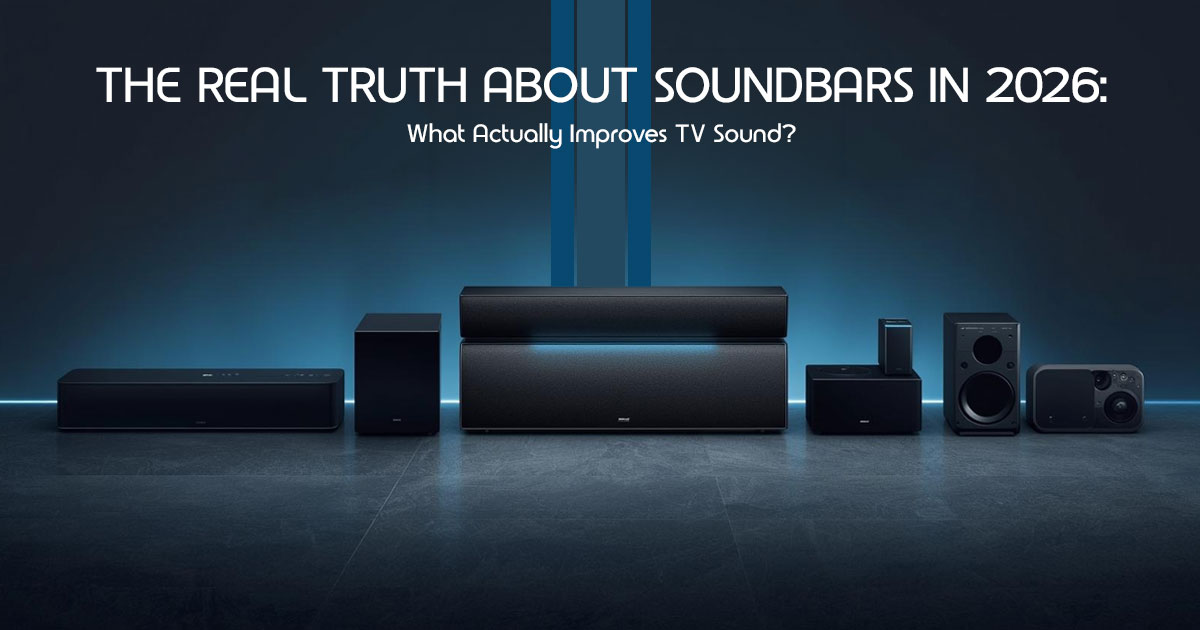
Why Your Thin TV Sounds So Bad
Most people spend weeks comparing 4K TVs, OLED panels, and refresh rates, then end up listening to movie dialogue through speakers that sound like they’re trapped inside a tin box. That’s the part most buyers don’t realize until the TV is already mounted on the wall.
Modern TVs have become unbelievably thin. And while ultra-thin TVs look impressive in a showroom, they create real sound limitations at home. There simply isn’t enough physical space inside today’s ultra-slim TVs for large speaker drivers, proper airflow, or deep bass. The result is weak sound, muffled voices, flat explosions, and volume levels that constantly need adjusting during movies and shows.
This is exactly why soundbars have become one of the fastest-growing home audio upgrades for modern TVs. A good soundbar can make dialogue clearer, add room-filling sound, improve gaming immersion, and completely upgrade your TV sound system at home.
But here’s where many people get frustrated.
A lot of buyers spend hundreds of dollars on a Dolby Atmos soundbar or a “cinematic audio system” only to discover it barely sounds better than their TV speakers. Marketing claims often sound bigger than the real-world experience. Some soundbars are amazing. Others focus heavily on marketing while offering limited real-world improvement.
That’s why customer reviews matter so much.
Specs alone rarely tell the full story. Real user feedback reveals things brands usually avoid talking about — weak bass performance, unclear dialogue, connection problems, poor surround effects, software bugs, and whether a soundbar actually feels worth the money after months of use.
In this guide, we break down what truly matters when buying the best soundbar for TV,
what features actually improve your experience, and which common mistakes lead to buyer’s remorse. You’ll also learn how different setups perform in real homes, apartments, gaming rooms, and family living spaces — not just in controlled marketing demos.
As technology experts with over 20 years of experience in hardware and application research and development, we deeply analyze each product based on real-world performance, durability, and value for money. Our goal is to help you find the best product in every category—budget, performance, reliability, and long-term usage. Whether you are a movie enthusiast, casual Netflix viewer, PS5 gamer, music lover, apartment owner, or someone simply tired of unclear TV dialogue, our recommendations are based on extensive research, component analysis, real-world usability, and industry expertise.
And there’s another reason this topic matters right now.
TV picture quality improved rapidly over the last decade, but many buyers still don’t understand what actually improves home audio. Today, many people own premium TVs but still don’t understand what makes a home theater sound system actually sound good.
Brands often focus on buzzwords like spatial audio, AI sound enhancement, and virtual surround sound, while ignoring the basics that truly change everyday listening.
This guide takes a different approach.
Instead of chasing marketing terms, we focus on the things you actually notice after living with a soundbar for weeks or months:
- Can you finally hear dialogue clearly?
- Does movie bass feel powerful without shaking the entire apartment?
- Is gaming audio more immersive?
- Does the sound stay balanced at low volume late at night?
- And most importantly — does it genuinely feel better than your TV speakers?
Because at the end of the day, the best soundbar for your home is not the one with the biggest spec sheet. It’s the one that makes your everyday watching experience feel richer, clearer, and more enjoyable every single time you press play.
TL;DR
- Modern ultra-thin TVs sacrifice sound quality because there’s little room for proper speakers.
- Many people buy expensive soundbars expecting theater-quality audio and end up disappointed.
- Real-world user reviews often reveal issues hidden behind marketing claims.
- A good home audio system should improve dialogue clarity, immersion, bass balance, and everyday usability.
- This guide explains what actually matters when choosing a soundbar for movies, gaming, music, and everyday TV watching.
- We focus on practical performance, long-term value, and real-life listening experiences — not marketing hype.
Quick Comparison: Soundbar Features That Actually Matter
| Feature | What It Actually Does | Why You Should Care |
| Channels | e.g., 2.1, 3.1, 5.1 | Shows how many speakers are built in. More channels usually improve audio quality, surround effects, and dialogue clarity. |
| Dolby Atmos | 3D spatial audio | Uses ceiling reflections and virtual height effects to create a more immersive surround sound experience. |
| HDMI eARC | High-speed audio connection | The best method for sending high-quality, uncompressed audio from your TV to a soundbar. |
| Wireless Subwoofer | Dedicated deep bass speaker | Adds stronger bass impact for movies, music, and gaming, making the overall sound feel fuller and more cinematic. |
| Room Calibration | Automatic sound tuning | Uses built-in microphones to adjust sound output based on your room layout and wall reflections. |
Soundbar Buying Guide: How to Choose Without Getting Overwhelmed
Instead of just looking at the price tag, use this simple “SPACE” framework to figure out what you actually need.
S — Size and Room Layout
A massive soundbar will look ridiculous under a 42-inch TV, and a tiny one will get “lost” in a large, open-plan living room. If you have high, vaulted ceilings, those fancy Dolby Atmos soundbars that bounce sound upward might not work as well as you’d hope.
P — Primary Use Case
Are you a movie enthusiast, a hardcore gamer, or a music lover?
- Movies: You need a dedicated center channel for clear
- Gaming: Look for low-latency connections and spatial audio so you can hear footsteps behind you.
- Music: You want a balanced soundstage and support for wireless music streaming via Wi-Fi or Bluetooth.
A — Audio Expectations
Be honest about your ears. If you just want to hear the news better, a basic 2.0 or 2.1 soundbar is plenty. If you want your floor to shake during action scenes, a soundbar with subwoofer will give you much deeper bass and a more cinematic feel.
C — Connectivity and Ecosystem
Make sure it has HDMI eARC. If you already own Sonos or Apple HomePod speakers, look for a soundbar that plays nice with your existing gear for multi-room audio.
E — Expansion Potential
Can you add rear speakers later? Some brands let you start with just the bar and add the “surround” parts when you have more budget. This is a great way to slowly build a more immersive surround sound system without spending everything upfront.
The “Dolby Atmos” Marketing Trap
You’ll see Dolby Atmos plastered on $100 soundbars these days. Don’t be fooled. The most convincing Dolby Atmos experience usually comes from soundbars with dedicated upward-firing speakers that reflect sound off the ceiling. Lower-cost models often rely on virtual audio processing to simulate height and surround effects without physical upward-firing speakers.
If you want the real cinematic effect, the best Dolby Atmos soundbar models usually come with dedicated upward-firing speakers that reflect sound off the ceiling.
Understanding the Numbers (2.1 vs 5.1 vs 7.1.4)
- 1: Two speakers in the bar and one subwoofer. Great for small rooms and a massive step up from TV speakers.
- 1: Adds a center speaker. This is the “sweet spot” for most people because it makes voices much easier to hear.
- 1: Adds two rear speakers. This is where you get actual surround sound.
- 1.4: The top-tier. The “.4” refers to four height channels used to create Dolby Atmos overhead effects. This is for people building a serious home entertainment hub.
Best Picks for Your Lifestyle
For Apartment Dwellers
You want clear sound without waking the neighbors. A compact wireless soundbar with a good Night Mode works especially well in apartments because it keeps dialogue clear without making explosions too loud.
Choosing the Right Gaming Soundbar for PS5 and Xbox
A good gaming soundbar should support HDMI 2.1 and include a dedicated “Game Mode” for lower latency and clearer directional audio. This helps reduce audio delay and makes competitive games feel more responsive and immersive.
For the “Dialogue First” Crowd
If you find yourself constantly turning the volume up for talking and down for action, look for a bar with “Voice Enhancement” or a dedicated center channel. This is a game-changer for older viewers or anyone tired of mumbling actors.
Setup Tips for the Best Experience
- Placement: Don’t hide your soundbar behind the TV or inside a It needs a clear “line of sight” to your ears.
- The Right Cable: Use the HDMI cable that came in the Not all old cables can handle high-resolution audio.
- Turn Off TV Speakers: Once you plug in your soundbar, go into your TV settings and disable the built-in speakers so they don’t interfere.
Common Questions (FAQs)
Q: Do I really need a subwoofer? If you watch movies or listen to music, yes. TV speakers have zero bass. A subwoofer provides that “thump” that makes audio feel full and professional.
Q: Can I use my TV remote to control the soundbar? Yes, as long as you use the HDMI eARC port. It syncs the power and volume automatically.
Q: Is a soundbar better than a full home theater? A full home theater audio system with 7+ separate speakers will always sound better, but it’s a nightmare to wire and takes up a ton of space. A high-end soundbar gets you 90% of the way there with 10% of the hassle.
Final Thoughts
If you want the feeling of a true home theater setup without filling your room with cables and speakers, a good soundbar setup is the easiest place to start. You don’t need to spend thousands to get a great experience. Focus on finding a soundbar that fits your room size, listening habits, and budget instead of chasing flashy marketing features. Your ears (and your family) will thank you.
***Disclaimer***
This blog post reflects our research, analysis, and opinions based on available product information, user feedback, and industry knowledge. It should not be taken as the official position of any brand, manufacturer, or company mentioned here. While we aim to keep information accurate and up to date, product details, pricing, and availability can change. We recommend double-checking important details before making a purchase.
Some links in this article may be affiliate links. If you choose to buy through these links, we may earn a small commission at no extra cost to you. This helps support our work and allows us to keep publishing in-depth, unbiased reviews. Our recommendations are never influenced by affiliate partnerships.
Comments shared by readers reflect their own views and not ours. We are not responsible for outcomes resulting from the use of information on this site. Please seek professional advice where appropriate.
All product names, logos, and brands mentioned are the property of their respective owners. These names are used for identification and informational purposes only and do not imply endorsement.