
Introduction
There was a time when buying a flagship graphics card was simple. You installed it, updated the drivers, and started gaming. Today, the conversation has changed. Modern GPUs are delivering performance that would have seemed impossible just a few years ago, but they are also consuming more power and generating more heat than ever before.
The RTX 5090 is a perfect example of this shift. Built to handle demanding 4K gaming, AI workloads, 3D rendering, and professional content creation, it packs an extraordinary amount of computing power into a single piece of hardware. The challenge is that all of that performance produces a tremendous amount of heat. Keeping temperatures under control is no longer just about comfort or noise levels—it directly affects sustained performance, system stability, power efficiency, and the long-term health of your investment.
This is where traditional GPU cooling starts to face real challenges.
For years, graphics card manufacturers responded to rising thermal demands by making air coolers larger and heavier. Bigger heatsinks, more heat pipes, and larger fans became the standard solution. But there is a practical limit to how much metal and airflow can be squeezed onto a graphics card. As power requirements continue to rise, many enthusiasts are beginning to ask a different question: Is adding a bigger cooler still the answer, or is it time to rethink GPU cooling entirely?
The arrival of the PNY RTX 5090 with LYNK+ Quick-Connect Cooling introduces a different way of thinking about GPU cooling. Instead of treating cooling as a permanent part of the graphics card, it separates the cooling system from the GPU itself, creating a platform that could potentially survive multiple upgrade cycles. For builders who regularly invest in high-end PC hardware, this raises an intriguing possibility: What if your cooling system becomes a long-term asset rather than something you replace with every new graphics card?
As technology experts with over 20 years of experience in hardware and application research and development, we evaluate products through the lens of real-world performance, durability, reliability, and long-term value for money. Whether you’re a competitive gamer chasing maximum frame rates, a content creator running hours-long rendering projects, an AI enthusiast building a local inference workstation, a PC hardware enthusiast looking for lower temperatures, or a system builder seeking a quieter and more efficient setup, understanding the strengths and limitations of modern GPU cooling solutions has never been more important.
Our recommendations are based on extensive research, component-level analysis, real-world usability, thermal performance evaluation, and industry expertise. We focus on helping readers find the best products across every category, including budget, performance, reliability, upgrade potential, and long-term ownership value.
In this guide, we’ll look beyond the product announcement and explore what modular GPU cooling actually means in practice. We’ll examine the thermal challenges of the RTX 5090, how the LYNK+ ecosystem works, where it fits against traditional air cooling, AIO GPU cooling, and custom water cooling loops, and whether this approach represents a genuine step forward or simply another experiment in enthusiast hardware.
Because with flagship GPUs now costing as much as complete gaming PCs once did, cooling is no longer an afterthought. It has become one of the most important factors in protecting performance, preventing thermal throttling, reducing noise, improving system longevity, and maximizing the return on your hardware investment.
The Shift from Traditional Air Cooling
For decades, air cooling has been the backbone of PC thermal management. Big heatsinks, copper pipes, and powerful fans have done a commendable job. But as GPUs grow larger, consume more power, and pack more transistors into smaller spaces, the effectiveness of even the most elaborate air coolers is reaching its limits.
We’re seeing cards that are three or even four slots thick, barely fitting into standard cases, all in an attempt to dissipate the heat generated. This trend is unsustainable for many users who value compact builds or simply want a quieter system. The industry is clearly signaling a shift, and liquid cooling is no longer just for extreme overclockers; it’s becoming a practical necessity for top-tier performance.
How Modular Cooling Changes the Upgrade Equation
Traditionally, if you wanted liquid cooling for your GPU, you had two main options: a factory-installed All-in-One (AIO) solution, which is often proprietary and not upgradeable, or a full custom loop, which requires significant expertise, time, and ongoing maintenance. Both have their drawbacks, especially when it comes to upgrading your GPU down the line.
A factory AIO means you’re tied to that specific card, and a custom loop means draining, disassembling, and reassembling a complex system. This is where modular cooling systems like LYNK+ become interesting. They try to make liquid cooling easier to live with while giving users a simpler upgrade path when it’s time to move to a new graphics card.
Quick Answer: What Is the PNY RTX 5090 LYNK+ Card?
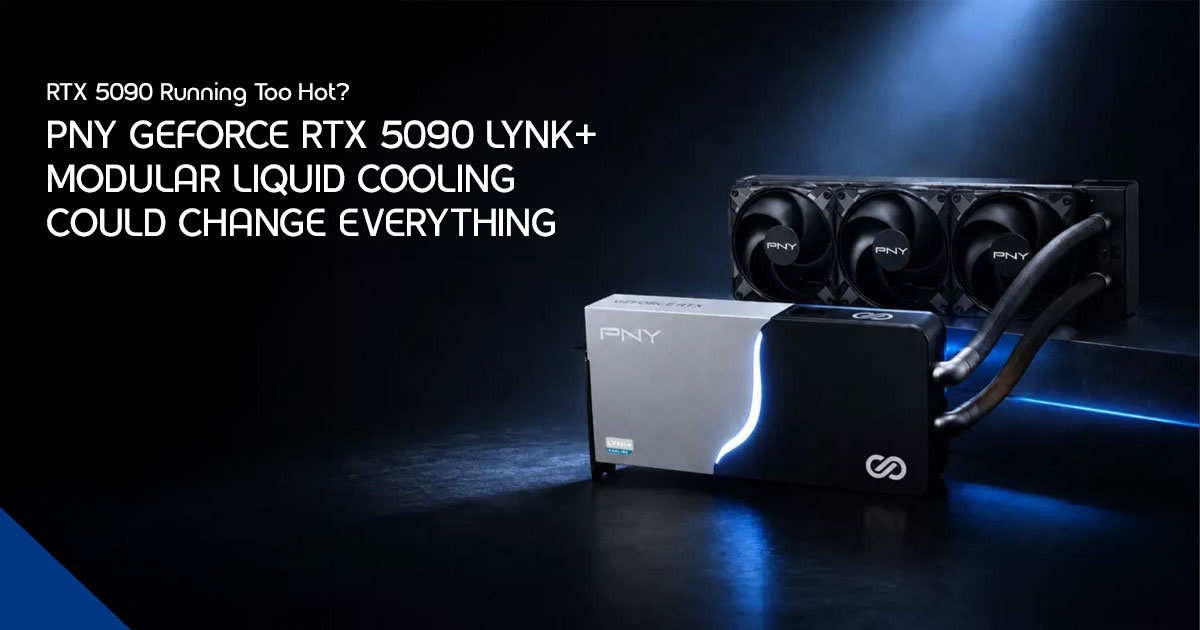
The PNY RTX 5090 LYNK+ is a high-performance graphics card featuring a modular, pre-filled liquid cooling system. Unlike traditional air-cooled cards or fixed AIO solutions, the LYNK+ system uses quick-connect fittings to easily attach a separate radiator module to the GPU’s cooler module. This design aims to provide superior thermal performance and quieter operation, with the added benefit of easier installation and the potential for future compatibility with new GPUs, making liquid cooling more accessible and less daunting for PC builders.
Overview Summary
What it is
The PNY RTX 5090 LYNK+ is a modular, pre-filled liquid cooling system for the RTX 5090 graphics card. It combines a GPU cooler module with a separate radiator module using drip-free quick-connect fittings, offering an easier-to-install alternative to custom liquid cooling loops.
Who it’s for
This system is designed for enthusiast PC builders, gamers, AI developers, and content creators who demand top-tier performance from their RTX 5090 and seek superior thermal management and quieter operation without the complexity of traditional custom water cooling.
Main benefit
The primary benefit is significantly lower GPU temperatures and reduced noise levels compared to traditional air cooling. According to LYNK+, the GPU cooling system can lower GPU temperatures by up to 25°C under specific testing conditions and reduce acoustic noise levels by up to 50% compared to conventional air-cooled solutions. These improvements can help maintain more consistent performance, sustain higher boost clocks for longer periods, and enhance the overall gaming experience or professional workload performance. The modular design also provides a more flexible GPU upgrade path for future GPU generations.
Biggest drawback
The biggest drawback is the initial investment cost and the requirement for case compatibility to house the radiator. While easier than a custom loop, it still involves more installation steps than a simple air cooler, and potential warranty implications should be considered.
Why RTX 5090 Cooling Matters More Than Previous Generations
It’s easy to look at a new graphics card and just see the raw performance numbers. But for anyone building or upgrading a high-end PC, the story goes much deeper, especially with something like the RTX 5090. This isn’t just another incremental upgrade; it’s a generational leap that brings with it some serious thermal considerations that simply weren’t as pressing before.
Power Consumption Reality
The reality is simple: the RTX 5090 is a power-hungry beast. While exact figures can vary based on specific models and workloads, we’re talking about GPUs that can easily draw upwards of 500-600 watts under heavy load. To put that into perspective, that’s more than many entire gaming PCs consumed just a few years ago. This isn’t a flaw; it’s a consequence of pushing performance boundaries.
More transistors, higher clock speeds, and increased memory bandwidth all contribute to higher power draw, and every watt consumed ultimately translates into heat that needs to be dissipated. Ignoring this reality means compromising performance, as the card will automatically reduce its clock speeds (thermal throttle) to stay within safe operating temperatures.
Thermal Density Explained
It’s not just the total power consumption that’s the issue; it’s how concentrated that heat is. Modern GPUs pack billions of transistors into a relatively small silicon die. This creates an incredibly high thermal density, meaning a huge amount of heat is generated in a very small area.
Imagine trying to cool a tiny, super-hot stovetop burner compared to a large, warm oven. The burner is much harder to cool efficiently because the heat is so concentrated. This high thermal density makes it challenging for even the most advanced air coolers to quickly draw heat away from the GPU die and other critical components like VRAM and VRMs, which also run hot.
Why Bigger Air Coolers Are Reaching Their Limits
For a long time, the solution to increasing GPU heat was simple: make the air cooler bigger. Add more fins, more heat pipes, and larger fans. This strategy has worked remarkably well, leading to the massive, multi-slot air coolers we see today. However, this approach is hitting a wall.
There’s only so much physical space inside a PC case, and these coolers are already pushing the boundaries of compatibility. Beyond a certain point, making an air cooler larger yields diminishing returns in cooling performance, while significantly increasing its size, weight, and noise output.
The airflow dynamics inside a case also become more complex, and simply adding more fans can lead to turbulence and increased noise without a proportional improvement in cooling.
This is why alternative cooling methods are becoming not just appealing, but increasingly necessary for the top-tier cards.
Understanding the LYNK+ Modular Cooling Ecosystem
The LYNK+ system isn’t just another AIO; it’s a thoughtfully designed ecosystem built around modularity and ease of use. It aims to bridge the gap between the simplicity of air cooling and the performance of custom liquid loops, without the associated headaches. This approach is what makes it particularly interesting for the RTX 5090 generation.
How the Quick-Connect System Works
At the heart of the LYNK+ system is its patented drip-free quick-connect system. This is the real game-changer. Instead of dealing with messy tubes, fittings, and coolant, you simply connect the radiator module to the GPU cooler module with a single screw. Both modules come pre-filled from the factory, eliminating the need for draining, bleeding, or filling the loop yourself.
This design ensures that coolant stays where it belongs, preventing spills and making installation significantly less intimidating than a traditional custom loop. The quick-connect mechanism also allows for easy detachment, which is crucial for future upgrades or maintenance.
Radiator Module
The LYNK+ 360 Radiator Module is a slim, universal unit that houses an integrated high-performance, ultra-low noise pump. It’s designed to be compatible with most modern PC cases that support a 360mm radiator.
The radiator surface area is optimized for efficient heat dissipation, and it supports three 120mm fans. The use of innovative low-diffusion tubing contributes to its maintenance-free design and long operational lifespan. This module is essentially the powerhouse of the cooling system, pushing coolant through the loop to carry heat away from the GPU.
GPU Cooler Module
The LYNK+ GPU Cooler Module is a full-cover block specifically engineered for RTX 5090 graphics cards. It’s designed to dissipate heat from all critical components, including the GPU die, VRAM, and VRMs, much like a high-end custom water block.
The copper coldplate features finely machined microfins to maximize surface area and heat transfer. An integrated reservoir within the block helps prevent air bubbles from getting trapped, ensuring consistent performance whether the GPU is mounted horizontally or vertically. This module comes factory-mounted on the graphics card, ensuring a perfect fit and optimal thermal contact.
Plate Kits
To ensure broad compatibility with various RTX 5090 board designs, LYNK+ offers different GPU Plate Kits. These kits provide the necessary backplate to ensure optimal connectivity between the GPU cooler block and the specific PCB layout of your RTX 5090.
Since different manufacturers (like PNY, Zotac, Palit/Gainward, Inno3D, MSI) might use slightly different PCB designs, having these specific plate kits is essential for a proper fit and efficient cooling. This attention to detail ensures that the modular system can adapt to the diverse landscape of GPU designs.
Air Cooling vs AIO Cooling vs Custom Loops
When it comes to cooling your high-end GPU, especially something as demanding as an RTX 5090, you’ve got a few main paths you can take. Each has its own set of trade-offs, and understanding them is key to making the right choice for your build and budget. Let’s break down the common options and see where the LYNK+ modular approach fits in.
Stock Air Cooler
This is what comes with most graphics cards, and for many years, it was perfectly adequate. Modern stock air coolers can be quite sophisticated, featuring large heatsinks, multiple fans, and intricate heat pipe designs.
Pros
- Cost-Effective: Included with the GPU, so no additional purchase necessary.
- Easy Installation: Simply plug the card into your motherboard.
- No Maintenance: Generally maintenance-free, beyond occasional dust cleaning.
- Broad Compatibility: Fits into most cases without special considerations (though larger cards can be tight).
Cons
- Limited Performance: Struggles with the extreme heat output of top-tier GPUs like the RTX 5090, leading to higher temperatures and potential thermal throttling.
- Noise Levels: Can become very loud under heavy load as fans spin up to compensate for heat.
- Aesthetics: Often bulky and can obscure other components.
- Case Airflow Dependent: Performance is heavily reliant on good case airflow, which can be a challenge.
Factory Liquid-Cooled RTX 5090s
Some manufacturers offer RTX 5090 cards with pre-installed All-in-One (AIO) liquid coolers. These are essentially self-contained liquid cooling systems that come attached to the GPU, similar to CPU AIOs.
Examples:
- ASUS Astral LC
- ZOTAC ArcticStorm
Pros
- Improved Performance: Significantly better thermal performance than stock air coolers, leading to lower temperatures and more stable boost clocks.
- Reduced Noise: Generally quieter than air coolers under load, as the heat is moved to a larger radiator that can be cooled by slower-spinning fans.
- Convenience: Pre-assembled and sealed, reducing the risk of leaks and simplifying installation compared to custom loops.
Cons
- Proprietary Design: Often tied to a specific GPU model and not easily transferable to future cards.
- Limited Modularity: You’re stuck with the radiator size and pump included by the manufacturer.
- Case Compatibility: Still requires space for a radiator, typically 240mm or 360mm.
- Higher Cost: More expensive than air-cooled versions of the same GPU.
LYNK+ Modular Approach
This is where the PNY RTX 5090 LYNK+ system carves out its niche. It combines the benefits of AIO convenience with a degree of modularity previously reserved for custom loops.
Pros
- Excellent Thermal Performance: Comparable to factory AIOs and approaching custom loop performance, offering significant temperature drops (up to 25°C lower GPU temps) and quieter operation (50% lower acoustic noise).
- Ease of Installation: Drip-free quick-connect fittings make installation much simpler and less intimidating than a full custom loop.
- Long-Term Upgrade Flexibility: The universal radiator module may be reused with compatible future GPU generations by replacing only the GPU cooler module and plate kit. This approach could reduce upgrade costs over time and extend the usefulness of the cooling ecosystem across multiple GPU generations.
- Maintenance-Free: Pre-filled and sealed, requiring no draining or refilling.
- Expandability: The LYNK+ ecosystem is designed to be expandable, potentially allowing for CPU cooling integration in the future.
Cons
- Initial Investment: While offering long-term savings, the upfront cost for the LYNK+ system is an additional expense beyond the GPU itself.
- Case Clearance: Requires adequate space for a 360mm radiator, which might not fit in all cases.
- Limited GPU Compatibility (Currently): While modular for future GPUs, it’s currently designed for specific RTX 5090 models and their corresponding plate kits.
- Still an AIO: While modular, it doesn’t offer the ultimate flexibility and customization of a full custom loop.
Full Custom Loop
This is the enthusiast’s choice, offering the absolute best in thermal performance, noise reduction, and aesthetic customization. It involves individually selecting and assembling components like pumps, reservoirs, radiators, blocks, tubing, and fittings.
Pros
- Unmatched Performance: The best possible thermal performance, allowing for extreme overclocking and lowest temperatures across all components (CPU, GPU, RAM, motherboard VRMs).
- Ultimate Customization: Complete control over aesthetics, component choice, and loop design.
- Lowest Noise: With large radiators and powerful pumps, fans can run at very low RPMs, resulting in near-silent operation.
- Long-Term Investment: Components can be reused and reconfigured across multiple system builds.
Cons
- High Complexity: Requires significant technical knowledge, planning, and patience to design, assemble, fill, and maintain.
- High Cost: The most expensive cooling solution, with individual components adding up quickly.
- Time-Consuming: Installation and maintenance can take many hours.
- Risk of Leaks: While rare with proper installation, the potential for leaks and damage to components is higher than with sealed AIOs.
- Regular Maintenance: Requires periodic draining, cleaning, and refilling of coolant.
Expected Performance in Real-World Workloads
Numbers on a spec sheet are one thing, but how does the PNY RTX 5090 LYNK+ actually perform in the real world? We’re interested in how this modular cooling system translates into tangible benefits across the most demanding applications. Our focus here isn’t just on raw FPS or benchmark scores, but on sustained performance, thermal stability, and overall user experience in scenarios where the RTX 5090 truly shines.
RTX 5090 Air Cooling vs Liquid Cooling
One of the biggest questions buyers ask is whether RTX 5090 liquid cooling is actually worth the extra cost compared to traditional RTX 5090 air cooling.
The answer depends on how you use your system.
For most gamers, a high-quality air-cooled RTX 5090 will deliver excellent performance and remain within safe operating temperatures. Modern air coolers are far more capable than many people realize.
However, as GPU power consumption continues to rise, liquid cooling offers several advantages. By moving heat away from the graphics card and into a dedicated radiator, a liquid-cooled setup can often maintain lower temperatures, reduce fan noise, and help the GPU sustain higher boost clocks during long gaming sessions or demanding workloads.
RTX 5090 Air Cooling
Best For:
- Most gamers
- Plug-and-play users
- Lower upfront cost
Advantages:
- Simpler installation
- No radiator required
- Lower purchase cost
- Minimal maintenance
Limitations:
- Higher GPU temperatures
- Increased fan noise under load
- Larger GPU coolers can restrict airflow
RTX 5090 Liquid Cooling
Best For:
- Enthusiast gamers
- AI developers
- Content creators
- Quiet PC enthusiasts
Advantages:
- Lower operating temperatures
- Reduced acoustic noise
- Better thermal stability
- Improved sustained performance
Limitations:
- Higher upfront cost
- Requires radiator space
- More installation planning
For users running long gaming sessions, AI workloads, video rendering, or other GPU-intensive tasks, RTX 5090 liquid cooling can provide meaningful thermal and acoustic benefits. For casual gaming, a quality air-cooled card remains a practical and cost-effective choice.
4K Gaming
Modern AAA games, especially at 4K resolution with ray tracing enabled, push GPUs to their absolute limits. This is where thermal throttling can quickly become an issue with less effective cooling solutions. The LYNK+ system aims to keep the RTX 5090 running cooler, allowing it to maintain higher boost clocks for longer periods, translating directly into smoother gameplay and higher average frame rates.
- Cyberpunk 2077: A notoriously demanding title, especially with its path tracing mode. We expect the LYNK+ to significantly reduce temperature spikes and maintain consistent performance during extended play sessions, preventing the dips in frame rate often seen with air-cooled cards as they heat up.
- Black Myth Wukong: As a visually stunning, upcoming title, it’s anticipated to be another GPU-intensive Stable temperatures from the LYNK+ should ensure the RTX 5090 can render its intricate environments and effects without compromise.
- Starfield: While not as graphically intense as Cyberpunk, its vast open worlds and detailed environments can still put a strain on the The LYNK+ should provide a comfortable thermal headroom, ensuring a smooth experience even in densely populated areas or during prolonged exploration.
AI Workloads
The RTX 5090 isn’t just for gaming; it’s a powerhouse for AI development and inference. These workloads often involve sustained, 100% GPU utilization for hours on end, making thermal management absolutely critical. Overheating can lead to reduced computational throughput and even system instability.
- LLM Inference: Running large language models locally requires immense computational The LYNK+ cooling should allow the RTX 5090 to maintain peak performance during complex inference tasks, speeding up response times and enabling larger models to run efficiently.
- Stable Diffusion: Generating high-resolution images with AI art tools like Stable Diffusion is a highly parallelized task that can quickly heat up a With LYNK+, we anticipate faster image generation times due to sustained clock speeds and improved stability during batch processing.
- Local AI Development: For developers training or fine-tuning AI models, consistent performance is The LYNK+ system provides the thermal stability needed for long training runs, preventing performance degradation that could otherwise prolong development cycles.
Content Creation
Professional content creators rely on their GPUs for rendering, video editing, and 3D modeling. These applications often involve bursts of intense activity followed by sustained loads, all of which benefit from efficient cooling.
- Blender: 3D rendering in Blender, especially with Cycles or Eevee, can push the GPU to its The LYNK+ should ensure faster render times by allowing the RTX 5090 to operate at its maximum potential without thermal throttling.
- Premiere Pro: Video editing, particularly with 4K or 8K footage and complex effects, heavily utilizes the Cooler operation means smoother playback, faster exports, and a more responsive editing experience.
- DaVinci Resolve: Similar to Premiere Pro, Resolve benefits significantly from a well-cooled GPU for color grading, effects, and rendering. The LYNK+ system should contribute to a more efficient and stable workflow for professional videographers.
Temperature Expectations
One of the most compelling reasons to invest in a liquid cooling solution like the LYNK+ is the promise of significantly lower operating temperatures. While exact numbers will always vary based on ambient room temperature, case airflow, and specific workloads, we can set some realistic expectations based on the LYNK+ claims and general liquid cooling performance.
Idle
Actual idle temperatures will vary based on ambient room temperature, case airflow, fan curves, and workload. This is a significant improvement over air-cooled cards, which might idle in the 30s or even low 40s, especially in warmer environments. Lower idle temps contribute to a quieter system and less heat saturation within your PC case.
Gaming
During intense 4K gaming sessions, where the GPU is under heavy, but often fluctuating, load, we anticipate the LYNK+ to keep the RTX 5090 well within comfortable operating ranges. Final gaming temperatures will depend on case airflow, ambient temperature, workload, and radiator placement. This 15-25°C reduction compared to air cooling is crucial for sustained boost clocks and preventing thermal throttling.
AI Workloads
AI workloads, characterized by sustained 100% GPU utilization, are the ultimate test for any cooling system. Here, the LYNK+ should truly shine. Expected to remain significantly cooler than comparable air-cooled models, though independent testing is still needed. This level of thermal control is vital for maintaining consistent performance and ensuring the longevity of the GPU under such demanding conditions.
Rendering
Similar to AI workloads, rendering tasks in applications like Blender or DaVinci Resolve will put a constant, heavy load on the GPU. The LYNK+ system should deliver similar temperature performance, helping the RTX 5090 maintain lower operating temperatures during extended rendering workloads, although actual results will vary depending on system configuration and ambient conditions.
Noise Expectations
Beyond raw thermal performance, noise is a critical factor for many PC enthusiasts. A powerful GPU that sounds like a jet engine under load can quickly ruin the experience, regardless of how many frames per second it’s pushing. Here’s how the different cooling solutions stack up in terms of acoustics.
Stock Air Cooling
Stock air coolers, especially on high-end cards like the RTX 5090, can be quite loud under load. As temperatures rise, the fans spin faster and faster to dissipate heat, often producing a noticeable whirring or even a high-pitched whine.
While idle noise might be acceptable, during intense gaming or demanding AI workloads, these coolers can easily reach 40-50 dBA or higher, making them the loudest component in many systems. This can be particularly distracting for users who prefer a quiet computing environment or those who don’t use headphones.
LYNK+ Setup
One of the significant advantages of liquid cooling is its ability to move heat away from the GPU to a larger radiator, which can then be cooled by larger, slower-spinning fans. The LYNK+ system, with its integrated low-noise pump and 360mm radiator, is designed to be significantly quieter than stock air cooling.
LYNK+ claims approximately 50% lower acoustic noise levels during demanding GPU workloads. Based on the design of the cooling system, users can reasonably expect lower noise levels than most high-end air-cooled RTX 5090 models, although actual acoustic performance will vary between systems. The noise profile will primarily be that of the radiator fans, which can often be controlled and optimized for silence.
Custom Loop Comparison
Full custom liquid cooling loops offer the ultimate in noise reduction. With large radiators (often multiple 360mm or 420mm units) and powerful, quiet pumps, custom loops can achieve near-silent operation even under extreme loads.
By spreading the heat across a much larger surface area, fans can run at very low RPMs, often inaudibly. It’s not uncommon for well-built custom loops to maintain noise levels in the 20-30 dBA range under full load, making them virtually silent.
While the LYNK+ is a huge step up from air cooling, a meticulously optimized custom loop still holds the crown for the quietest possible operation.
Who Should Buy It?
The PNY RTX 5090 LYNK+ isn’t for everyone, but for a specific set of users, it offers a compelling solution to the thermal challenges of high-end GPUs. If you fall into one of these categories, the LYNK+ system might be exactly what you need.
Enthusiast Gamers
If you’re an enthusiast gamer who demands the absolute best performance from your RTX 5090, especially at 4K resolutions with ray tracing, and you want to ensure consistent frame rates without thermal throttling, the LYNK+ is a strong contender.
It allows your GPU to maintain higher boost clocks for longer, translating directly into a smoother and more immersive gaming experience. If you also value a quieter gaming rig, the reduced noise levels compared to air cooling will be a significant bonus.
AI Builders
For AI builders, researchers, and developers who utilize their RTX 5090 for sustained, intensive workloads like LLM inference, Stable Diffusion, or local model training, the LYNK+ offers crucial thermal stability.
These applications push GPUs to 100% utilization for extended periods, making efficient cooling paramount to prevent performance degradation and ensure the longevity of your expensive hardware. The LYNK+ helps maintain peak computational throughput, which can directly impact your productivity and research outcomes.
Content Creators
Content creators working with demanding applications like Blender, Premiere Pro, or DaVinci Resolve will find immense value in the LYNK+ system. Faster render times, smoother video editing, and a more responsive workflow are direct benefits of a cooler-running GPU. If your livelihood depends on your PC’s performance, investing in a cooling solution that prevents thermal throttling during critical tasks is a wise decision.
Silent PC Enthusiasts
If you’re a silent PC enthusiast who prioritizes a quiet computing environment, the LYNK+ is a significant upgrade over stock air cooling. The ability to move heat to a larger radiator, cooled by slower-spinning fans, drastically reduces acoustic output under load. While not as silent as a meticulously optimized custom loop, it offers a much quieter experience than even the best air coolers, making your high-performance rig a pleasure to work and play on without the constant fan noise.
Who Should Skip It?
While the PNY RTX 5090 LYNK+ offers compelling advantages for certain users, it’s not a universal solution. For others, the investment and effort might outweigh the benefits. Here are a few scenarios where you might be better off sticking with a different cooling approach.
Casual Gamers
If you’re a casual gamer who primarily plays less demanding titles, or you’re content with 1440p gaming without pushing every setting to the absolute maximum, the LYNK+ is likely overkill.
The stock air cooler on an RTX 5090, while loud under load, will still provide perfectly adequate cooling for most scenarios. The significant additional cost and installation effort of the LYNK+ won’t translate into a proportional improvement in your specific use case.
Frequent Hardware Flippers
For those who frequently upgrade or sell their hardware, the modularity of LYNK+ might seem appealing, but the initial investment and the niche market for used modular cooling components could make it less practical.
While the radiator is reusable, the GPU cooler module is specific to the RTX 5090. If you’re constantly swapping out your GPU every year or two, the hassle of reinstalling and potentially reselling the LYNK+ components might not be worth it compared to simply buying a new air-cooled card each time.
Small Cases Without Radiator Support
This is a practical limitation. If you own a small form factor (SFF) PC case or any case without adequate mounting points for a 360mm radiator, the LYNK+ system simply won’t fit. While some SFF cases can accommodate 240mm or even 280mm AIOs, a 360mm radiator requires substantial space.
Attempting to force it into an incompatible case will lead to poor airflow, higher temperatures, and a frustrating build experience. Always verify case compatibility before considering any large liquid cooling solution.
Frequently Asked Questions
Is the PNY RTX 5090 LYNK+ cooler worth it?
For enthusiast gamers, AI builders, and content creators who demand peak performance and quiet operation from their RTX 5090, the LYNK+ cooler is a worthwhile investment. It significantly lowers temperatures and noise compared to air cooling, and its modularity offers long-term upgrade value. For casual users, it might be overkill.
Does LYNK+ perform like a custom loop?
The LYNK+ system aims to narrow the gap between factory AIO cooling and custom water-cooling loops. However, it lacks the ultimate customization and multi-component cooling capabilities of a full, open custom loop.
Can the radiator be reused with future GPUs?
Yes, the LYNK+ radiator module is designed for reuse with future GPU generations. You would only need to replace the GPU cooler module and the specific plate kit for your new graphics card, making it a more sustainable upgrade path.
Is GPU liquid cooling safe?
Modern GPU liquid cooling systems, especially pre-filled and sealed AIOs like LYNK+, are very safe. They are designed to be leak-resistant and undergo rigorous testing. Proper installation and occasional visual checks further minimize any risks.
How much cooler is the RTX 5090 with LYNK+?
According to LYNK+, the cooling system can reduce RTX 5090 GPU temperatures by up to 25°C compared to traditional air cooling under specific testing conditions. Actual operating temperatures will vary depending on case airflow, ambient temperature, workload, and system configuration.
Does installation require draining coolant?
No, installation does not require draining coolant. Both the radiator and GPU cooler modules come pre-filled and utilize drip-free quick-connect fittings, making the installation process clean and straightforward without handling liquid coolant.
Does liquid cooling improve RTX 5090 FPS?
Liquid cooling does not automatically increase FPS. However, lower GPU temperatures can help the RTX 5090 maintain higher boost clocks for longer periods. In demanding games and extended workloads, this can result in more consistent performance and fewer drops caused by thermal throttling.
Is a 360mm radiator enough for RTX 5090?
A high-quality 360mm radiator is generally considered sufficient for cooling an RTX 5090 under gaming and professional workloads. Actual results depend on radiator quality, fan configuration, ambient temperature, and case airflow.
Does GPU liquid cooling require maintenance?
Most closed-loop and pre-filled liquid cooling systems require very little maintenance beyond occasional dust cleaning and visual inspections. Unlike custom loops, systems such as LYNK+ do not require routine coolant replacement or loop draining.
Can RTX 5090 run safely on air cooling?
Yes. Modern RTX 5090 air-cooled graphics cards are designed to operate safely within NVIDIA’s temperature specifications. Liquid cooling is primarily beneficial for users who want lower temperatures, reduced noise, or improved thermal stability during extended workloads.
Is LYNK+ better than a custom loop?
Not necessarily. A full custom loop still offers the highest level of cooling performance, customization, and expandability. However, LYNK+ aims to deliver many of the benefits of liquid cooling while dramatically reducing installation complexity and maintenance requirements.
Conclusion
The PNY RTX 5090 LYNK+ represents a significant step forward in GPU cooling, offering a compelling blend of performance, ease of use, and long-term upgrade flexibility. We’ve seen how the escalating power demands and thermal density of the RTX 5090 necessitate more robust cooling solutions than traditional air coolers can provide.
The LYNK+ system effectively addresses these challenges by delivering substantial temperature reductions and quieter operation, making it a powerful alternative to both stock air cooling and complex custom loops.
Its modular, pre-filled design with quick-connect fittings simplifies installation and maintenance, removing many of the barriers that have historically deterred users from liquid cooling. The ability to reuse the radiator module across future GPU generations also offers a smart long-term investment, potentially saving money and reducing waste.
Best User Profiles
This modular cooling solution is ideally suited for enthusiast gamers, AI builders, content creators, and silent PC enthusiasts who prioritize peak performance, thermal stability, and a quiet computing experience. These are the users who will most benefit from the LYNK+’s ability to maintain high boost clocks under sustained load and significantly reduce acoustic output.
Call to Action
Excited about the potential of the PNY GeForce RTX 5090 All-In-One Liquid Cooled Graphics Card and its innovative LYNK+ Quick-Connect Cooling System? The concept promises a compelling mix of lower temperatures, quieter operation, and a potentially more flexible upgrade path for future high-performance GPUs.
However, it’s important to note that the PNY GeForce RTX 5090 All-In-One Liquid Cooled graphics card featuring the LYNK+ cooling system has not yet been officially released for retail purchase. While enthusiasts eagerly await its launch, there are currently no confirmed retail listings or purchase options available.
If you’re looking to build a high-end gaming or AI workstation right now, you can explore currently available GeForce RTX 5090 graphics cards through the links below:
We’ll continue monitoring developments surrounding the PNY RTX 5090 LYNK+, including pricing, availability, compatibility details, and real-world thermal performance as soon as retail units become available.
Join the Discussion
Are you considering a move from traditional air cooling to liquid cooling for your next GPU upgrade? Do you think modular GPU cooling systems like LYNK+ represent the future of enthusiast PC building, or would you rather stick with proven cooling solutions?
Share your thoughts, experiences, questions, or build plans in the comments below. Whether you’re a PC gamer, content creator, AI developer, or hardware enthusiast, we’d love to hear your perspective and help you get the most from your hardware investment.
***Disclaimer***
This blog post reflects our research, analysis, and opinions based on available product information, user feedback, and industry knowledge. It should not be taken as the official position of any brand, manufacturer, or company mentioned here. While we aim to keep information accurate and up to date, product details, pricing, and availability can change. We recommend double-checking important details before making a purchase.
Some links in this article may be affiliate links. If you choose to buy through these links, we may earn a small commission at no extra cost to you. This helps support our work and allows us to keep publishing in-depth, unbiased reviews. Our recommendations are never influenced by affiliate partnerships.
Comments shared by readers reflect their own views and not ours. We are not responsible for outcomes resulting from the use of information on this site. Please seek professional advice where appropriate.
All product names, logos, and brands mentioned are the property of their respective owners. These names are used for identification and informational purposes only and do not imply endorsement.