
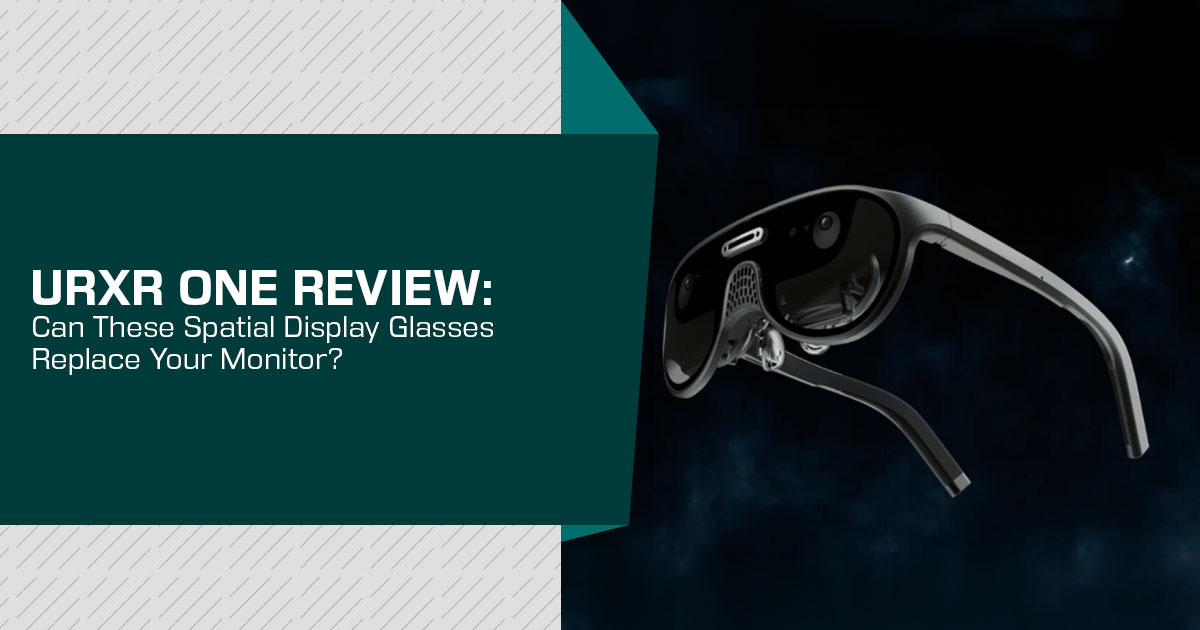
The URXR One is a 93 g pair of spatial display glasses from Unseen Reality, built for people who want a private virtual monitor they can carry anywhere. At the current US$799 Kickstarter price, it is one of the more complete smart glasses monitor replacement options in this price range. It combines 2,448 × 2,064-pixel micro-OLED displays per eye, a 90° diagonal field of view, 36 PPD, and built-in 3DoF/6DoF tracking without an external puck or base station.
As technology experts with over 20 years of experience in hardware and application research and development, we assess products through real-world performance, durability, and value for money. Our goal is to help readers choose the right product based on price, performance, reliability, and long-term use. This review is aimed at remote workers, frequent travellers, developers, digital professionals, students, and anyone who needs a private multi-screen workspace away from a desk. Our recommendations are based on extensive research, component analysis, available hands-on evidence, real-world usability reports, and industry expertise.
The URXR One is not a universal desktop monitor replacement. It has no built-in speakers, no battery, relies on the host device for power, source content and general computing, and it is not a substitute for a colour-critical 4K desktop monitor. For a permanent workstation, a good physical monitor remains the better choice. But for remote work, travel, portable productivity, gaming, and private screen use, the URXR One offers a strong mix of display resolution, spatial tracking, portability, and flexibility. If your work moves with you, it is worth serious consideration; if you already have a high-end 4K workstation, treat it as a portable second screen and spatial workspace, not a replacement.
Key takeaways:
- 93 g, with no battery and no built-in speakers — the glasses draw power from the host over USB-C DisplayPort Alt Mode, while audio comes from the host device or connected headphones/earbuds.
- 36 PPD per eye, according to Unseen Reality — hands-on reports describe the image as readable for code and documents during normal working sessions.
- Two main modes: Bypass mode is plug-and-play for one large screen with no software; App mode through URXR Connect adds multiple spatial screens, 6DoF and hand gestures on supported
- Pricing: US$799 on Kickstarter; a limited US$699 early-bird tier was offered at Unseen Reality currently lists US$999 MSRP. Shipping is scheduled for mid-October 2026.
- Main trade-offs: no Linux support, no SteamVR/PCVR at launch, an audible cooling fan, phones/tablets may need the US$69 Power Hub, and this is Unseen Reality’s first hardware
- Compatibility: Linux is not URXR Connect is planned for Windows and Mac first, with iOS/Android support targeted for November/December 2026; the company describes that timing as tentative.
A note on this review: As of September 3, 2026, the URXR One has not yet shipped to customers; the company says shipping is scheduled for mid-October 2026. This is a research-based review, not a retail-unit lab test. We cross-checked Unseen Reality's current specifications and roadmap against independent hands-on coverage, AWE 2026 demonstrations, and community compatibility reports. We have not tested a retail unit ourselves, so hands-on performance claims are attributed to the people who tested pre-release hardware. We will revisit the article when retail units and independent long-term reviews are available.
What Is the URXR One?
The URXR One is a 93 g pair of spatial display glasses from Unseen Reality, a spatial computing company based in Mountain View, California. You connect it to a laptop, Mac, phone, tablet, handheld or compatible console over USB-C DisplayPort Alt Mode, and the source device’s display appears as a large virtual screen. The glasses can also run spatial tracking and video see-through on the device itself. Unseen Reality’s URXR Connect app adds a spatial workspace with multiple virtual screens, 6DoF and hand gestures on supported hosts.
Unseen Reality publicly debuted the glasses at AWE 2026 in Long Beach, held June 15–18, 2026. The Kickstarter campaign opened on August 4, 2026, and the current roadmap targets mid-October 2026 shipping to the US, Canada, UK, EU, Switzerland, Japan, South Korea, Singapore, Hong Kong, Australia, Norway, New Zealand and Taiwan.
It’s worth naming what the URXR One is not, because most confusion about this product comes from category confusion:
- Not a standalone VR headset. There is no general-purpose standalone computing environment or standalone app ecosystem, and SteamVR/PCVR is not supported at launch. The glasses depend on a connected host for the source content and computing workload, while an on-glasses spatial processing unit handles tracking, video see-through and reprojection.
- Not AI camera glasses. The cameras are used for SLAM tracking and video see-through. The product is positioned as a display and spatial-computing device, not as a camera-first AI wearable.
- Not self-powered. The glasses draw power and receive the display signal through USB-C. They also have no built-in speakers; audio comes from the host device or connected headphones/earbuds.
If you’ve seen the name URXR1 in older coverage, it refers to the same product now sold as URXR One.
Why the Smart Glasses Monitor Replacement Question Matters in 2026
Display glasses are not new. XREAL, VITURE and RayNeo have sold wearable displays for years, mainly for private media viewing, handheld gaming and second-screen use. The URXR One changes the proposition by adding higher per-eye resolution, a wider field of view and built-in 6DoF spatial tracking.
Three things have made the monitor replacement question more interesting:
- The products now target different jobs. XREAL One Pro and VITURE Beast focus on high-refresh media and general viewing, while ROG XREAL R1 targets high-refresh The URXR One takes a different route with a high-resolution spatial workspace and built-in 6DoF.
- Tracking has become more Many traditional display glasses primarily track head rotation, while 6DoF adds positional tracking that can anchor a virtual screen in physical space, so it can stay in place as you lean, stand or move around.
- The buying question is now about use case. Community discussions point to travel, media and handheld gaming as strong fits, while all-day productivity depends on text clarity, comfort and software stability. Community reports are useful signals, not controlled testing.
The display figure worth understanding is PPD — pixels per degree — because it gives a better sense of perceived sharpness than panel resolution alone.
URXR One Specs: The Full Table (September 2026)
Here is the URXR One specification table, based primarily on Unseen Reality’s current product information, with hands-on sources used where the company does not publish a detail:
| Specification | URXR One |
|---|---|
| Weight | 93 g |
| Display | Dual 1.03-inch Micro-OLED displays with mini-pancake optics |
| Resolution per Eye | 2,448 × 2,064 |
| Maximum Host Input | Reported support for up to 2,560 × 1,440 at 90Hz following firmware updates; current firmware support should be verified before purchase |
| Pixel Density | 36 PPD (Unseen Reality specification) |
| Field of View | 90° diagonal |
| Refresh Rate | 90Hz |
| Tracking | 3DoF + 6DoF using dual-camera SLAM and a 1,000Hz IMU, with spatial processing handled on the glasses |
| See-Through Mode | Video see-through with claimed latency of under 10ms (manufacturer rating) |
| Controls | Hand gestures plus physical buttons |
| Connection | USB-C with DisplayPort Alt Mode |
| IPD Adjustment | 58–68 mm, manually adjustable |
| Prescription Support | Supports custom prescription inserts; current prescription range and pricing should be confirmed when ordering |
| Battery & Speakers | No built-in battery and no integrated speakers; the connected host device supplies power and audio |
| Price | US$799 Kickstarter price; US$999 current MSRP |
| Shipping | Expected from mid-October 2026 |
Values are based on the current Unseen Reality specifications unless otherwise noted. 36 PPD is now listed by the company as an official product figure; competitor PPD values remain estimates where vendors do not publish them.
One detail needs a footnote. The panels are 2,448 × 2,064 per eye, but the source signal is a separate limitation. Early reviewer units were reported to accept 1080p input in Bypass mode (called Direct mode in some early coverage); later hands-on reporting indicates support for 2,560 × 1,440 at 90 Hz after firmware updates. Because input support has changed with firmware, treat 1440p/90Hz as the current reported capability, not as a timeless hardware guarantee, and check the latest firmware notes before buying.
What the Specs Actually Mean for You
Spec tables don’t tell you whether text is readable or whether a virtual desktop feels stable. Here’s what each number means in practice.
Pixels per degree: the sharpness number that actually matters
For physical monitors you think in PPI (pixels per inch). For glasses, the relevant unit is PPD — pixels per degree — because a virtual screen’s apparent sharpness depends on how many pixels your eye sees per degree of vision, at whatever distance the screen is placed.
Unseen Reality lists the URXR One at 36 PPD per eye. That is useful context for productivity, where perceived text clarity matters more than the raw panel count alone. Independent hands-on reports describe text as clear enough for code, documents and spreadsheets, while a good physical 4K desktop monitor still offers a more predictable pixel-perfect workspace. The URXR One is therefore better described as a major step beyond older 1080p-class display glasses, not as a replacement for every 4K monitor.
A 90° field of view: why width changes productivity
At 90° diagonal FOV, the URXR One gives you substantially more visual room than the roughly 57–58° class of many competing display glasses. That wider canvas helps when several windows are visible at once. Hands-on reports describe it as useful for multi-window work, although the exact sense of scale depends on how the virtual screen is positioned.
6DoF tracking without a puck
6DoF (six degrees of freedom) means the glasses track both head rotation and movement through space. The URXR One uses dual-camera SLAM, a 1,000 Hz IMU and on-glasses spatial processing; no external puck or base station is required. Unseen Reality claims drift of under 1 cm, while hands-on reports describe virtual windows staying stable during movement. Those are manufacturer and reviewer observations rather than results from our own testing.
Compared with the XREAL One Pro, the URXR One includes 6DoF as standard, while XREAL sells the XREAL Eye accessory separately to add 6DoF. VITURE Beast and ROG XREAL R1 are also positioned primarily as display glasses rather than built-in 6DoF spatial workstations. This is one of the URXR One‘s clearest differences in the group we compare here.
Video see-through under 10 ms
The URXR One uses video see-through (VST) rather than optical see-through. Unseen Reality rates the VST path at under 10 ms latency, with MRTV reporting a 9 ms figure in its hands-on testing. The practical benefit is that the real world remains visible through the camera-fed view around the display area, which matters more for desk work than for simply watching a movie.
Real-World Performance: What Hands-On Reports Tell Us
Because the URXR One has not yet shipped to customers, the performance evidence available today comes from AWE 2026 demos, pre-release reviewer units and community testing. We separate manufacturer claims from independent hands-on observations and avoid presenting those results as our own testing.
At the desk: multi-monitor work
The core monitor replacement scenario is one laptop driving several virtual screens pinned in space. MRTV tested a pre-release unit with URXR Connect and reported a multi-screen experience close to the spatial-window approach seen on Apple Vision Pro. Other community users have also reported readable, anchored screens during longer sessions. These are third-party hands-on reports, not results from our own test bench.
The caveats are equally consistent across sources:
- Text clarity is strong but not identical to a desktop At 36 PPD, documents and code can be readable in normal working sessions, but a high-end 4K monitor remains the safer choice for long, colour-critical or pixel-perfect work. Comfort also varies by user and prescription.
- Software is still a risk. URXR Connect is a first-generation platform, with Windows and Mac support planned first and mobile support We would judge the software on its own release and stability rather than importing older complaints about competing ecosystems.
- The cooling fan is a trade-off. MRTV reports an audible low hum, while some community users say they barely noticed it. A fanless pair of display glasses has an obvious advantage here, but fan noise appears to be a matter of user sensitivity.
Travel and on-the-go
This is where the URXR One makes the strongest practical case. A 93 g private virtual screen can reduce the need for a portable monitor in airplane seats, hotel rooms and hot-desk environments. Two properties matter most for travel:
- A virtual screen can reduce shoulder-surfing exposure compared with a physical monitor. For remote workers and frequent travellers, that can be a meaningful advantage in cafés, airports and shared offices.
- Setup Bypass mode works over USB-C without the companion app, giving you a single large screen. The glasses include on-device controls for switching display modes and sizes. The exact experience depends on the host device and available USB-C power.
Gaming with Steam Deck and handhelds
The URXR One can work with devices such as Steam Deck and ROG Ally through USB-C DisplayPort Alt Mode, turning them into a large private screen. The 90 Hz refresh rate is well suited to general gaming, but it is not aimed at the highest-refresh competitive crowd. Two limits matter:
- 90 Hz is below the 120–240 Hz range targeted by high-refresh gaming glasses such as the ROG XREAL R1.
- No SteamVR/PCVR at launch, so this is a large-screen gaming experience rather than a full PCVR headset.
Media
The 90° field of view and high per-eye resolution make the URXR One well suited to movies and large-screen media. A virtual cinema environment is part of URXR Connect. The trade-off is simple: there are no built-in speakers, so audio comes from the host device or connected earbuds/headphones.
Design, Build, and Comfort: 93 Grams of Deliberate Compromise
The 93 g weight comes partly from keeping the battery and general-purpose computing off the face. The glasses still contain an on-glasses spatial processing unit, cameras, IMU, display system and active cooling. The host supplies the source content and much of the computing workload, while spatial tracking, video see-through and reprojection are handled on the glasses.
Hands-on reports describe the glasses as light and well balanced, with a large adjustable nose pad and less face pressure than a conventional VR headset. The IPD is manually adjustable from 58–68 mm.
Comfort remains personal, so prescription, face shape and IPD should be checked before ordering.
Unseen Reality supports custom prescription inserts, with the Kickstarter FAQ listing a range of −8.00 to +8.00 diopters. Prescription-lens availability and pricing should still be confirmed before ordering.
Power and Audio: What’s Deliberately Missing
Power and audio are easy to overlook, but they can change the daily experience.
Power. The glasses have no built-in battery and draw power over USB-C. Hands-on testing indicates that full 6DoF operation can require roughly 15 W from the USB-C port, while around 7.5 W can support stable 3DoF operation. Phones, tablets and some lower-power hosts may need the optional US$69 Power Hub, a 10,000 mAh pocket battery. Unseen Reality says the Power Hub ships later than the glasses, so check the latest bundle and delivery timing before ordering.
Audio. There are no built-in speakers. Audio comes from the host device or connected earbuds/headphones. That is easy enough at a desk but worth remembering on a plane or in another quiet public space.
The design is a clear trade-off: keeping the frame at 93 g means leaving the battery and speakers out while retaining spatial-tracking hardware. The XREAL One Pro takes a different approach with built-in Bose-tuned audio and a lighter 87 g frame. If built-in sound matters most, XREAL has the advantage; if 6DoF spatial work matters most, URXR One has the stronger feature set.
Connectivity and Software
How it connects
The URXR One uses USB-C DisplayPort Alt Mode, which lets a compatible USB-C port carry a video signal. If your laptop, Mac, handheld or phone supports DP Alt Mode, you can connect directly without an HDMI adapter in most cases. Compatibility still depends on the device and its power output.
Bypass Mode vs. URXR Connect App Mode
There are two practical ways to use the glasses:
| Mode | What It Does | Requirements |
|---|---|---|
| Bypass Mode | Provides one large, spatially locked virtual screen with plug-and-play operation and no companion app required. | A compatible device with USB-C DisplayPort Alt Mode support. |
| App Mode (URXR Connect) | Enables multiple spatial screens, 6DoF tracking, hand gestures, and a dedicated cinema environment. | Windows and macOS support first; iOS and Android targeted for November/December 2026. The host device must also provide sufficient power. |
The important buying point is that the full multi-screen workspace depends on URXR Connect. Unseen Reality currently targets Windows and Mac first, with iOS/Android support planned for November/December 2026 and described as tentative. Bypass mode remains the simpler option for a single screen on compatible devices.
Compatibility, per available reports
The official compatibility claim is USB-C devices with DisplayPort Alt Mode video output. Community testing published by Unseen Reality is useful as an indication of edge cases, but it should not be treated as a universal compatibility guarantee:
| Device | Reported Result |
|---|---|
| GPD Pocket 4 | Reported to work successfully in Bypass mode. |
| Lenovo Legion Y700 | Reported to work successfully in Bypass mode. |
| XREAL Beam Pro | Reported to work successfully in Bypass mode. |
| Xiaomi 15 Ultra | Reported as unreliable in community testing, with inconsistent Bypass mode operation. |
What’s not supported
- Linux is not supported according to the current product information.
- SteamVR/PCVR is not supported at launch.
- iOS/Android URXR Connect support is planned after the Windows/Mac launch, currently targeted for November/December 2026 and marked tentative by Unseen Reality.
If Linux is your main desktop platform, this is a clear limitation and should be treated as a buying blocker unless support changes.
URXR One Price: Kickstarter vs. Current MSRP
Here is the current URXR One pricing picture, using the latest company listing and launch information:
| Tier | Price | Status |
|---|---|---|
| Kickstarter (Current Official Listing) | US$799 | Currently live; the crowdfunding campaign opened on August 4, 2026. |
| Early-Bird (Limited) | US$699 | Limited promotional tier offered when the campaign launched; not the current standard Kickstarter price. |
| Current Listed MSRP | US$999 | Current MSRP listed on the Unseen Reality product page. |
| Power Hub | US$69 | 10,000mAh accessory designed to provide additional power when using the device with lower-power host hardware. |
Back it or wait? Here’s the honest frame:
- The case for backing now: US$799 is currently US$200 below the company’s listed US$999 MSRP, and working hardware has been publicly demonstrated and independently reviewed before launch. Shipping is currently targeted for mid-October 2026.
- The case for waiting: this is Unseen Reality’s first hardware product, and the URXR One has not yet reached customers. There are no independent long-term retail reviews yet, so waiting gives buyers more information about production quality, software stability, support and delivery.
- What is still unproven: long-term daily-driver performance, mass-production consistency, the final iOS/Android app experience, customer support and on-schedule shipping.
Our recommendation is straightforward: if US$799 is meaningful to you and you are comfortable with Kickstarter delivery risk, backing now can make sense. If you need a fixed delivery date or want to see independent long-term reviews first, waiting for retail is the safer choice. The current official MSRP is US$999, so the present Kickstarter saving is US$200 before any changes to campaign pricing.
Check the current Kickstarter tier, MSRP and shipping information on Unseen Reality’s official product page before ordering. Prices, bundles and delivery targets can change during a crowdfunded launch.
URXR One vs. XREAL One Pro, ROG XREAL R1, and Viture Beast
The URXR One does not compete with every display-glasses buyer. It is aimed at a specific job: portable spatial work. The comparison below uses current US pricing checked in September 2026; prices can change.
| Specification | URXR One | XREAL One Pro | ROG XREAL R1 | Viture Beast |
|---|---|---|---|---|
| Price | US$799 Kickstarter / US$999 MSRP | US$599 | US$849 | US$549 |
| Per-Eye Resolution | 2,448 × 2,064 | 1,920 × 1,080 | 1,920 × 1,080 | 1,920 × 1,200 |
| Field of View | 90° diagonal | 57° | 57° | 58° |
| Pixels per Degree (PPD) | 36 PPD (official claim) | Not independently standardized | Not independently standardized | Not independently standardized |
| Refresh Rate | 90Hz | 120Hz | Up to 240Hz | 120Hz |
| Weight | 93g | 87g | 91g | 88g |
| Tracking | Built-in 3DoF + 6DoF | 3DoF; 6DoF via XREAL Eye | 3DoF; 6DoF via XREAL Eye | Native 3DoF |
| Hand Gesture Support | Yes | No | No | No |
| See-Through Technology | Video see-through, <10ms latency | Optical see-through | Optical see-through | Optical see-through |
| Built-in Speakers | No | Yes, Bose-tuned | Yes, Bose | Yes, Harman-tuned |
| Built-in Battery | No — host-powered | No — host-powered | No — host-powered | No — host-powered |
| Availability | Kickstarter; mid-October 2026 shipping target | Available now | Pre-order; expected September 2026 | Available now |
PPD note: Unseen Reality now publishes 36 PPD for URXR One. The competitor PPD figures below are estimates or company-published comparison figures rather than a uniform independent measurement.
Competitor specifications and prices were checked against current manufacturer listings where available. How to read that table without spin:
- Best on-paper display resolution for text and multitasking: URXR One. It has more than twice the per-eye pixel count of the XREAL One Pro and a much wider PPD is a different metric, so a higher PPD number on a narrower display should not be treated as a simple verdict on overall text quality.
- Best for built-in audio and high-refresh general viewing: XREAL One It offers 120 Hz, Bose-tuned speakers, 87 g weight and is already available.
- Best for high-refresh competitive gaming: the ROG XREAL It targets gaming with a 240 Hz refresh rate and 91 g design; its current US listing is a pre-order with expected September 2026 shipping.
- Value pick for private media: VITURE At US$549, it offers a 1200p-per-eye display, 120 Hz refresh rate and built-in spatial audio.
- Best fit for a spatial workspace: URXR One. Among the four products compared here, it is the only one with built-in 6DoF and hand gestures as standard.
The pattern is simple: One Pro, Beast and R1 are primarily viewing/gaming displays; URXR One is the spatial-workspace option in this comparison. If your priority is a large screen for media, the cheaper models offer better value. If you want multi-monitor work you can carry anywhere, URXR One is the stronger match.
Is Unseen Reality Legit? A Quick Trust Check
A first hardware product on Kickstarter deserves extra scrutiny. Here is what can be verified today:
- Public demonstrations: URXR One units were shown and used at AWE 2026 in Long Beach in June
- Independent hands-on coverage: pre-release units have been tested by outlets and reviewers including MRTV and GizmoCrowd, providing evidence that working hardware exists before retail
- Public company information: Unseen Reality has published dated product announcements, specifications and a shipping roadmap.
What remains unproven, stated plainly:
- No independent long-term retail review The product has not shipped to customers.
- Mass-production consistency remains Trade-show and reviewer units cannot establish retail build quality.
- iOS/Android URXR Connect support is still a roadmap item, currently targeted for November/December 2026.
- Long-term support history is This is the company’s first hardware product, so buyers do not yet have a long service track record to judge.
The main concern is therefore execution risk, not a lack of evidence that working hardware exists. Buyers still have to accept uncertainty around production, delivery, support and future software. We would treat those as normal but meaningful risks for first-generation crowdfunded hardware.
URXR One Pros and Cons
| Pros | Cons |
|---|---|
| ✔ At just 93g, hands-on reports describe the frame as lightweight and well balanced for wearable use. | ✖ No built-in speakers — audio must come from the connected host device or headphones. |
| ✔ 2,448 × 2,064 resolution per eye and 36 PPD provide strong on-paper clarity for text-heavy productivity and virtual-screen workloads. | ✖ The 90Hz refresh rate is lower than that of some high-refresh gaming-focused XR glasses. |
| ✔ Integrated 6DoF tracking and hand tracking eliminate the need for a separate external tracking puck. | ✖ No Linux support or SteamVR / PCVR compatibility at launch. |
| ✔ Wide 90° diagonal field of view, exceeding the competing models included in this comparison. | ✖ Cooling fan noise can be audible during operation. |
| ✔ Manufacturer-rated video see-through latency below 10ms is designed to provide responsive mixed-reality viewing. | ✖ No internal battery — lower-power host devices may require the optional US$69 Power Hub. |
| ✔ Plug-and-play Bypass mode allows basic operation without installing the companion application. | ✖ URXR Connect support for iOS and Android is planned but has not yet been delivered. |
| ✔ Supports custom prescription lens inserts, although buyers should verify the currently supported prescription range and pricing. | ✖ This is the startup’s first hardware product, so its long-term manufacturing, warranty, and customer-support track record remains unproven. |
| ✔ US$799 Kickstarter pricing provides a substantial discount compared with the currently listed US$999 MSRP. | ✖ Customer shipments have not yet started, with delivery currently targeted for mid-October 2026. |
Who Should Buy the URXR One (And Who Shouldn’t)
Consider it if you:
- Work remotely or travel frequently and want a private multi-monitor workspace without carrying a portable monitor
- Use a Steam Deck, ROG Ally or similar handheld and want a large private screen
- Want built-in 6DoF and hand tracking without buying a tracking accessory
- Wear prescription lenses, but confirm the current insert options and pricing before ordering
- Are comfortable with Kickstarter risk and the current US$799 price is worth the wait for a mid-October 2026 target
Wait or look elsewhere if you:
- Run Linux as your main desktop
- Need a device by a fixed date before mid-October 2026
- Need a 1:1 replacement for a high-end 4K editing or monitoring station
- Prioritize 120–240 Hz competitive gaming
- Mainly want a lower-cost private movie screen
- Want to see independent long-term retail reviews before committing
Frequently Asked Questions
Can AR glasses really replace a monitor?
For portable and multi-screen work, yes — with an asterisk. Virtual monitor glasses such as the URXR One give you private screen space and a spatial multi-monitor layout that travels with you. They still do not replace the consistency and fidelity of a premium 4K desktop panel. The practical answer is a monitor replacement for the right mobile workflow, and a supplement for a fixed workstation.
How sharp is the URXR One display?
The panels are 2,448 × 2,064 per eye, and Unseen Reality lists 36 PPD. Hands-on reports describe the image as readable for code, documents and spreadsheets, but a physical 4K monitor remains the better choice for pixel-perfect desktop work.
What devices does the URXR One work with?
Compatible devices need USB-C DisplayPort Alt Mode video output. That includes many Windows and Mac laptops, Windows handhelds, Steam Deck and some phones/tablets. The Power Hub may be required for lower-power devices. Linux is not supported.
What is App mode on the URXR One?
URXR Connect App mode adds multiple spatial screens, 6DoF and hand gestures on supported Windows and Mac hosts. The company currently targets iOS/Android support for November/December 2026.
Bypass mode provides the simpler single-screen experience without the companion app.
Does the URXR One have 6DoF tracking?
Yes. The URXR One supports 3DoF and 6DoF using dual-camera SLAM, a 1,000 Hz IMU and on-glasses spatial processing. No external puck or base station is required. XREAL One Pro and ROG XREAL R1 can add 6DoF with the separate XREAL Eye accessory.
Is the URXR One a VR headset?
No. It is spatial display glasses, not a standalone VR headset. It relies on a connected host for the source content and general computing, while the glasses handle spatial tracking, video see-through and reprojection. SteamVR/PCVR is not supported at launch.
How much does the URXR One cost and when does it ship?
It is currently US$799 on Kickstarter. A limited US$699 early-bird tier was offered at launch, while Unseen Reality now lists a US$999 MSRP. Shipping is scheduled for mid-October 2026 to the US, Canada, UK, EU, Switzerland, Japan, South Korea, Singapore, Hong Kong, Australia, Norway, New Zealand and Taiwan.
Does the URXR One have built-in audio or a battery?
It has no built-in battery and no built-in speakers. Power comes through USB-C, while audio comes from the host device or connected headphones/earbuds. The optional US$69 Power Hub can provide extra power for phones, tablets and other lower-power hosts.
Is Unseen Reality legit, or is the URXR One a scam?
We found no clear evidence in the sources reviewed that the URXR One is fraudulent. Working units have been publicly demonstrated and independently reviewed. The meaningful risks are more ordinary: delivery, production consistency, software maturity and support history for a first hardware product.
Should you back the URXR One on Kickstarter or wait for retail?
Back it if you are comfortable with Kickstarter delivery risk and the US$799 price is worth the wait. Wait for retail if you need a firm delivery date or want to see independent long-term reviews first. The current company-listed MSRP is US$999, so the present campaign saving is US$200.
Final Verdict: Should You Replace Your Monitor with the URXR One?
Our verdict: the URXR One is one of the most complete smart glasses monitor replacement options in this price class for portable spatial work. It stands out because the combination of 2,448 × 2,064-per-eye micro-OLED displays, 36 PPD, a 90° diagonal FOV and built-in 6DoF tracking is unusual among the models compared here. That conclusion is based on published specifications and independent hands-on reports, not our own retail-unit testing.
It is not a universal replacement for a physical monitor. The fan can be audible, there are no built-in speakers, the software is still developing, and a good 4K desktop panel remains the better choice for fixed, colour-critical work. But for a private multi-monitor workspace you can carry anywhere, the URXR One makes a strong case.
If your work follows you around, the URXR One is one of the first devices we would consider. If you spend most of your time at one desk, it makes more sense to watch the retail launch and independent long-term reviews before replacing anything.
Where to Buy: Check Current Prices
As of September 3, 2026, the URXR One is available through its Kickstarter campaign at US$799, with shipping targeted for mid-October 2026. Unseen Reality currently lists a US$999 MSRP. Retail and marketplace availability may change after the campaign, so verify the current price and delivery status before buying.
Amazon US
The URXR One‘s headline strengths — 93 g weight, 2,448 × 2,064 resolution per eye, built-in 6DoF and a 90° FOV — make it a product worth watching in the monitor replacement category. If and when retail marketplace listings appear, verify the seller, warranty and current price before ordering.
→ Check the latest price and availability for the URXR One on Amazon US
Prices and availability change frequently — the link shows current listings at time of viewing.
Amazon India
If you’re in India, the current official shipping list does not include India, so local availability is uncertain. Importer listings or a future regional launch may change that, but buyers should check the seller, warranty, shipping cost and any applicable duties before ordering.
→ Check the latest price and availability for the URXR One on Amazon India
If the product is not listed through a marketplace yet, Unseen Reality’s official store/Kickstarter page is the direct source for current availability and campaign information.
Have you tried virtual monitor glasses or the URXR One? Tell us what you think in the comments, or ask us anything about the display, 6DoF tracking, compatibility, power or everyday use. Follow us for more straightforward tech reviews, comparisons and buying guides.
***Disclaimer***
This blog post reflects our research, analysis, and opinions based on available product information, independent hands-on reports, user feedback, and industry knowledge. It is not the official position of any brand, manufacturer, or company mentioned here. Product specifications, pricing, software roadmaps, shipping dates, and availability can change after publication. We recommend checking the latest manufacturer information before making a purchase.
Some links in this article may be affiliate links. If you choose to buy through them, we may earn a small commission at no extra cost to you. This helps support our work and does not influence our recommendations.
Opinions expressed by readers are their own and do not necessarily reflect ours. We are not responsible for outcomes resulting from the use of information on this site. Please seek professional advice where appropriate.
All product names, logos, and brands mentioned are the property of their respective owners. These names are used for identification and informational purposes only and do not imply endorsement.