
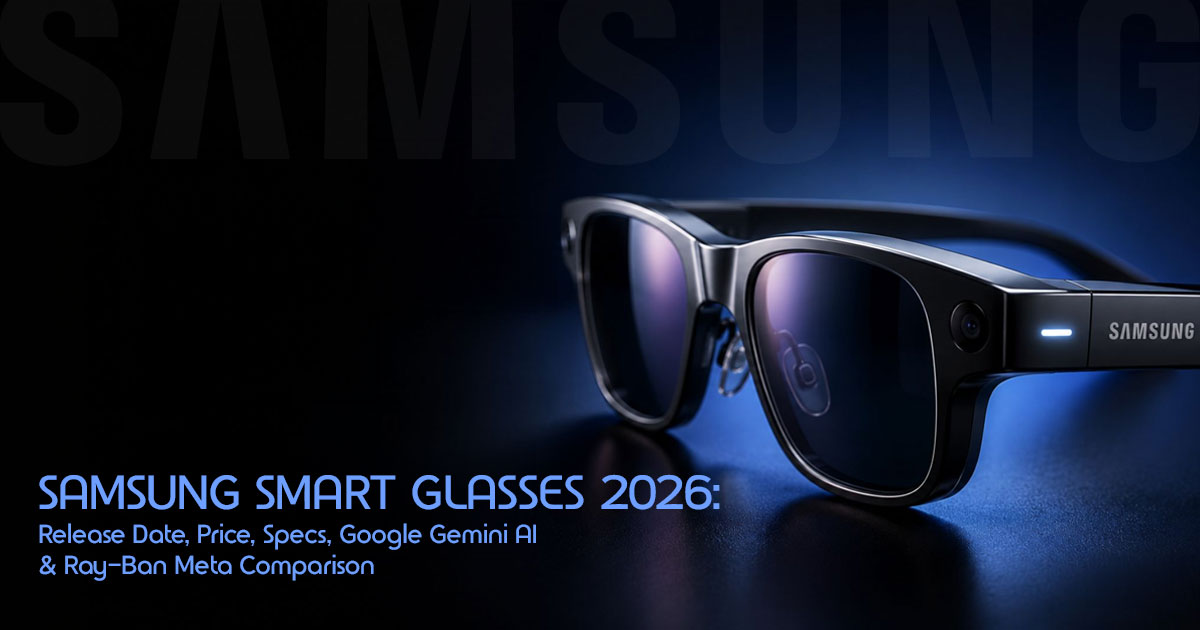
After months of leaks and speculation, Samsung Smart Glasses 2026 were officially unveiled during Galaxy Unpacked 2026. This guide covers the latest release date, expected price, specifications, Google Gemini AI features, battery life, and how Samsung compares with the Ray-Ban Meta Gen 2.
With more than 20 years of experience in hardware and software research, we evaluate products using real-world testing, long-term usability, repairability, and independent technical analysis—not marketing claims. Whether you are a tech enthusiast or a first-time buyer, our recommendations are based on hands-on evaluation, industry research, and verified technical information.
Click here to buy from Amazon
For this article, we carefully reviewed Samsung’s official announcements, hands-on demonstrations, trusted industry reports, and technical analysis to separate confirmed facts from speculation. By the end, you will know exactly what Samsung’s smart glasses can do, how they compare with Meta’s Ray-Ban smart glasses, who should consider buying them, and whether they are worth waiting for.
Quick Take: Should You Wait for Samsung Smart Glasses?
| If You… | Our Take |
|---|---|
| Want smart glasses right now | Ray-Ban Meta Gen 2 is the safer choice. It’s available today starting at $379 with a mature feature set and proven real-world performance. |
| Already use Samsung Galaxy devices | Waiting for Samsung Smart Glasses may be worthwhile, thanks to deep integration with Galaxy Watch9, Samsung Notes, and Google’s ecosystem. |
| Prefer Google Gemini over Meta AI | Samsung’s glasses are expected to be among the first consumer smart glasses built around Google Gemini AI, making them an attractive option for users invested in Google’s AI ecosystem. |
| Need the longest battery life in smart glasses | Samsung claims up to 9 hours of battery life, although independent testing will be needed to verify real-world endurance. |
| Want to try them in-store before buying | You may need to wait. Samsung has not yet announced retail availability, demo locations, or hands-on store availability. |
Key Highlights at a Glance
- Google Gemini AI
- Android XR
- Snapdragon AR1 Gen 1
- 9-hour claimed battery life
- Galaxy Watch9 gesture controls
- Fall 2026 launch
- Expected price: $379–$499
What Are Samsung Smart Glasses?
Samsung smart glasses — officially branded as Samsung Intelligent Eyewear — are the company’s first consumer eyewear product. They were developed through a collaboration between Samsung, Google, and two established eyewear brands: Gentle Monster and Warby Parker.
These are not augmented reality glasses with a screen. There is no display built into the lenses.
Instead, they follow the same design philosophy as the Ray-Ban Meta — a camera, microphones, and open-ear speakers packed into a frame that looks like normal glasses.
The key difference is what powers them. Samsung Smart Glasses run on the Android XR platform with Google Gemini as the built-in AI assistant. Meta’s glasses use Meta AI. That distinction matters more than it might seem at first glance.
How the Partnership Works
This is not Samsung making glasses and slapping a brand name on them. The breakdown is:
- Samsung — Hardware design, camera, battery, system integration with Galaxy devices
- Google — Android XR operating system, Gemini AI, Google services integration
- Qualcomm — Snapdragon AR1 Gen 1 processor (same chip in Ray-Ban Meta Gen 2)
- Gentle Monster — Fashion-forward frame designs (slim black silhouette)
- Warby Parker — Everyday-wear frame designs (brown upswept brow line)
Samsung showed at least four frame designs at the Unpacked event. More styles, colors, and lens options — including prescription lenses — are confirmed for the launch lineup.
Samsung Smart Glasses Release Date
Samsung has confirmed a fall 2026 launch. No specific date, no preorder window, and no confirmed list of launch markets.
Here is the timeline we have pieced together:
| Date | Event |
|---|---|
| Google I/O — May 2026 | Samsung and Google previewed the first two smart glasses frame designs and showcased their Android XR collaboration. |
| Galaxy Unpacked — July 22, 2026 | Official reveal featuring four frame designs, battery life estimates, AI capabilities, and additional product details during the London launch event. |
| Fall 2026 | Confirmed retail launch window for the first-generation Samsung Smart Glasses. The exact release date has not yet been announced. |
| 2027 (Expected) | Expected debut of the second-generation model (codename Haean) featuring an integrated micro-LED display. |
The glasses were previewed alongside the Galaxy Z Fold8, Galaxy Z Fold8 Ultra, Galaxy Z Flip8, Galaxy Watch9, and Galaxy Watch Ultra2. All those devices opened pre-orders on July 22, with general availability on August 7. The smart glasses are on a separate, later timeline.
Samsung has not announced when pricing or preorders will be revealed, although more details are expected before the fall launch window.
Samsung Smart Glasses Price: What We Know
Samsung has not announced an official price.
However, multiple supply-chain reports and analyst estimates place the first-generation model (internally codenamed Jinju, model number SM-O200J) in the $379 to $499 range.
Here is how that positions against the competition:
| Product | Price | Status |
|---|---|---|
| Ray-Ban Meta Gen 2 | $379 | Available now |
| Meta Glasses (Entry-Level) | $299 | Available now |
| Oakley Meta HSTN | $399 | Available now |
| Samsung Smart Glasses (Estimated) | $379–$499 | Expected in Fall 2026 |
| Ray-Ban Meta Display | $799 | Available now |
| Samsung Haean (Display Model, Estimated) | $600–$900 | Expected in 2027 |
Samsung’s EVP Jaein Choi described the positioning as “premium” but “not crazy expensive.” That language, combined with the leaked range, suggests Samsung is targeting the same price bracket as the Ray-Ban Meta Gen 2 — not undercutting it.
The pricing decision matters because Samsung is asking buyers to adopt a first-generation product with no track record. Meta has years of product feedback, an established retail network through EssilorLuxottica, and approximately 69% of the global smart glasses market, according to IDC.
For Samsung to justify a similar or higher price, the Gemini AI experience and Galaxy ecosystem integration need to deliver measurable value over what Meta already offers.
Samsung Smart Glasses Specs: Full Breakdown
Here is everything confirmed about the hardware, along with what remains unverified.
| Feature | Samsung Smart Glasses | Status |
|---|---|---|
| Processor | Qualcomm Snapdragon AR1 Gen 1 | ✅ Confirmed |
| AI Assistant | Google Gemini with Bixby support | ✅ Confirmed |
| Operating System | Android XR | ✅ Confirmed |
| Camera | Built-in outward-facing camera with recording LED | ✅ Confirmed |
| Camera Resolution | Rumored 12MP Sony IMX681 sensor with autofocus | ⚠️ Unconfirmed |
| Display | No display (Gen 1 is audio-first) | ✅ Confirmed |
| Battery Life | Up to 9 hours per charge | ✅ Confirmed |
| Charging Case | Provides up to 7 additional full charges | ✅ Confirmed |
| Audio | Open-ear directional speakers with a multi-microphone array | ✅ Confirmed |
| Phone Compatibility | Android and iOS | ✅ Confirmed |
| Interaction | Voice commands, touch controls, and Galaxy Watch9 gesture controls | ✅ Confirmed |
| Weight | Rumored to weigh approximately 50 grams | ⚠️ Unconfirmed |
| Battery Capacity | Rumored between 155mAh and 245mAh | ⚠️ Unconfirmed |
| Connectivity | Bluetooth 5.3 (phone-tethered) | ⚠️ Unconfirmed |
| Prescription Lens Support | Supported | ✅ Confirmed |
| Privacy Features | Recording LED with LED obstruction detection | ✅ Confirmed |
| Price | Not officially announced | ❓ Unknown |
| Exact Release Date | Expected in Fall 2026 (launch window only) | ❓ Unknown |
What This Means for Buyers
The Snapdragon AR1 Gen 1 is the same chipset Meta uses. That means raw processing power is not where Samsung differentiates. The separation comes from software — specifically Google Gemini and the Android XR platform — and from battery endurance.
Samsung’s claimed 9-hour battery life is one of its strongest selling points—if independent testing confirms it. The Ray-Ban Meta Gen 2 lists up to 8 hours under moderate use. But there is a catch: Samsung has not published a standardized test workload. Battery claims across brands use different measurement methods, so the one-hour headline difference may not reflect real-world performance. Independent testing under the same conditions will be the real proof.
The glasses require a paired smartphone to function. All heavy AI processing is offloaded to the phone. This is by design — it keeps the glasses lightweight and thermally manageable — but it means they cannot work independently.
Click here to buy from Amazon
Google Gemini AI: Samsung’s Biggest Differentiator
Samsung isn’t trying to beat Meta on hardware alone. Its biggest differentiator is Google Gemini.
Google Gemini on smart glasses does things that go beyond simple voice commands. Here is what Samsung and Google have confirmed:
What Gemini Does on Samsung Smart Glasses
| Feature | What It Does |
|---|---|
| Visual Search | Identify objects in view and ask Google Gemini what they are, how to use them, or where to purchase them. |
| Live Translation | Translate spoken conversations and written text in real time with natural tone matching. |
| Navigation | Receive turn-by-turn navigation through Google Maps using voice-guided audio prompts. |
| Whiteboard Capture | Capture whiteboards or meeting notes and automatically organize them into Samsung Notes. |
| Message Summaries | Generate spoken summaries of lengthy messages, emails, and notification threads. |
| Context-Aware Assistance | Gemini remembers previous conversations and continues tasks with contextual awareness. |
| Live Visual Sharing | Share your first-person camera view during video or voice calls in real time. |
| App Integration | Perform actions through connected smartphone apps, such as booking restaurants or ordering coffee with voice commands. |
| AI Photo Editing | Use Nano Banana AI to edit captured photos through natural voice commands. |
Why Gemini Matters More Than the Chip
Both Samsung and Meta use the same Qualcomm processor. The real competition is between AI assistants.
Meta AI is deeply integrated with Instagram, WhatsApp, and Messenger. It excels at social content capture and sharing. Over seven million Ray-Ban and Oakley smart glasses sold in 2025, which means Meta AI has significantly more real-world usage data to refine its responses.
Google Gemini connects to Google’s broader service ecosystem — Google Maps, Google Calendar, Google Workspace, Google Translate, and Google Search. For users who already live in Google’s ecosystem, the glasses become a hands-free extension of tools they use every day.
The Galaxy Watch9 integration adds another layer. According to Samsung, gesture controls through the connected Galaxy Watch reduce the need to reach for the phone during multi-step tasks.
The limitation: neither Samsung nor Google has published data on how reliably these features work in practice. Task completion rates, latency, and how often Gemini requires correction or phone confirmation are all unknowns until independent reviewers get retail units.
Design and Build Quality
Rather than relying on a single design partner, Samsung worked with Gentle Monster and Warby Parker to create two distinct styles.
Gentle Monster Edition
- Slim black frame
- Straight upper rim with softly rounded lower edges
- Fashion-forward silhouette
- Targets style-conscious buyers
Warby Parker Edition
- Rich brown hue with a subtly upswept brow line
- More conventional, versatile shape
- Designed for everyday, all-day wear
- Targets practical buyers who want glasses that look normal
Samsung worked with both brands to refine fit around the forehead and ears — two pressure points that determine whether glasses are comfortable after several hours of use.
What Hands-On Reports Say
Journalists could handle the frames during Galaxy Unpacked but were not allowed to wear them, leaving key questions about comfort unanswered. That restriction is unusual and means key details remain untested:
- Actual comfort over extended periods
- Audio leakage at higher volumes
- Camera positioning and field of view in practice
- Heat buildup during sustained AI use
Gizmodo, which handled the frames, described them as “extremely light and evenly balanced” but also noted the demonstration units “felt cheaper than expected, scratched easily and collected fingerprints.” Those units may not represent final production materials.
At a rumored ~50 grams, the Samsung glasses would be marginally heavier than the Ray-Ban Meta Gen 2 at approximately 49 grams. In practical terms, the difference is negligible — both are in the range of a thick pair of regular prescription glasses.
Battery Life: Samsung’s Strongest Claim
Samsung’s 9-hour battery life headline is the single most competitive specification on the sheet.
Here is how it compares across the current smart glasses market:
| Product | Battery Life (Glasses) | Charging Case | Estimated Total Endurance |
|---|---|---|---|
| Samsung Smart Glasses | Up to 9 hours | Provides up to 7 additional full charges | ~72 hours |
| Ray-Ban Meta Gen 2 | Up to 8 hours (moderate use) | Up to 48 additional hours | ~56 hours |
| Meta Glasses | Approximately 4 hours | Up to 8 additional full charges | ~36 hours |
| Oakley Meta HSTN | Approximately 8 hours | Up to 48 additional hours | ~56 hours |
| Solos AirGo 3 | Approximately 10+ hours | Swappable temple batteries | Variable |
Samsung reports charging capacity in full recharge cycles, while Meta reports additional hours of use, making direct comparisons difficult.
The internal battery capacity is disputed. Pre-event leaks cited either 155mAh (consistent with Meta’s 154mAh cell) or 245mAh (from a certification filing). If the 9-hour claim holds with a 155mAh cell, that would point to aggressive power optimization through the Samsung-Google-Qualcomm “Power Camp” collaboration. Independent battery testing will settle this.
Samsung Smart Glasses vs Ray-Ban Meta: The Full Comparison
This is the comparison that matters most for buyers.
| Feature | Samsung Smart Glasses | Ray-Ban Meta Gen 2 |
|---|---|---|
| Price | Not announced (estimated $379–$499) | $379 |
| Availability | Expected in Fall 2026 | Available now |
| AI Assistant | Google Gemini with Bixby integration | Meta AI |
| Processor | Qualcomm Snapdragon AR1 Gen 1 | Qualcomm Snapdragon AR1 Gen 1 |
| Camera | Built-in camera (resolution not yet disclosed) | 12MP camera with 3K video recording |
| Battery Life | Up to 9 hours | Up to 8 hours (moderate use) |
| Charging Case | Provides up to 7 additional full charges | Provides up to 48 additional hours of use |
| Display | No display | No display |
| Design Partners | Gentle Monster and Warby Parker | Ray-Ban and Oakley (EssilorLuxottica) |
| Frame Options | 4+ frame styles expected at launch | 5+ product variants currently available |
| Phone Compatibility | Android and iOS | Android and iOS |
| Ecosystem | Samsung Galaxy ecosystem with Google services | Meta ecosystem (Instagram, WhatsApp, Messenger) |
| Watch Integration | Galaxy Watch9 gesture controls | Not supported |
| Prescription Lens Support | Yes | Yes |
| Market Position | New entrant to the smart glasses market | Approximately 69% global smart glasses market share (IDC estimate) |
| Privacy Indicator | Recording LED with obstruction detection | Recording LED indicator |
Where Samsung Has the Advantage
- Battery life: The 9-hour claim beats Meta’s 8-hour figure
- Google integration: Direct access to Google Maps, Translate, Calendar, and Workspace
- Galaxy Watch controls: Gesture-based interaction without touching the phone
- Fresh competition: One of the strongest new competitors to Meta’s smart glasses lineup
Where Meta Still Leads
- Available now: No waiting, no unknowns about the final product
- Proven track record: Years of product feedback and software updates
- Social integration: Seamless capture and sharing to Instagram and WhatsApp
- Retail presence: Physical try-on available through EssilorLuxottica’s global network
- Market dominance: 7+ million units sold in 2025 alone, with production scaling toward 10 million annually
- Product range: Five distinct tiers from $299 to $799, including the Ray-Ban Meta Display with a waveguide screen
Privacy Considerations
Any camera-equipped glasses raise privacy concerns, and no manufacturer has completely solved them.
Samsung includes:
- An outward-facing recording LED that activates when the camera is recording
- LED obstruction detection — the glasses will prevent recording if the LED is blocked or covered
Samsung’s COO Won-Joon Choi acknowledged privacy as “an industry-shared problem” and stated the company’s controls support responsible use.
For context, Meta uses a similar LED indicator approach on the Ray-Ban Meta. Despite the indicator, Meta’s glasses have faced criticism from privacy advocates and have been banned in certain workplaces and venues.
The practical reality: the visibility and effectiveness of Samsung’s recording indicator, combined with regional privacy laws and social acceptance, will influence whether these glasses face the same pushback. Samsung has not yet published detailed data-handling policies comparable to what buyers would need to evaluate before purchasing.
Who Should Buy Samsung Smart Glasses?
These Glasses Make Sense If:
- You are already deep in the Samsung Galaxy ecosystem — Galaxy phone, Galaxy Watch, Samsung Notes
- You use Google services as your primary productivity stack
- You want Google Gemini instead of Meta AI for AI assistance
- You value longer battery life over social media integration
- You are willing to wait for a fall 2026 launch and accept first-generation risks
Look at Alternatives If:
- You need smart glasses today — the Ray-Ban Meta Gen 2 is proven and available
- Your primary use case is social media capture — Meta’s Instagram and WhatsApp integration is unmatched
- You want to try before you buy — Samsung has not confirmed retail try-on availability
- You need a display — neither Samsung’s Gen 1 nor the standard Ray-Ban Meta includes The Ray-Ban Meta Display at $799 is the closest option with a waveguide screen
Samsung Smart Glasses Roadmap
Samsung is not treating this as a single product. It is a platform play.
| Model | Codename | Expected Launch | Display | Estimated Price |
|---|---|---|---|---|
| Gen 1 (Audio-First) | Jinju (SM-O200J) | Fall 2026 | No display | $379–$499 |
| Gen 2 (Display Model) | Haean (SM-O200P) | 2027 | Yes (micro-LED) | $600–$900 |
The Haean model is expected to add a micro-LED in-lens display for augmented reality overlays, targeting the same premium tier as the Ray-Ban Meta Display. This two-stage approach lets Samsung enter the market with an accessible, proven form factor before stepping up to full AR functionality.
Google is also developing its own Android XR glasses with Warby Parker and Gentle Monster, which would sit alongside Samsung’s offerings in the same ecosystem. The broader Android XR platform is designed to support multiple hardware partners — similar to how Android phones span Samsung, Google, OnePlus, and others.
Click here to buy from Amazon
Frequently Asked Questions
When will Samsung smart glasses be available to buy?
Samsung has confirmed only a fall 2026 launch window. An exact release date, preorder schedule, and launch markets have not yet been announced.
How much will Samsung smart glasses cost?
Samsung has not confirmed pricing. Leaked estimates suggest $379–$499 for the first-generation model. The display-equipped second generation (expected 2027) is estimated at $600–$900.
Do Samsung smart glasses have a screen?
No. The first-generation Samsung smart glasses are display-free. All output is delivered through audio — voice responses, navigation directions, and notification readouts. A model with a micro-LED display is expected in 2027.
Can Samsung smart glasses work with an iPhone?
Yes. Google confirmed at I/O 2026 that the glasses will pair with both Android and iOS devices. However, some features like Galaxy Watch9 gesture controls and certain Samsung Notes workflows may be limited to Samsung hardware.
What is the battery life on Samsung smart glasses?
Samsung claims up to 9 hours on a single charge under mixed use. The charging case provides up to 7 additional full charges, bringing the theoretical total past 70 hours.
What AI assistant do Samsung smart glasses use?
Google Gemini is the primary AI assistant, running on the Android XR platform. Samsung’s Bixby is also available as an option.
Are Samsung smart glasses better than Ray-Ban Meta?
Samsung offers stronger battery life, Google Gemini integration, and Galaxy Watch controls. Meta offers proven reliability, social media integration, established retail presence, and immediate availability. The “better” choice depends on which ecosystem you use and whether you can wait for Samsung to launch.
Will there be different sizes and styles?
Samsung confirmed at least four frame designs across Gentle Monster and Warby Parker, with more styles, colors, and prescription lens options planned for the launch lineup.
What We Still Don’t Know
Although Samsung has confirmed many core features, several important details won’t be known until independent reviewers test retail units.
- Final retail pricing — Samsung has not announced official pricing, and the final cost will heavily influence its competitiveness against the Ray-Ban Meta lineup.
- Real-world battery life — The claimed 9-hour battery life sounds promising, but independent testing is needed to see how it performs during photography, navigation, music playback, and continuous AI use.
- Camera quality — Samsung has confirmed the presence of a camera, but image quality, video performance, autofocus speed, and low-light capability remain unknown.
- Microphone quality — Call clarity, voice recognition accuracy, and background noise reduction have not yet been independently evaluated.
- Audio performance — Samsung has demonstrated open-ear speakers, but sound quality, volume, bass response, and audio leakage still need real-world testing.
- AI accuracy — Google Gemini is expected to be the biggest differentiator, but its response speed, reliability, contextual understanding, and task completion rates remain unverified.
- Long-term comfort — Journalists handled the glasses but were not allowed to wear them, so extended comfort during several hours of use is still unknown.
- Durability — Samsung has not yet shared details about scratch resistance, hinge strength, or long-term build quality.
- Water resistance — No official IP rating has been announced, leaving buyers uncertain about protection against rain, sweat, or dust.
- Repairability — Samsung has not disclosed repair options, replacement part availability, or battery serviceability.
Final Verdict
Samsung smart glasses represent the most credible challenge to Meta’s smart glasses dominance since the Ray-Ban Meta launched in 2023. The combination of Google Gemini, a 9-hour battery, and design partnerships with Gentle Monster and Warby Parker gives Samsung a strong foundation.
Samsung has built a promising foundation, but the real test begins once retail units reach customers.
The Ray-Ban Meta Gen 2 at $379 remains the lower-risk choice for anyone buying today. It has a known camera quality, established battery performance, years of software refinement, and physical retail availability through EssilorLuxottica’s global network.
Samsung’s success now depends on three things: competitive pricing, all-day comfort, and reliable Gemini performance.
If you already use the Samsung Galaxy ecosystem, these smart glasses could be worth waiting for. Everyone else should wait for independent reviews, confirmed pricing, and real-world testing before making a purchase decision.
We will update this article as Samsung announces pricing, exact launch dates, and as early review units become available.
Check Current Availability & Pricing
Samsung smart glasses are expected to launch in fall 2026. While pre-orders are not yet open, here is where you can check for the latest availability and pricing updates:
Amazon Worldwide
Check Samsung Smart Glasses on Amazon Worldwide →
Bookmark this link to check pricing and availability as soon as Samsung opens sales in the US market.
Meanwhile, Available Now: Ray-Ban Meta Gen 2
If you do not want to wait, the Ray-Ban Meta Gen 2 is the current benchmark in smart glasses.
| Platform | Purchase Link |
|---|---|
| Amazon Worldwide | Check Ray-Ban Meta Gen 2 Price |
| Amazon India | Check Ray-Ban Meta Gen 2 Price |
Would Samsung’s smart glasses convince you to switch from Meta, or would you rather wait? Or would you buy the Ray-Ban Meta Gen 2 today? Share your thoughts in the comments.
If you found this guide helpful, follow us for in-depth technology reviews, buying guides, and the latest updates on AI devices, smart wearables, and upcoming consumer technology. If you have any questions or need help deciding which product is right for you, leave a comment and we’ll be happy to help.
Sources
This article is based on Samsung’s official Galaxy Unpacked 2026 announcements, Google I/O 2026 presentations, Qualcomm Snapdragon AR1 documentation, IDC market research, trusted hands-on reports, and reputable technology publications. Information marked as “unconfirmed” is based on industry reports and supply-chain leaks and may change before retail release.
***Disclaimer***
This blog post reflects our research, analysis, and opinions based on available product information, user feedback, and industry knowledge. It should not be taken as the official position of any brand, manufacturer, or company mentioned here. We make every effort to keep this guide accurate, but product specifications, pricing, and availability may change after publication. We recommend double-checking important details before making a purchase.
Some links in this article may be affiliate links. If you choose to buy through these links, we may earn a small commission at no extra cost to you. This helps support our work and allows us to keep publishing in-depth, unbiased reviews. Affiliate partnerships never influence our recommendations.
Opinions expressed by readers are their own and do not necessarily reflect ours. We are not responsible for outcomes resulting from the use of information on this site. Please seek professional advice where appropriate.
All product names, logos, and brands mentioned are the property of their respective owners. These names are used for identification and informational purposes only and do not imply endorsement.