
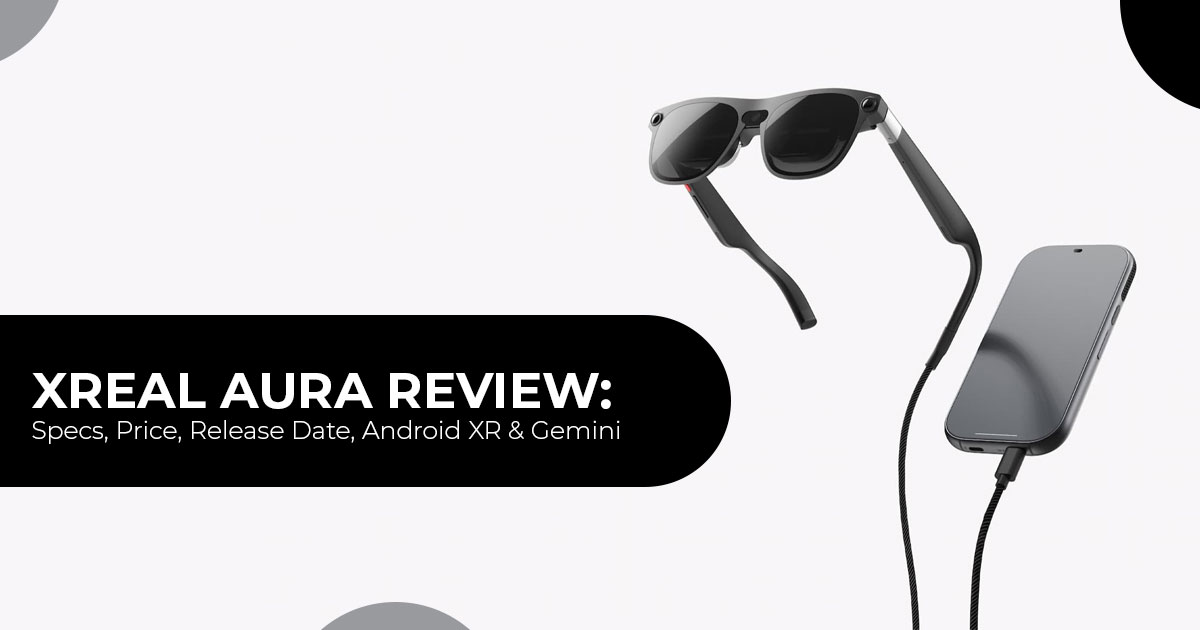
The XREAL Aura is a new pair of optical-see-through AR glasses built around Google’s Android XR platform, Gemini AI, and Qualcomm’s Snapdragon Reality Elite. It is the first see-through AR glasses built to run Android XR, combining XREAL’s display hardware with Google’s software and Qualcomm’s platform. First shown as Project Aura, the glasses are expected to launch in fall 2026, with the base model priced at no more than US$1,500 before taxes. XREAL says it has already received more than 10,000 reservations.
But the most important part of the Aura is not just what is inside the glasses. It uses a split-compute design, moving the processor, battery, and storage into a small tethered compute puck. That keeps the glasses lighter and changes how you use the device compared with a traditional all-in-one headset. It also brings some trade-offs that are worth understanding before you spend the money.
Click here to buy from Amazon
This guide is aimed at tech enthusiasts, early adopters, professionals, developers, and anyone considering premium AR glasses who wants to know what the Aura can actually offer rather than simply reading a list of specifications.
As technology experts with over 20 years of experience in hardware and application research and development, we look closely at products based on real-world performance, durability, and value for money. Our goal is simple: to help you find the right product for your needs, whether you care most about budget, performance, reliability, or long-term use. Our recommendations are based on extensive research, component analysis, real-world usability, and industry expertise.
There is one important limitation with this review: we have not tested a final retail XREAL Aura unit. Our assessment is based on XREAL’s official product information, published specifications, Google I/O and AWE 2026 announcements, and early hands-on reports from press at those events. Where something has been reported but not officially confirmed, we make that clear.
So, is the XREAL Aura worth reserving, and does its Android XR, Gemini AI, and Snapdragon Reality Elite hardware justify its price? We’ll break down the display, computing system, design, software, expected performance, comfort, battery setup, pricing, and key limitations to help you decide.
XREAL Aura at a Glance
A quick summary of the XREAL Aura specs before the detail:
- First optical-see-through Android XR glasses — access to Google Play apps without relying on a phone for the core spatial-computing experience.
- 70° field of view — the widest XREAL has offered in a glasses form factor.
- Sony Micro-OLED panels at 1920×1200 per eye, with refresh rates up to 120 Hz.
- Snapdragon Reality Elite powers the compute puck; an X1S Spatial Coprocessor sits in the glasses.
- Frames weigh under 95 grams; the puck carries a 4,455 mAh battery.
- Gemini AI offers context-aware help, with permission.
- Priced at no more than US$1,500 before tax, with a fall 2026 launch planned for the US, UK, Japan, South Korea, and multiple European markets; availability varies by region.
- XREAL Aura specifications
| Category | Specification | Status |
|---|---|---|
| Product Type | Optical see-through spatial computing glasses | Confirmed |
| Operating System | Android XR | Confirmed |
| Glasses Processor | XREAL X1S Spatial Coprocessor | Confirmed |
| Compute Puck Processor | Qualcomm Snapdragon Reality Elite | Confirmed |
| Display | Sony Micro-OLED, one display per eye | Confirmed |
| Resolution | 1920 × 1200 pixels per eye | Confirmed |
| Refresh Rate | Up to 120Hz | Confirmed |
| Field of View | 70° | Confirmed |
| Lens Control | Electrochromic dimming with five adjustable transparency levels | Confirmed |
| Tracking | 6DoF tracking using two world-facing cameras, plus hand tracking | Confirmed |
| Additional Camera | High-resolution camera with a privacy LED | Confirmed |
| Audio & Microphones | Bose-tuned audio, Android XR spatial audio, and four microphones | Confirmed |
| On-Head Weight | Under 95 grams | Reported (XREAL materials) |
| Battery | 4,455mAh / 34.84Wh, housed inside the compute puck | Confirmed |
| Memory & Storage | 12GB + 256GB and 16GB + 512GB configurations | Confirmed |
| Connectivity | Wi-Fi 6/6E, Bluetooth 5.3, and USB-C with DisplayPort input | Confirmed |
| IPD Sizes | Medium: 60–66mm; Large: 66–72mm | Confirmed |
| Prescription Lenses | Supports insertable prescription lenses | Confirmed (XREAL) |
| Price | Base model will cost no more than US$1,500, excluding applicable taxes | Confirmed |
| Launch Window | Fall 2026 | Confirmed |
Status key: “Confirmed” means stated by XREAL or corroborated by multiple independent outlets. “Reported” means from a limited number of sources and not yet finalized on XREAL’s spec sheet.
Key Features and What They Mean for a Buyer
Android XR with Google Play
The Aura runs Android XR, with Chrome, YouTube, Google Maps, and other Android apps available through Google Play. For a buyer, this means the Aura works more like a wearable Android XR computer than a conventional display-focused pair of glasses. The flip side: Android XR is brand new, and app availability at launch is not fully known. If you rely on specific apps, check whether they have an Android XR version before reserving.
Split-compute design
Keeping the processor, battery, and storage in the puck helps keep the glasses lighter and moves more heat away from the frame. The trade-off is a cable and a pocket-sized unit to carry. That setup works well for work, media, and gaming, but the extra hardware is less convenient when you’re walking or traveling.
70-degree field of view
The 70° field of view shapes how the Aura feels to use. The wider FOV gives virtual monitors and app windows more room in your field of view, which should make multitasking more practical. It is still narrower than enclosed headsets such as the Apple Vision Pro.
Electrochromic dimming
The electrochromic lenses darken in steps across five transparency levels, which helps when watching media in bright rooms and keeps the see-through view usable outdoors. It is useful, but it does not replace a display brightness figure, which XREAL has not published yet.
Gemini AI assistance
With permission, Gemini can describe what you are looking at, answer questions about your surroundings, and offer suggestions — multimodal AI in a glasses form. How useful this is depends on the model’s accuracy and on your comfort with camera-based AI. XREAL has stated that AI assistance works with user permission.
6DoF and hand tracking
Two world-facing cameras provide six degrees of freedom (6DoF) tracking, and hand tracking lets you interact without touching the device. This separates the Aura from display-focused glasses such as the XREAL One Pro: the Aura combines its display hardware with Android XR, 6DoF tracking, hand tracking, and a dedicated compute puck.
Bose-tuned audio
Sound is tuned with Bose and includes four microphones for calls and voice input. The open-ear audio provides spatial cues rather than the sound isolation of headphones.
Design and Build Quality
The XREAL Aura frames weigh under 95 grams, far lighter than headset-style devices. The glasses contain the displays, optics, sensors, cameras, audio hardware, and the X1S Spatial Coprocessor; the heavier components — the Snapdragon Reality Elite processor, battery, memory, and storage — live in the puck.
Even so, the Aura is larger than an ordinary pair of glasses. The frames need room for two Sony Micro-OLED displays, projection optics, and world-facing sensors, so they read as tech eyewear rather than a normal frame. Reports also note that your eyes stay visible through the lenses, which can make the device feel less isolating in meetings and shared spaces.
Points worth knowing from the reported details:
- The puck includes touch controls (a touchpad-style surface) for navigation, so you do not always have to reach for the frames.
- IPD (interpupillary distance) comes in two sizes — M (60–66 mm) and L (66–72 mm) — and XREAL confirms insertable prescription lenses are That is a real plus for glasses wearers, who often get little support in this category.
- Because the puck is tethered, there is a cable to At a desk it is a minor issue; while walking around or traveling, it is the main drawback.
What this means: if long-wear comfort is your priority, the light frames are a strong argument for the Aura. If you want a device you can forget you are carrying, the puck changes that calculation.
Display and Optics
The display is the heart of the Aura. Each eye gets a Sony Micro-OLED panel at 1920×1200 pixels, with refresh rates up to 120 Hz, inside a 70° field of view optical see-through system.
What this means in practice:
- Clarity for text and 1920×1200 per eye is enough for floating windows, documents, and video. It is not in the same class as the higher pixel counts of the Apple Vision Pro or Samsung Galaxy XR, but those are headsets that cost considerably more.
- Smooth motion. The 120 Hz refresh rate should make on-screen movement feel smoother, which matters for scrolling, animation, gaming, and fast-moving content.
- See-through Digital content overlays the real world instead of replacing it, so you keep peripheral awareness — useful for navigation, productivity, and simply feeling less cut off.
- Adaptive The electrochromic lenses offer adjustable transparency, letting you darken the view for movies or brighten it for outdoor use.
One important specification is still missing: peak brightness. Outdoor readability is a common weak point for AR glasses, so this is a spec to watch as final details are announced.
Performance and Processing
The Aura uses two chips instead of one:
- Snapdragon Reality Elite (in the puck) runs Android XR, applications, Gemini AI, and graphics work.
- XREAL X1S Spatial Coprocessor (in the glasses) handles low-latency display output, sensor processing, and spatial stability.
The split makes sense: the glasses handle low-latency spatial work, while the puck handles heavier Android XR workloads. Qualcomm says Snapdragon Reality Elite supports up to 48 TOPS of AI processing and is designed for lightweight tethered optical-see-through devices. XREAL demonstrated multitasking with several floating app windows at launch events; reports mention up to five windows at once.
Two configurations are planned: 12 GB RAM / 256 GB storage and 16 GB / 512 GB.
What this means: on paper, the Aura has the computing base of a small Android device, which is a clear step up from display-focused glasses. Real-world performance — app load times, sustained tracking quality, thermal behavior — cannot be verified until retail units ship. Keep that distinction in mind when reading any benchmark-style claims.
Click here to buy from Amazon
Battery Life
The puck holds a 4,455 mAh battery (34.84 Wh). Reported mixed-use estimates point to roughly four hours of use per charge, though XREAL has not published a final runtime figure.
Practical implications:
- If the reported four-hour estimate holds in mixed use, it could cover a work session or a couple of movies, but it would not make the Aura an all-day device.
- The battery is in the puck, and the puck charges over USB-C. The puck has two USB-C ports: one for the glasses and another for charging and DisplayPort input, allowing the Aura to stay connected to a laptop while the puck is charged.
- Runtime will vary with brightness, refresh rate, and how many apps and AI features are
For a buyer: treat four hours as a planning number, not a promise. If you use the Aura mainly at a desk or on a couch, it is less of a concern; if you want long sessions away from a power source, battery life could be a limitation.
Connectivity
- Wi-Fi 6 / 6E and Bluetooth 3 handle networking and peripherals.
- USB-C with DisplayPort input lets the glasses act as a private monitor for a PC, laptop, or handheld console.
- Bluetooth pairing supports keyboards, mice, controllers, and
The dual personality is worth calling out: the Aura can run Android XR apps by itself (no phone or PC required), and it can also act as a wearable external display for hardware you already own. That second role gives the Aura value even before the Android XR app catalog matures.
Software: Android XR, Google Play, and Gemini
The software story is where the Aura is genuinely different from earlier smart glasses:
- Google Play access — XREAL says millions of Android apps will be available through Google Play, alongside more than 100 apps made specifically for XR.
- Multitasking — multiple floating windows can be arranged around you, which is the core productivity pitch.
- Gemini AI — with permission, the assistant uses the camera to understand what you see, from identifying objects to summarizing what is on screen.
- Launch titles — confirmed games and experiences include Fallout: Factions, Project Hail Mary: Journey Among the Stars, and Demeo, plus the Fox Sports XR app.
- Google I/O demos covered immersive Google Maps navigation, 180/360-degree YouTube video, and a WebXR painting app built with Gemini.
The main concern is that Android XR is still new. The catalog will grow, but app depth at launch is unproven, and some phone-style apps may need time to work well in a spatial interface. Buyers who need a mature app store today should weigh this against an established display-glasses product.
Real-World Performance and Use Cases
Because the Aura has not shipped, this section covers expected behavior based on announced features and early press demos, not our own testing.
Productivity
The most obvious use case is a portable, private multi-monitor setup. Floating windows for documents, email, and web apps can stand in for a laptop screen in a hotel room or at a cramped desk. The light frames should make longer sessions more comfortable than with a headset, though comfort is subjective.
Entertainment and media
Watching video on a large virtual screen is the easiest use case to understand. Electrochromic dimming helps in bright rooms, and Bose-tuned spatial audio adds directionality. Google Play gives the Aura access to a large Android app library, although individual apps may vary in how well they work in a spatial interface.
Gaming
Confirmed games (Fallout: Factions, Project Hail Mary, Demeo) show the platform’s range. Hand tracking is a primary input method and should suit menus and gesture-based interactions, while controllers remain preferable for games that require precise physical input. Through DisplayPort-in, the Aura can also serve as a large virtual display for compatible PCs and handheld consoles such as the Steam Deck. A Nintendo Switch would require the appropriate dock or adapter.
Navigation
Immersive Google Maps was a headline Google I/O demo, with turn-by-turn directions overlaid on the street in front of you. It is early-stage, but it is the kind of feature that could make the Aura useful away from a desk.
The Aura is capable but tethered. The puck keeps it light, but the cable limits how freely you can use it. It should work well at a desk or while seated, while mobile use will depend on how comfortable you are carrying the puck.
Pros and Cons
| Pros | Cons |
|---|---|
| ✔ See-through Android XR glasses with native access to Google Play apps. | ✖ Requires a tethered compute puck, making the setup less convenient for fully mobile use. |
| ✔ Wide 70° field of view, the largest XREAL has offered in its glasses lineup. | ✖ Final retail pricing remains unknown, with only a US$1,500 price ceiling announced so far. |
| ✔ Lightweight frames weighing under 95 grams, designed to improve comfort during extended use. | ✖ The Android XR ecosystem is still relatively new, so the depth of optimized applications remains unproven. |
| ✔ Built-in Gemini AI, 6DoF tracking, and hand tracking expand its spatial-computing capabilities. | ✖ The 1920 × 1200 resolution is relatively modest compared with higher-resolution premium XR headsets. |
| ✔ Supports prescription lenses and offers two IPD sizes to accommodate a broader range of users. | ✖ Peak display brightness has not been published, leaving outdoor visibility unverified. |
| ✔ Can also function as an external display for laptops and handheld gaming consoles via USB-C. | ✖ The exact launch date and battery runtime have not yet been confirmed. |
XREAL Aura vs the Competition
| Product | Form Factor | Price (US) | Platform | Field of View | On-Head Weight | Best For |
|---|---|---|---|---|---|---|
| XREAL Aura | See-through glasses + computing puck | Up to US$1,500 | Android XR + Gemini | 70° | Under 95 g | Android users who want a spatial computer in a glasses-style form factor |
| Apple Vision Pro | Enclosed spatial-computing headset | US$3,499 | visionOS | Not published | 600+ g (reported) | Users seeking a premium spatial-computing experience |
| Samsung Galaxy XR | Enclosed XR headset | US$1,799 | Android XR + Gemini | 109° horizontal / 100° vertical | 545 g | Users who want the Android XR ecosystem in a full headset |
| Ray-Ban Meta Display | Everyday sunglasses with integrated display | US$799 | Meta AI | 20° monocular | 68–70 g | Everyday notifications, navigation, and AI features in a conventional-looking frame |
| XREAL One Pro | Display-focused AR glasses | US$599 | No standalone platform; works with compatible phones and PCs | 57° | 87 g | Users wanting a large virtual display at a substantially lower price |
Prices are US launch or listed prices at the time of writing (August 2026) and can change. “Ray-Ban Meta Display” is the display-equipped variant of Meta’s Ray-Ban smart-glasses line. Apple does not publish a Vision Pro FOV figure; Samsung publishes Galaxy XR’s FOV as 109° horizontal and 100° vertical. Headset weights are approximate press figures where noted.
XREAL Aura vs Apple Vision Pro. The Aura does not compete with the Vision Pro on raw capability, and it does not need to. With a price ceiling of US$1,500 versus US$3,499, the Aura targets people who want spatial computing in a glasses form at a lower price, while the Vision Pro remains the benchmark for display fidelity at the cost of weight and price. If maximum display fidelity is your priority, the Vision Pro is the stronger choice. If you want a lighter, far cheaper device with a full spatial operating system, the Aura is the more practical pick.
XREAL Aura vs Samsung Galaxy XR. Both run Android XR with Gemini. The Galaxy XR is an enclosed 545g headset with a separate 302g battery, while the Aura uses much lighter glasses tethered to a compute puck. The Galaxy XR has higher-resolution displays and a wider field of view at US$1,799; the Aura is see-through and has a stated price ceiling of US$1,500. The two devices target different forms of spatial computing. The Aura also doubles as a monitor for your laptop.
XREAL Aura vs XREAL One Pro. This is the upgrade question existing XREAL owners will ask. The One Pro (listed at about US$599 at the time of writing) is a capable display-focused device — a big virtual screen at a lower price. The Aura adds a full operating system (Android XR), on-device app support, 6DoF and hand tracking, Gemini, and a wider 70° FOV, for roughly two and a half times the price. If you only want a wearable monitor, the One Pro is the simpler option. If you want a self-contained spatial computer in a glasses-style form factor, the Aura is the more capable option.
Who Should Buy the XREAL Aura
Consider the Aura if:
- You are invested in Android and Google services and want them on a wearable
- You work with multiple windows and want a portable private monitor without buying a
- You already own XREAL glasses and want the upgrade to a device with its own spatial operating
- You want Gemini AI, 6DoF tracking, and hand tracking in a light
- You can accept a tethered puck and an early-stage app
Wait (or pass) if:
- You need an established app ecosystem on day one.
- You want a cable-free experience without carrying a compute puck.
- Your budget is below the US$1,500 mark; display-focused options like the XREAL One Pro or VITURE models cost far less.
- You expect Vision Pro-class resolution — the Aura is not that.
- You are outside the initial launch countries and do not want to wait.
Pricing, Availability, and Reservations
XREAL has confirmed the base model will not exceed US$1,500, excluding taxes — a ceiling, not a final price. Exact pricing and configurations are expected closer to launch.
Reservations opened in mid-June 2026:
| Reservation Tier | Cost | What You Get |
|---|---|---|
| Launch Credit Reservation | US$99 (Sold Out) | Launch offer providing US$199 in credit toward the final purchase. |
| Founder Priority Pass | US$299 (Sold Out) | Includes numbered special-edition hardware and access to the earliest production batch. Limited to 2,000 reservations. |
| Priority Deposit | US$199 | Refundable US$199 deposit applied toward the final purchase price at launch; currently the available reservation option. |
Reservation terms as of August 2026; offers can change. XREAL says reservation payments are refundable before final purchase confirmation.
XREAL says reservations have surpassed 10,000.
Launch regions: XREAL currently lists the United States, United Kingdom, Japan, South Korea, and multiple European countries for the Aura, with availability varying by region.
Practical advice: the original US$99 Launch Credit and US$299 Founder Priority Pass have sold out. XREAL currently offers a refundable US$199 Priority Deposit that is applied toward the purchase. Wait for the final price and shipping details before treating the reservation as a purchase.
What We Still Don’t Know
Being explicit about unknowns is part of an honest review:
- The final retail price below the US$1,500 ceiling.
- The exact launch date within fall 2026.
- Peak display brightness and the final confirmed refresh-rate behavior.
- Real-world battery runtime (the ~4-hour figure is a report, not a promise).
- How well the Android XR app catalog holds up at launch.
- Hand-tracking precision and comfort over long sessions in everyday We will update this guide as these details are announced.
Click here to buy from Amazon
Frequently Asked Questions
What is the XREAL Aura?
The XREAL Aura is the first optical see-through AR glasses product to run Android XR, pairing lightweight frames with a Snapdragon Reality Elite compute puck. It runs Google Play apps, includes Gemini AI, and is scheduled for fall 2026.
When is the XREAL Aura release date?
Fall 2026, with availability varying by region. XREAL currently lists the US, UK, Japan, South Korea, and multiple European countries as supported launch regions. No exact release date has been announced.
How much does the XREAL Aura cost?
The base model will not exceed US$1,500, excluding taxes. Final pricing is pending.
What is the XREAL Aura field of view?
A 70-degree field of view — the widest XREAL has offered in a glasses form factor.
What is the XREAL Aura display resolution?
Sony Micro-OLED panels at 1920×1200 pixels per eye, with refresh rates up to 120 Hz. How long does the XREAL Aura battery last?
The puck carries a 4,455 mAh battery; reported estimates are around four hours of mixed use. XREAL has not confirmed a final figure.
Is the XREAL Aura standalone?
Not as an all-in-one device. The glasses require the tethered compute puck, which holds the processor, battery, and storage.
Does the XREAL Aura support prescription lenses?
Yes — XREAL confirms insertable prescription lenses, with IPD sizes M (60–66 mm) and L (66–72 mm).
Is the XREAL Aura worth it?
That depends on what you are replacing. With a stated price ceiling of US$1,500, 6DoF, hand tracking, and Gemini, the Aura has a clear niche. If you need an established app store or full portability today, alternatives like the XREAL One Pro or a headset make more sense.
Final Verdict
The XREAL Aura is a significant AR glasses release for 2026. It brings Android XR, Google Play, Gemini AI, 6DoF tracking, and a 70° field of view to a see-through glasses form factor with a frame under 95 grams and a stated price ceiling of US$1,500. On paper, that combination is a clear step forward for the category.
The caveats are equally clear: it is tethered, its ecosystem is unproven, key specs (brightness, runtime, final price) are unpublished, and it is not a resolution champion. For Android users who want a lightweight glasses-based spatial computing setup and can tolerate an early-adopter platform, the Aura is a compelling option in its price band. For everyone else, the safer move is to wait for retail reviews and the confirmed price.
Our recommendation: if the refundable US$199 Priority Deposit fits your plans, it keeps your place in line without committing to the final purchase. Before you commit, decide whether a tethered, glasses-style device with a growing app store fits how you actually work and play.
Where to Buy: Check the Latest Price
The XREAL Aura is scheduled for fall 2026, and retailer listings will go live as launch approaches. The best way to make an informed decision is to compare current pricing and offers when the product becomes available.
Amazon US
For readers in the United States, XREAL has announced US availability, including Best Buy, for fall 2026. When Amazon listings become available, compare the current price, seller, warranty coverage, and shipping terms before ordering.
👉 Check the latest XREAL Aura price on Amazon US (Bookmark this page for the updated link)
Amazon India
For readers in India, XREAL’s current Aura reservation information does not list India among the launch regions. Check XREAL’s website for updates before considering an import. If listings appear, verify the XREAL Aura price in India, check active offers, and confirm regional availability before purchase.
👉 Check the latest XREAL Aura price on Amazon India (Bookmark this page for the updated link)
Note: the Aura has not launched as of this guide’s publication (August 2026). Prices, availability, and offers are subject to change — confirm details on the retailer page before buying.
Reserve directly with XREAL
Prefer the official route? XREAL currently offers a refundable US$199 Priority Deposit, which is applied toward the final purchase. The US$99 Launch Credit and US$299 Founder Priority Pass have sold out. Reserve XREAL Aura on xreal.com
Have questions about the XREAL Aura, its Android XR features, pricing, or what it means for everyday use? Leave a comment below and we’ll be happy to help. If you found this guide useful, follow us for more hands-on tech guides, product reviews, and buying advice. And if there’s
anything about the Aura you’d like us to cover in more detail, let us know in the comments.
***Disclaimer***
This blog post reflects our research, analysis, and opinions based on available product information, user feedback, and industry knowledge. It should not be taken as the official position of any brand, manufacturer, or company mentioned here. We make every effort to keep this guide accurate, but product specifications, pricing, and availability may change after publication. We recommend double-checking important details before making a purchase.
Some links in this article may be affiliate links. If you choose to buy through these links, we may earn a small commission at no extra cost to you. This helps support our work and allows us to keep publishing in-depth, unbiased reviews. Affiliate partnerships never influence our recommendations.
Opinions expressed by readers are their own and do not necessarily reflect ours. We are not responsible for outcomes resulting from the use of information on this site. Please seek professional advice where appropriate.
All product names, logos, and brands mentioned are the property of their respective owners. These names are used for identification and informational purposes only and do not imply endorsement.