
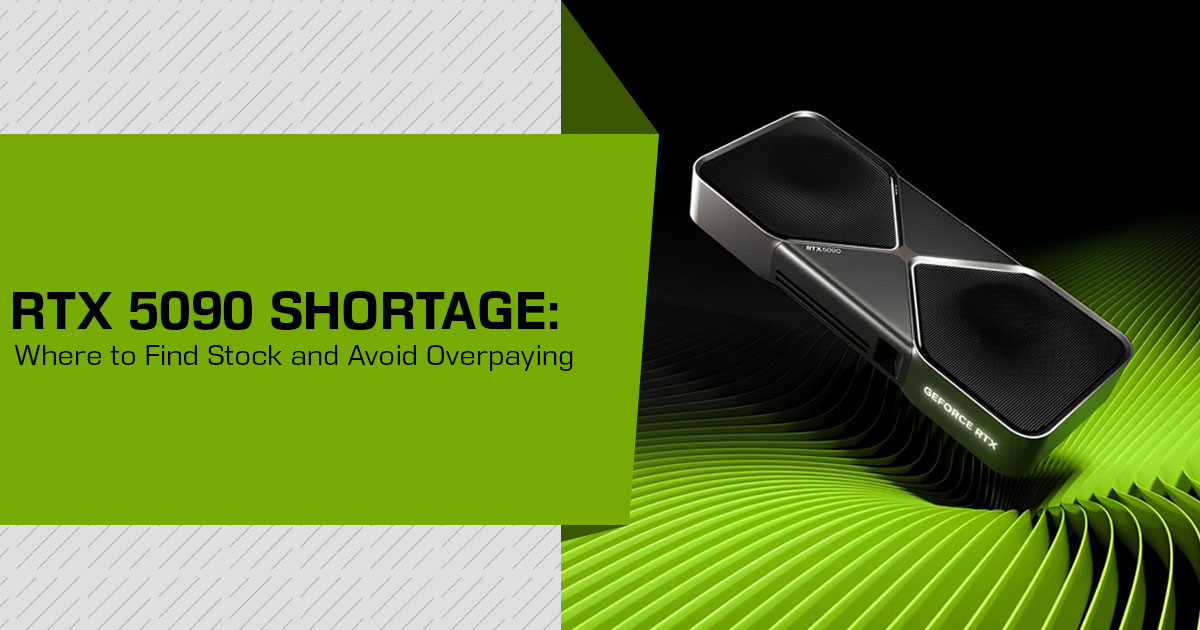
The RTX 5090 is difficult to find at its official price
The NVIDIA GeForce RTX 5090 is NVIDIA’s flagship GeForce graphics card, with a US$1,999 launch price. Finding one at that price is difficult. Reports from September 2026 show some third-party marketplace listings reaching US$6,000 to US$10,000 or more, while retailer-direct stock remains limited. Some RTX 5090 listings are available only as part of bundles or prebuilt systems.
The high marketplace prices do not mean NVIDIA has raised the RTX 5090’s official launch price. The US$1,999 launch price remains the key benchmark. Many of the much higher prices come from third-party sellers or bundled listings, so buyers should check who is actually selling the card and what is included before paying a premium.
For gamers, PC builders, content creators, AI users, and professionals looking for RTX 5090 stock, availability varies by retailer, model, location, and sales channel. Standalone online stock is limited, but some physical stores may still have cards at lower prices.
As technology experts with over 20 years of experience in hardware and application research and development, we assess products through real-world performance, durability, and value for money. Our reviews are aimed at readers who want to compare budget, performance, reliability, and long-term usage before buying.
Our recommendations come from product research, component analysis, real-world usability, and industry experience. With the RTX 5090, that means looking beyond the headline price and checking what you are actually getting for your money.
RTX 5090 verified fact sheet
The following facts are the baseline used throughout this article.
| Item | Verified Information | What It Means for Buyers |
|---|---|---|
| Product | NVIDIA GeForce RTX 5090 | NVIDIA’s flagship GeForce graphics card within the RTX 50 Series, based on its product positioning. |
| Architecture | Blackwell | Supports NVIDIA’s current consumer graphics platform for ray tracing and AI-assisted graphics. |
| Memory | 32GB GDDR7 | Provides substantial VRAM for high-resolution gaming, demanding creative workloads, and selected local AI applications. |
| Memory Interface | 512-bit | Supports high memory throughput for workloads that need to move large quantities of data between the GPU and its memory. |
| CUDA Cores | 21,760 | Provides extensive parallel processing resources for CUDA applications, rendering, compute workloads, and GPU-accelerated software. |
| Launch Price | US$1,999 | Provides a useful baseline for evaluating current retailer premiums, but does not guarantee availability at the original launch price. |
| Power | 575W Total Graphics Power (TGP) | Requires careful planning around the power supply, case airflow, cooling, and power connections. |
| Current Availability | Highly variable | A retailer listing does not necessarily indicate that the graphics card is in stock and available for immediate purchase. |
NVIDIA lists the card with 32GB of GDDR7 memory, Blackwell architecture, a 512-bit memory interface, and a 575W total graphics power rating. These specifications explain why the card attracts both high-end gamers and users running memory-intensive professional or AI workloads, but they do not by themselves justify a multi-thousand-dollar marketplace premium.
What is happening to RTX 5090 prices?
Independent reports published in September 2026 describe a market in which normal online supply has become harder to find and third-party sellers are setting unusually high prices. The reported examples are snapshots, so they should not be treated as a stable price list.
| Channel or Listing Type | Reported Price Range or Example | Availability Context |
|---|---|---|
| NVIDIA Launch Price | US$1,999 | Official NVIDIA launch price for the US market; current stock availability is not guaranteed. |
| Newegg Marketplace Listings | Approximately US$6,449–US$9,659 in reported examples | Third-party marketplace sellers in the US; pricing and availability can change without notice. |
| Newegg Bundle Listing | Around US$10,849.96 for a large ASUS bundle in one September report | This price applies to a hardware bundle rather than a standalone graphics card. |
| Best Buy Founders Edition | US$1,999.99 | The referenced Best Buy product page lists the Founders Edition at MSRP but shows it as sold out. |
| Micro Center Examples | Approximately US$4,299–US$5,300 in reported examples | Pricing and availability vary by store, with some products restricted to in-store pickup. |
| Amazon & Other Marketplace Listings | Approximately US$6,500–US$9,500 in recently reported examples | Marketplace prices depend heavily on the seller and available stock; check shipping, warranty, and return terms before purchasing. |
The highest visible RTX 5090 listing is not necessarily the price buyers are paying. A card can be listed for US$9,500 without there being broad evidence that buyers are completing purchases at that amount.
Before buying, check four details: who sells the card, whether it is actually in stock, whether the price includes a bundle, and what warranty and return protections apply.
Why is the RTX 5090 so expensive now?
The available evidence points to several overlapping factors rather than one confirmed explanation.
Limited normal retail supply
The clearest short-term factor is the disappearance of reasonably priced standalone cards from major online channels.
When a retailer has few or no direct-sold cards, marketplace listings can become the most visible results. Those sellers may set prices based on scarcity rather than on NVIDIA’s launch price.
This is why RTX 5090 availability should be evaluated by seller type. A marketplace listing at US$8,000 and a retailer-direct card at US$4,300 are not equivalent forms of supply, even if both appear in a search result for the same GPU.
AI demand may be competing with gaming demand
The RTX 5090 has characteristics that make it useful beyond gaming. It combines a high-end Blackwell GPU with 32GB of GDDR7 memory, and its CUDA support makes it relevant to many software environments used for machine learning and local AI experimentation.
Reports of RTX 5090 cards being used in AI server systems suggest that AI demand may be adding pressure to retail supply. However, the available evidence does not quantify AI demand as the sole cause of the shortage.
Gaming buyers may be competing with AI and workstation users for some of the same retail cards. But there is no evidence that every missing card went to an AI company or that NVIDIA has confirmed AI demand as the only cause.
The card’s memory capacity has value outside gaming
The RTX 5090’s 32GB memory capacity can matter when a workload cannot fit comfortably into a smaller graphics card. Local AI models, high-resolution content creation, simulation, and some professional applications can benefit from additional video memory.
However, more memory does not automatically make the RTX 5090 the correct purchase. Software compatibility, sustained cooling, power consumption, driver support, and total system cost still matter. A professional buyer may need a workstation or data-center product with different warranty and support terms, while a gamer may gain better value from a lower-tier card.
NVIDIA GeForce RTX 5090 versus NVIDIA GeForce RTX 5080: which purchase makes more sense?
The NVIDIA GeForce RTX 5090 and NVIDIA GeForce RTX 5080 serve different buyers. The NVIDIA GeForce RTX 5090 is aimed at users who need the highest performance available within NVIDIA’s consumer GeForce range and can make use of its larger memory capacity. The RTX 5080 is a lower-tier high-end RTX 50-series option with 16GB GDDR7, making it a relevant comparison for buyers who do not need the RTX 5090’s 32GB memory capacity.
| Buying Factor | RTX 5090 | RTX 5080 |
|---|---|---|
| Position in the Lineup | Flagship GeForce RTX 50-series graphics card | High-end GeForce RTX 50-series model positioned below the RTX 5090 |
| Memory Capacity | 32GB GDDR7 | 16GB GDDR7 |
| Best Fit | High-end gaming, demanding content creation, local AI workloads, and applications that benefit from a larger memory capacity | High-end gaming and content creation where the RTX 5090’s additional 32GB memory capacity is not essential |
| System Requirements | Very demanding power, cooling, and case airflow requirements | Still requires a capable power supply and a well-ventilated PC case, but system demands are generally lower than the RTX 5090 |
| Price Risk During Shortages | Greater exposure to extreme marketplace premiums when supply is constrained | May allow a more manageable overall system budget, depending on current pricing and availability |
The correct RTX 5090 alternative depends on the workload. If the main goal is gaming at 1440p or 4K, compare complete system cost and actual monitor resolution rather than buying the largest card by default. If a workflow requires CUDA or more than 16GB of video memory, check software compatibility before switching to another GPU platform.
Is a prebuilt RTX 5090 PC better value than a standalone card?
A prebuilt system can sometimes have a lower effective GPU cost than an inflated standalone listing, but the comparison must include every component. A system with an RTX 5090 may look expensive while including a processor, memory, storage, motherboard, power supply, case, cooling, operating system, and warranty.
That does not make every RTX 5090 prebuilt a good purchase. Check whether the builder identifies the exact graphics-card model, power supply, memory configuration, cooling design, and warranty terms. Some prebuilts use lower-cost supporting components to keep the headline price down.
A prebuilt may be worth considering when:
- A standalone RTX 5090 listing is several thousand US dollars above the launch price.
- The system includes components that would otherwise be purchased separately.
- The buyer needs a complete working system rather than a GPU upgrade.
- The builder provides clear specifications, return terms, and warranty coverage.
Buying a prebuilt only to obtain the graphics card can create compromises. The system may be difficult to upgrade, and the included processor or power supply may not match the buyer’s long-term plans.
Where can buyers look for RTX 5090 stock?
Readers searching for where to buy an RTX 5090 should separate retailer-direct inventory from marketplace offers.
Micro Center and local pickup
Independent coverage has reported Micro Center locations with RTX 5090 cards around the low-to-mid-US$4,000 range. These reports also indicate that availability varies by store and may require in-store pickup. Buyers should check the exact location, model, purchase limit, and return policy before traveling.
Newegg and marketplace listings
Newegg may show both retailer-direct products and third-party offers. The seller name, seller rating, shipping terms, and return policy deserve as much attention as the product title. A card appearing in search results does not establish that it is sold by Newegg or that the listing will remain available.
Best Buy and other large retailers
Large retailers can still show product pages after inventory has sold out. Treat the displayed price as a historical or current listing value unless the page confirms that the item can be ordered for delivery or pickup.
Amazon
Amazon search results can include multiple sellers for the same graphics card. Confirm the seller and the “sold by” information before paying. High-value graphics-card purchases deserve extra caution because a low price can reflect an incomplete product, a questionable seller, or a listing that is no longer available.
How to avoid an RTX 5090 marketplace scam
The RTX 5090 shortage increases the risk of an expensive buying mistake. Tom’s Hardware has reported earlier scams involving supposed RTX 5090 purchases, including orders that did not deliver the advertised graphics card.
Before buying from a marketplace seller:
- Confirm the seller’s identity and recent feedback.
- Check whether the product is sold by the retailer or only fulfilled by it.
- Read the return and warranty terms rather than relying on the product title.
- Avoid direct payment outside the retailer’s protected checkout.
- Save the listing, invoice, and delivery records.
- Be cautious when a price is far below the prevailing market range.
- Confirm that the box contains a complete graphics card, not a component, damaged unit, or placeholder listing.
A low price is not automatically evidence of a scam, but an unusually low price combined with weak seller information is a reason to stop and verify.
Should you buy an RTX 5090 at today’s inflated price?
For gaming buyers, a large premium should be weighed against the workload and total system cost. The purchase becomes easier to defend when the buyer has a specific workload that benefits from the RTX 5090’s memory capacity and performance, has a reliable seller, and has already budgeted for the required power and cooling hardware.
Waiting or choosing another GPU may be more sensible when:
- The card will mainly be used for ordinary 1440p gaming.
- The listing is from an unfamiliar seller with weak return protection.
- The premium would reduce the budget for the monitor, CPU, storage, or power supply.
- A lower-priced card can meet the target frame rate and resolution.
- The buyer does not need CUDA or the RTX 5090’s 32GB memory capacity.
The key RTX 5090 buying advice is to evaluate the whole system and workload, not just the graphics card. A high-end GPU can be technically appropriate and still be a poor purchase at an extreme marketplace premium.
RTX 5090 pros and cons
| Advantages | Limitations |
|---|---|
| 32GB of GDDR7 memory provides substantial capacity for demanding graphics, creative, and AI workloads. | Marketplace pricing can be extremely high during periods of limited availability. |
| Blackwell architecture provides access to NVIDIA’s current-generation graphics, AI, and acceleration features. | A 575W total graphics power rating requires careful planning for the power supply, cooling, and overall system configuration. |
| Well suited to high-end gaming and demanding professional content-creation workloads. | Standalone retail availability can be difficult to verify and may vary significantly by region. |
| NVIDIA’s CUDA ecosystem can accelerate compatible AI, rendering, scientific, and professional applications. | Third-party marketplace listings can introduce additional seller, warranty, authenticity, and return-policy risks. |
| The large 32GB memory capacity can benefit local AI models and other VRAM-intensive workloads. | Its additional performance and memory capacity may provide limited practical benefit for less demanding gaming setups. |
Frequently asked questions about RTX 5090 stock and pricing
Is the RTX 5090 officially priced at $10,000?
No. RTX 5090 $10,000 listings are marketplace asking prices or retailer snapshots. NVIDIA’s launch price was US$1,999, although cards at that price can be difficult to find.
Is the RTX 5090 completely sold out?
Not necessarily. RTX 5090 stock is limited through normal online channels, but reports have identified store-specific availability and other purchase routes. Inventory should be verified directly before traveling or ordering.
Why is the RTX 5090 so expensive in 2026?
The current picture reflects constrained supply and high marketplace demand. Reported AI-server purchases may be adding pressure, but available coverage does not prove that AI demand is the only cause.
Is the RTX 5090 good for AI?
Its 32GB memory, CUDA support, and high compute capability can suit some local AI and professional workloads. Software compatibility, power requirements, cooling, and total system cost still need to be evaluated.
Should gamers buy an RTX 5090 from a third-party seller?
Only after verifying the seller, return policy, warranty, delivery terms, and product condition. The shortage has increased the risk of overpriced or misleading listings, so retailer-direct stock or a reputable system builder may provide stronger protection.
Is an RTX 5090 prebuilt cheaper than a standalone card?
Sometimes the complete system can offer better value than a heavily marked-up standalone listing, but this depends on the included components and warranty. Compare the full system specification rather than assuming the prebuilt is automatically cheaper.
Current RTX 5090 pricing: Amazon US and Amazon India
Prices on Amazon can change quickly, and regional inventory may differ. The links below are intended to help readers check the latest listings rather than to represent a fixed price or guaranteed stock position.
Check RTX 5090 prices on Amazon US
The NVIDIA GeForce RTX 5090 offers 32GB of GDDR7 memory and Blackwell architecture, but current marketplace premiums make seller verification especially important. Check the latest RTX 5090 price on Amazon US, then compare the seller, warranty, delivery estimate, and return terms before making a decision.
Check current RTX 5090 listings on Amazon US
Check RTX 5090 prices on Amazon India
Indian availability, import costs, taxes, warranty coverage, and distributor pricing can differ significantly from US listings. Check the latest RTX 5090 price on Amazon India and confirm that the product has valid regional warranty support before ordering.
Check current RTX 5090 listings on Amazon India
RTX 5090: performance is clear, but price and stock need scrutiny
The RTX 5090 shortage is a supply and availability problem, not evidence of a confirmed official MSRP change. Normal online standalone inventory has become difficult to find, and marketplace sellers have posted prices far above NVIDIA’s US$1,999 launch price. Micro Center and some system channels may still offer alternatives, but their stock and pricing require checking at the time of purchase.
Its 32GB memory, Blackwell architecture, and CUDA support make it relevant to high-end gaming, content creation, and selected AI workloads. Those specifications do not by themselves justify an inflated listing. For buyers who need the specific capability and can verify the seller, the RTX 5090 may still be appropriate. For everyone else, comparing the RTX 5080, a reputable prebuilt, or waiting for more normal supply may reduce risk and total cost.
Have you found an RTX 5090 at a reasonable price? Share your experience in the comments. Follow us for more hardware updates, product analysis, and buying advice, and if you have a question about the RTX 5090, its pricing, availability, or specifications, leave it below. We’ll be happy to help.
Disclaimer

This blog post reflects our research, analysis, and opinions based on available product information, user feedback, and industry knowledge. It should not be taken as the official position of any brand, manufacturer, or company mentioned here. We make every effort to keep this guide accurate, but product specifications, pricing, and availability may change after publication. We recommend double-checking important details before making a purchase.

Some links in this article may be affiliate links. If you choose to buy through these links, we may earn a small commission at no extra cost to you. This helps support our work and allows us to keep publishing in-depth, unbiased reviews. Affiliate partnerships never influence our recommendations.

Opinions expressed by readers are their own and do not necessarily reflect ours. We are not responsible for outcomes resulting from the use of information on this site. Please seek professional advice where appropriate.

All product names, logos, and brands mentioned are the property of their respective owners. These names are used for identification and informational purposes only and do not imply endorsement.