
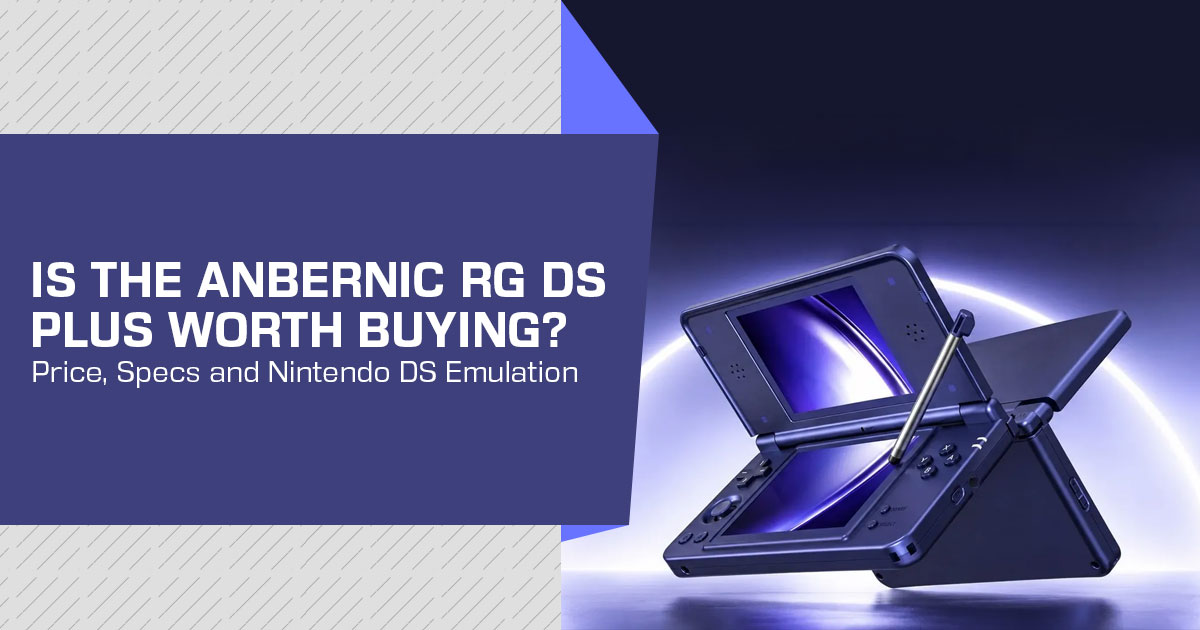
The ANBERNIC RG DS Plus is a dual-screen retro handheld built for gamers who want a Nintendo DS-style gaming experience in a clamshell design. It runs Linux and features two 4.3-inch displays, a built-in capacitive stylus, and a redesigned hinge. The handheld is also designed to support ported games and more than 20 game formats, making it more than a dedicated DS-style device.
The “Plus” name does not indicate a major hardware upgrade. ANBERNIC lists the same Rockchip RK3568 processor and 1GB RAM, while the main changes focus on the display and dual-screen experience. You get larger, higher-resolution screens, an integrated stylus, a new hinge design, and a Linux interface built for two-screen gaming.
That makes the ANBERNIC RG DS Plus worth considering if you are a Nintendo DS fan, retro gamer, handheld gaming enthusiast, or collector looking for a compact device with a familiar dual-screen layout. The key questions are how well the screens work for DS-style games, how comfortable the controls are, how the hinge holds up, and whether the hardware offers enough value for its price.
As technology experts with over 20 years of experience in hardware and application research and development, we assess each product based on performance, build quality, usability, durability, and value for money. For the ANBERNIC RG DS Plus, we focus on what matters to retro gamers and Nintendo DS enthusiasts—display quality, controls, software, stylus support, portability, emulation performance, and long-term use.
Our recommendations are based on product research, component analysis, real-world usability, and industry expertise. In this ANBERNIC RG DS Plus review, we look at what the handheld offers, where its hardware stands, and whether it makes sense for buyers looking for a dual-screen retro gaming console.
Price status: At the time of this fact-check, the official ANBERNIC store lists the base configuration at $84.99 USD, with $94.99 USD shown as the regular price. Prices and availability can change.
ANBERNIC RG DS Plus price and availability
At the time of this fact-check, the official ANBERNIC store lists the base configuration at $84.99 USD. It includes a 16GB system TF card. The store also lists 16GB+64GB and 16GB+128GB configurations. Final prices can vary by region, seller, taxes, and shipping.
The original launch promotion reduced the base configuration to $84.99 USD for the first 72 hours and ended on September 18, 2026. The official store is currently showing $84.99 USD as a sale price, so readers searching for an ANBERNIC RG DS Plus discount should check the current product page before relying on an older article or search result.
The official listing shows Matte Black, Coral Pink, and Metallic Blue color options. Buyers should also check shipping origin, estimated delivery time, import charges, warranty coverage, and return terms. These details can affect the final cost, especially when purchasing outside the seller’s primary market.
ANBERNIC RG DS Plus specifications
The following ANBERNIC RG DS Plus specs are based on published manufacturer information and supporting sources. Battery life is a manufacturer estimate rather than an independently measured result.
| Specification | ANBERNIC RG DS Plus | Buyer Relevance |
|---|---|---|
| Displays | Two 4.3-inch IPS displays | Provides a larger dual-screen layout than the standard ANBERNIC RG DS. |
| Resolution | 1024 × 768 per screen | Matches a 4× integer scale of the Nintendo DS’s original 256 × 192 resolution. |
| Touch Input | Multi-touch on the lower display | Supports touch-oriented games, menus, and other compatible software. |
| Stylus | Integrated capacitive stylus | Built-in storage keeps the stylus with the console instead of requiring a separate case or holder. |
| Processor | Rockchip RK3568, quad-core 64-bit Cortex-A55 at up to 2.0GHz | Uses the same RK3568 platform listed for the ANBERNIC RG DS, so this is not a major CPU upgrade. |
| GPU | ARM Mali-G52 2EE | Handles graphics for the Linux gaming platform, with real-world performance dependent on software, emulator, and game settings. |
| RAM | 1GB | Lower than the 3GB RAM listed for the ANBERNIC RG DS. |
| Operating System | Linux | Designed around a dedicated dual-screen gaming interface rather than an Android-based software environment. |
| System Storage | 16GB TF card | Used for system files, with additional storage-card configurations available. |
| Battery | 4,000mAh polymer lithium battery | ANBERNIC lists approximately six hours of battery life, although actual runtime will vary by workload and settings. |
| Wireless Connectivity | 2.4GHz / 5GHz Wi-Fi and Bluetooth 4.2 | Supports compatible wireless features and accessories, subject to software support. |
| Audio & Input | Stereo speakers, microphone, and 3.5mm headphone jack | Provides built-in stereo audio, microphone support, and compatibility with wired headphones. |
| Hinge | 15°–180° positioning | Allows the upper display to be positioned at multiple viewing angles. |
| Controls | D-pad, face buttons, shoulder buttons, and one left analog stick | Uses a simpler analog-control layout than the standard ANBERNIC RG DS. |
What the 4.3-inch displays mean for Nintendo DS emulation
The two 4.3-inch 1024 × 768 displays are the central hardware feature. The original Nintendo DS resolution is 256 × 192 pixels per screen. Multiplying both dimensions by four produces 1024 × 768, allowing an exact integer scale.
Integer scaling affects image presentation, not processing speed. It can enlarge the original pixel structure without the uneven interpolation that may make older graphics appear soft. That makes the resolution relevant to people searching for ANBERNIC RG DS Plus Nintendo DS emulation, but it does not establish how every game will perform.
The lower screen supports multi-touch and the console includes an integrated capacitive stylus. This combination is useful for games and interfaces that rely on touch input. It should not be presented as proof that the device reproduces every characteristic of original Nintendo DS hardware.
Design, hinge, and controls
The ANBERNIC RG DS Plus uses a clamshell body with a hinge that the manufacturer lists as supporting 15°–180° positioning. The hinge is described by ANBERNIC as a dual-alloy structure with stepless positioning. Those specifications indicate a flexible viewing angle, but they do not establish long-term hinge durability without extended ownership testing.
A Hall switch is included for sleep and wake behavior when the lid is closed or opened. This is a convenience feature that suits a portable clamshell design. The console also has one left analog stick, a D-pad, face buttons, shoulder buttons, stereo speakers, a microphone, and a 3.5mm headphone jack.
The single-stick layout is worth checking before purchase. The ANBERNIC RG DS is listed with two analog sticks, so the Plus model is not a straightforward control upgrade for users who rely on a right stick.
Linux software and the NNDDSS emulator
The ANBERNIC RG DS Plus Linux configuration is built around dual-screen use. ANBERNIC’s published material identifies NNDDSS as an emulator with features such as screen swapping, save states, shader options, microphone support, a real-time clock, and cheat-code support.
A device-specific interface can make two-screen navigation more coherent than a general handheld menu. The trade-off is software flexibility. The ANBERNIC RG DS Plus is listed with Linux, not Android. Buyers should not assume that Android applications, Android storefronts, or Android-specific emulator setups will work natively on this model.
This is a key software distinction in the ANBERNIC RG DS Plus vs ANBERNIC RG DS comparison. The ANBERNIC RG DS is listed with Android 14 and 3GB of RAM, while the ANBERNIC RG DS Plus is listed with Linux and 1GB of RAM. The Plus model is configured around a focused dual-screen environment, while the RG DS offers greater Android flexibility.
Performance expectations from the Rockchip RK3568
The published processor is a Rockchip RK3568 quad-core Cortex-A55 chip with a listed frequency of up to 2.0GHz. The same Rockchip RK3568 appears in the published specifications for the ANBERNIC RG DS.
That information supports a cautious conclusion: the main reason to choose the Plus model is its display and dual-screen design, not a documented jump to a new performance class. The higher resolution can improve image presentation, but it does not by itself prove better frame rates or support for demanding 3D systems.
For that reason, this guide does not describe the ANBERNIC RG DS Plus as a general-purpose high-end emulator. Game-by-game performance should be verified through independent testing or current owner reports rather than inferred from the product name.
Battery and connectivity
The ANBERNIC RG DS Plus battery life is advertised at approximately six hours with its 4000mAh battery. This is a manufacturer-stated estimate. Brightness, wireless activity, speaker volume, emulator settings, and game load can all change runtime.
The published connectivity list includes 2.4GHz and 5GHz Wi-Fi, Bluetooth 4.2, USB-C, and a 3.5mm headphone jack. The feature list also mentions streaming and online multiplayer. Whether a specific service works depends on the firmware and software involved, so those features should be treated as listed capabilities rather than universal compatibility.
ANBERNIC RG DS Plus vs ANBERNIC RG DS
The two models serve different priorities rather than representing a simple old-versus-new upgrade.
| Area | ANBERNIC RG DS Plus | ANBERNIC RG DS |
|---|---|---|
| Screen Size | Dual 4.3-inch displays | Dual 4.0-inch displays |
| Resolution | 1024 × 768 per screen | 640 × 480 per screen |
| Operating System | Linux listed | Android 14 listed, with Linux configurations also available |
| RAM | 1GB | 3GB |
| Processor | Rockchip RK3568, up to 2.0GHz | Rockchip RK3568, up to 2.0GHz |
| Analog Controls | Single left analog stick | Dual analog sticks |
| Stylus | Included with integrated storage inside the handheld | Included, although the storage arrangement differs from the Plus model |
| Primary Emphasis | Larger, higher-resolution displays with a dedicated Linux dual-screen interface | Smaller form factor with greater Android flexibility |
Choose the ANBERNIC RG DS Plus when larger screens, 4× scaling, an internal stylus, and a Linux-focused interface are more important than Android support or additional RAM. Consider the ANBERNIC RG DS when Android applications, two analog sticks, 3GB of RAM, or a smaller body are more relevant.
Strengths and limitations
Strengths
- Dual 3-inch 1024 × 768 displays provide a larger dual-screen presentation than the ANBERNIC RG DS.
- 4× integer scaling corresponds directly to the Nintendo DS’s 256 × 192 resolution.
- Integrated capacitive stylus keeps the input accessory with the console.
- Linux-focused software includes listed dual-screen functions such as screen swapping and save states.
- 15°–180° hinge positioning provides a range of viewing angles.
- The listed base price remains below $100 The original 72-hour launch offer ended on September 18, 2026, but the official store is currently showing an $84.99 USD sale price.
Limitations
- The device has 1GB of RAM, compared with 3GB listed for the ANBERNIC RG DS.
- The published configuration is Linux-only, not Android.
- The RK3568 processor family does not represent a documented move to a higher performance tier.
- The single-stick layout may not suit users who want two analog controls.
- The approximately six-hour battery figure is an estimate, not a test result.
- The current $84.99 USD sale price may Check the current listing before purchase.
Who should buy the ANBERNIC RG DS Plus?
The ANBERNIC RG DS Plus is most relevant to buyers who want a dedicated clamshell device for Nintendo DS-style gaming, touch input, stylus use, and a larger dual-screen layout. It also suits buyers who prefer a focused Linux interface and do not need Android applications.
Caution is appropriate for buyers who want Android software, two analog sticks, or a documented performance increase over the ANBERNIC RG DS. Those requirements point toward comparing other models before ordering.
Frequently asked questions
How much is the ANBERNIC RG DS Plus?
At the time of this fact-check, the base configuration is listed at $84.99 USD on the official ANBERNIC store, with
$94.99 USD shown as the regular price. Check the current listing before purchase.
Does the ANBERNIC RG DS Plus run Android?
No. The published configuration lists Linux. The ANBERNIC RG DS is the model associated with Android 14 support.
Does the ANBERNIC RG DS Plus include a stylus?
Yes. It includes an integrated capacitive stylus, and the lower display supports multi-touch.
What is the ANBERNIC RG DS Plus screen resolution?
Each display is listed at 1024 × 768 pixels. This corresponds to a 4× scale of the Nintendo DS’s 256 × 192 resolution.
How much RAM does the ANBERNIC RG DS Plus have?
It is listed with 1GB of RAM. The ANBERNIC RG DS is listed with 3GB, so the Plus is not a RAM upgrade over that model.
What is the ANBERNIC RG DS Plus battery life?
ANBERNIC lists approximately six hours of battery life from the 4000mAh battery. Actual runtime depends on use and settings.
Is the ANBERNIC RG DS Plus worth buying?
It is worth considering when the priority is a larger dual-screen layout, touch and stylus input, Linux software, and a listed price below $100 USD. It is less suitable for buyers who require Android, two analog sticks, or a documented increase in processing power.
Amazon price-check sections
Check the ANBERNIC RG DS Plus on Amazon US
Amazon US availability and pricing may differ from Anbernic’s official store. Search Amazon US for the ANBERNIC RG DS Plus and compare the seller, delivered price, warranty, return terms, and expected delivery date.
Check the ANBERNIC RG DS Plus on Amazon India
Amazon India availability, import costs, taxes, and marketplace pricing may differ from the USD price shown on the official store. Search Amazon India for the ANBERNIC RG DS Plus and compare the complete delivered cost before ordering.
Final verdict
The ANBERNIC RG DS Plus is a specialized revision centered on dual-screen presentation and touch-oriented play. Its documented advantages over the ANBERNIC RG DS are the larger 4.3-inch screens, 1024 × 768 resolution, 4× scaling, integrated stylus storage, and a Linux interface designed for the two-screen layout.
Its limitations are also clear: 1GB of RAM, a Linux-only published configuration, one analog stick, and the same Rockchip RK3568 processor family listed for the original model. Buyers who value the larger displays and dedicated dual-screen interface may consider those trade-offs reasonable. Buyers who need Android flexibility, two analog sticks, or more processing headroom should compare alternatives before making a purchase.
Have questions about the ANBERNIC RG DS Plus? Leave a comment below and tell us what you want to know. If you have used the handheld, share your experience with other readers. Follow us for more hardware reviews, buying guides, and product comparisons, and tell us what you want us to cover next.
Disclaimer

This blog post reflects our research, analysis, and opinions based on available product information, user feedback, and industry knowledge. It should not be taken as the official position of any brand, manufacturer, or company mentioned here. We make every effort to keep this guide accurate, but product specifications, pricing, and availability may change after publication. We recommend double-checking important details before making a purchase.

Some links in this article may be affiliate links. If you choose to buy through these links, we may earn a small commission at no extra cost to you. This helps support our work and allows us to keep publishing in-depth, unbiased reviews. Affiliate partnerships never influence our recommendations.

Opinions expressed by readers are their own and do not necessarily reflect ours. We are not responsible for outcomes resulting from the use of information on this site. Please seek professional advice where appropriate.

All product names, logos, and brands mentioned are the property of their respective owners. These names are used for identification and informational purposes only and do not imply endorsement.