
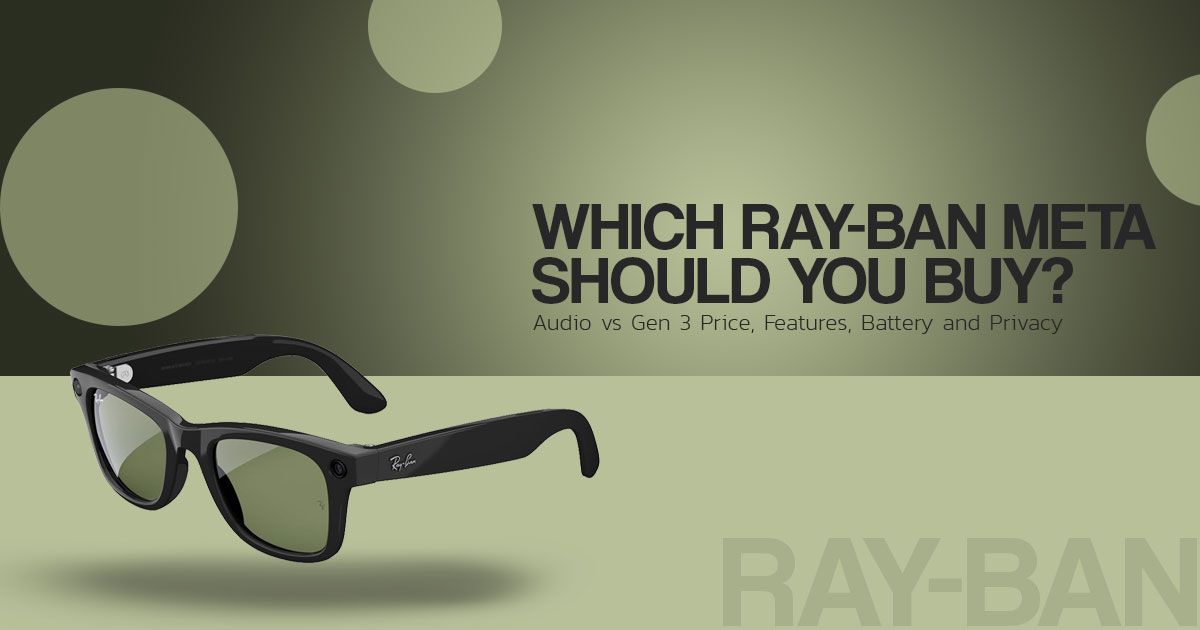
Which Ray-Ban Meta should you buy? The Ray-Ban Meta Audio and Ray-Ban Meta (Gen 3) take different approaches to smart glasses. Audio is camera-free and focused on open-ear audio, calls, podcasts, and hands-free AI, while Gen 3 adds a camera and video capture. Comparing the two makes it easier to see which features match your needs.
Ray-Ban Meta Audio is built around open-ear audio, calls, music, podcasts, and hands-free access to Meta’s AI features. There is no camera, which may appeal to people who want camera-free smart glasses, but the glasses can record audio through their microphone array. Muse Charm is another new product in Meta’s lineup, but details about its hardware and retail specifications remain limited.Ray-Ban Meta Audio
For buyers, the choice comes down to what you want from your glasses. Do you need camera and video features, or would you rather have a simpler pair of camera-free audio glasses for everyday use? The differences become clearer when you compare the features, audio experience, AI functions, battery life, comfort, and price.
As technology experts with over 20 years of experience in hardware and application research and development, we analyze products based on real-world performance, durability, and value for money. Our goal is to help you find the right product based on budget, performance, reliability, and long-term use.
This comparison is for smart-glasses buyers, music and podcast listeners, frequent callers, AI users, privacy-conscious users, and anyone deciding between camera-free glasses and a camera-equipped model. Our recommendations are based on product research, component analysis, real-world usability, and industry experience.
Read on for our Ray-Ban Meta Audio vs Ray-Ban Meta (Gen 3) comparison, covering features, audio, cameras, AI, battery life, comfort, pricing, everyday use, privacy, and buying considerations.
Verified fact sheet: Ray-Ban Meta Audio and Muse Charm
This table separates information confirmed by Meta from details reported by other publications.
| Product | Information confirmed by Meta | Reported or not yet confirmed |
| Ray-Ban Meta Audio | Meta’s first audio-glasses product; open-ear audio; 43 grams; up to 12 hours of battery life; up to 48 additional hours from the charging case; Clubmaster and Burbank styles; 23 color-and-lens combinations; optical-prescription compatibility; preorder starting at $349 USD; ships October 13, 2026 | Independent battery and comfort testing; final availability in every country; the exact audio-recording notification system |
| Muse Charm | Device for talking and interacting with Muse; designed to fit in a pocket; more details promised later in 2026 | Price, final dimensions, camera status, battery, connectivity, storage, privacy controls, and exact release date |
| Ray-Ban Meta (Gen 3) | 12 MP camera; 3K Ultra HD video; up to nine hours of battery life; six-microphone array; built-in LED for awareness during photo or video capture; prices starting at $449 USD | Independent testing and regional pricing |
| Meta VR Glasses | $1,299.99 USD; planned for spring 2027; about 100 grams; 5K Infinite Display using micro-OLED panels; separate battery and processor puck | Final retail availability in India and other markets; independent testing |
Meta’s official pages confirm the product names and the main Ray-Ban Meta Audio specifications. India Today reports that the camera-free glasses support audio recording and says they do not provide bystanders with a clear signal when recording is underway. Treat that privacy point as reported coverage until Meta publishes more detailed product documentation. Reuters has reported broader privacy concerns around smart glasses, but the Audio-specific recording detail in this article is attributed to India Today.
What is Ray-Ban Meta Audio?
Ray-Ban Meta Audio is Meta’s first pair of audio glasses. The official product description says the glasses combine open-ear audio with AI in a Ray-Ban frame. They are designed for music, podcasts, calls, and hands-free conversations with Meta AI.
Open-ear audio is different from an earbud that seals the ear canal. The design can help the wearer stay aware of surrounding sounds, which may be useful while walking, commuting, or working around other people. It is not the same as active noise cancellation or strong passive isolation. In a loud environment, conventional earbuds or headphones may be easier to hear.
The glasses weigh 43 grams according to Meta. That gives buyers a useful reference point, but it does not prove that the frame will be comfortable for every wearer. Fit depends on the frame shape, nose pads, temple adjustment, lens configuration, and the wearer’s face shape.
Meta offers Clubmaster and Burbank styles, with 23 color and lens combinations. Both styles support a wide range of optical prescriptions. Lens availability and prescription limits can vary by market, so buyers should confirm the exact configuration before ordering.
Ray-Ban Meta Audio price, battery life, and shipping date
Meta lists Ray-Ban Meta Audio at a starting price of $349 USD for preorder. This is an official US dollar starting price, not an India retail price and not a guarantee that every lens or prescription configuration will cost the same. Meta says the glasses ship on October 13, 2026.
Meta claims up to 12 hours of use on a single charge, with up to 48 additional hours from the included charging case. These are maximum claims. Actual battery life can vary with call time, audio volume, AI use, connectivity, and other settings. No independent battery test is included in this article.
For buyers outside the United States, the practical purchase questions are different. Check the local price, warranty, prescription support, delivery date, and whether all AI features work in that region. A direct conversion from $349 USD should not be presented as official local pricing.
Does Ray-Ban Meta Audio record audio?
India Today reports that Ray-Ban Meta Audio can record audio and says the glasses do not provide bystanders with a clear signal when recording is underway. This is a privacy consideration for anyone buying an audio-only smart-glasses product.
Meta says the camera-equipped Ray-Ban Meta (Gen 3) has a built-in LED intended to make people nearby aware when photos or video are being taken. The official material reviewed for this article does not provide an equivalent detailed description of the audio-recording notification system on Ray-Ban Meta Audio. Buyers should not assume that the Gen 3 camera indicator applies to the Audio model.
The careful conclusion is not that Ray-Ban Meta Audio is illegal or unsafe in every situation. The evidence supports a narrower conclusion: removing the camera changes the privacy considerations, but it does not remove questions about audio recording, consent, notification, data handling, or local law.
Privacy questions to check before buying
Before placing an order, review the final product documentation for:
- How audio recording starts and stops
- Whether a visible or audible signal alerts nearby people
- Whether recordings are stored on the glasses, a phone, a cloud service, or a combination
- How long recordings are retained
- Which AI functions process data locally and which use cloud services
- Whether account data and recordings can be deleted
- Which recording and AI functions are available in the buyer’s country
These questions are more useful than treating “camera-free” as a complete privacy assessment.
What is Muse Charm?
Muse Charm is Meta’s announced device for talking and interacting with the Muse AI agent. Meta describes it as a device that fits in a pocket and says more details will be shared later in 2026. Meta has not published a complete retail specification covering price, exact dimensions, battery, camera, connectivity, storage, or privacy controls.
India Today reports a roughly two-inch touchscreen, 5G support, speakers, microphones, and a fingerprint sensor. Other reporting has indicated possible camera hardware, but Meta has not published a final camera specification. Treat these reported hardware details as provisional until Meta releases complete product documentation.
The reported December timing is a target for the holiday period, not a guaranteed release date. Buyers should also wait for information about the required account, internet connection, subscription terms, data retention, warranty, and supported markets.
Who may benefit from Muse Charm?
The device may appeal to users who want voice access to Muse without taking out a phone. It may also suit people who already use Meta’s apps and want another way to interact with the assistant.
The trade-off is that a separate AI device creates another product to carry, charge, update, and secure. Until the final price and service requirements are published, it is not possible to calculate the full ownership cost or make a firm value judgment.
Ray-Ban Meta Audio vs Ray-Ban Meta (Gen 3)
These products belong to the same broader wearable category but serve different use cases. Ray-Ban Meta Audio removes the camera and focuses on audio and voice features. Ray-Ban Meta (Gen 3) includes a camera for photos and video.
| Feature | Ray-Ban Meta Audio | Ray-Ban Meta (Gen 3) |
| Camera | Meta describes it as camera-free | 12 MP camera |
| Video | No video feature is listed in the Audio announcement | 3K Ultra HD video |
| Audio and AI | Open-ear audio, calls, music, podcasts, and AI conversations | Audio, calls, AI, photos, and video |
| Battery claim | Up to 12 hours | Up to nine hours |
| Microphones | Six-microphone array | Six-microphone array |
| Starting price | $349 USD preorder starting price | $449 USD starting price |
| Styles | Audio-recording notification details remain unclear in the supplied sources | Aviator, Zena, and Wayfarer |
| Recording awareness | Audio-recording notification details remain unclear in the supplied sources | Meta says a built-in LED helps alert people when photos or video are being taken |
The Audio model is aimed at buyers who want prescription-compatible frames, open-ear listening, calls, and voice AI without a camera. Gen 3 is the relevant comparison for buyers who want hands-free photos and video.
The $100 difference between the published US starting prices should not be treated as the only distinction. The models have different hardware and different privacy considerations.
Ray-Ban Meta Audio compared with wireless earbuds
Wireless earbuds remain a relevant alternative. They can be removed without changing eyewear and are available across a wider range of prices and designs. Depending on the model, they may also provide stronger isolation in noisy places.
Ray-Ban Meta Audio may be convenient for someone who already wears glasses and wants open-ear sound, calls, and AI access in the same frame. That convenience comes with a specific frame, charging case, companion software, and Meta account ecosystem.
The right choice depends on the use case. Someone who only wants music may not need smart glasses. Someone who wants prescription eyewear with hands-free audio has a more specific reason to consider this product.
What the reported specifications mean for daily use
The published information suggests several possible uses:
- Listening to music or podcasts while remaining aware of surrounding sound
- Taking calls without holding a phone
- Speaking with Meta AI through the glasses
- Using prescription-compatible frames instead of separate glasses and earbuds
- Wearing a camera-free frame in situations where a camera would be unwanted
The limitations are also clear:
- The Audio model is not a substitute for Gen 3 if photos or video are important
- Open-ear audio may be harder to hear in loud locations
- “Up to 12 hours” is a maximum claim, not a guaranteed daily result
- Audio-recording notification and bystander awareness require closer review
- Prices, prescription options, warranty, and AI features may vary by country
- Muse Charm remains too lightly specified for a complete buying recommendation
Pricing and retailer checks
The only official prices established in the verified fact sheet are $349 USD starting at preorder for Ray-Ban Meta Audio, $449 USD starting price for Ray-Ban Meta (Gen 3), and $1,299.99 USD for Meta VR Glasses. These are launch or announced prices in US dollars, not current sale prices and not universal regional prices.
No verified Amazon US or Amazon India listing was available in the research used for this article. The purchase prompts below should therefore be linked to a verified retailer page before publication.
Amazon US
When a verified Amazon US listing is available, check the current listed price, seller, warranty, delivery date, return policy, and whether the listing is for Ray-Ban Meta Audio rather than Ray-Ban Meta (Gen 3).
Check the current Ray-Ban Meta Audio price on Amazon US
The official starting price is $349 USD, but prescription lenses and other configurations may cost more.
Amazon India
Before using an Amazon India listing, verify the seller, local warranty, prescription support, return terms, import status, and whether the advertised AI functions are supported in India. Do not convert the US starting price into an official Indian price.
Check Ray-Ban Meta Audio availability on Amazon India
If no authorized local listing is available, an imported product may have different warranty and service conditions.
Pros and limitations
| Potential advantages | Limitations and open questions |
| Camera-free design for buyers who do not need photos or video | Audio-recording notification and bystander awareness require clarification |
| Open-ear audio for music, podcasts, and calls | Open-ear audio may be less suitable in noisy environments |
| 43-gram weight reported by Meta | No independent comfort or battery test is included here |
| Up to 12 hours of battery life claimed by Meta | Actual use may be lower than the maximum claim |
| Clubmaster and Burbank styles | Prescription and regional availability can differ |
| Official US starting price of $349 | No verified India price in the supplied research |
| Muse integration is planned across Meta’s AI-glasses ecosystem | Muse Charm’s final price and hardware remain incomplete |
Who should consider Ray-Ban Meta Audio?
Consider Ray-Ban Meta Audio if the priority is open-ear listening, calls, podcasts, prescription compatibility, and voice AI in a camera-free frame. It may also suit buyers who do not want a camera-equipped wearable in social or professional settings.
Compare it with Ray-Ban Meta (Gen 3) if photos, video, the action button, and the camera-based feature set matter more than the lower Audio starting price. Compare it with wireless earbuds if eyewear is not part of the requirement.
Buyers who are especially concerned about recording privacy should wait for final documentation about audio indicators, controls, retention, and regional compliance. The camera-free design is relevant, but it is not a complete privacy assessment.
Final verdict
Based on Meta’s official announcement and the reported privacy coverage, Ray-Ban Meta Audio is a camera-free, open-ear option within Meta’s AI-glasses lineup. Its main confirmed points are a 43-gram frame, up to 12 hours of claimed battery life, Clubmaster and Burbank styles, prescription compatibility, a $349 USD starting price, and October 13 availability.
The main unresolved issue is how audio recording is indicated to people nearby. India Today reports that the glasses can record audio and may not provide a clear bystander signal. That makes the final recording controls and privacy documentation important parts of the purchase decision.
Muse Charm is less defined for a firm buying assessment because Meta has not published its full price and hardware specifications. Treat the reported December holiday target as provisional.
The Audio model is aimed at buyers who want glasses-based audio and voice features without a camera. It is less suitable for buyers who want hands-free photography, video capture, strong noise isolation, or a fully documented privacy system at launch.
Frequently asked questions
Are Ray-Ban Meta Audio glasses camera-free?
Yes. Meta and the supplied reporting identify Ray-Ban Meta Audio as an audio-glasses product without a camera.
Can Ray-Ban Meta Audio record audio?
India Today reports that it can record audio. The supplied sources do not establish a clearly disclosed bystander signal equivalent to the camera-recording LED described for Ray-Ban Meta (Gen 3).
How much do Ray-Ban Meta Audio glasses cost?
Meta lists the US preorder starting price at $349 USD. A final price can vary by lens type, prescription configuration, taxes, retailer, and market.
When will Ray-Ban Meta Audio ship?
Meta says Ray-Ban Meta Audio ships on October 13, 2026. Buyers should confirm the delivery date and local availability at the time of purchase.
What is Muse Charm?
Muse Charm is Meta’s announced pocket-sized device for talking and interacting with the Muse AI agent. Meta says more details will be shared later in 2026, but it has not published a complete retail hardware specification.
Does Muse Charm have a camera?
Meta has not published a complete final camera specification for Muse Charm. Some reporting has indicated possible camera hardware, but that detail is not confirmed by Meta and should not be treated as a final specification.
When will Muse Charm ship?
India Today reports a target for the December holiday period. Meta’s official announcement says more details will be shared later in 2026, so the timing should be treated as provisional.
Are Ray-Ban Meta Audio glasses available in India?
The supplied sources do not establish an official India price or confirmed India retail availability. Check Meta, Ray-Ban, and authorized local retailer pages before ordering.
Are Ray-Ban Meta Audio glasses better than earbuds?
They serve different needs. Ray-Ban Meta Audio may suit someone who wants prescription eyewear with open-ear audio and voice AI. Earbuds may suit buyers who want stronger isolation, simpler audio hardware, or a lower-cost option.
What do you think about the Ray-Ban Meta Audio and Ray-Ban Meta (Gen 3)? Share your thoughts in the comments, especially if you already use a pair of Meta smart glasses or are planning to buy one.
If you found this comparison useful, follow us for more honest product comparisons, buying guides, and hardware reviews. And if you have any questions or doubts about the Ray-Ban Meta Audio, Ray-Ban Meta (Gen 3), or any other tech product, drop them in the comments. We’ll do our best to help.
Disclaimer

This article is based on our research, analysis, available product information, user feedback, and industry knowledge. It is not an official statement from any brand or manufacturer mentioned in the article. Product specifications, prices, software features, and availability can change. We do our best to keep the information up to date, but please check the latest details with the manufacturer or retailer before making a purchase.

Some links in this article may be affiliate links. If you buy something through one of these links, we may earn a small commission at no extra cost to you. These commissions help support the site and our work. They do not affect how we assess or discuss products. Comments and opinions shared by readers belong to the people who post them and do not necessarily represent our views. Information on this site is provided for general purposes, and we cannot guarantee a particular result from using it. Where professional advice is needed, consult a qualified professional.

All product names, logos, and trademarks belong to their respective owners. We use them only to identify the products and companies discussed and do not imply endorsement or affiliation.