
Introduction
TCL just launched two gaming monitors in China that offer strong competition in the OLED gaming monitor market.
The 32-inch TCL 32X3B OLED+ runs 4K at 240Hz natively and switches to 1080p at 480Hz for competitive games. The 27-inch TCL 27X3B OLED+ delivers 1440p at 280Hz. Both use a fourth-generation WOLED (Tandem WOLED) panel with 1,500 nits peak brightness, 99.5% DCI-P3 color, and speakers tuned by Bang & Olufsen — at launch prices of roughly $960 and $546.
For context, the established 480Hz OLED options from LG and Sony sell for roughly $900 to $1,100. That’s what makes this launch particularly interesting.
We’ve spent more than 20 years testing PC hardware, analyzing components, and following display technology as it has evolved. Our reviews focus on real-world performance, image quality, build quality, long-term reliability, and overall value. Whether you’re building a high-end gaming PC, upgrading your current setup, or buying your first OLED gaming monitor, our goal is to help you understand what matters before you spend your money.
A note before we begin: These monitors are China-only at launch, and no independent review units exist yet. This article is a research-based analysis built from manufacturer specifications, TCL’s retail listings, and our evaluation of how these numbers compare against panels we know well. Where a specification needs real-world testing, we say so directly.
TCL 32X3B and 27X3B OLED+ at a Glance
The X3B OLED+ series replaces the 32X3A that TCL launched only months earlier. Both new models share the same core panel technology, and they differ mainly in size, resolution, and ports.
| Specification | TCL 27X3B OLED+ | TCL 32X3B OLED+ |
| Panel | 27-inch fourth-generation WOLED | 32-inch fourth-generation WOLED |
| Resolution | 2560×1440 (1440p) | 3840×2160 (4K) |
| Native Refresh Rate | 280Hz | 240Hz |
| Secondary Display Mode | BFI (black frame insertion) at 280Hz | 1080p at 480Hz (dual mode) |
| Response Time | 0.03ms | 0.03ms |
| Peak / Full-Screen Brightness | 1,500 nits / 335 nits | 1,500 nits / 335 nits |
| Color | 10-bit, 99.5% DCI-P3 | 10-bit, 99.5% DCI-P3 |
| HDR Certification | VESA DisplayHDR True Black 500 | VESA DisplayHDR True Black 500 |
| Key Ports | DP 1.4, 2× HDMI 2.1, 3.5mm | DP 2.1, 2× HDMI 2.1, USB-C 90W PD, KVM (2× USB-A) |
| Audio | Bang & Olufsen-tuned front-facing speakers | Bang & Olufsen-tuned front-facing speakers |
| China Launch Price | CNY 3,699 (~$546) | CNY 6,499 (~$960) |
There are two important differences between these monitors.
- TCL did not configure a “cheap” model and a “good” model — both get the same brightness, color, and response time.
- The 27X3B loses USB-C and the KVM switch, which matters more than most buyers We’ll explain why that matters later in the review.
What Is Fourth-Generation WOLED?
Fourth-generation WOLED refers to a tandem panel structure that stacks four organic emission layers— red, blue, green, and blue — instead of the three-layer design used in the previous generation. Using four emission layers spreads the workload more evenly across the panel, which helps improve brightness, color performance, and long-term durability.
- Higher brightness without pushing any single layer harder
- Improved color performance while maintaining higher brightness and efficiency
- Slower panel wear, since lower per-layer stress is the main driver of OLED aging
That last point connects directly to OLED burn-in concerns, which we address in a dedicated section below.
One detail worth understanding: the four-layer structure TCL describes matches the design that LG Display calls its fourth-generation WOLED (“Primary RGB Tandem”). TCL’s own display division, TCL CSOT, is developing inkjet-printed RGB OLED panels separately. So while the badge says TCL, the panel inside these monitors most likely comes from the same supplier behind LG’s and ASUS’s best WOLED monitors. That’s reassuring because the panel technology is already well established rather than completely new.
For shoppers weighing Tandem WOLED vs QD-OLED, the short version:
| Feature | Tandem WOLED (TCL X3B) | QD-OLED (Samsung/MSI/ASUS models) |
| Bright Rooms | Strong — polarizer keeps blacks deep | Black levels rise; slight purple tint under light |
| Color Volume | Very good (99.5% DCI-P3 here) | Best in class, especially saturated brights |
| Text Clarity | Improved pixel layout on fourth-generation panels | Diamond subpixel layout can fringe fine text |
| Highlight Brightness | 1,500 nits peak (claimed) | Typically ~1,000–1,300 nits on current monitors |
Neither panel is better in every situation. Your room lighting and how you use the monitor matter more than the specifications alone.
Display Quality: The Numbers That Actually Matter
4K at 240Hz or 1080p at 480Hz: What Dual Mode Means
The dual-mode feature on the 32X3B runs two configurations: full 4K at 240Hz, or 1080p at 480Hz with a button press. Dual Mode is genuinely useful, but whether you’ll use it depends on the games you play.
At 1080p, you give up three-quarters of the pixels. In exchange, motion appears noticeably clearer. For esports titles — Counter-Strike 2, Valorant, Overwatch 2 — frame rates above 400fps are realistic on modern hardware, and at those frame rates, 480Hz can provide smoother motion than 240Hz when your system can sustain extremely high frame rates.
For cinematic single-player games, 4K at 240Hz is where the monitor should stay. Most people will probably spend most of their time in 4K mode and switch to 480Hz only for competitive games. But paying nothing extra for the option is better than paying a premium for it, which is what competitors charge.
One thing to know before buying: running games at 480fps requires a powerful CPU in esports titles, and 4K at high frame rates demands a flagship-class GPU or upscaling (DLSS/FSR). Your PC still needs enough CPU and GPU performance to take advantage of these refresh rates.
1440p at 280Hz and BFI on the 27X3B
The 27X3B targets the 1440p high-refresh sweet spot, where mid-range GPUs can actually keep up. Its Black Frame Insertion (BFI) mode inserts dark frames between real frames to sharpen perceived motion. BFI works, but there are two trade-offs. It lowers brightness while active, and a minority of users notice flicker at low frame rates. OLED’s raw 280Hz already looks clean enough that many owners will never turn BFI on.
1,500 Nits and DisplayHDR True Black 500
TCL quotes 1,500 nits peak HDR brightness and 335 nits full-screen. The 1,500-nit figure applies to small HDR highlights, while the 335-nit full-screen brightness is a better indicator of everyday desktop use.
The VESA DisplayHDR True Black 500 certification confirms OLED-level black depth alongside 500-nit-class HDR performance. Until independent measurements land, treat the 1,500-nit figure as a small-window peak, not a description of everyday brightness.
Text Clarity and 99.5% DCI-P3 Color
Earlier OLED monitors often showed colored fringing around text because of their subpixel layout. TCL addresses this with a revised pixel structure it calls “Matrix-Pure,” explicitly designed to clean up text edges. Combined with 99.5% DCI-P3 coverage and native 10-bit color, both monitors are credible for photo and video work — though color-critical professionals should still wait for third-party calibration measurements before replacing a reference display.
0.03ms Response Time in Real Games
The quoted 0.03ms response time is why OLED monitors feel different from LCDs in motion. Pixels switch much faster than LCD pixels, which greatly reduces ghosting and motion blur. The result is cleaner motion with almost no visible ghosting compared with traditional LCD panels. On this specific point, OLED panel behavior is well documented across the industry, and TCL’s panel should match it.
Design and Build: The Bang & Olufsen Surprise
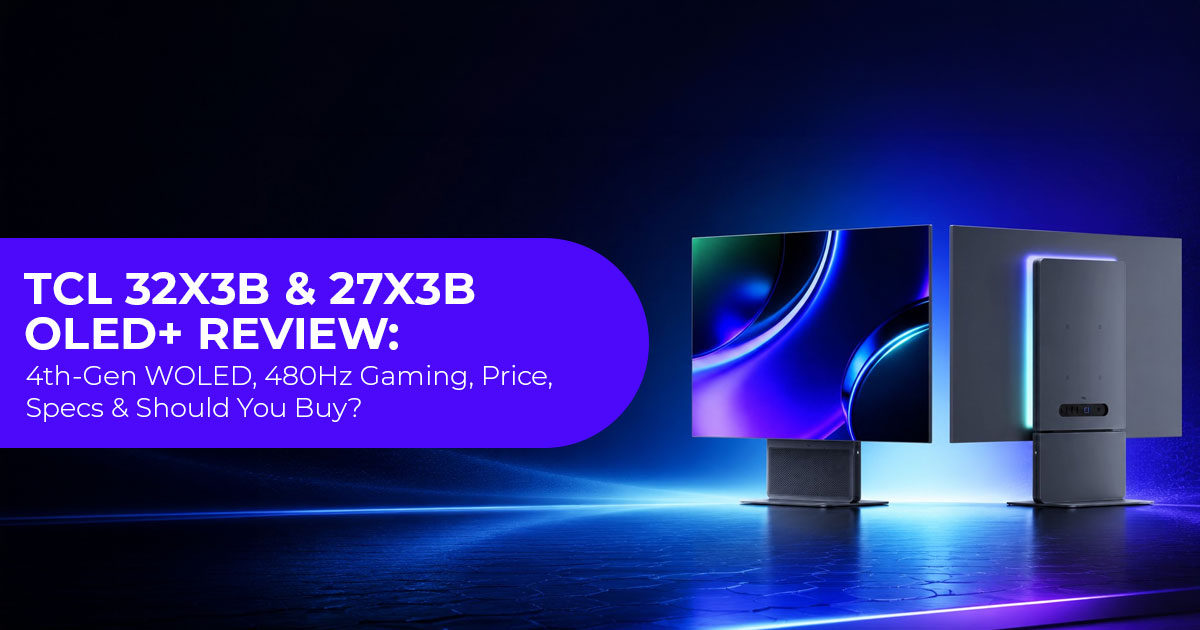
Both monitors use a metal enclosure just 6.4mm thick, a design TCL calls “Stargate,” with rear ambient lighting and a tilt-adjustable stand. The monitor looks and feels more premium than its price suggests.
The unusual inclusion here is front-facing speakers tuned with Bang & Olufsen, driven by a dedicated DSP. Built-in monitor speakers are historically bad — thin, downward-firing, and easy to ignore. A front-firing, brand-tuned system changes the math: These speakers may be good enough for many desktop setups, although that still needs real-world testing. For many users, this could reduce the need for external desktop speakers, adding practical value to the monitor. Speaker quality still needs independent testing before we can draw any conclusions.
Connectivity: HDMI 2.1, DisplayPort 2.1, and USB-C 90W
The 32X3B covers the full modern set: two HDMI 2.1 ports for consoles at 4K 120Hz, DisplayPort 2.1 for the full PC signal, and USB-C with 90W power delivery. The USB-C port plus the built-in KVM switch (with two USB-A ports) creates a clean one-cable laptop setup: plug in a notebook, and it charges, outputs video, and shares your keyboard and mouse with the desktop PC.
This is also where the 27X3B shows its first real compromise. It drops USB-C and the KVM entirely, leaving DisplayPort 1.4, two HDMI 2.1 ports, and a headphone jack. For a pure desktop gaming PC, that is enough. For anyone planning a hybrid laptop-desktop desk, the 32X3B is the only sensible choice in this lineup — and the $400 gap partly pays for that docking function alone.
OLED Burn-In: What TCL’s Protection Actually Includes
Burn-in worries still follow every OLED purchase, so here is the complete picture on the X3B series:
- Panel structure: the fourth-generation tandem stack distributes electrical stress across four layers, which slows the organic wear that causes image retention
- Hardware/software: TCL includes its “Kunlun Anti-Burn Shield,” a combination of thermal management and software mitigation
- Warranty: TCL offers a three-year replacement warranty in China — unusual for OLED monitors, and a real signal of the company’s confidence
What we know so far: Long-term effectiveness still depends on real-world usage and independent testing. The warranty terms in your region matter more than the technology names — verify coverage before importing.
TCL 32X3B vs TCL 32X3A: What Changed
The 32X3A launched only months before the X3B series, so the comparison is fair and necessary.
| Feature | TCL 32X3A OLED+ | TCL 32X3B OLED+ |
| HDR Certification | DisplayHDR True Black 400 | DisplayHDR True Black 500 |
| Peak Brightness | 1,300 nits | 1,500 nits |
| Color Coverage | 98.5% DCI-P3 | 99.5% DCI-P3 |
| Screen Reflectivity | 2% | 1.1% |
| China Launch Price | CNY 5,999 | CNY 6,499 |
The improvements are noticeable, but they’re evolutionary rather than dramatic. Better HDR certification, 200 more peak nits, slightly wider color, and a meaningfully less reflective screen (the anti-glare improvement matters daily in bright rooms).
Our buying guidance: existing 32X3A owners have no urgent reason to upgrade — the gains are refinement, not transformation. New buyers should choose the X3B series unless the 32X3A drops well below its old launch price.
TCL vs the Competition: 480Hz OLED Monitor Prices
Here is how TCL’s China pricing stacks up against the monitors it actually competes with:
| Pros | Cons |
| Undercuts rival 480Hz OLED monitors by hundreds of dollars | China-only at launch; no confirmed US, EU, or India dates |
| Dual-mode 4K 240Hz + 1080p 480Hz on the 32X3B | Global pricing and warranty terms unverified |
| 1,500 nits peak, 335 nits full-screen, 99.5% DCI-P3 | Brightness figures unconfirmed by independent testing |
| B&O-tuned front-facing speakers — rare at any price | 27X3B lacks USB-C and KVM |
| 3-year replacement warranty signals burn-in confidence | No third-party reviews exist yet |
| Anti-glare coating improved to 1.1% reflectivity | Tilt-only stand limits ergonomics |
The comparison shows both TCL’s strengths and its current limitations.
Where TCL wins: the 27X3B at ~$546 lands several hundred dollars below the 480Hz-class displays from LG, Samsung, and Sony while delivering the same OLED fundamentals — 0.03ms response, HDMI 2.1, certified HDR. No rival at this price includes B&O-tuned speakers. The 32X3B matches the ASUS dual-mode formula — 4K/240 plus 1080p/480 — at what will likely be a lower price.
Where TCL loses: LG, Sony, and ASUS offer established global warranty networks and shelves full of independent reviews. TCL offers neither outside China today. And for shoppers cross-shopping productivity displays — the 27X3B at ~$546 versus a $1,539 Apple Studio Display running 60Hz IPS
— TCL looks like a strong value on paper, but international buyers should confirm local warranty and support before considering them for productivity-focused setups.
Pros and Cons at a Glance
| Pros | Cons |
| Undercuts rival 480Hz OLED monitors by hundreds of dollars | China-only at launch; no confirmed US, EU, or India dates |
| Dual-mode 4K 240Hz + 1080p 480Hz on the 32X3B | Global pricing and warranty terms unverified |
| 1,500 nits peak, 335 nits full-screen, 99.5% DCI-P3 | Brightness figures unconfirmed by independent testing |
| B&O-tuned front-facing speakers — rare at any price | 27X3B lacks USB-C and KVM |
| 3-year replacement warranty signals burn-in confidence | No third-party reviews exist yet |
| Anti-glare coating improved to 1.1% reflectivity | Tilt-only stand limits ergonomics |
Who Should Buy It (and Who Should Wait)
| Buyer Type | Recommendation |
| Competitive FPS player on a budget | 27X3B — 280Hz OLED at ~$546 has no direct rival at this price |
| Buyer wanting one monitor for AAA + esports | 32X3B — dual mode covers both, with 4K clarity for work |
| Laptop + desktop hybrid desk setup | 32X3B only — the USB-C 90W and KVM are the point |
| Content creator doing color work | Wait for reviews — calibration accuracy is unverified |
| Owner of a 32X3A or recent OLED | Skip — this is a refinement cycle, not a leap |
| Anyone needing global warranty support now | Wait — buy once local stock and coverage are confirmed |
In short: the case for these monitors is strongest where the price advantage is biggest, and weakest wherever independent verification is required.
Pricing and Availability: TCL 32X3B Price and Release Status
| Model | Launch Price | Regular Price | Status |
| TCL 27X3B OLED+ | CNY 3,699 (~$546 / ~₹48,000) | CNY 4,999 (~$738) | China preorder, JD.com |
| TCL 32X3B OLED+ | CNY 6,499 (~$960 / ~₹85,000) | CNY 7,999 (~$1,180) | China preorder, JD.com |
As of July 2026, both models are preorder-only in China through JD.com, with a three-year replacement warranty. TCL has not confirmed US, European, or Indian release dates.
Keep this in mind: international pricing will likely be higher once taxes, import duties, and local warranty costs are included. TCL’s China pricing clearly targets buyers looking for premium OLED performance at a lower price.
Our advice: resist importing at a premium. If these launch globally near China pricing, they will still be the value pick months from now.
Frequently Asked Questions
What is fourth-generation WOLED?
Fourth-generation WOLED is a tandem OLED design that stacks four emission layers — red, blue, green, and blue — instead of the previous three. The structure raises brightness, improves color, and reduces the wear that causes OLED burn-in. TCL’s X3B monitors are among the first to ship with it.
How much do the TCL 32X3B and 27X3B cost?
In China, the 32X3B launched at CNY 6,499 (about $960) and the 27X3B at CNY 3,699 (about $546). Regular prices are CNY 7,999 and CNY 4,999. US and Indian pricing has not been announced.
When will the TCL X3B monitors launch globally?
TCL has not confirmed dates for markets outside China as of July 2026. The company brings most monitor lines abroad eventually, but nothing is official until regional listings appear.
Is 480Hz worth it over 240Hz?
For competitive esports at frame rates above 400fps, yes — motion clarity becomes easier to notice. For most single-player games, no. The 32X3B’s dual mode means you do not have to choose permanently, but your PC must actually reach those frame rates for 480Hz to matter.
Tandem WOLED vs QD-OLED — which should you pick?
For bright rooms, mixed work-and-gaming use, and text-heavy days, Tandem WOLED is the better fit due to its polarizer and improved subpixel layout. For dark-room gaming where maximum color volume is the priority, QD-OLED still holds an edge. Room lighting should decide this more than brand preference.
Do these TCL monitors work with PS5 and Xbox Series X?
Both models include HDMI 2.1 ports, which support 4K 120Hz console output. The 32X3B is the stronger console choice given its 4K native panel; consoles cannot use the 480Hz mode.
Final Verdict
Based on everything TCL has announced so far, the X3B OLED+ series looks like one of the strongest value launches in the premium OLED gaming monitor market this year. The 27X3B at ~$546 undercuts every comparable high-refresh OLED by hundreds of dollars, and the 32X3B brings the same dual-mode 4K/480Hz setup as premium ASUS and LG models at a lower expected price, with that B&O audio on top.
The caveats are equally clear. No independent reviews exist, global availability is unconfirmed, and warranty support outside China is a genuine risk for importers.
Our recommendation: put the X3B series on your shortlist now, and buy when regional stock and warranty terms are confirmed. If global pricing stays anywhere near China’s, the TCL 27X3B could become the value leader in high-refresh OLED, and the 32X3B becomes one of the strongest options in its class. We’ll update this review once independent testing, global pricing, and regional availability are confirmed.
Where to Buy
Amazon Worldwide
Global listings had not gone live at the time of writing, and stock typically appears shortly after a US announcement. When it does, the models to look for are:
- TCL 32X3B OLED+ — the dual-mode pick: 4K 240Hz for everyday gaming, 1080p 480Hz for competition, plus USB-C 90W and KVM for one-cable laptop Check the current price on Amazon Worldwide →
- TCL 27X3B OLED+ — the value pick: 1440p 280Hz OLED with 1,500 nits peak at a price no rival currently matches. Check the latest offers on Amazon Worldwide →
Amazon India
Indian pricing will land above the direct conversions (~₹48,000 for the 27X3B, ~₹85,000 for the 32X3B) once duties are applied, so check live listings rather than assuming parity. Watch for these models once they become available:
- TCL 32X3B OLED+ — full-featured model with DisplayPort 1, HDMI 2.1 for PS5/Xbox, and the 3-year warranty to confirm regionally before purchase. Check availability and price on Amazon India →
- TCL 27X3B OLED+ — the model most likely to undercut LG and Samsung OLED pricing in View today’s deals on Amazon India →
If you need a high-end OLED gaming monitor right now, you don’t have to wait for TCL’s global launch. The Alienware AW3225QF and ASUS ROG Swift PG32UCDM are both proven 4K 240Hz QD-OLED gaming monitors with excellent image quality, fast response times, and wide availability. We’ve included purchase links for both Amazon Worldwide and Amazon India below.
- Alienware AW3225QF (Amazon Worldwide)
- Alienware AW3225QF (Amazon India)
- ASUS ROG Swift PG32UCDM (Amazon Worldwide)
- ASUS ROG Swift PG32UCDM (Amazon India)
If you’re planning to wait for TCL’s OLED gaming monitors, buy only from authorized retailers that provide an official regional warranty. Bookmark this page and follow us—we’ll update it with verified purchase links as soon as the monitors become available.
If you have any questions about the TCL X3B series or you’re unsure which OLED gaming monitor is right for your setup and budget, leave a comment below. We’ll help you choose the right monitor for your needs.
If you found this review useful, follow us for more hardware reviews, buying guides, and the latest PC hardware news. Bookmark this page—we’ll update it with hands-on testing, pricing, and buying links as soon as they’re available.
***Disclaimer***
This blog post reflects our research, analysis, and opinions based on available product information, user feedback, and industry knowledge. It should not be taken as the official position of any brand, manufacturer, or company mentioned here. We make every effort to keep this guide accurate, but product specifications, pricing, and availability may change after publication. We recommend double-checking important details before making a purchase.
Some links in this article may be affiliate links. If you choose to buy through these links, we may earn a small commission at no extra cost to you. This helps support our work and allows us to keep publishing in-depth, unbiased reviews. Affiliate partnerships never influence our recommendations.
Opinions expressed by readers are their own and do not necessarily reflect ours. We are not responsible for outcomes resulting from the use of information on this site. Please seek professional advice where appropriate.
All product names, logos, and brands mentioned are the property of their respective owners. These names are used for identification and informational purposes only and do not imply endorsement.