
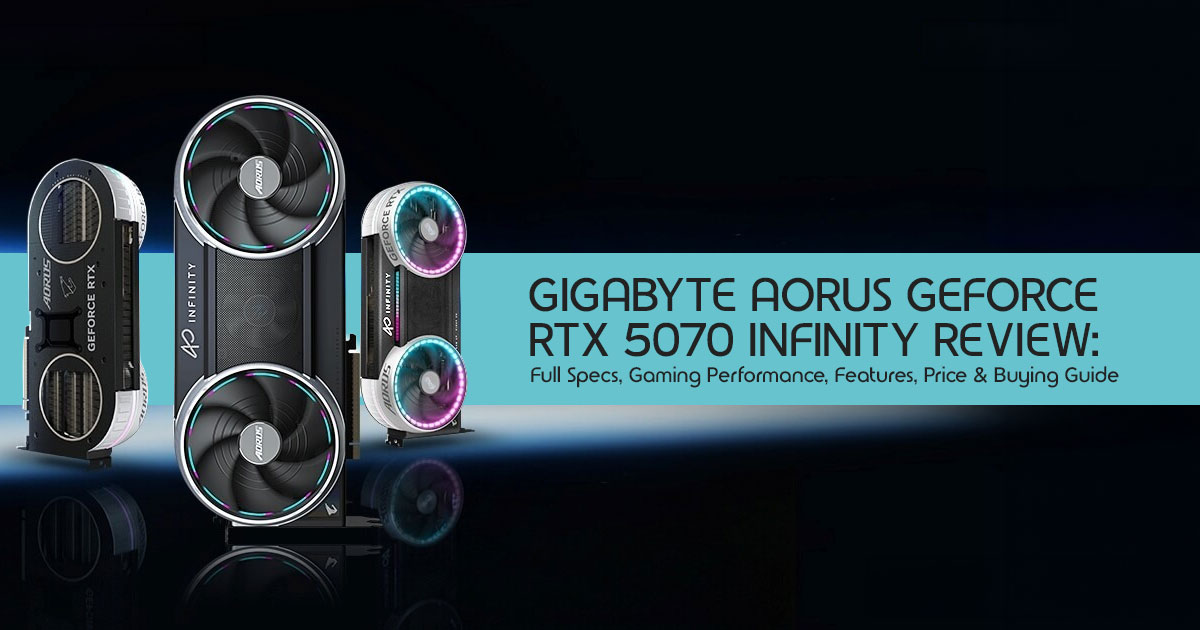
What We Know So Far About the Gigabyte AORUS RTX 5070 Infinity
Gigabyte has officially confirmed the specifications of the Gigabyte AORUS GeForce RTX 5070 Infinity, giving us our first complete look at the company’s newest premium RTX 5070 graphics card. Since these details come directly from Gigabyte’s product documentation, we can now focus on what the hardware actually offers instead of relying on rumors or leaks.
As technology experts with over 20 years of experience in hardware and application research and development, we evaluate every product based on real-world performance, durability, thermal design, and long-term value. Whether you’re a gamer, content creator, AI developer, or PC builder planning your next upgrade, our recommendations are backed by extensive research, component analysis, real-world usability, and industry expertise.
The Gigabyte AORUS RTX 5070 Infinity is aimed at gamers, creators, and PC enthusiasts looking for premium cooling, factory overclocking, and high-end build quality without stepping up to RTX 5080 or RTX 5090 pricing. In this Gigabyte AORUS GeForce RTX 5070 Infinity review, we’ll break down the confirmed specifications, real-world benefits, and whether this RTX 5070 is worth considering if you’re upgrading from an RTX 3070-class GPU or older.
Whether you’re researching RTX 5070 gaming performance, RTX 5070 specifications, or deciding if this is the best RTX 5070 graphics card for your next build, this guide covers everything you need to know before buying.
Who Is This Card Actually For?
Before we dive into the specifications, let’s see whether this RTX 5070 graphics card is the right fit for your needs.
This graphics card is a great fit if:
- You are gaming at 1440p or 4K resolution and want consistent high frame
- You edit videos, create 3D content, or work with AI applications and need a high CUDA core count for gaming, rendering, and GPU-accelerated workloads.
- You are currently on an RTX 3070, RTX 3080, or RTX 4060 Ti and the performance difference is becoming more noticeable in newer games, creative software, and AI workloads.
- You want a premium AIB (Add-in Board) card with better cooling and build quality than the Founders Edition.
If you are already running an RTX 4080 or higher, the jump is smaller. But for everyone else, this is a meaningful generational upgrade.
Gigabyte AORUS RTX 5070 Infinity – Confirmed Specifications
Here is what Gigabyte has officially confirmed:
| Specification | Details |
| GPU Architecture | NVIDIA Blackwell architecture |
| CUDA Cores | 6,144 |
| Boost Clock Speed | Up to 2,877 MHz (OC Mode) |
| Memory | 12 GB GDDR7 |
| Memory Bus | 192-bit |
| Memory Bandwidth | Up to 672 GB/s |
| Power Connector | 16-pin 12V-2×6 |
| Total Board Power (TDP) | 250W |
| Ray Tracing Cores | 4th Generation |
| Tensor Cores | 5th Generation |
| DLSS Support | DLSS 4 with Multi Frame Generation |
| Cooling Solution | AORUS Triple-Fan WINDFORCE cooling system |
| Card Length | Approximately 330 mm (3.5-slot design) |
| Display Outputs | 3× DisplayPort 2.1, 1× HDMI 2.1 |
| PCI Express Interface | PCIe 5.0 ×16 |
What Makes the AORUS Infinity Version Different?
Gigabyte makes several versions of every GPU. The AORUS line is their flagship tier. Here is what separates the Infinity from the cheaper Gigabyte models:
- Higher factory overclock: The boost clock on this card is pushed to 2,877 MHz out of the box. That is notably higher than the NVIDIA reference spec for the RTX You get extra performance without touching any overclocking software.
- Advanced cooling design: The AORUS WINDFORCE cooling on this card uses a large vapor chamber, direct-touch copper heat pipes, and three fans with alternate spinning to reduce turbulence. In practical terms, this means the card is designed to stay cooler and quieter during long gaming sessions or demanding creative workloads.
- Build quality: A reinforced PCB, sturdy mounting bracket, and metal backplate give the card a premium feel while improving durability for long-term use.
- RGB and aesthetics: If that matters to you, the AORUS Infinity has a customizable LCD side panel and full RGB lighting controlled through Gigabyte’s GCC software.
NVIDIA Blackwell Architecture – Why It Matters for Everyday Use
The RTX 5070 is powered by NVIDIA’s new Blackwell GPU architecture, succeeding the Ada
Lovelace architecture used in the RTX 40 Series and bringing improvements to gaming performance, AI features, and ray tracing efficiency.
DLSS 4 with Multi Frame Generation
One of the biggest upgrades is DLSS 4 with Multi Frame Generation. This technology can generate multiple frames at once instead of just one. In supported games, this can effectively double or triple your visible frame rate without the GPU doing traditional rendering for every single frame.
If you play games like Cyberpunk 2077, Alan Wake 2, or Hogwarts Legacy, this feature alone changes the experience.
4th Gen Ray Tracing Cores
Ray tracing performance has been the weak point of mid-range cards for years. The RTX 5070 makes path tracing much more practical in supported games, especially when paired with DLSS 4
and Multi Frame Generation, helping deliver smoother gameplay without sacrificing visual quality.
5th Gen Tensor Cores
These handle AI-accelerated tasks — not just DLSS, but also AI video upscaling, AI noise removal in creative apps, and local AI model inference if you work with tools like Stable Diffusion or ComfyUI.
GDDR7 Memory
This is the first generation of consumer GPUs to use GDDR7 memory. Compared to GDDR6X on the RTX 4070, you get significantly higher memory bandwidth (672 GB/s), which helps at higher resolutions where the card needs to move large amounts of texture and frame data quickly.
RTX 5070 vs RTX 4070 – Is the Upgrade Worth It?
This is the question most people are actually asking. Here is a side-by-side comparison:
| Feature | RTX 4070 (Reference) | RTX 5070 AORUS Infinity |
| Architecture | Ada Lovelace | Blackwell |
| CUDA Cores | 5,888 | 6,144 |
| Boost Clock | 2,475 MHz | 2,877 MHz |
| Memory | 12 GB GDDR6X | 12 GB GDDR7 |
| Memory Bandwidth | 504 GB/s | 672 GB/s |
| TDP | 200W | 250W |
| DLSS Version | DLSS 3 (Single Frame Generation) | DLSS 4 (Multi Frame Generation) |
| Ray Tracing | 3rd Generation RT Cores | 4th Generation RT Cores |
| PCI Express Interface | PCIe 4.0 ×16 | PCIe 5.0 ×16 |
Based on the confirmed hardware specifications and architectural improvements, early expectations suggest the RTX 5070 could deliver around 20–30% higher gaming performance than the RTX
4070, along with stronger ray tracing capabilities and DLSS 4 support. Independent benchmarks will provide a clearer picture once full reviews become available.
If you are on an RTX 3070 or older, the upgrade makes a lot of sense. If you are on an RTX 4070, it depends on whether DLSS 4 and the ray tracing improvements matter for the games you play.
RTX 5070 vs RTX 5070 Ti – Should You Wait?
NVIDIA has not officially announced the RTX 5070 Ti specifications. Based on previous product positioning, it is expected to offer more CUDA cores, additional VRAM, and higher overall performance.
- Our take: If you need a card right now and your budget is in the $549 to $649 range, the RTX 5070 is the right If you can wait 3-4 months and your budget stretches to $749+, holding out for the RTX 5070 Ti might make sense.
Waiting can bring better hardware, but it also means spending more time with a graphics card that may already be limiting your gaming or creative work.
Power Supply and Build Compatibility
Before you add this to your cart, make sure your system can handle it:
| Component | Recommendation |
| PSU (Power Supply Unit) | 700W minimum. A quality 750W or 850W PSU is recommended for additional headroom, future upgrades, and sustained gaming workloads. |
| Power Connector | 16-pin 12V-2×6 connector. An adapter may be included, but a native 12V-2×6 cable from a compatible ATX 3.0 or ATX 3.1 PSU is preferable. |
| Case Clearance | Allow at least 340mm of GPU length clearance, with additional space for the power cable and front-mounted cooling hardware. |
| Case Slot Width | Approximately 3.5 expansion slots. Measure the available space carefully, especially in compact ATX and micro-ATX cases. |
| Recommended CPU Pairing | AMD Ryzen 7 7800X3D, Ryzen 9 9900X, Intel Core i7-14700K, or another modern high-performance processor to minimize bottlenecks at 1440p and high refresh rates. |
If you are running a 500W or 600W PSU, you will need to upgrade that first. Skipping this step leads to crashes, shutdowns, and potential hardware damage.
Cooling and Noise – What to Expect in a Real Build
The AORUS WINDFORCE triple-fan cooler on this card is one of Gigabyte’s most capable air cooling solutions for its graphics cards.
Based on Gigabyte’s previous AORUS cards, you can expect:
- GPU temperatures under load: Based on previous Gigabyte WINDFORCE cooling designs, temperatures are expected to stay in the mid-60°C to low-70°C range during gaming in a well-ventilated case.
- Noise levels: Moderate at full load, near-silent at idle (fans stop below a certain temperature threshold)
- Zero RPM mode: Yes, fans turn off completely when the card is not under significant load
If you are building a quiet gaming PC or a content creation workstation, this cooler will not be the weak link.
Display Output and Monitor Compatibility
The AORUS RTX 5070 Infinity comes with:
- 3x DisplayPort 1 — supports up to 8K at 60Hz or 4K at 240Hz with DSC
- 1x HDMI 1 — supports 4K at 120Hz for TVs and console-style setups
If you own a high-refresh-rate 1440p monitor (like the ASUS VG27AQ1A, LG 27GP850-B, or Dell S2722DGM), this card will fully saturate it in most games.
If you are gaming on a 4K 144Hz monitor (like the Samsung Odyssey G7 or LG 27GR95QE), this card paired with DLSS 4 should deliver smooth frame rates in nearly every modern title.
Expected Pricing for the Gigabyte AORUS RTX 5070 Infinity
NVIDIA set the RTX 5070 MSRP at $549. However, the AORUS Infinity is a premium AIB model, so expect a price tag between $599 and $679 depending on the retailer and region.
| Region | Expected Price Range |
| USA | $599 – $679 |
| India | ₹52,000 – ₹62,000 |
| Europe | €629 – €719 |
Prices at launch may be higher due to demand. If stock is tight (and it usually is for xx70-class cards), prices can spike by 10-20% for the first few weeks.
Should You Buy the AORUS RTX 5070 Infinity or a Different RTX 5070?
Here is a quick comparison of the main RTX 5070 models expected at launch:
| Model | Cooling | Boost Clock | Price Tier | Best For |
| NVIDIA Founders Edition | Dual-fan reference cooler | Reference specification | Entry-Level | Buyers who want NVIDIA’s official design at the lowest price. |
| Gigabyte AORUS RTX 5070 Infinity | Triple-fan WINDFORCE cooling | 2,877 MHz (Factory OC) | Premium | Enthusiasts seeking maximum cooling, quiet operation, and higher factory overclocks. |
| MSI Gaming X Slim | Dual or triple-fan cooler (varies by model) | Moderate factory overclock | Mid-Range | Slim PC builds that need a balance of cooling, acoustics, and size. |
| ASUS TUF Gaming RTX 5070 | Triple-fan cooling solution | Moderate factory overclock | Mid-Range | Users who prioritize durability, build quality, and long-term reliability. |
| ZOTAC Trinity RTX 5070 | Triple-fan cooling | Moderate factory overclock | Budget AIB | Price-conscious builders looking for strong RTX 5070 performance at a lower cost. |
The AORUS RTX 5070 Infinity is a great choice if you want one of the highest factory-overclocked RTX 5070 models announced so far, along with advanced thermal design and solid long-term performance.
What Games Will Run Best on the RTX 5070?
Based on the spec sheet and architecture improvements, here is what we expect:
| Game | Resolution | Expected FPS (Ultra Settings) | With DLSS 4 |
| Cyberpunk 2077 (Path Tracing) | 1440p | 45–55 FPS | 90–120+ FPS |
| Alan Wake 2 | 1440p | 50–60 FPS | 100–130 FPS |
| Black Myth: Wukong | 1440p | 55–70 FPS | 110–140 FPS |
| Call of Duty: Modern Warfare III | 1440p | 120–150 FPS | 200+ FPS |
| Hogwarts Legacy | 4K | 40–55 FPS | 80–110 FPS |
| Fortnite (Competitive Settings) | 1080p | 300+ FPS | N/A |
Note: These are estimated figures based on architecture improvements and confirmed specs. Actual RTX 5070 benchmark results will vary depending on the game, system configuration, drivers, and graphics settings. We will update this table once independent reviews go live.
Content Creation and Professional Workloads
The RTX 5070 is not just a gaming card. Here is where it performs well outside of games:
- Adobe Premiere Pro: GPU-accelerated encoding and playback with NVENC encoder (Blackwell generation)
- DaVinci Resolve: Faster timeline rendering and color grading with 12 GB GDDR7
- Blender: Significant CUDA and OptiX rendering improvements over RTX 4070
- Stable Diffusion / ComfyUI: 12 GB VRAM is the minimum for most models; this card handles SD 1.5 and SDXL well, though 16 GB would be better for larger models
- Unreal Engine 5: Hardware ray tracing and Nanite rendering benefit directly from Blackwell architecture
Thanks to its Blackwell GPU, CUDA cores, and GDDR7 memory, the RTX 5070 is also well suited for AI workloads, video editing, 3D rendering, and other GPU-accelerated applications.
If you are a freelance video editor, 3D artist, or AI developer, this card offers a solid balance of performance and price compared to the RTX 5080 (which costs significantly more).
Things We Do Not Love About This Card
Every graphics card has its strengths and compromises, and the RTX 5070 Infinity is no exception.
- 12 GB VRAM may feel limiting in 2-3 At 4K with max textures in upcoming AAA games, 12 GB could become a bottleneck. The RTX 5070 Ti (expected to have 16 GB) might age better.
- 250W TDP is higher than the RTX If you have a compact build with limited airflow, this card will run hotter than its predecessor. Plan your cooling accordingly.
- 192-bit memory While GDDR7 compensates with higher bandwidth per pin, a wider bus (like the 256-bit on the 5070 Ti) handles large texture loads more gracefully.
- Price premium over Founders Edition. You are paying extra for the AORUS branding, the LCD panel, and the factory If those do not matter to you, the Founders Edition or a budget AIB card will deliver 95% of the same experience.
When Can You Buy the Gigabyte AORUS RTX 5070 Infinity?
Based on current information, the RTX 5070 launch window is expected in Q1 2025. Gigabyte typically makes their AORUS models available within the first wave of AIB launches, so expect availability within days of the reference launch.
Stock will be limited at launch. If you are serious about getting one at retail price, here is what we recommend:
- Set up stock alerts on Amazon, Newegg, and Best Buy
- Do not buy from scalpers — prices normalize within 4-6 weeks of launch
- Consider bundled deals — retailers sometimes pair new GPUs with PSUs or monitors at a discount
Where to Buy the Gigabyte AORUS RTX 5070 Infinity
We will keep these links updated as the card becomes available:
🇺🇸 Amazon Worldwide: Gigabyte AORUS RTX 5070
(Bookmark this link — we will update it with the direct product listing as soon as it goes live)
🇮🇳 Amazon India: Gigabyte AORUS RTX 5070
(Availability in India typically follows 1-2 weeks after the US launch)
Final Verdict – Is the Gigabyte AORUS RTX 5070 Infinity Worth Buying?
Here is the bottom line:
Buy this card if:
- You want one of the highest factory-overclocked RTX 5070 graphics cards, along with premium Gigabyte WINDFORCE cooling and excellent build quality
- You are upgrading from an RTX 3070, RTX 3060 Ti, RTX 4060, or older GPU
- You game at 1440p or 4K and want smooth frame rates with ray tracing enabled
- You do content creation or AI work and need a modern GPU without spending $999+
Skip this card if:
- You already have an RTX 4070 Ti or higher — the jump is not big enough
- You need 16 GB VRAM for large AI models or future-proofing at 4K — wait for the RTX 5070 Ti
- You have a strict budget under $549 — look at the Founders Edition or last-gen deals on the RTX 4070
The Gigabyte AORUS GeForce RTX 5070 Infinity combines premium cooling, strong factory
overclocking, and solid build quality into a graphics card that looks ready for demanding gaming and creative workloads. Based on its confirmed specifications, premium cooling, and factory overclock, the Gigabyte AORUS GeForce RTX 5070 Infinity looks set to become one of the best RTX 5070 graphics cards for gamers, creators, and power users.
***Disclaimer***
This blog post reflects our research, analysis, and opinions based on available product information, user feedback, and industry knowledge. It should not be taken as the official position of any brand, manufacturer, or company mentioned here. While we aim to keep information accurate and up to date, product details, pricing, and availability can change. We recommend double-checking important details before making a purchase.
Some links in this article may be affiliate links. If you choose to buy through these links, we may earn a small commission at no extra cost to you. This helps support our work and allows us to keep publishing in-depth, unbiased reviews. Our recommendations are never influenced by affiliate partnerships.
Comments shared by readers reflect their own views and not ours. We are not responsible for outcomes resulting from the use of information on this site. Please seek professional advice where appropriate.
All product names, logos, and brands mentioned are the property of their respective owners. These names are used for identification and informational purposes only and do not imply endorsement.