
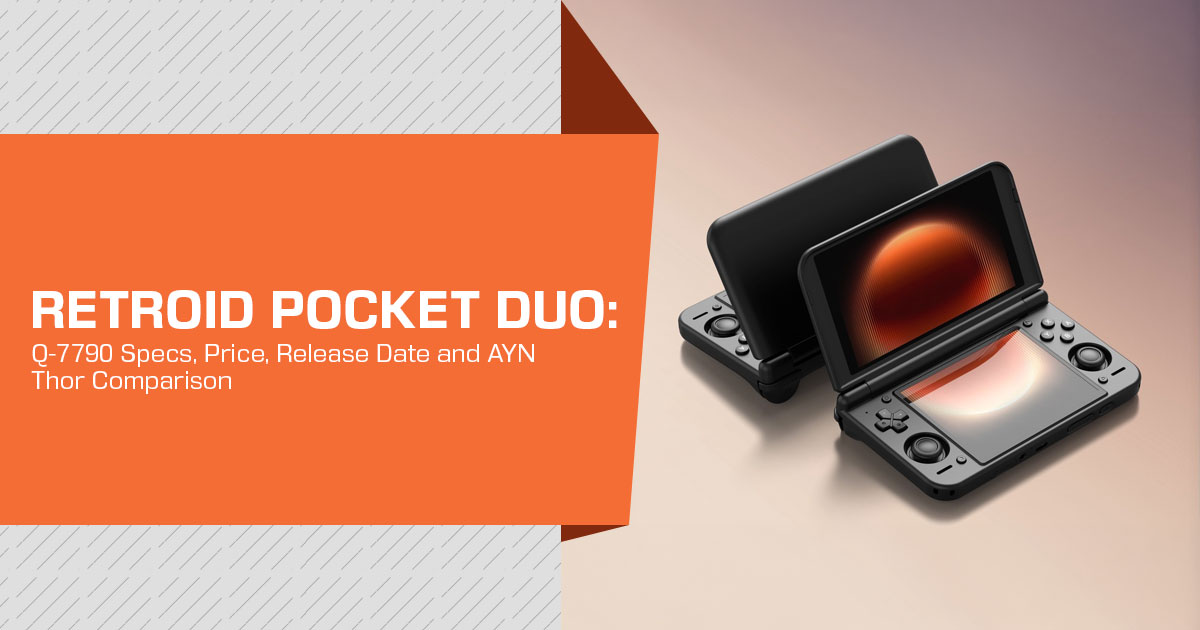
Should you wait for the Retroid Pocket Duo, or is it too early to get excited? That is the biggest question for anyone considering this unusual dual-screen Android handheld. Retroid has shown a device with two OLED displays and a Qualcomm Dragonwing Q-7790 processor, but several details that can make or break a buying decision are still missing.
Retroid has not announced the price, release date, pre-order window, RAM, storage, or battery capacity. Without those numbers, it is too early to say whether the Pocket Duo will be a great value, a niche curiosity, or a handheld worth waiting for. Some specifications and performance expectations being discussed online are also estimates, not confirmed information. We will clearly separate official specifications from reasoned estimates throughout this guide.
The Dragonwing Q-7790 also makes the Pocket Duo particularly interesting. It is a Qualcomm IoT processor, rather than a Snapdragon-branded mobile chip, so its real-world performance in a gaming handheld deserves a closer look. For retro gamers, Android gaming enthusiasts, emulation fans, collectors, and buyers looking for a different kind of handheld, the hardware choice could have a major impact on what this device can actually do.
As technology experts with over 20 years of experience in hardware and application research and development, we do not judge a product by specifications alone. We look at real-world performance, durability, usability, and value for money to understand what you are actually getting for your investment.
Our goal is to help you make the right choice based on what matters to you most, whether that is gaming performance, price, reliability, battery life, build quality, or long-term use. Our recommendations are based on extensive research, component analysis, real-world usability, and industry expertise.
In this guide, we will break down everything currently known about the Retroid Pocket Duo, explain what the confirmed hardware tells us, identify what remains unknown, and separate facts from expectations so you can decide whether this is a handheld worth waiting for.
⚠️ We have not handled a Retroid Pocket Duo, and we are not treating any pre-release estimate as a measured result. This is a research-based analysis built from Qualcomm’s official product documentation, Retroid’s own announcements, AYN’s and AYANEO’s official product pages, and named third-party reporting. No performance figure here comes from testing.
What We Know and What We Still Don’t
| Category | Status |
|---|---|
| Processor | ✅ Qualcomm Dragonwing Q-7790 confirmed |
| Displays | ✅ Dual 120Hz OLED displays — 16:9 upper screen and 4:3 lower screen |
| Design | ✅ Clamshell design with the D-pad positioned on the upper section; no external clip or connecting cable required |
| Colors | ✅ Black and translucent purple variants shown |
| Price | ❌ Not announced |
| Release Date | ❌ Not announced |
| Pre-orders | ❌ Not open |
| RAM / Storage / Battery | ❌ Not announced |
| Screen Sizes / Weight | ❌ Not announced |
This matters more than it sounds. A reader searching for Retroid Pocket Duo price or Retroid Pocket Duo release date deserves a straight answer, and the straight answer today is that nobody outside Retroid knows. What the pricing section does instead is narrow the range using evidence.
Retroid Pocket Duo Specifications Confirmed So Far
Two different kinds of numbers circulate in Retroid Pocket Duo specs coverage, and mixing them is where buyers get misled. Qualcomm’s specifications describe what the chip can do. Retroid’s specifications describe what the handheld will actually ship with. Only the second kind is a confirmed product configuration, and Retroid has published very little of it.
| Specification | Value | Source |
|---|---|---|
| Processor | Qualcomm Dragonwing Q-7790 (Q7 Series) | Retroid announcement |
| CPU | 8-core Qualcomm Kryo, up to 2.8GHz | Qualcomm |
| GPU | Qualcomm Adreno 722, up to 1.15GHz | Qualcomm |
| NPU | 24 TOPS | Qualcomm |
| Memory Support | 2 × 16-bit LPDDR5X at 4200MHz, supporting up to 16GB | Qualcomm |
| Alternative Memory Support | LPDDR4X at 2133MHz and LPDDR5 at 3200MHz also supported | Qualcomm |
| Storage Support | UFS 3.1 / UFS 4.0, eMMC 5.1, and SD 3.0 | CNX Software |
| Wireless Connectivity | Wi-Fi 7 and Bluetooth 6 via WCN6755 / WCN7750 companion chips | Qualcomm, CNX Software |
| Operating System Support | Android and Linux | Qualcomm |
| Top Display | OLED, 120Hz, 16:9 | Retroid announcement |
| Bottom Display | OLED, 120Hz, 4:3 | Retroid announcement |
| Controls | Top-positioned D-pad with symmetrical recessed thumbsticks | Retroid announcement |
| Ports | USB-C, microSD, 3.5mm audio jack, power, and volume controls located along the bottom edge | Retroid announcement |
| Colors Shown | Black and translucent purple | Retroid announcement |
Not announced: price, release date, pre-order date, RAM configuration, storage configuration, battery capacity, screen sizes, weight, final color list.
Two further points qualify the table above. Qualcomm lists Wi-Fi 7 and Bluetooth 6 as supported, but CNX Software notes those arrive through companion chips and that a Wi-Fi 6E / Bluetooth 5.3 configuration is also possible — so the retail wireless spec depends on which chips Retroid selects. And the 16 GB memory figure is the chip’s ceiling, not a configuration Retroid has confirmed.
What Is the Qualcomm Dragonwing Q-7790 and Why Isn’t It Called a Snapdragon?
The Qualcomm Dragonwing Q-7790 belongs to Qualcomm’s Q7 series, sold under the Dragonwing brand. Qualcomm positions that family for IoT and edge-AI hardware — its own product page lists smart displays, AI TVs, smart home hubs and industrial handhelds as target uses. It is not a phone chip, and Qualcomm has not marketed it as one, which is why the name is unfamiliar.
The Snapdragon 7 Gen 4 connection that most coverage leads with is an inference rather than a published specification. Notebookcheck describes the chip as “said to be” the IoT version of the Snapdragon 7 Gen 4, and several other outlets repeat the claim. Qualcomm has not published that equivalence. It is a widely reported assumption — useful for estimating performance, not an official specification.
The CPU, GPU and NPU in plain English
- CPU (8 Kryo cores, up to 2.8 GHz): the general-purpose processor. Retro Handhelds and CNX Software both describe a 1+4+3 layout — one higher-clocked core for heavy bursts, four mid cores for sustained work, three efficiency cores for background tasks. In emulators, the single fast core usually carries the most weight.
- GPU (Adreno 722, up to 15 GHz): the main graphics processor for 3D rendering and an important part of 3DS and Switch emulation. Clock speed is only part of the picture; GPU drivers, emulator software and thermals also affect real-world performance.
- NPU (24 TOPS): an AI accelerator that Qualcomm designs for on-device vision and voice For gaming, its practical value is limited unless software specifically uses the NPU.
Wi-Fi 7 and Bluetooth 6: what changes in practice
Wi-Fi 7 and Bluetooth 6 are current-generation radios. Their effect on this device is narrow but real:
- Wi-Fi 7 can help with game streaming — Xbox Cloud Gaming, Steam Link, GeForce NOW — where latency and stability can matter more than peak The actual benefit depends on the network, router and streaming setup.
- Bluetooth 6 adds newer connectivity features, but it does not by itself guarantee lower audio latency; actual latency depends on the audio stack and codec.
- Neither affects cartridge-era Retro game files load from local storage, not the network.
These radios can help with newer connectivity and streaming use cases, but they do not change local emulation performance.
Why an IoT-class chip can make sense in a games handheld
The exact reason Retroid chose the Q-7790 has not been stated publicly.
One practical reason to use an IoT-class part is that the Q-7790 is designed for long-lived edge devices and supports Android and Linux. It can also be paired with different connectivity components rather than being tied to a phone-style modem design. For a handheld maker, that flexibility can matter.
Retroid has used an IoT-class Qualcomm part before. The Retroid Pocket Nova uses the Qualcomm QCS8550, which is widely described as being close to Snapdragon 8 Gen 2-class hardware. The comparison is useful, but the important point is that an IoT-branded Qualcomm chip can still deliver the kind of performance expected from a modern gaming handheld.
What this means for the buyer: an IoT chip is not automatically a downgrade. The trade-offs sit elsewhere — driver support, update cadence and how much of the chip's capability the manufacturer actually enables.
What the chip supports versus what Retroid will ship
Qualcomm’s product page lists platform capabilities, but it does not confirm what Retroid will ship. The 16 GB memory ceiling, storage standards and wireless options should therefore be treated as chip-level capabilities, not Pocket Duo specifications.
Retroid Pocket Duo Performance: Where the Q-7790 Sits
| Chip | Used In | Relative Position |
|---|---|---|
| Snapdragon 865 | AYN Thor Lite, Retroid Pocket 5, Retroid Pocket Flip 2 | Older flagship-class processor with mature driver support and a well-established emulation ecosystem. |
| Qualcomm Q-7790 | Retroid Pocket Duo | Uses a newer architecture and occupies the mid-to-upper performance tier. |
| Snapdragon 8 Gen 2 | AYN Thor Base / Pro / Max, Retroid Pocket 6 | Represents the high-end performance tier among current Android gaming handhelds. |
Notebookcheck frames the comparison directly: the Q-7790 is superior to the Snapdragon 865 in the Thor Lite, but does not reach the Snapdragon 8 Gen 2 used in the higher Thor tiers. Retro Handhelds goes further and estimates performance somewhere between a Snapdragon 888+ and a Snapdragon 8 Gen 1. Both are pre-release assessments.
So the Retroid Pocket Duo vs AYN Thor question has two answers. Against the Thor Lite, the Duo is reported to be faster. Against the Thor Base and above, it is reported to be slower.
What this means for emulation
Based on specifications rather than testing, this is a reasonable expectation ladder:
| System | Expected Performance | Confidence |
|---|---|---|
| NES, SNES, Genesis, GB / GBA | Expected to run at full speed, with additional performance headroom for upscaling and enhancements. | High |
| PS1, N64, Dreamcast | Expected to deliver full-speed emulation. | High |
| Nintendo DS | Expected to run at full speed, with the dual-screen form factor providing a natural native-style layout. | High |
| PSP, GameCube, PS2 | Expected to achieve full-speed performance across much of the game library, although results may vary by title. | Moderate |
| Nintendo 3DS | Performance may vary significantly depending on the game and emulator; demanding titles remain unverified. | Low — pre-release and untested |
| Nintendo Switch | Lighter titles may be playable, while more demanding games are expected to run at below 30 FPS. | Low — pre-release estimate |
The 3DS row is the one many buyers will care about, because dual-screen hardware is designed around DS and 3DS-style use. Based on the Q-7790 specifications and pre-release comparisons, 3DS emulation with resolution scaling looks plausible, but it still needs real testing. Switch results are even harder to predict, so demanding games should not be treated as a buying target until review units are tested.
The driver question that matters more than TOPS
This is the risk most coverage skips.
On Android handhelds, emulation performance depends heavily on custom GPU drivers. Snapdragon 865 devices perform as well as they do partly because years of community driver work have gone into the Adreno 650. The Adreno 722 inside an IoT SoC is a different situation: smaller install base, less community incentive, and no confirmed driver support at the time of writing. Community members on r/retroid have raised this concern directly.
How it resolves is unknown. It is a larger variable than the 24 TOPS figure, and it is the first thing worth checking when review units ship.
Dual OLED Displays: Why Matching Both Panels Matters
The Retroid Pocket Duo uses two 120Hz OLED panels — a 16:9 screen on top, similar to the Retroid Pocket Flip 2, and a 4:3 screen below, similar to the Retroid Pocket Nova. Notebookcheck and Retro Handhelds both report that both panels refresh at 120Hz.
Refresh rate is one area where the Duo stands out. The AYN Thor uses a 6-inch 120Hz AMOLED on top and a 3.92-inch 60Hz AMOLED below. Within this comparison, the Duo is the only handheld confirmed to run 120Hz on both screens, which can make menus, scrolling and supported high-frame-rate content feel more consistent when moving between screens.
In practical terms:
- OLED provides deeper blacks and higher contrast, which can make DS and 3DS content look cleaner and more vivid.
- 120Hz mainly benefits Android interface smoothness and games that support higher frame Most retro emulation runs at 30 or 60 fps regardless.
- 16:9 above, 4:3 below fits the use case: widescreen for Android games and video, squarer for DS touch input and menus.
⚠️ The trade-off nobody has measured: two OLED panels in a hinged chassis is a demanding power and thermal layout. Battery life is the largest unknown here, and Retroid has not published a capacity figure.
Design and Controls: D-Pad on Top, Everything on the Bottom
The Retroid Pocket Duo is a clamshell with two built-in screens. That distinction matters for Retroid specifically: the company previously sold a $69 clip-on dual screen accessory for the Pocket 5, Pocket Mini and Pocket 4 Pro. The Duo removes the clip and the cable.
Confirmed design details:
- D-pad on top with symmetrical recessed thumbsticks, closer to the original Nintendo DS layout than the AYN Thor, which places the D-pad below an offset left stick.
- Power and volume on the bottom edge, alongside USB-C, microSD and a 5 mm jack. The sides stay clear, with lanyard holes in the corners.
- Rounded corners and side bezels thicker than the top bezel, similar to the Pocket Flip 2.
What this means for the buyer: if your library is DS and 3DS, the Duo’s control layout is the closer match. If you mostly play modern Android games or stream from a PC, the Thor’s offset sticks suit thumb-forward ergonomics better. Bottom-edge button placement is unusual and worth checking in hands-on coverage before committing.
Translucent Purple and the Color Question
Retroid revealed the processor alongside a second colorway: translucent purple. The device first appeared in black.
Clear shells echo the transparent plastic of 1990s consoles, so this is a deliberate design choice rather than a neutral one. Whether the production shell matches the reveal images is unknown — those images are manufacturer renders, and community members have already questioned whether the final finish will look the same. Retroid may announce further colors before launch.
Retroid Pocket Duo vs AYN Thor vs Anbernic RG DS vs AYANEO Pocket DS
Five devices are compared below; four are dual-screen Android handhelds. Figures come from manufacturer pages where available, with prices shown as a September 2026 snapshot.
| Device | Processor | Display Configuration | Listed US Price (Sept. 2026) | Best Suited For |
|---|---|---|---|---|
| Retroid Pocket Duo | Qualcomm Q-7790 | Dual OLED displays with 16:9 and 4:3 aspect ratios | Not announced | DS and 3DS libraries at a potentially mid-range price point |
| AYN Thor Lite | Snapdragon 865 | 6″ AMOLED 120Hz + 3.92″ AMOLED 60Hz | $259 | Buyers seeking a lower-cost entry into dual-screen handheld gaming |
| AYN Thor Base / Pro / Max | Snapdragon 8 Gen 2 | Dual AMOLED panels with higher RAM and storage configurations across the lineup | $329 (Base) to $579 (Max 1TB) | Users prioritizing high dual-screen performance and larger memory or storage configurations |
| Anbernic RG DS | Rockchip RK3568 | Dual 4″ 640 × 480 IPS displays at 60Hz | $94.99 sale price; $99.99 regular price | DS-era gaming on a tight budget |
| Retroid Pocket 6 | Snapdragon 8 Gen 2 | Single widescreen display | Around $244 | Buyers prioritizing performance over dual-screen functionality |
| AYANEO Pocket DS | Snapdragon G3x Gen 2 | 7″ OLED 165Hz + 5″ LCD | $579 | Buyers wanting larger dual screens and a premium handheld design |
⚠️ AYN raises Thor pricing between pre-order batches. The Thor prices have changed during 2026, reaching $259 for the Lite and $329 for the Base. AYN sells through batches, so check the current configuration and batch price before comparing.
Reading the table: the Retroid Pocket Duo could sit between the Thor Lite and the Thor Base on current pre-release performance estimates. The Anbernic RG DS sits in a lower class: HeldGames’ review notes its RK3568 chip lacks the headroom for reliable 3DS emulation, making it a DS machine. The AYANEO Pocket DS is the premium option, with AYANEO’s official page listing a Snapdragon G3x Gen 2, up to 16 GB LPDDR5X and an 8,000 mAh battery.
Retroid Pocket Duo Price: What the Evidence Suggests
Retroid has not announced a price. The reasoning below uses listed prices for comparable devices:
| Reference Point | Listed Price (US) | Configuration |
|---|---|---|
| AYN Thor Lite | $259 | Snapdragon 865, 8GB RAM + 128GB storage |
| AYN Thor Base | $329 | Snapdragon 8 Gen 2, 8GB RAM + 128GB storage |
| Retroid Pocket 6 | Around $244 | Snapdragon 8 Gen 2 with a single-screen design |
| Retroid Pocket Flip 2 | From $179 | Snapdragon 865 or MediaTek Dimensity 1100 variant |
| Retroid Pocket Nova | From $239 | 4:3 single-screen handheld design |
The logic is straightforward. The Pocket Duo has two OLED panels, so it is likely to cost more than the Pocket Nova from $239. Its reported performance sits below the Thor Base at $329. That puts a rough working range in the high-$200s to low-$300s, but this remains an estimate rather than an announced price.
Our assessment: $269 – $329 is a reasonable working range, with $289 as a useful midpoint rather than a prediction. This is an estimate built from comparable products, not a leak or an official figure.
Retroid Pocket Duo Release Date and Pre-Order Status
No release date has been announced, and pre-orders are not open.
On timing, two things are documented. Retroid hinted in July 2026 at a second-half launch, then moved much sooner than expected: a teaser on 7 September, followed by a full design reveal within roughly 24 hours. The company has been revealing details in stages through social posts and community channels rather than one complete launch announcement.
Retroid has been revealing details in stages. RAM and storage, battery capacity, screen sizes, price and pre-order timing remain unconfirmed, so those details should be treated as open questions rather than a predicted release sequence.
Retroid Pocket Duo Price in India: What to Budget
No India pricing or availability has been announced. Retroid sells direct and ships internationally, but the final India cost can vary with exchange rates, shipping, taxes, import charges and seller margins.
There is not yet a reliable basis for converting the Pocket Duo’s expected US price into a precise India price. Existing US and India listings for other Retroid devices can use different RAM/storage configurations and different tax and seller structures.
| Reference | Current US Price | Observed India Listing |
|---|---|---|
| Retroid Pocket 5 | $209 (12GB RAM + 128GB storage, official) | — |
| Retroid Pocket 5 | — | ₹44,619 (8GB RAM + 256GB storage listing) |
For that reason, this article does not assign a precise rupee estimate to the Pocket Duo before an actual India listing exists.
| India Pricing Guidance | Status |
|---|---|
| Retroid Pocket Duo | No reliable India price estimate should be given until an official or credible India listing becomes available. |
| US-to-India Price Conversion | Not recommended because configurations, taxes, import costs, shipping, and seller margins can differ significantly between markets. |
| Best Buying Reference | Compare the live India listing with Retroid’s direct pricing once both options are available. |
Use the US estimate only as a rough reference. Once an India listing appears, compare its final price with Retroid’s direct price, shipping, taxes and warranty terms rather than relying on a fixed exchange ratio.
Imported Android handhelds can cost more in India after shipping, taxes, marketplace margins and other charges. Buying direct from the manufacturer may be cheaper, but the buyer then has to deal with shipping, customs and warranty logistics.
Should You Wait for the Retroid Pocket Duo or Buy Now?
Buy now if you need a dual-screen handheld today
The AYN Thor is the more established option because it is already shipping. The Thor Lite at $259 is the lower-cost route if dual-screen 3DS emulation is the priority. Availability can vary because AYN sells through batches, and its prices have risen during 2026.
Wait for the Pocket Duo if
- You want 120Hz on both screens rather than a faster top panel only.
- You prefer the D-pad-on-top layout over the Thor’s offset sticks.
- You want Retroid’s pricing pattern — Retroid has often priced comparable handhelds below AYN, but the Pocket Duo‘s final price is still unknown.
- DS and 3DS are your main libraries, so a mid-tier chip may be sufficient if real-world 3DS performance meets expectations.
Consider something else if
- Switch emulation is the priority. The Duo and Thor Lite are not the models I would choose for demanding Switch games; a Snapdragon 8 Gen 2 handheld such as the Retroid Pocket 6, listed at around $244 direct from Retroid, is a safer starting point.
- You only want DS The Anbernic RG DS, listed at about $93 – $100 depending on the current sale, covers DS-era libraries at a much lower cost.
- You need a device immediately and would rather not buy from announced specifications.
Our recommendation
On the available evidence, waiting carries less risk than pre-ordering early. Two variables — price and GPU driver support — will determine whether the Duo is good value, and neither is known yet. If you cannot wait, the AYN Thor Lite is the more settled purchase: it is shipping, its performance is documented, and its chip has mature driver support.
Retroid Pocket Duo Pros and Cons Based on What We Know
Strengths
- Dual 120Hz OLED panels, which no other device in this comparison is confirmed to offer
- Qualcomm Q-7790 is a newer architecture, reported to sit ahead of the Snapdragon 865 in the Thor Lite
- Wi-Fi 7 can help with high-bandwidth streaming, while Bluetooth 6 adds newer wireless features; neither should be treated as a guarantee of lower audio latency
- D-pad on top matches DS and 3DS control layouts better than offset sticks
- The Q-7790 supports Android and Linux, which could help keep community OS options open, but device-level Linux support remains unconfirmed.
- Translucent purple is the second colorway shown, alongside black
Limitations
- No price, release date, RAM, storage or battery figures announced
- Pre-release comparisons place the Q-7790 below Snapdragon 8 Gen 2-class hardware, including the Thor Base and Retroid Pocket 6, but real-world performance remains untested.
- Adreno 722 driver support is unconfirmed — the largest performance unknown
- Two OLED panels in a hinged chassis raise unanswered battery and thermal questions
- Bottom-edge port and button placement may not suit every hand.
- Chip capabilities are not confirmed configurations — the 16 GB memory ceiling is not a shipping specification
What the Community Is Saying
Reaction on r/retroid has been divided since the chip reveal.
Some commenters were hoping for a Snapdragon 8 Gen 2 at Retroid prices, while others note that using an 8 Gen 2 would likely push the device toward higher pricing.
Some commenters argue the chip is adequate for the device’s likely purpose — DS and 3DS emulation with upscaling — and that the screens, rather than the silicon, are the main reason to buy a dual-screen handheld.
Two recurring concerns are worth repeating: driver support for the Adreno 722, and interest from some commenters in a future model with stronger silicon. Meanwhile, 120Hz on both panels is among the details receiving praise.
Frequently Asked Questions
What processor does the Retroid Pocket Duo use?
The Qualcomm Dragonwing Q-7790 — also written Qualcomm Q-7790 — is an IoT-focused processor with eight Kryo cores up to 2.8 GHz, an Adreno 722 GPU and a 24 TOPS NPU.
Is the Qualcomm Q-7790 a Snapdragon processor?
No. Qualcomm sells it under the Dragonwing brand for IoT devices. It is widely reported to share architecture with the Snapdragon 7 Gen 4, but Qualcomm has not confirmed that equivalence.
How much will the Retroid Pocket Duo cost?
Retroid has not announced a price. Based on the $259 AYN Thor Lite and $329 Thor Base, $269 – $329 is a reasonable working range, with $289 used as a midpoint rather than a firm prediction. When is the Retroid Pocket Duo release date?
No release date or pre-order window has been announced. Retroid hinted at a second-half 2026 launch and is revealing specifications gradually.
Is the Retroid Pocket Duo more powerful than the AYN Thor?
It depends on the model. Pre-release comparisons report the Q-7790 as more powerful than the Snapdragon 865 in the Thor Lite, and less powerful than the Snapdragon 8 Gen 2 in the Thor Base, Pro and Max.
Can the Retroid Pocket Duo emulate Nintendo 3DS games?
Based on the chip’s specifications, 3DS emulation with resolution scaling looks plausible, but real performance still needs testing. Switch emulation is harder to predict, and demanding games should not be assumed to run at a specific frame rate before reviews. These are pre-release expectations rather than tested results.
What colors will the Retroid Pocket Duo come in?
Black and translucent purple have been shown. Retroid may announce more before launch.
What is the Retroid Pocket Duo price in India?
India pricing has not been announced. A direct rupee estimate is unreliable because the available US and India listings can use different RAM/storage configurations and include different taxes, shipping and seller margins. Treat the US estimate as the starting point and wait for an India listing before treating any rupee figure as a buying price.
Final Verdict
The Retroid Pocket Duo is shaping up as a mid-tier dual-screen Android handheld that could sit between the AYN Thor Lite and the AYN Thor Base. Its clearest advantage is the dual 120Hz OLED design. Its biggest unknown is the Qualcomm Q-7790 in this specific handheld: pre-release comparisons place it above Snapdragon 865-class hardware and below Snapdragon 8 Gen 2-class hardware, but driver support and real-world cooling will decide how that translates to emulation.
On the evidence available, waiting is the lower-risk choice. Price, GPU driver support, battery capacity and real-world thermals still matter more than any pre-release performance estimate. Those answers should become clearer as Retroid publishes more details and hands-on testing appears.
If DS and 3DS are your libraries, this is one of the closest announced matches to that use case, with a mid-tier price still to be determined. If Switch emulation is the goal, a Snapdragon 8 Gen 2 handheld fits that use case better.
Where to Buy: Amazon US
The Retroid Pocket Duo is not available to order yet. When it goes on sale, this is where to find it:
🔗 Check the latest Retroid Pocket Duo listings on Amazon US — worth bookmarking for launch day.
These are the devices available to buy today. Prices were listed as shown on 9 September 2026 and change frequently:
| Product | Configuration | Why Consider It | Link |
|---|---|---|---|
| Retroid Pocket Flip 2 | Snapdragon 865 variant with a clamshell design | Features a 5.5-inch AMOLED display and Hall-effect sticks, making it the closest design predecessor to the Duo. | Check Price on Amazon US |
| Anbernic RG DS | RK3568 with dual 4-inch IPS displays | A lower-cost true dual-screen handheld designed primarily for DS-era game libraries and retro emulation. | Search Amazon US |
Check the current listing before buying. Retro handheld prices and stock can change quickly. The Pocket Flip 2 is also sold with a Dimensity 1100 variant, so confirm the processor and RAM configuration before ordering.
Where to Buy: Amazon India
Indian buyers face a different situation. Imported Android handhelds carry a significant premium over US list prices, and stock is inconsistent.
| Product | Configuration | India Price (9 Sep 2026) | Link |
|---|---|---|---|
| Retroid Pocket 5 | 8GB + 256GB listing | ₹44,619 | Check Price on Amazon.in |
| Retroid Pocket Flip 2 | Configuration varies by seller | From ₹44,880 | Search Amazon.in |
| Retroid Pocket Duo | Not yet listed | — | Track It on Amazon.in |
⚠️ Before ordering in India: compare the Amazon.in listing against Retroid’s official store, including shipping. Marketplace pricing may include taxes and import costs, while direct orders can handle those charges differently. Ordering direct may be cheaper, but it can shift customs and warranty handling to the buyer. Verify today’s price on the live listing — the figures above are a snapshot from 9 September 2026.
What do you think about the Retroid Pocket Duo? Would you consider buying a dual-screen Android handheld, or would you rather stick with a traditional single-screen model? Share your thoughts in the comments.
If you have questions about the Retroid Pocket Duo, its processor, OLED displays, expected performance, or any of the unconfirmed specifications, ask us in the comments and we will do our best to help.
And if you want to stay updated on new gaming handhelds, hardware launches, reviews, and buying guides, follow us so you do not miss the next update.
***Disclaimer***
This blog post reflects our research, analysis, and opinions based on available product information, user feedback, and industry knowledge. It should not be taken as the official position of any brand, manufacturer, or company mentioned here. We make every effort to keep this guide accurate, but product specifications, pricing, and availability may change after publication. We recommend double-checking important details before making a purchase.
Some links in this article may be affiliate links. If you choose to buy through these links, we may earn a small commission at no extra cost to you. This helps support our work and allows us to keep publishing in-depth, unbiased reviews. Affiliate partnerships never influence our recommendations.
Opinions expressed by readers are their own and do not necessarily reflect ours. We are not responsible for outcomes resulting from the use of information on this site. Please seek professional advice where appropriate.
All product names, logos, and brands mentioned are the property of their respective owners. These names are used for identification and informational purposes only and do not imply endorsement.