
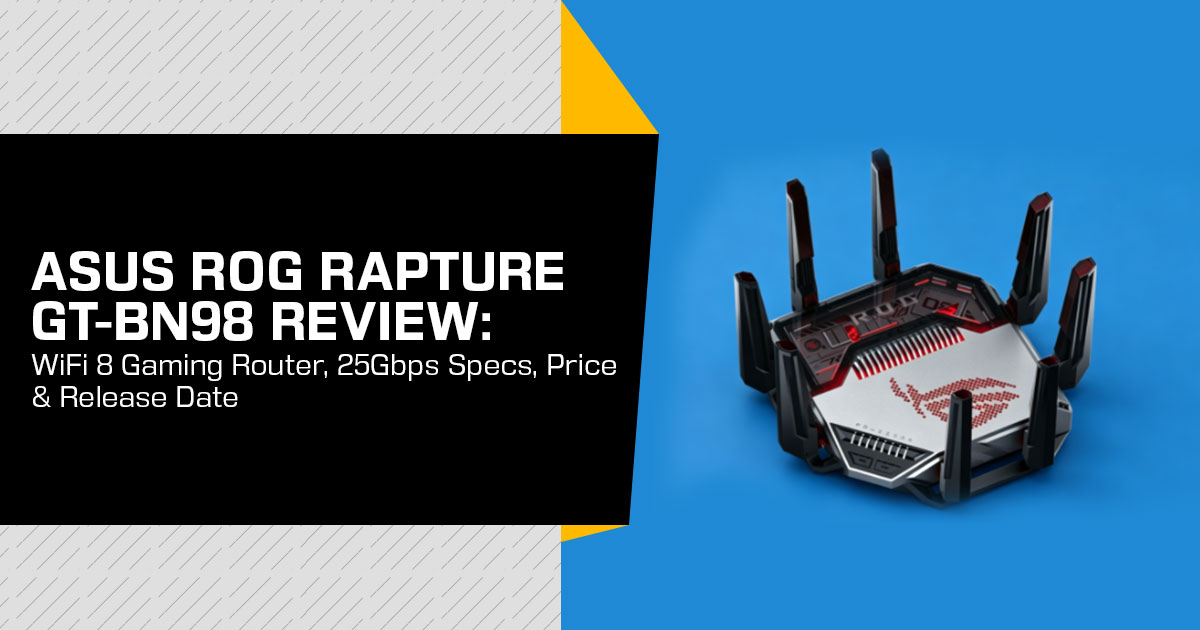
Status (verified 30 August 2026): Announced at Gamescom 2026 · European price: €960 · Planned European availability: 14–20 September 2026 · Standard: WiFi 8 (IEEE 802.11bn, draft)
The ASUS ROG Rapture GT-BN98 is a quad-band WiFi 8 gaming router announced at Gamescom 2026. ASUS claims up to 25,000 Mbps of combined wireless throughput, along with two 10GbE ports, four 2.5GbE ports, and gaming features such as AI Game Boost. ASUS confirmed a European price of €960 and planned availability between September 14 and 20, 2026, according to PC Games Hardware. There is also an important point to keep in mind: WiFi 8 has not been ratified by the IEEE, and consumer WiFi 8 client devices are not available yet.
That means we cannot verify the GT-BN98’s wireless performance through independent testing. Consumer WiFi 8 client devices are not widely available yet, so we cannot run a proper consumer WiFi 8 wireless benchmark. This article is based on ASUS’s product information, its Gamescom 2026 press materials, and independent coverage from Computex 2026 and Gamescom. When specifications differ between sources, we point that out rather than presenting one figure as fact.
We have more than 20 years of experience in hardware and application research and development, and our reviews focus on performance, build quality, reliability, usability, and value for money. For the GT-BN98, that means looking at what the hardware offers today, what can actually be verified, and what you can expect once WiFi 8 devices become available.
This review is aimed at PC gamers, competitive gamers, streamers, networking enthusiasts, and users planning a high-speed home network. If you’re considering a WiFi 8 router, we’ll help you understand what ASUS is offering, what remains unproven, and whether it makes sense to wait for this router or choose a WiFi 7 model instead.
Our recommendations are based on product research, component analysis, real-world usability, and industry experience.
Key takeaways
- Quad-band layout: one 4 GHz band, two 5 GHz bands, and one 6 GHz band with 320 MHz channels and 4096-QAM modulation.
- ASUS’s class name for the wireless side is up to 25,000 Mbps combined (BN25000). The listed per-band rates add up to roughly 4 Gbps — more on that below.
- Wired: two 10GbE ports, four 5GbE ports, one standard 1GbE port, plus USB 3.2 Gen 1 and USB 2.0.
- Gaming tools: AI Game Boost, Adaptive QoE, GTNet route optimization, and WiFi Insight interference monitoring.
- Price and availability: €960 in Europe, with planned availability between September 14 and 20, 2026, according to PC Games Hardware citing ASUS.
- WiFi 8’s new features need compatible WiFi 8 client Until then, current clients use the WiFi capabilities they support.
What is the ASUS ROG Rapture GT-BN98?
The GT-BN98 is the newest flagship in the ROG Rapture gaming router line, and ASUS’s headline WiFi 8 product at Gamescom 2026. In the lineup, the GT-BN98 closely follows the GT-BE98’s quad-band layout, while the GT-BN98 Pro follows the GT-BE98 Pro’s 30,000-class configuration (per DongKnows’s comparison of the two generations). The model code makes the generation split easy: BE refers to 802.11be, which is WiFi 7; BN refers to 802.11bn, which is WiFi 8.
ASUS calls the GT-BN98 “the world’s first WiFi 8 gaming router.” The higher-throughput GT-BN98 Pro was announced earlier at Computex 2026, but ASUS’s Gamescom announcement applies the “world’s first” claim to the GT-BN98. The two models share the same chassis and most of the same hardware — they differ mainly in how the four wireless bands are split, which the comparison section below breaks down.
At the same event, ASUS also announced the ZenWiFi BN12, a WiFi 8 mesh system. The GT-BN98 is part of ASUS’s first WiFi 8 hardware lineup, alongside the ZenWiFi BN12 and GT-BN98 Pro.
GT-BN98 at a glance: full specifications
| Specification | ASUS ROG Rapture GT-BN98 |
|---|---|
| Wireless Standard | WiFi 8 (IEEE 802.11bn, draft) |
| Band Configuration | Quad-band: 1× 2.4 GHz, 2× 5 GHz, and 1× 6 GHz |
| 2.4 GHz Speed | Up to 1,376 Mbps |
| 5 GHz Speed (Each Band) | Up to 5,764 Mbps |
| 6 GHz Speed | Up to 11,529 Mbps using 320 MHz channels |
| Advertised Total Wireless Speed | Up to 25,000 Mbps (BN25000 class) |
| Modulation | 4096-QAM |
| Antennas | 8 external antennas |
| Processor | 2.6 GHz quad-core processor |
| Memory / Storage | 2 GB RAM and 256 MB flash storage |
| 10GbE Ports | 1× 10GbE WAN/LAN + 1× 10GbE LAN |
| 2.5GbE Ports | 1× 2.5GbE WAN/LAN + 3× 2.5GbE LAN |
| 1GbE Port | 1× Gigabit LAN |
| USB Connectivity | USB 3.2 Gen 1 and USB 2.0 |
| Gaming Features | AI Game Boost, Adaptive QoE, GTNet, and WiFi Insight |
| Security Features | AiProtection, ad and tracker blocking, parental controls, and comprehensive VPN functionality |
| Network Segmentation | Guest Network Pro with support for up to 5 SSIDs |
| Mesh Networking | ASUS AiMesh |
| Operating Modes | Router, AiMesh node, access point, repeater, and media bridge |
| Price | €960 in Europe |
| Release Date | Planned European availability: September 14–20, 2026 |
Note on the per-band numbers: two sets of figures are circulating in the press — 5,764 Mbps and 11,529 Mbps (used in this table) versus 5,762 Mbps and 11,525 Mbps. Both trace back to ASUS’s specification sheet, and the difference is rounding. We use the former set because it appears in more independent reports.
What is WiFi 8 (802.11bn), in plain language
Most of the confusion around the GT-BN98 comes from not knowing what WiFi 8 actually is, so here is the short version.
WiFi 8 is the next wireless standard, formally called IEEE 802.11bn. Its official focus is UHR — Ultra-High Reliability — which is an interesting shift. Previous WiFi generations have placed strong emphasis on peak speed. WiFi 8 is not primarily aimed at increasing the peak PHY rate over WiFi 7. Its focus is improving reliability, latency, throughput at weaker signal levels, and packet loss: the design goals set for the standard are roughly 25% better throughput in poor signal conditions, roughly 25% lower worst-case (95th-percentile) latency, and roughly 25% lower MPDU loss, particularly during transitions between access points. In simple terms, that means fewer lost packets during a transition.
The mechanisms behind those targets include:
- Multi-AP coordination — multiple access points coordinate transmission instead of competing, which reduces interference.
- ELR (Enhanced Long Range) — steadier links at the edge of coverage, where most real-world slowdowns happen.
- DRU (Distributed Resource Units) — data spreads across the band instead of one continuous block, which helps in crowded areas.
- DSO (Dynamic Sub-band Operation) — the router assigns channel space based on what each device actually needs.
- UEQM (Unequal Modulation) — each data stream runs at the rate it can handle, instead of every stream being limited to the weakest one.
- Enhanced MLO (Multi-Link Operation) — WiFi 7’s ability to use multiple bands at once, refined.
Two things matter for a buyer. First, the standard is still in draft — the IEEE’s current project timeline targets completion in 2028. Second, consumer WiFi 8 client devices are not available yet, so the new capabilities will come online only as compatible WiFi 8 client hardware arrives. For today’s devices, the router uses the WiFi capabilities supported by each client.
Key features of the GT-BN98, and what they mean for you
Quad-band WiFi 8: what “25,000 Mbps” actually means
The GT-BN98 runs four radio bands at once:
| Band | Maximum Listed Rate | Channel Width | Best Suited For |
|---|---|---|---|
| 2.4 GHz | 1,376 Mbps | 20 / 40 MHz | Longer-range connections, smart home devices, and IoT equipment |
| 5 GHz (Band 1) | 5,764 Mbps | Up to 160 MHz | Everyday high-speed clients such as laptops, phones, gaming systems, and streaming devices |
| 5 GHz (Band 2) | 5,764 Mbps | Up to 160 MHz | A second group of high-bandwidth clients, helping distribute network traffic across the two 5 GHz bands |
| 6 GHz | 11,529 Mbps | Up to 320 MHz | Wi-Fi 6E, Wi-Fi 7, and Wi-Fi 8 clients, high-speed wireless links, and bandwidth-intensive applications |
Adding the listed rates gives about 24.4 Gbps, while ASUS advertises the class name 25,000 Mbps (BN25000). This is a rounded class figure, not a measured wireless speed. And to be clear about what none of these numbers mean: they are the theoretical maximum per band, combined. A single device will not see the full 25 Gbps over the air. A single-client WiFi 7 connection can be far below the combined advertised figure, and lower through walls.
What the quad-band setup does offer is headroom: separate bands for smart home devices, everyday streaming, and the high-speed 6 GHz link a gaming PC or next-generation client will use. In a busy household, that separation is where consistent low-latency performance comes from, rather than one congested band.
Wired: dual 10GbE and four 2.5GbE ports
The wired side is the part of this router that can be evaluated today, before WiFi 8 clients are available:
- The two 10GbE ports (one WAN/LAN, one LAN) leave room for a 10Gbps internet line and a 10G connection to a NAS or workstation.
- The four 5GbE ports connect a small multi-gig device set without a separate switch.
- A standard 1GbE port, plus USB 2 Gen 1 and USB 2.0, cover legacy devices and shared storage.
For many households, a 1GbE connection is enough, so this layout is aimed at users with multi-gig or 10Gbps internet plans, home NAS rigs, or several high-speed machines. If that describes your setup, the ports can cover it without a separate switch. If not, the extra ports may be more than you need.
Gaming tools: AI Game Boost, Adaptive QoE, GTNet, WiFi Insight
- AI Game Boost — ASUS’s three-stage game acceleration: it detects gaming devices on the network, applies priority, and routes their ASUS’s own lab testing (bandwidth-constrained conditions, specific games) shows up to 34% lower latency. Those are manufacturer numbers under controlled conditions, so treat them as a direction, not a certainty.
- Adaptive QoE — bandwidth allocation that adjusts to live network conditions instead of a fixed priority list.
- GTNet — routes game traffic through reliable paths to supported game It is a third-party service rather than an ASUS-developed one.
- WiFi Insight — continuous monitoring of WiFi and non-WiFi interference across all bands, with automatic channel optimization.
For competitive players who cannot run Ethernet to every device, traffic management is one of the router’s main practical benefits.
Security and home networking: AiProtection, Guest Network Pro, VPN, AiMesh
- AiProtection — blocks malicious sites and infected devices, filters ads and trackers, and includes parental controls.
- Guest Network Pro — up to five separate SSIDs, which makes it practical to segment IoT devices, guests, VPN traffic, and family devices without juggling virtual networks.
- VPN — comprehensive VPN features, as described on the ASUS product page.
- AiMesh — the GT-BN98 can act as a node in an existing ASUS AiMesh setup, so it is an upgrade path rather than a rip-and-replace if you already run ASUS networking.
Five operating modes: router, AiMesh node, access point, repeater, media bridge
The router runs as a router, an AiMesh node, an access point, a repeater, or a media bridge. Those modes give you flexibility to use it as an access point, repeater, or media bridge later instead of being limited to router duty.
Design and build quality
The GT-BN98 keeps the design of the previous-generation GT-BE98 models: a large square chassis with eight external antennas. The large chassis and eight external antennas make its enthusiast focus clear.
Thermal design is also important for a router built for sustained multi-gigabit workloads. ASUS says the top plate is up to 30% thicker than the GT-AXE16000’s, with an enhanced nanocarbon layer, an elevated stand, and a specially engineered vent and heat spreader — a combination ASUS says delivers up to 35% better heat dissipation compared with that older model. Those are manufacturer measurements, and the design is aimed at maintaining stable performance under sustained load.
The 2.6 GHz quad-core processor, 2 GB of RAM, and 256 MB of flash are the hardware specifications ASUS lists for the router; without testing, we cannot judge whether they are enough for every workload. There is no basis here to rate it as a NAS-class storage or media-transcoding platform.
Real-world performance: what we can and cannot say yet
Because independent reviews are not yet available and consumer WiFi 8 client devices are not widely available, this is where the article has to stay honest.
What we can say with confidence:
- Wired performance is knowable The two 10GbE ports and four 2.5GbE ports support up to their rated link speeds with compatible 10G or 2.5G clients; actual throughput still depends on the connected hardware and network conditions. For buyers coming from a 1GbE router, this is a major day-one improvement.
- With existing devices, the router can use WiFi 7 capabilities where the client supports The radio supports 4096-QAM, 320 MHz channels on 6 GHz, and MLO — and the per-band rates ASUS lists are the same as those of the previous-generation models, per DongKnows’s spec comparison. Actual wireless performance will depend on the client, signal conditions, and network environment.
What is manufacturer-reported only:
At CES 2026, ASUS ran what it described as the first real-world WiFi 8 throughput test using the ROG NeoCore concept hardware: up to 2× higher median mid-range throughput, 2× wider IoT coverage, and up to 6× lower worst-case latency versus WiFi 7. These are promising figures from the company itself, and they have not been independently reproduced.
The practical bottom line: with current clients, the GT-BN98 uses the WiFi capabilities those devices support, including WiFi 7 features where available. Any WiFi 8-specific advantages depend on compatible client hardware and the final standard.
GT-BN98 vs GT-BN98 Pro vs GT-BE98 Pro: which one is which
This is the comparison that actually helps with a buying decision, because early coverage mixes the models up.
| Feature | GT-BN98 | GT-BN98 Pro | GT-BE98 Pro |
|---|---|---|---|
| Wi-Fi Standard | Wi-Fi 8 (802.11bn, draft) | Wi-Fi 8 (802.11bn, draft) | Wi-Fi 7 (802.11be) |
| Wireless Class | BN25000 — up to 25,000 Mbps | BN30000 — up to 30,000 Mbps | Same per-band rates as the GT-BN98 Pro, according to DongKnows |
| Band Configuration | 2.4 GHz + 2× 5 GHz + 6 GHz | 2.4 GHz + 5 GHz + 2× 6 GHz | 2.4 GHz + 5 GHz + 2× 6 GHz, mirroring the GT-BN98 Pro configuration according to DongKnows |
| Wired Ports | 2× 10GbE, 4× 2.5GbE, 1× 1GbE | 2× 10GbE, 4× 2.5GbE, 1× 1GbE | 2× 10GbE, 4× 2.5GbE, 1× 1GbE |
| Announced / Availability | Gamescom 2026 | Computex 2026 | In market since 2023 |
| Price at Time of Writing | €960 in Europe | Not announced | US$599.99 listed on Newegg according to TweakTown price tracking; recent 30-day U.S. pricing reached approximately US$685 |
How to read this:
- GT-BN98 vs GT-BN98 Pro: same box, same ports, same processor. The difference is the fourth band — the GT-BN98 adds a second 5 GHz band, while the Pro adds a second 6 GHz If you are in a market where 6 GHz spectrum is wide open and you expect WiFi 8 clients, the Pro’s extra 6 GHz band offers more long-term headroom. In regions where 5 GHz is heavily congested, the GT-BN98’s second 5 GHz band may be the more useful split.
- GT-BN98 vs GT-BE98 Pro: the BE98 Pro is the previous-generation model you can buy today. It shares the GT-BN98’s port layout and delivers WiFi 7 performance. The main reason to wait for the GT-BN98 is its support for WiFi 8 and future compatible clients.
If you want the GT-BE98 Pro while you wait, its price varies by retailer; it was recently listed around US$600 at Newegg — so it is worth checking the current Amazon US price before deciding. Indian readers should check the Amazon India listing for the BE98 Pro’s current price as the local reference.
WiFi 8 vs WiFi 7 at a glance
| Feature | Wi-Fi 7 (802.11be) | Wi-Fi 8 (802.11bn) |
|---|---|---|
| Maximum Theoretical PHY Rate | ~46 Gbps | ~46 Gbps (largely unchanged) |
| Frequency Bands / Channel Width | 2.4 GHz, 5 GHz, and 6 GHz, with channels up to 320 MHz | Same 2.4 GHz, 5 GHz, and 6 GHz bands with up to 320 MHz channels |
| Primary Design Focus | Maximizing peak throughput and wireless speed | Improving reliability through Ultra High Reliability (UHR) features |
| Key Technologies | Multi-Link Operation (MLO), 320 MHz channels, and 4096-QAM | Multi-AP coordination, ELR, DRU, DSO, and UEQM |
| IEEE Status | Ratified and already shipping in commercial products | Currently in draft development; the IEEE timeline targets completion in 2028 |
| Consumer Client Devices | Widely available across smartphones, laptops, routers, and other devices | Not yet commercially available for mainstream consumers |
Pros and cons of the GT-BN98
| Pros | Cons |
|---|---|
| Dual 10GbE plus four 2.5GbE ports cover most multi-gigabit network setups without requiring a separate high-speed switch. | High €960 European price, with availability planned for September 14–20, 2026. |
| Full quad-band WiFi 8 radio with support for 320MHz channels and 4096-QAM. | WiFi 8 client devices are not yet widely available, so many of the standard’s advantages depend on future-compatible hardware. |
| Comprehensive gaming-focused features, including AI Game Boost, Adaptive QoE, GTNet, and WiFi Insight. | WiFi 8 remains a draft standard, with final ratification expected around 2028. |
| Five operating modes plus ASUS AiMesh support provide flexibility for expanding and upgrading a home network. | US pricing has not yet been announced. |
| Backward compatible with existing WiFi 4, WiFi 5, WiFi 6, WiFi 6E, and WiFi 7 devices. | The premium €960 price makes it difficult to justify unless you specifically need its multi-gigabit networking and next-generation wireless capabilities. |
| Robust thermal design is intended to maintain stable performance during sustained 24/7 workloads. | GTNet is a third-party service rather than an ASUS-developed networking technology. |
Who should buy the GT-BN98 (and who should wait)
Buy it if you fall in one of these groups:
- You run 10Gbps or multi-gig internet and have several multi-gig devices — the wired layout alone justifies the class.
- You game competitively on wireless and want a complete traffic-management toolkit.
- You already run an ASUS AiMesh network and want the top node with WiFi 8 headroom.
- You build systems for a long horizon (labs, studios, content rigs) and expect WiFi 8 clients in your stack by 2027–2028.
Wait if:
- Your internet plan is under 1 Gbps and you do not have multi-gig devices or local network workloads.
- Your daily drivers are WiFi 7 devices — you would be paying a premium for capabilities that cannot activate yet.
- You are happy with the GT-BE98 Pro and do not need WiFi 8 yet.
GT-BN98 price and availability
As of 30 August 2026, ASUS has confirmed a European price of €960 and planned availability between September 14 and 20, 2026, according to PC Games Hardware. Here is the most useful context we can offer:
- The closest price comparison is the GT-BE98 Pro, the previous-generation model that shares this port layout. It was recently listed at US$599.99 on Newegg (per TweakTown’s price tracking at the time of writing), with the recent 30-day US range running to about US$685. That gives useful context, but US and European street prices are not directly comparable.
- Independent coverage (Dong Knows Tech) estimates availability in late 2026; treat that as an informed guess, not a commitment.
- The WiFi 8 standard is still in The IEEE’s current project timeline targets completion in 2028, while compatible client hardware is not available yet.
- For India: no local pricing or availability has been announced as of 30 August We will update this section when ASUS confirms an Indian launch.
We will update this section if ASUS announces pricing for other markets. In the meantime, the links below will carry the listing as soon as it is live.
Frequently asked questions
Is the ASUS ROG Rapture GT-BN98 worth buying?
For most households in 2026, probably not. The GT-BE98 Pro covers the same wired port layout and offers established WiFi 7 support, while the GT-BN98’s main advantage is support for the still-developing WiFi 8 standard. The GT-BN98 makes the most sense for 10G users, serious wireless gamers, and buyers planning around future WiFi 8 hardware.
How much will the GT-BN98 cost?
ASUS has confirmed a European price of €960. The GT-BE98 Pro’s recent Newegg listing around US$600 provides some context, but regional pricing is not directly comparable. We will update this article if ASUS announces pricing for other markets.
When will the GT-BN98 release?
ASUS has confirmed planned European availability between September 14 and 20, 2026, according to PC Games Hardware. Consumer WiFi 8 client devices are not available yet, so the router’s WiFi 8-specific features cannot be fully evaluated today.
Is WiFi 8 faster than WiFi 7?
Not in peak speed — both top out near ~46 Gbps at the physical layer. WiFi 8’s design targets include roughly 25% better throughput in poor signal conditions and 25% lower worst-case latency, along with reduced packet loss during transitions between access points. These are targets for the standard, not measured performance figures for the GT-BN98. With today’s clients, the router uses the WiFi capabilities those devices support.
Will the GT-BN98 work with WiFi 6 or WiFi 7 devices?
Yes. The GT-BN98 is backward compatible with WiFi 4, 5, 6, 6E, and 7 clients. Existing devices will connect normally; only new WiFi 8 clients will use the newer mechanisms.
What is the difference between the GT-BN98 and the GT-BN98 Pro?
Same chassis, ports, and processor. The difference is the fourth band: the GT-BN98 uses two 5 GHz bands (BN25000 class), while the GT-BN98 Pro uses two 6 GHz bands (BN30000 class). If your region has open 6 GHz spectrum, the Pro’s split offers more long-term headroom.
Do you need a new internet plan to use the GT-BN98?
No. The router works with any broadband plan. However, to make use of the dual 10GbE ports, you would need a 10Gbps-class internet service or a 10G NAS/server on the LAN side.
Final verdict
The ASUS ROG Rapture GT-BN98 is a flagship-class router: a dual-10GbE, quad-2.5GbE wired layout that covers most enthusiast setups, a comprehensive set of gaming and security features, and a quad-band radio that brings the WiFi 8 standard to the home in one of the first router implementations. The build and thermal design are aimed at sustained load, and the router remains compatible with current WiFi generations, so existing devices can still connect while you wait for WiFi 8 clients.
The main caveat is that WiFi 8 client hardware is not available yet and the standard is still in draft. ASUS has confirmed a European price of €960, with planned availability between September 14 and 20, 2026, according to PC Games Hardware. The router’s WiFi 8-specific advantages therefore depend on future compatible client hardware and the final standard.
For 10G households, wireless-first competitive gamers, and buyers planning for future WiFi 8 hardware, the GT-BN98 is the more relevant option once it becomes available. For everyone else, the GT-BE98 Pro remains the more practical purchase — the same port layout, established WiFi 7 support, and a known street price.
Where to check prices: Amazon US and Amazon India
Amazon US
If the GT-BN98 is the router you are waiting for, check the US listing once it is available to compare current prices. The strengths to weigh before you buy: dual 10GbE ports, a quad-band WiFi 8 radio with 320 MHz channels, and the AI Game Boost / Adaptive QoE feature set. At €960 in Europe, the GT-BN98 is aimed at buyers who need its multi-gig wired connectivity or want early access to WiFi 8.
Amazon India
For Indian readers: no local price has been announced for the GT-BN98 yet, and regional pricing may differ from US street pricing. Once a listing appears, it is worth checking both the GT-BN98 and the GT-BE98 Pro, the latter being the more immediately practical option for most homes.
Alternative: ROG Rapture GT-BE98 Pro
If you don’t want to wait for the GT-BN98, the ROG Rapture GT-BE98 Pro is the obvious alternative. It offers quad-band Wi-Fi 7, 320 MHz channels, dual 10GbE ports, and ASUS’s gaming-focused networking features.
Amazon US:
ROG Rapture GT-BE98 Pro Gaming Router
India — third-party retailer, not Amazon:
ASUS ROG Rapture GT-BE98 Pro/GT
Note: The India link above is for a third-party retailer and is not an Amazon India listing.
If you have questions about the ASUS ROG Rapture GT-BN98, its WiFi 8 features, or any of the specifications covered here, leave a comment below. We’ll do our best to answer your questions and clear up anything that may not be clear.
If you find our reviews useful, follow us for more hardware and networking reviews, comparisons, and buying advice.
***Disclaimer***
This blog post reflects our research, analysis, and opinions based on available product information, user feedback, and industry knowledge. It should not be taken as the official position of any brand, manufacturer, or company mentioned here. We make every effort to keep this guide accurate, but product specifications, pricing, and availability may change after publication. We recommend double-checking important details before making a purchase.
Some links in this article may be affiliate links. If you choose to buy through these links, we may earn a small commission at no extra cost to you. This helps support our work and allows us to keep publishing in-depth, unbiased reviews. Affiliate partnerships never influence our recommendations.
Opinions expressed by readers are their own and do not necessarily reflect ours. We are not responsible for outcomes resulting from the use of information on this site. Please seek professional advice where appropriate.
All product names, logos, and brands mentioned are the property of their respective owners. These names are used for identification and informational purposes only and do not imply endorsement.