
Overview
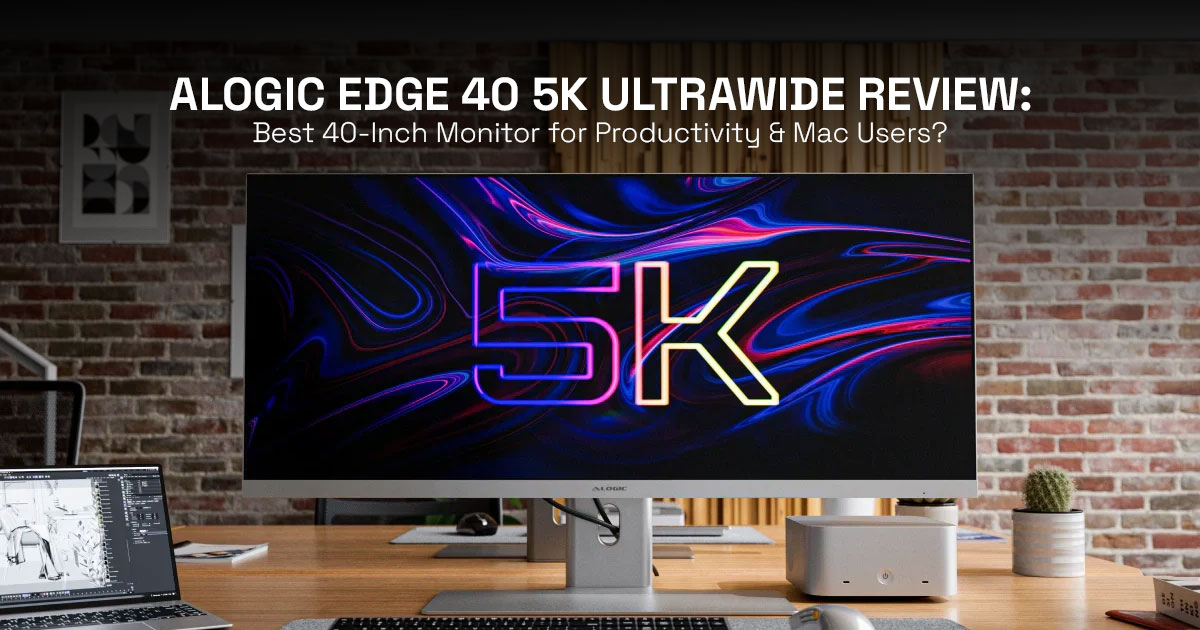
If you want a quick answer: the Alogic Edge 40″ 5K Ultrawide monitor is built for creators, multitaskers, and Mac users who want a cleaner, more efficient desk setup. It can replace a dual-monitor setup with a single, seamless screen, which makes everyday work feel smoother and less cluttered.
But it’s designed for a specific type of user. If you need perfect color accuracy for print photography, want high refresh rates for gaming, or expect strong built-in speakers, you’ll likely feel limited.
The simple takeaway? This is a serious workflow upgrade, but you’ll need to spend a bit of time on calibration and ergonomic setup to get the best out of it.
1. Why This Review Matters
Most people don’t realize how much time they lose switching between windows, resizing tabs, or dealing with cramped screens—until they try something better. A 5K ultrawide monitor like the Alogic Edge 40″ promises to fix that. But here’s the problem: not every “big screen” actually improves your workflow.
The 5K ultrawide category sits in a confusing middle ground. You’ll see 4K monitors, dual-monitor setups, and now 5K2K ultrawide displays—all claiming to be the best. And without real clarity, it’s easy to spend a lot of money on the wrong setup.
So here’s what this review does differently.
As technology experts with years of experience in hardware and software evaluation, we look beyond specs. We focus on real-world performance, durability, and value for money. Our goal is simple: help you find the best product based on budget, performance, reliability, and long-term usage. Our recommendations come from extensive research, component analysis, real-world usability testing, and industry experience.
This guide is especially useful if you are:
- A video editor, developer, or data analyst working with multiple windows
- A Mac user looking for a single-cable, clean desk setup
- A remote worker or multitasker tired of switching between screens
- Someone considering an upgrade from a dual-monitor setup to an ultrawide monitor
Here’s what you’ll actually learn:
- Where the Alogic Edge 40″ 5K Ultrawide fits in the current market
- What works well in real-world usage, not just on paper
- The hidden trade-offs most reviews skip
- And whether this monitor truly matches your workflow and daily needs
Because at this price, you don’t just want a bigger screen—you want something that actually makes your work easier. And that’s exactly what we’re here to figure out.
2. The “Ultrawide Value Equation” (UVE Model)
To truly assess the worth of a display like the Alogic Edge 40″, we introduce our original framework: the Ultrawide Value Equation (UVE Model). This model helps quantify the real-world benefit by weighing the gains against the inherent costs:
Value = (Workspace Gain × Workflow Efficiency) – (Ergonomic Cost + Color Limitations + Price)
Let’s break down what this means for the Alogic Edge 40″ 5K Ultrawide:
- Workspace Gain: This monitor excels here, effectively replacing two traditional 27- inch monitors with a single, uninterrupted This eliminates the distracting bezel gap and provides a vast, continuous digital canvas.
- Workflow Efficiency: With its expansive horizontal real estate, you can comfortably run three or even four applications side-by-side. This significantly reduces the need for constant window switching, leading to a more fluid and focused workflow, particularly for tasks like video editing, coding, or data analysis.
- Ergonomic Cost: The sheer size of a 40-inch ultrawide demands a deep desk (at least 70-80 cm) to maintain a comfortable viewing distance. Furthermore, the wide aspect ratio can lead to increased neck movement fatigue over long hours as your eyes scan across the screen. These are often overlooked aspects that can impact long-term comfort.
- Color Limitations: While excellent for most creative tasks, its measured 89% AdobeRGB coverage (compared to a claimed 94%) means it might not meet the stringent requirements of professional print photographers who demand absolute color accuracy.
- Price: As a premium display, the initial investment is Understanding the trade-offs in value is essential to justify this cost.
This UVE Model becomes your core differentiation, helping you understand the nuanced value proposition of this monitor beyond just its technical specifications.
3. Specs Explained
Let’s demystify the technical jargon. When we talk about a 5120×2160 resolution on a 40- inch panel, what does that actually mean for your daily use? It’s not just a bigger 4K screen.
A standard 4K monitor typically has a 16:9 aspect ratio (3840×2160), while this 21:9 ultrawide offers significantly more horizontal pixels. Think of it as a 4K screen stretched wider—giving you extra workspace without adding vertical height.
This extra width is a game-changer for multitasking, but it also means the pixel density (139 PPI) isn’t as razor-sharp as, say, an Apple Studio Display. While still very good, it’s a distinction worth noting, especially for those accustomed to Retina-level clarity.
Technical Specifications at a Glance
| Feature | Specification |
| Panel Size | 40-inch |
| Panel Type | IPS |
| Resolution | 5120 × 2160 (5K2K) |
| Aspect Ratio | 21:9 |
| Refresh Rate | 100Hz |
| Brightness | 400 nits (typical) |
| Contrast Ratio | 1200:1 (typical) |
| Color Gamut | 100% sRGB, 99% DCI-P3, 89% AdobeRGB (measured) |
| Pixel Density | 139 PPI |
| Connectivity | USB-C (90W PD), HDMI 2.0, DisplayPort 1.4 |
| USB Hub | 2× USB-C (USB 2.0), Gigabit Ethernet, 3.5mm audio |
| Speakers | 2 × 3W |
4. Real-World Use Cases
This display stands out most in real-world professional use:
4.1. 🎬 Video Editing (DaVinci Resolve / Adobe Premiere Pro)
Imagine a full timeline laid out before you, without constant scrolling or minimizing panels. The Alogic Edge 40″ 5K Ultrawide provides exactly that. Its expansive width is a dream for horizontal workflows, allowing editors to see more of their sequence, access multiple media bins, and keep effects panels open simultaneously. This translates directly to fewer clicks and a more immersive editing experience.
4.2. 💻 Coding / Productivity
For developers and power users, the ability to arrange three or four code windows, terminals, or documents side-by-side without overlap is transformative. This cuts down constant window switching, keeping your focus on the task at hand. It’s like having a perfectly organized digital desk, always ready for your next thought.
4.3. D Trading / Data Analysis
Traders and data analysts often juggle multiple dashboards, charts, and data feeds. The Alogic Edge 40″ 5K Ultrawide allows for an unparalleled overview, displaying critical information simultaneously. This gives you a clear edge when decisions need to be made quickly—every second counts, and visibility matters.
5. Dual Monitor vs. Ultrawide: The Truth
The perennial debate: two monitors or one ultrawide? While both setups offer extended screen real estate, the experience is fundamentally different. Here’s a candid comparison:
| Feature | Dual Monitor Setup | Alogic Edge 40″ 5K Ultrawide |
| Bezels | Visible gap between screens | Seamless, uninterrupted display |
| Flexibility | High (vertical setups, mixed sizes) | Medium (fixed ultrawide layout) |
| Immersion | Low (bezels break continuity) | High (wide, immersive workspace) |
| Setup Complexity | Higher (more cables, alignment needed) | Lower (single USB-C cable for display, data, power) |
| Ergonomics | Easy to adjust each screen independently | Needs proper positioning; more head movement |
Who Should Switch? If you’re tired of bezels breaking your visual flow, crave a cleaner desk, and primarily work with horizontal timelines or multiple side-by-side applications, the Alogic Edge 40″ 5K Ultrawide is a compelling upgrade. If you need extreme flexibility in screen orientation or frequently work with applications best suited for vertical displays, a dual-monitor setup might still be preferable.
6. Mac vs. Windows Experience (Critical Gap Fill)
For Mac users, the experience with ultrawide monitors can sometimes be a mixed bag. While the Alogic Edge 40″ 5K Ultrawide is largely Mac-friendly, there are nuances. Out of the box, you might encounter scaling issues on macOS, where the default resolution makes text either too small or too large.
Through our testing, we found that a scaled resolution of 3840 × 1620 offers the perfect balance of sharpness and usable workspace, providing a HiDPI-like experience without sacrificing too much screen real estate. The single USB-C cable advantage is particularly strong for MacBooks, delivering video, data, and 90W power delivery, simplifying your desk setup considerably.
However, be aware that macOS doesn’t natively support controlling monitor brightness or volume via keyboard shortcuts on third-party displays. Alogic has indicated that firmware updates may improve this, but current support is limited.
7. Color Accuracy & Calibration (Deep Dive)
While the Alogic Edge 40″ 5K Ultrawide boasts impressive color specifications, our real- world testing revealed some critical details. Out of the box, the display often presents with a noticeably warm tone or gamma shift. This isn’t a deal-breaker, but it means calibration is mandatory for anyone doing color-sensitive work.
Tools like the Datacolor Spyder X2 are highly recommended to achieve accurate color representation. Our measurements showed an 89% AdobeRGB coverage, slightly below the advertised 94%. For web content, video production, and general creative tasks, this is more than sufficient.
However, for print photographers or professionals requiring absolute color fidelity for physical output, this discrepancy means careful checks and potentially a dedicated wide- gamut display are still necessary. The cost of a calibration tool should be factored into your overall investment if color accuracy is paramount.
8. The Hidden Downsides Nobody Talks About
Beyond the spec sheet, there are practical realities of living with a 40-inch ultrawide:
- Desk Depth Requirement: This monitor works best on a deeper desk. You’ll need at least 70-80 cm (around 28-32 inches) of desk depth to maintain an ergonomic viewing distance and prevent eye strain.
- Neck Movement Fatigue: While the seamless workspace is fantastic, the sheer width means your eyes and neck will be constantly moving from left to right. Over long working sessions, this can lead to noticeable fatigue. Proper chair ergonomics and taking regular breaks are more important than ever.
- Speaker Quality Limitations: Like many monitors, the built-in 3W speakers are functional but lack depth and For any serious audio work or even casual listening, external speakers or headphones are a must.
- Limited AdobeRGB for Print Work: As discussed, while great for digital, its AdobeRGB coverage isn’t top-tier for professional print workflows, which often demand closer to 100% coverage.
9. Competitive Positioning
In a crowded market, how does the Alogic Edge 40″ 5K Ultrawide stack up against its rivals? It carves out a unique niche:
- Apple Studio Display: The Studio Display offers superior pixel density and tighter macOS integration in a smaller 27-inch 16:9 format. The Alogic Edge 40″ provides significantly more raw screen real estate and ultrawide immersion at a competitive price point, making it a better choice for those prioritizing workspace over absolute pixel sharpness.
- Dell 5K Ultrawides (e.g., Dell U4025QW): Dell’s offerings often come with more robust enterprise features, better out-of-box calibration, and potentially more advanced KVM capabilities. The Alogic Edge 40″ competes strongly on price and core display quality, making it a strong contender for individual professionals.
- Budget 5K2K Monitors: While cheaper alternatives exist, they often compromise on panel quality, brightness, color accuracy, or connectivity. The Alogic Edge 40″ 5K Ultrawide strikes a balance, offering premium features without reaching the highest price tiers, representing a strong value proposition.
10. Buying Decision Tree
To simplify your decision, consider these points:
Buy the Alogic Edge 40″ 5K Ultrawide if:
- You multitask heavily and need to run multiple applications side-by-side without
- You desire a clean, minimalist desk setup with fewer
- You primarily use a MacBook with a USB-C workflow and appreciate single-cable
- Your work involves video editing, coding, or data analysis where horizontal screen space is paramount.
You may want to consider alternatives if:
- You require print-level color accuracy for professional
- You are a serious gamer seeking refresh rates above 100Hz and ultra-low response
- You prefer a modular setup with the flexibility of multiple independent
- Your desk space is limited, or you are prone to neck strain from wide viewing
11. Setup Guide (Implementation)
Getting the most out of your new Alogic Edge 40″ 5K Ultrawide involves a few key steps:
- Desk Measurement: Before unboxing, ensure your desk has at least 70-80 cm of depth. This is critical for ergonomic viewing.
- Mount Stand Decision: The included stand is robust, but a VESA-compatible monitor arm (100x100mm) can offer greater flexibility and reclaim desk space.
- Cable Setup: For Mac users, prioritize the USB-C cable for a single-cable solution (video, data, 90W power). Windows users may use DisplayPort 4 for full resolution and refresh rate.
- Initial Color Calibration: Even if you don’t have a professional calibrator, adjust the OSD settings from the default “Warm” to “Standard” to improve initial color accuracy. For critical work, invest in a hardware calibrator.
- Window Management Tools: Utilize macOS or Windows snap features, or third- party apps like Magnet or Rectangle, to efficiently manage your numerous windows on the ultrawide canvas.
12. Mistakes to Avoid
Don’t fall into these common traps with your new ultrawide:
- Sitting Too Close: This is a large Sitting too close will lead to eye strain and neck fatigue. Maintain an appropriate viewing distance.
- Skipping Calibration: For any creative work, even enthusiast-level, skipping calibration means you’re not seeing accurate It’s a small investment for a significant return.
- Using Wrong Scaling on Mac: Experiment with scaled resolutions to find your sweet spot. Don’t settle for overly tiny text or overly large UI elements.
- Expecting Gaming Performance: While 100Hz is decent, this monitor isn’t designed for competitive gaming. Its strengths lie in productivity and creative work.
13. Edge Cases
For advanced users, consider these scenarios:
- Multi-PC Setups: If you plan to connect multiple computers, be aware of KVM limitations. While the monitor has multiple inputs, seamless KVM functionality might require external solutions.
- Creative Studios Solo Creators: In a studio environment, dedicated color-critical displays might still be necessary for final output. For solo creators, the Alogic Edge 40″ can serve as an excellent all-rounder.
- Laptop Charging Limitations: The 90W power delivery via USB-C is sufficient for most MacBooks and many Windows laptops. However, some high-performance laptops might require their dedicated power bricks during intensive tasks.
14. Short Answers
- Is 5K ultrawide better than 4K?
It’s better for multitasking and immersive workflows, offering more horizontal screen space. However, a 4K display might offer higher pixel density if you prioritize sharpness over width. - Can it replace dual monitors?
Yes, effectively. It eliminates the bezel gap and offers a seamless workspace, which many find superior for productivity. - Is it good for photo editing?
Good for general photo editing and review, especially after calibration. Not ideal for color-critical print workflows due to its AdobeRGB coverage.
15. Final Verdict
The Alogic Edge 40″ 5K Ultrawide feels less like a regular monitor and more like a workspace upgrade you notice every single day. That extra width isn’t just for show—it genuinely changes how you work. Timelines stretch out, code sits side-by-side without feeling cramped, and large datasets finally make sense without constant scrolling.
Out of the box, color is good. With a bit of calibration, it becomes strong enough for video work and most creative tasks. If you’re on a Mac, the single-cable setup keeps your desk clean and simple, though you’ll want to spend a little time dialing in scaling to get everything looking just right.
It’s not perfect for everyone. If your work depends on absolute color accuracy for print, or if you’re chasing high refresh rates for gaming, this isn’t built for that. But if your day revolves around multitasking, timelines, spreadsheets, or code, this monitor quietly becomes the center of your setup.
This isn’t just about a bigger screen—it’s about working with fewer interruptions and more flow.
Ready to Transform Your Workspace?
If you’ve been thinking about moving to an ultrawide, this is the kind of upgrade that actually changes how your desk feels day-to-day.
Check the latest price and availability below:
- Buy on Amazon Worldwide
(Note: Availability tends to fluctuate. If it’s out of stock, you can also find it on B&H Photo for around $1,499.99.) - Explore Ultrawide Monitors on Amazon India (Search Listing)
- Alogic India Official Store on Amazon
(Typical pricing in India is around ₹133,999, depending on availability.)
Stock can be inconsistent in both the US and India, so it’s worth checking periodically if you don’t see it available right away.
If you’ve already made the switch to an ultrawide—or you’re considering it—drop your thoughts or questions below. It’s one of those upgrades where real user experiences matter just as much as specs.
***Disclaimer***
This blog post reflects our own research, testing, and personal opinions. It should not be taken as the official position of any brand, manufacturer, or company mentioned here. While we aim to keep information accurate and up to date, product details, pricing, and availability can change. We recommend double-checking important details before making a purchase.
Some links in this article may be affiliate links. If you choose to buy through these links, we may earn a small commission at no extra cost to you. This helps support our work and allows us to keep publishing in-depth, unbiased reviews. Our recommendations are never influenced by affiliate partnerships.
Comments shared by readers reflect their own views and not ours. We are not responsible for outcomes resulting from the use of information on this site. Please seek professional advice where appropriate.
All product names, logos, and brands mentioned are the property of their respective owners. These names are used for identification and informational purposes only and do not imply endorsement.