
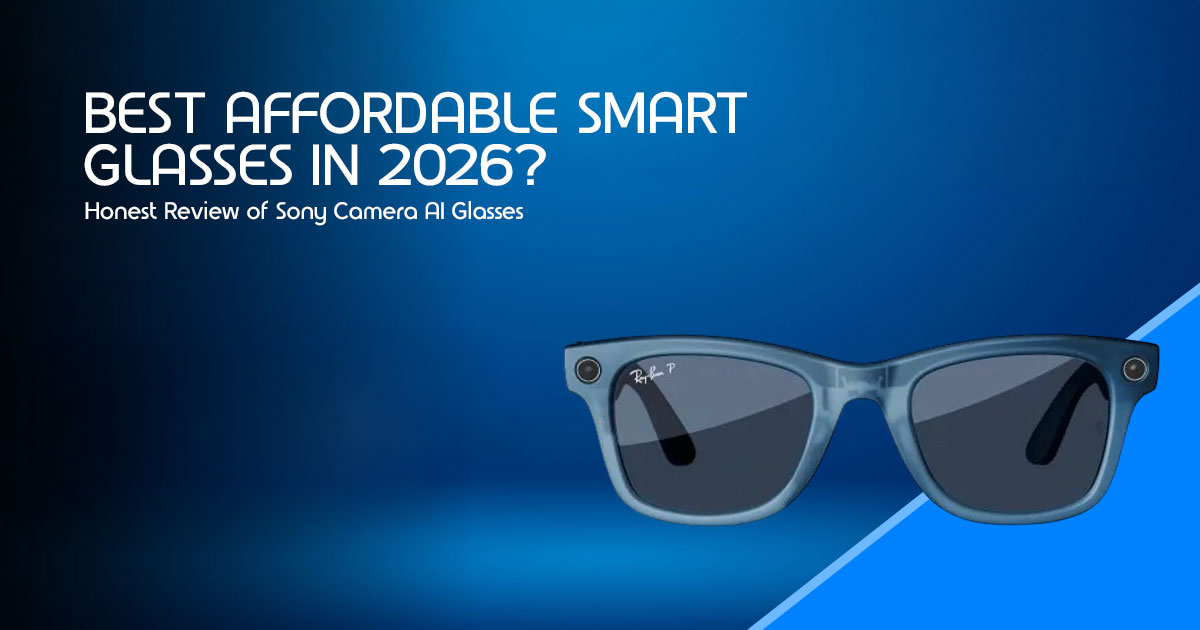
The wearable tech market has changed rapidly in 2026. Today’s buyers no longer have to choose between expensive augmented reality headsets and simple audio glasses with limited features. A new generation of affordable smart glasses is making advanced technology accessible, combining an 8MP Sony image sensor capable of capturing 13MP photos, AI-powered features, open-ear audio, and long battery life at a price that doesn’t feel out of reach.
That sounds exciting—but here’s the real question: Can a budget-friendly pair of smart glasses actually improve your daily life, or is it another gadget you’ll stop using after a few weeks? Marketing claims are easy to make, but everyday performance is what matters. Whether you’re commuting to work, traveling, creating content, attending college, or simply trying to spend less time staring at your phone, the right smart glasses should solve real problems instead of creating new ones.
As technology experts with over 20 years of experience in hardware and application research and development, we evaluate every product with one goal: helping readers make smarter buying decisions. We don’t rely on marketing claims alone. Our reviews are based on extensive research, component analysis, real-world usability, long-term reliability, durability, and overall value for money. We compare products across every price range to identify the best choices for budget-conscious buyers, performance seekers, and those looking for dependable devices that will continue to deliver over time.
If you’re a student looking for hands-free note-taking and music, a traveler wanting to capture memories without constantly holding a phone, a professional who needs convenient communication on the move, a content creator searching for affordable POV recording, or simply someone curious about whether AI smart glasses are finally worth buying, this review is for you.
In this review, we’ll go beyond the specification sheet to examine real-world camera quality, battery life, comfort, AI features, audio performance, everyday usability, and the compromises you should know before spending your money. By the end, you’ll know exactly who these smart glasses are built for, who should skip them, and whether they deserve a place in your everyday carry.
Quick Verdict
Best for: Travelers, parents, and casual content creators who want hands-free POV recording and AI assistance without spending over $200. Avoid if: You are a professional vlogger needing 4K video, or an AR enthusiast looking for virtual displays.
Overall rating: 4.2/5 Value score: 4.8/5 Camera score: 4.0/5 Battery score: 4.1/5 Comfort score: 4.5/5 AI features score: 3.8/5
Check today’s latest price on the official site
What Makes These Smart Glasses Different?
Key highlights
Most budget smart glasses cut corners on the camera sensor, leaving you with grainy, unusable footage. The standout feature here is the upgraded 8MP Sony sensor, which captures 13MP photos and 1080P video. They also include 32GB of built-in storage, eliminating the need for constant phone transfers, and feature built-in AI translation for 26 languages.
Design philosophy
The design leans heavily into subtlety. At just 42 grams, they look and feel like standard wayfarer-style sunglasses. The goal here is clearly everyday wearability rather than looking like a cyborg. The inclusion of both UV400 tinted lenses and clear blue-light blocking lenses in the box shows a commitment to versatility.
Why affordability matters
In 2026, the affordable smart glasses market is proving that you do not need to spend $300 to $500 to get a reliable wearable camera. By stripping away complex AR displays and focusing on core features—camera, audio, and AI—these glasses offer a practical entry point for everyday users.
Where they sit in the current smart glasses market
These glasses occupy the middle ground. They are significantly more capable than basic Bluetooth audio frames, yet they avoid the high price tag and ecosystem lock-in of premium models like the Meta Ray-Bans. They are designed for utility rather than social media-focused experiences.
Specifications at a Glance
| Feature | Specification |
| Camera | 8MP Sony sensor (captures up to 13MP photos) |
| Video Recording | 1080p at 30fps with Electronic Image Stabilization (EIS) |
| Battery Life | Up to 10 hours of audio playback or approximately 3 hours of continuous recording |
| Charging | Magnetic fast charging |
| Connectivity | Bluetooth 5.4 and Wi-Fi (for file transfer) |
| Weight | 42 grams |
| Speakers | Dual open-ear speakers |
| Microphones | Dual microphones with noise cancellation |
| AI Features | ChatGPT integration with support for real-time translation in up to 26 languages |
| Companion App | Ad-free mobile app with Wi-Fi file transfer support |
| Price | Under $150 |
What Can You Actually Do With These Glasses?
Capture everyday moments
The biggest advantage is how easy it is to capture everyday moments. When your dog does something funny or your child takes their first steps, you do not have to fumble for your phone. A single tap on the frame captures the moment exactly as you see it.
Record POV travel videos
For travelers, these Sony camera smart glasses are a great companion for capturing hands-free memories. You can record a bike ride through a new city or a hike up a mountain while keeping your hands completely free. The EIS helps reduce minor camera shake during walking and everyday movement.
Listen to music
The open-ear dual speakers allow you to listen to podcasts or music while remaining aware of your surroundings. It is a safer alternative to noise-canceling earbuds when walking in busy urban areas.
Answer calls
With Bluetooth 5.4 and dual noise-canceling microphones, taking calls is seamless. The dual microphones are designed to improve voice clarity by reducing background noise during calls.
Voice assistant access
A long press activates your phone’s native voice assistant, allowing you to send texts, set reminders, or check the weather without looking at a screen.
Navigation
While they do not project a map into your field of view, you can receive turn-by-turn audio directions directly into your ears, which is incredibly useful for cycling or walking in unfamiliar places.
Notifications
You can configure the companion app to read out incoming notifications, ensuring you never miss an important message while your phone is tucked away.
Hands-free work
For DIY enthusiasts or mechanics, having a camera to document a process or audio to listen to instructions while both hands are occupied is highly practical.
AI assistance
The integrated ChatGPT feature allows you to ask questions about your environment. The real-time translation feature is particularly impressive, listening to foreign speech and whispering the translation into your ear.
Real-World Usage Scenarios
Daily commute
Listen to the morning news and answer work calls while keeping your ears open to traffic and transit announcements.
College students
Record lectures (where permitted) or use the AI translation feature during study abroad programs.
Business meetings
Use the clear lenses indoors to take hands-free reference photos of whiteboards or documents without holding up a phone.
Walking and cycling
The EIS helps produce smoother POV footage while walking or cycling, and the open-ear audio lets you stay aware of your surroundings.
Travelers
Navigate new cities with audio directions and capture tourist attractions without experiencing life through a smartphone screen.
Parents
Capture genuine, candid moments of your children playing without the distraction of a phone lens breaking their concentration.
Content creators
Gather unique b-roll footage and behind-the-scenes POV shots to supplement your main camera setup.
Outdoor adventures
The UV400 lenses protect your eyes while fishing or hiking, and the camera captures the exact moment you reel in a catch or reach the summit.
Camera Review
Sony sensor advantages
The 8MP Sony image sensor is one of the biggest reasons these affordable smart glasses stand out. It captures detailed 13MP photos with better color and clarity than many budget alternatives.
Daylight quality
In well-lit outdoor environments, the camera performs very well. Colors are punchy, and the dynamic range is surprisingly capable of handling bright skies and darker shadows simultaneously.
Indoor quality
Performance dips slightly indoors, as is expected with small sensors. However, as long as the room is reasonably well-lit, the footage remains clear and usable for social media or personal memories.
Night performance
Low-light performance is the Achilles’ heel of all smart glasses. In dark environments, the footage becomes grainy, and the stabilization struggles. These are strictly daytime or brightly lit indoor cameras.
Selfie limitations
Because the camera faces outward, taking a selfie requires taking the glasses off and pointing them at yourself, which is awkward and defeats the purpose of the device.
Video stabilization expectations
The EIS does a commendable job of smoothing out walking and light jogging. However, it is not an action camera. If you take these mountain biking over rough terrain, the footage will still be jittery.
Social media suitability
The 1080P video is perfectly sized for Instagram Reels, TikTok, or YouTube Shorts. The WiFi transfer via the app makes it incredibly easy to move clips to your phone for quick editing.
Battery Life: Marketing vs Reality
Manufacturers love to claim “up to 12 hours” of battery life, but that rarely matches real-world workloads. Here is what you can actually expect based on different usage patterns.
| Activity | Expected Runtime |
| Music Playback | 8–10 hours |
| Camera Recording | Approximately 2.5–3 hours of continuous recording |
| Mixed Daily Use | Approximately 5–6 hours |
| Standby Time | Up to 48 hours |
| Voice Calls | Approximately 6–7 hours |
Summary: If you are just listening to music and taking occasional photos, they will easily last a full workday. If you are recording long video clips, expect to recharge them by lunchtime.
Comfort for All-Day Wear
Weight
At 42 grams, they are only slightly heavier than standard sunglasses. You will not feel weighed down, even after hours of use.
Nose pressure
The molded nose pads distribute the weight well. The lightweight design and molded nose pads are intended to improve comfort during extended use.
Frame fit
The frames are designed to fit a wide variety of face shapes. They grip securely enough for light exercise but do not squeeze the temples uncomfortably.
Heat
During extended video recording, the right arm (where the processor and battery are housed) gets slightly warm, but it never becomes uncomfortably hot against the skin.
Prescription compatibility
Currently, these glasses do not offer custom prescription lenses directly out of the box, which is a limitation for those who require corrective eyewear daily.
Long sessions
Thanks to the lightweight build and lack of heavy AR displays, wearing these for a full 8-hour day is entirely feasible and comfortable.
AI Features Explained
Voice commands
You can control music playback, answer calls, and trigger the camera using simple voice prompts, keeping your hands entirely free.
Notifications
The glasses can read your incoming texts and app alerts aloud, allowing you to stay connected without looking at a screen.
Translation
The standout AI feature is the 26-language translation. It listens to the person speaking to you and provides an audio translation, making travel significantly easier.
Navigation
Based on the available product information and user reports, navigation should work reliably with supported mapping apps.
Assistant capabilities
The ChatGPT-powered AI assistant lets you ask complex questions and receive conversational answers directly through the glasses.
Current limitations
The AI features require an active internet connection via your smartphone. If you lose cell service, the translation and ChatGPT functions will not work.
Privacy Considerations
Camera etiquette
Wearing a camera on your face comes with responsibility. It is crucial to be mindful of where you are recording and who is in the frame.
Recording indicators
These glasses feature a visible LED light that illuminates when the camera is active, alerting those around you that they are being recorded.
Public use
In public spaces, recording is generally acceptable, but it is always best practice to respect the privacy of strangers.
Workplace policies
Many corporate environments strictly prohibit recording devices. You should always check your company’s policy before wearing camera glasses to the office.
Travel considerations
Some countries have strict privacy laws regarding public photography. Always research local regulations before traveling with smart glasses.
Pros and Cons
Pros
- What We Liked: Excellent 8MP Sony sensor for the price, lightweight all-day comfort, seamless WiFi file transfer, and genuinely useful AI translation features.
Cons
- Things to Consider: Poor low-light camera performance, no native prescription lens options, and AI features require a constant phone connection.
Comparison With Popular Alternatives
| Feature | Sony Camera AI Smart Glasses | Meta Ray-Ban | Lenskart B Glasses | XREAL One Pro |
| Price | Under $150 | ~$299+ | ~$260 | ~$649 |
| Camera | 8MP camera (up to 13MP photos) | 12MP | 12MP | N/A (Display-focused) |
| AI Features | ChatGPT integration, AI assistant, real-time translation | Meta AI | Google Gemini | None |
| Battery | ~6 hours (mixed use) | ~4 hours (mixed use) | ~5 hours (mixed use) | Powered by the connected device |
| Audio | Dual open-ear speakers | Premium open-ear speakers | Dual open-ear speakers | Spatial audio |
| Comfort | 42g (Very light) | 49g (Light) | 45g (Light) | 72g (Relatively heavy) |
| Ecosystem | Open compatibility with Android and iPhone | Optimized for the Meta ecosystem | Open ecosystem | Requires USB-C DisplayPort (DP Alt Mode) |
| Best For | Budget-conscious users | Social media creators | Tech enthusiasts | Gamers and remote workers |
Who Should Buy These?
| Audience | Why They’re a Good Fit |
| Students | Great for recording lectures, listening to music between classes, taking hands-free calls, and using AI features for quick research and everyday productivity. |
| Travelers | Perfect for capturing hands-free travel memories, navigating unfamiliar places, listening to audio directions, and overcoming language barriers with real-time translation. |
| Professionals | Ideal for hands-free calls during commutes, documenting site visits with quick photos or videos, and staying connected without constantly checking a smartphone. |
| Content Creators | An affordable way to capture unique first-person (POV) footage for travel vlogs, behind-the-scenes clips, outdoor adventures, and social media content. |
| Casual Users | A great choice for anyone who wants to capture everyday family moments, enjoy music, and stay connected while spending less time looking at a phone. |
Who Should Skip Them?
| Audience | Why They May Not Be the Right Choice |
| Professional Photographers | While the Sony camera sensor delivers good image quality, it cannot replace the flexibility, image processing, and lens options of a dedicated mirrorless camera or flagship smartphone. |
| Serious Vloggers | If your workflow requires 4K recording, professional audio controls, advanced stabilization, or extensive editing flexibility, you’ll likely need a dedicated camera. |
| AR Enthusiasts | These smart glasses focus on audio, AI, and camera features rather than augmented reality. If you want virtual displays or spatial computing, consider devices like XREAL or Rokid instead. |
| Gamers | These glasses do not provide a visual display for gaming or media streaming, making them unsuitable as a gaming accessory. |
| Users Wanting Advanced Displays | If your goal is to watch movies on a virtual screen, browse apps in front of your eyes, or use extended desktop displays, these glasses won’t meet those expectations. |
Common Buying Mistakes
- Buying only for the camera: Remember that these are also excellent audio devices and AI assistants.
- Ignoring app compatibility: Ensure your smartphone is relatively modern to handle the WiFi transfers smoothly.
- Overestimating AI features: The AI is helpful, but it is not a human assistant; it has limitations and requires internet.
- Expecting action-camera quality: They are great for walking, but they will not replace a GoPro for extreme sports.
- Forgetting prescription lens needs: If you are blind without your prescription, these will not work for you out of the box.
Frequently Asked Questions
Are affordable smart glasses worth buying?
Yes, in 2026, affordable smart glasses offer excellent value, providing high-quality audio, capable cameras, and AI features without the premium brand markup.
Can they replace wireless earbuds?
For most daily activities like walking, working, or commuting, yes. However, because they are open-ear, they do not block out loud background noise like noise-canceling earbuds do.
Is the Sony camera good?
The 8MP Sony sensor captures excellent 13MP photos and smooth 1080P video in daylight, making it vastly superior to older budget smart glasses.
Can they record in low light?
No. Like most small-sensor cameras, they struggle in dark environments, producing grainy footage.
Do they work with Android and iPhone?
Yes, the companion app and Bluetooth connectivity are fully compatible with both iOS and Android devices.
Can you wear prescription lenses?
Currently, these specific glasses do not offer custom prescription lenses out of the box.
Are they waterproof?
They are generally water-resistant (sweat and light rain), but they are not waterproof. Do not submerge them.
Do they need a subscription?
No. The companion app and the built-in AI features do not require a monthly subscription.
Can they work offline?
The camera and Bluetooth audio work offline, but the AI translation and ChatGPT features require an internet connection via your phone.
Are they suitable for daily use?
Yes. At just 42 grams, these smart glasses are comfortable enough for all-day wear as sunglasses or blue-light glasses.
Final Buying Verdict
- Buy now if… you want a lightweight, affordable way to capture hands-free POV video, listen to music, and access AI translation without spending a fortune.
- Wait if… you absolutely require prescription lenses built-in from the factory.
- Consider competitors if… you are deeply embedded in the Meta ecosystem and want seamless Instagram live-streaming (look at Ray-Ban Meta), or if you want virtual AR screens (look at XREAL).
Overall recommendation: These Sony camera smart glasses, powered by an 8MP Sony image sensor that captures 13MP photos, represent one of the best value options in today’s wearable tech market. They do the basics—photos, video, and audio—incredibly well, while adding practical AI features, all at a price point that makes them an easy recommendation for everyday users.
We continuously monitor firmware updates, pricing changes, and competing products to keep this review accurate over time.
Check today’s latest price and availability on the official site
Have you tried smart glasses yet? Let us know your experience in the comments below, or ask any questions you might have about setting them up!
***Disclaimer***
This blog post reflects our research, analysis, and opinions based on available product information, user feedback, and industry knowledge. It should not be taken as the official position of any brand, manufacturer, or company mentioned here. While we aim to keep information accurate and up to date, product details, pricing, and availability can change. We recommend double-checking important details before making a purchase.
Some links in this article may be affiliate links. If you choose to buy through these links, we may earn a small commission at no extra cost to you. This helps support our work and allows us to keep publishing in-depth, unbiased reviews. Our recommendations are never influenced by affiliate partnerships.
Comments shared by readers reflect their own views and not ours. We are not responsible for outcomes resulting from the use of information on this site. Please seek professional advice where appropriate.
All product names, logos, and brands mentioned are the property of their respective owners. These names are used for identification and informational purposes only and do not imply endorsement.