
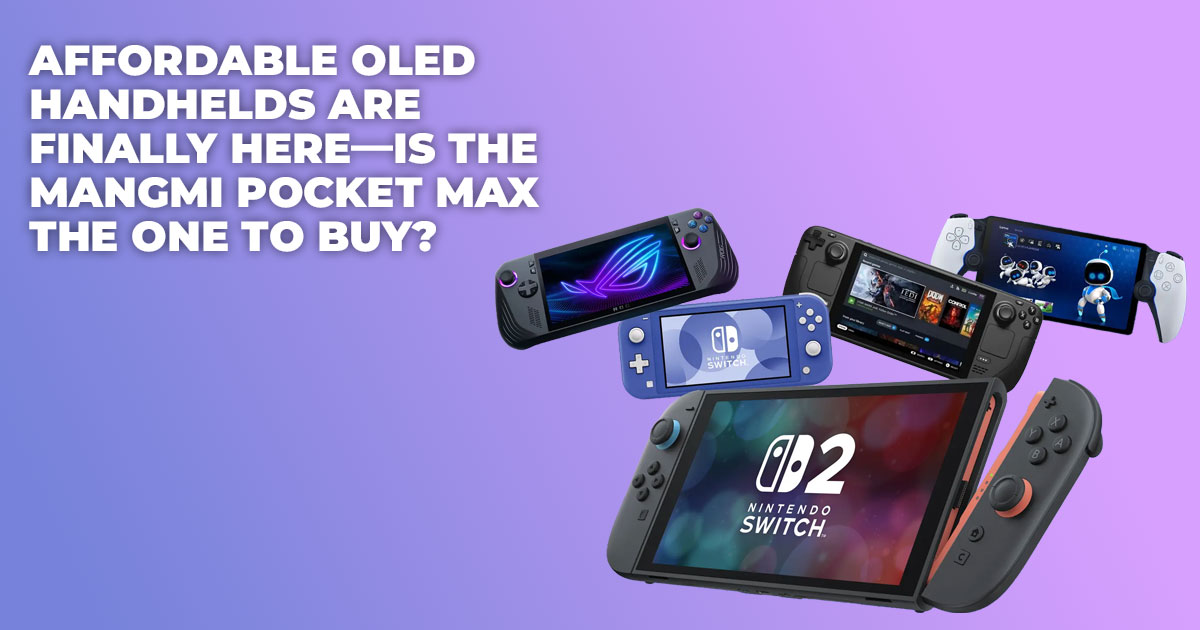
The Mangmi Pocket Max is a budget OLED gaming handheld made for how most people actually play: retro games, Android titles, and game streaming. For around $199.99, it offers a 7- inch 144Hz OLED display, solid Android performance, and modular controls. It’s not chasing
high-end power, but for screen quality, comfort, and value, it gets a lot right.
Buy from Amazon now
Buy on Amazon Worldwide | Buy on Amazon India
Introduction: Why the Mangmi Pocket Max Is Getting Attention
Most handheld gaming devices fail for the same reason. The screen feels cramped, the colors look dull, or your hands start hurting long before the game gets good. That’s where the Mangmi Pocket Max gaming handheld changes the conversation.
Portable gaming keeps growing, but prices have climbed fast. Many players want something simpler: a big screen, smooth visuals, and a device that feels good to use. The Mangmi Pocket Max answers that with a 7-inch OLED gaming handheld featuring a 144Hz refresh rate, priced close to $199.99 during early sales. That mix alone explains why the Mangmi Pocket Max launch caught attention.
This device runs on Android, making it well-suited for retro emulation, native Android gaming, and especially PC or console game streaming. It isn’t built to replace high-powered handheld PCs. Instead, it focuses on comfort, display quality, and flexibility—the things that matter most during everyday use.
As technology experts with over 20 years of experience in hardware and application research and development, products are evaluated based on real-world performance, durability, and value for money. The goal is simple: help readers choose the best option across budget, performance, reliability, and long-term usability.
This review is written for casual gamers, retro gaming fans, streaming-first players, and budget- conscious buyers who want clear answers. The focus stays on what matters after the excitement fades—how this budget OLED gaming handheld actually fits into daily life.
Technical Specifications at a Glance
Here’s a clear breakdown of what the Mangmi Pocket Max handheld offers:
| Feature | Details |
| Display | 7-inch AMOLED (OLED), 1920×1080 resolution, 144Hz refresh rate |
| Processor | Qualcomm Snapdragon 865 octa-core |
| GPU | Adreno 650 |
| RAM | 8GB LPDDR4X |
| Storage | 128GB UFS 3.1, expandable via microSD |
| Battery | 8000mAh with 27W fast charging |
| Controls | Full-sized TMR joysticks, a modular D-pad, and action buttons with magnetic swapping |
| Cooling | Active fan system |
| Operating System | Android 13 |
| Connectivity | Wi-Fi 6, Bluetooth 5.1, USB-C with video output, 3.5mm headphone jack |
| Weight and Size | Around 450–500 grams, built for ergonomic comfort |
On paper, this setup points to a handheld designed for steady performance, good thermals, and long play sessions without discomfort.
Why This Review Is Essential
The handheld gaming market is crowded. There are cheap retro devices that cut corners and premium handheld PCs that cost more than some laptops. What’s missing is clarity.
This Mangmi Pocket Max review exists to answer practical questions. How does the OLED display feel after an hour? Is setup friendly for beginners? Does the experience match expectations around the Mangmi Pocket Max release date?
Specs explain capability. Real-world use explains value. This review focuses on the second part.
What You’ll Learn From This Review
- What the Mangmi Pocket Max actually is and who it fits best
- How the 7-inch OLED display and 144Hz refresh rate affect real play
- Honest expectations for emulation, Android gaming, and streaming
- Comfort and portability for travel or long sessions
- Clear thoughts on value at the current Mangmi Pocket Max price
- Straightforward Mangmi Pocket Max pros and cons
1. What the Mangmi Pocket Max Is — and Why People Are Talking About It
The Mangmi Pocket Max OLED handheld is an Android-based portable gaming console built for relaxed gaming. It handles retro emulation, runs Android games smoothly, and works especially well for cloud gaming and PC streaming.
The attention comes from balance. A 1080p OLED handheld device with a 144Hz refresh rate is rare at this price. Early buyers saw a $199.99 Mangmi Pocket Max price, often bundled with extra modular controller parts.
Rather than chasing the latest processors, this new OLED handheld console prioritizes screen quality, comfort, and usability. For readers searching for the best budget gaming handheld 2025 or the best handheld gaming console under $200, it offers a practical middle ground—better visuals without premium pricing.
And that’s why it stands out.
2. Who the Mangmi Pocket Max OLED Handheld Actually Makes Sense For
This device shines when expectations are aligned.
It works well for:
- Casual gamers who want a large, sharp display for everyday play
- Emulation fans running classics up to PlayStation 2 or GameCube
- Players focused on couch gaming or travel gaming
- Buyers looking for an affordable OLED gaming handheld
- Gamers who enjoy adjusting layouts using the modular control system
The modular buttons add flexibility without complicating setup.
t may not be the right choice for:
- Players focused on high-end AAA native performance
- Anyone wanting a pocket-sized device
- Users expecting long-term update support from major console brands
- Key takeaway: For a handheld console for retro gaming, streaming, or casual play, the Mangmi Pocket Max offers strong handheld gaming device value for money, especially if screen quality matters more than raw power.
3. The Screen: Why a 7-Inch 144Hz OLED Is a Big Deal (and When It’s Not)
The screen is the first thing most people notice, and here it earns that attention. A 7-inch 144Hz OLED display changes how games feel on a handheld at this price. Colors look fuller, blacks stay deep, and motion feels cleaner than what most LCD-based budget devices offer.
For retro gaming, pixel art looks sharp and natural. For game streaming, the higher refresh rate keeps motion smooth when frame rates fluctuate. Menus scroll cleanly, and fast action feels more responsive. That’s where 144Hz makes sense on a handheld.
A 1080p resolution on a 7-inch screen also holds up well. Text stays readable, UI elements feel spaced right, and games look detailed without feeling cramped.
There are limits. OLED panels draw more power at higher brightness and refresh rates, which can shorten battery life. Static HUD elements carry a small burn-in risk, though modern panels handle this far better than earlier generations. Compared to OLED versus LCD handheld gaming, OLED delivers stronger contrast but may struggle more in bright outdoor light.
- Summary: The screen improves everyday play in ways that are easy to notice, making this one of the strongest OLED handheld gaming console displays in its price range.
4. Performance Expectations for This Budget Handheld for Emulation
What the Snapdragon 865 Brings to the Table
The Snapdragon 865 sets realistic expectations. It isn’t new hardware, but it’s stable, well supported, and predictable. In a dedicated handheld, that reliability matters more than chasing peak numbers.
4.1 Emulation Performance: What Runs Well
For emulation, results match what most players expect from this class of device:
- NES through PlayStation 1 runs without issues
- PSP and Dreamcast perform well
- PlayStation 2 and GameCube reach near full speed with sensible settings
- Some lighter Nintendo Switch titles work, depending on the game This covers the systems most people return to again and again.
4.2 Upscaling and Resolution: Why Games Look Better Here
The Snapdragon 865 GPU has enough overhead to improve image quality, not just run games.
- Many PlayStation 2 and GameCube titles can be pushed to 2× resolution (720p)
- Lighter games can reach 3× resolution (1080p)
On a 7-inch 1080p display, this matters. Native PS2 output looks soft. Upscaling sharpens edges, cleans up text, and makes classic games feel more modern.
4.3 Thermal Management and Long Sessions
This isn’t a phone repurposed into a handheld. The active cooling system keeps performance steady during long play sessions.
Instead of throttling after short bursts, the device holds stable clocks. That prevents frame drops caused by heat buildup and makes extended emulation sessions feel consistent.
4.4 The Driver Advantage: Why Snapdragon Helps Emulation
The Adreno GPU supports Mesa Turnip drivers, which many emulators rely on.
These drivers:
- Improve performance in AetherSX2 and Dolphin
- Reduce graphical glitches
- Provide better long-term compatibility
This gives Snapdragon-based handhelds an edge over many devices using Mali GPUs, where driver issues often limit emulation quality.
4.5 144Hz Display: Where It Actually Makes a Difference
Most emulated games lock to 30 or 60 frames per second, so the 144Hz panel doesn’t change their speed.
Where it helps:
- Game streaming through Moonlight or Steam Link
- Native Android games that support higher frame rates
In these cases, motion feels smoother, and input response feels tighter.
4.6 Efficiency and Sleep Mode: Everyday Convenience
The Snapdragon 865 is efficient at idle. Combined with the 8000mAh battery, the handheld can stay in sleep mode for days.
That means:
- No full boot-up every time
- Instant wake and play
- Less friction between sessions
For a handheld, this kind of convenience matters more than raw benchmark numbers.
Key Takeaway
The Mangmi Pocket Max real-world performance focuses on consistency, clean upscaling, and sustained play. It meets handheld gaming performance expectations for emulation and streaming and stands out as a practical 144Hz handheld gaming device at this price.
5. Portability, Comfort, and Everyday Use of the Mangmi Pocket Max
This handheld isn’t pocket-sized, and it doesn’t try to be. The size favors comfort. The grip shape, full-sized sticks, and balanced weight help reduce hand strain during longer sessions.
The modular control system adds flexibility without complexity. Button feel and layout can be adjusted to match different games, which helps across genres.
Thermals stay under control. The active cooling system keeps heat in check, though the fan becomes noticeable during heavier emulation. Overall, handheld thermal management feels stable rather than aggressive.
Battery life varies with use. The 8000mAh battery typically lands between 6 and 10 hours, depending on brightness, refresh rate, and game type. That covers flights, commutes, and long breaks without stress.
As a portable gaming device for travel, it works best for players who value comfort and screen size over compact design.
Buy from Amazon now
Buy on Amazon Worldwide | Buy on Amazon India
6. Software, Ecosystem, and the Everyday Experience
Running Android 13 keeps the experience familiar. Emulators, streaming apps, and games install easily. Some setup requires sideloading, but most users can handle it without frustration.
Community support helps fill gaps. Settings guides and optimization tips are easy to find. Official updates depend on the manufacturer, so expectations should stay realistic.
The software experience on handheld consoles here feels open. It supports customization without locking users into a narrow setup, which suits both casual use and light tweaking.
7. How the Mangmi Pocket Max Compares to Familiar Alternatives
In a broader gaming handheld comparison, the Mangmi Pocket Max takes a clear position. It trades peak performance for screen quality and price.
Against devices like the Odin 2 Portal, it offers a larger OLED handheld gaming console at a lower cost, but with less room for demanding emulation. Compared to the Switch OLED, it provides far more freedom for emulation and streaming, but without access to official Nintendo titles.
Some Mangmi Pocket Max alternatives with newer processors will outperform it in raw power. Still, this device stands out for its display quality and value, especially when early Mangmi Pocket Max deals are factored in.
- What you gain: screen quality, comfort, and affordability
- What you give up: future-proofing and top-tier native performance
8. Mangmi Pocket Max Price Breakdown: Is This Budget OLED Gaming Handheld Worth Paying For?
Price is where the Mangmi Pocket Max either clicks—or doesn’t. The $199.99 super early bird price made this device feel like a rare find. At that level, a 7-inch 144Hz OLED display in a budget gaming handheld category is hard to argue with.
At a more common price around $240, the value still holds, but the decision becomes more personal. You’re paying for the screen, comfort, and flexibility—not cutting-edge power. And that’s an important distinction.
Where corners are cut is clear. The Snapdragon 865 is older, and long-term software support isn’t guaranteed. If future-proofing matters more than how the device feels today, this may not be the right call.
Early buyers get the strongest value. The best Mangmi Pocket Max deals often include extra modular parts that improve comfort and customization—things you actually notice every day.
- Choose this if: screen quality and comfort matter more than raw power
- Skip this if: you want the newest chip or guaranteed long-term updates
Bottom line on price: Strong handheld gaming device value for money when visuals and daily comfort are the priority.
9. Mangmi Pocket Max Pros and Cons: What You’ll Love—and What You’ll Tolerate
This is where decisions get clearer.
9.1 What the Mangmi Pocket Max Gets Right
- 7-inch 144Hz OLED display that genuinely improves everyday play
- Modular controls that let you adjust the feel instead of adapting your hands
- Large battery that supports long sessions
- Excellent fit for retro emulation and game streaming
- Expandable storage and reliable connectivity These are benefits you feel every time you pick it
9.2 Where You’ll Notice the Trade-Offs
- Older processor limits demanding or newer use cases
- Larger size reduces ultra-portability
- Cooling fan is audible under heavier loads
- Software updates depend on the manufacturer
- Some setup effort required for emulation
None of these are deal-breakers—but they do define who this handheld is for.
10. What Still Needs Time Before We’d Recommend It to Everyone
A few questions only time can answer.
Long-term battery health, durability of the modular controls, and how fast community tools and support mature will matter over months of use. This includes emulator development, shared configuration profiles, and ongoing work around tools like AetherSX2, Dolphin, and Turnip GPU drivers, which many users rely on for smoother emulation.
Early impressions are encouraging, but this isn’t a “buy once and forget” device yet.
For buyers who prefer stability over experimentation, waiting for broader feedback makes sense.
11. Final Verdict: Who Should Buy the Mangmi Pocket Max—and Who Should Wait
This is the decision point.
Buy the Mangmi Pocket Max if you are:
- An emulation fan who wants classics to look sharp
- A streaming-first player using PC or console streaming
- A casual gamer who values comfort over raw power
- Someone looking for a portable gaming console with an OLED display without premium pricing
Wait or look elsewhere if you:
- Need top-tier native AAA performance
- Prefer established brands with guaranteed long-term updates
- Want something truly pocket-sized
Our take: If the question is “Is Mangmi Pocket Max worth buying?”, the answer is yes—for the right person. If screen quality, comfort, and value matter more than future-proof specs, buying during the current Mangmi Pocket Max availability makes sense. This is a handheld gaming console for 2025 built around how people actually play.
What to do next:
If the display and size appeal to you, look for current bundles or early pricing. If long-term support is your main concern, keep this on your shortlist and revisit after a few months of user feedback.
12. Quick Verdict: Should You Buy the Mangmi Pocket Max?
If you’ve read this far, the decision is already close.
Choose the Mangmi Pocket Max if you care most about a large OLED screen, comfortable controls, and smooth retro gaming or streaming at a reasonable price. It delivers where you’ll notice it every day—visuals, comfort, and ease of use.
Skip it if raw performance, long-term software guarantees, or a pocket-sized design matter more than screen quality.
Our stance: For emulation fans, streamers, and casual players, this is one of the clearest value picks in its class right now. If the display and size match how you play, waiting doesn’t add much upside.
Buy from Amazon now
Buy on Amazon Worldwide | Buy on Amazon India
13. Frequently Asked Questions
Before deciding on a handheld like the Mangmi Pocket Max, most readers want quick, straight answers to practical questions. This section clears up common doubts around performance, battery life, portability, and everyday use, helping readers decide if this budget OLED gaming handheld fits how they actually play.
Q. What is the Mangmi Pocket Max?
- The Mangmi Pocket Max is an Android-based portable gaming console with an OLED display, designed mainly for retro emulation, Android games, and PC or console game streaming. Its main focus is screen quality, comfort, and value rather than high-end processing power.
Q. What games run well on the Mangmi Pocket Max?
- The Mangmi Pocket Max gaming handheld runs retro games up to PlayStation 2 and GameCube very well, handles most popular Android games, and excels at streaming modern PC and console games through apps like Moonlight or Steam Link.
Q. How long does the Mangmi Pocket Max battery life last?
- Real-world Mangmi Pocket Max battery life usually falls between 6 and 10 hours, depending on screen brightness, refresh rate, and game type. That’s strong battery performance for a 7-inch OLED handheld.
Q. Is the 7-inch size too big for portability?
- The 7-inch OLED display makes the device comfortable for couch gaming and travel bags, but it’s not pocket-sized. It works best for players who value screen size and ergonomics over ultra- compact portability.
Q. Does 144Hz matter for handheld gaming?
- Yes, but with context. Most retro games run at fixed frame rates, but the 144Hz refresh rate improves menu smoothness, responsiveness, game streaming, and supported Android titles. It’s most noticeable during streaming and fast-paced gameplay.
Q. OLED versus LCD handheld gaming — which is better here?
- For this device, OLED handheld gaming is clearly better. OLED delivers deeper blacks, stronger contrast, and richer colors than LCD. If visuals matter, the OLED screen is one of the strongest reasons to consider the Mangmi Pocket Max.
Q. Is the Mangmi Pocket Max good for beginners?
- Mostly yes. Basic gaming and streaming are easy to set up. Emulation requires some initial setup, but guides and community support make it manageable even for first-time users.
14. Conclusion
The Mangmi Pocket Max knows exactly who it’s for. It isn’t chasing raw power or trying to replace high-end handheld PCs. Instead, it focuses on the parts that shape everyday use: a large OLED screen, comfortable controls, solid battery life, and smooth retro gaming and streaming at a price that feels reasonable.
Timing matters here. The MANGMI Pocket Max officially launched on February 5, 2026, and it’s currently in its Super Early Bird launch phase, which runs through February 12. During this window, sales are handled mainly through the official MANGMI website, not major third-party stores.
As of now, no official Mangmi Pocket Max is listed on Amazon US. That isn’t unusual. Its predecessor, the Mangmi Air X, followed the same path and appeared on Amazon later. Based on that pattern, it’s likely the Pocket Max will reach Amazon a few months after the early launch phase ends.
How to Decide What to Do Next
- Buy now if the OLED screen, comfort, and early pricing matter most, and buying directly from the manufacturer isn’t an issue.
- Wait if Amazon availability, long-term feedback, or wider retail support matter more than getting it early.
If you want something available today from a familiar storefront, the Mangmi Air X is already well established:
- Amazon Worldwide – Mangmi Air X Retro Handheld Game Console
For readers in India who want to browse similar devices right away, this category page offers plenty of alternatives:
- Amazon India – Handheld Retro Game Consoles
If you’ve already spent time with the Mangmi Pocket Max, share how it’s been working for you. Setup tips, performance notes, and small tweaks help others decide whether to buy early, wait for Amazon, or choose a different handheld.
For players who value screen quality, comfort, and everyday usability over chasing specs, this handheld earns a serious look—and for the right buyer, an early purchase makes sense.
***Disclaimer***
This blog post reflects our own research, testing, and personal opinions. It should not be taken as the official position of any brand, manufacturer, or company mentioned here. While we aim to keep information accurate and up to date, product details, pricing, and availability can change. We recommend double-checking important details before making a purchase.
Some links in this article may be affiliate links. If you choose to buy through these links, we may earn a small commission at no extra cost to you. This helps support our work and allows us to keep publishing in-depth, unbiased reviews. Our recommendations are never influenced by affiliate partnerships.
Comments shared by readers reflect their own views and not ours. We are not responsible for outcomes resulting from the use of information on this site. Please seek professional advice where appropriate.
All product names, logos, and brands mentioned are the property of their respective owners. These names are used for identification and informational purposes only and do not imply endorsement.