
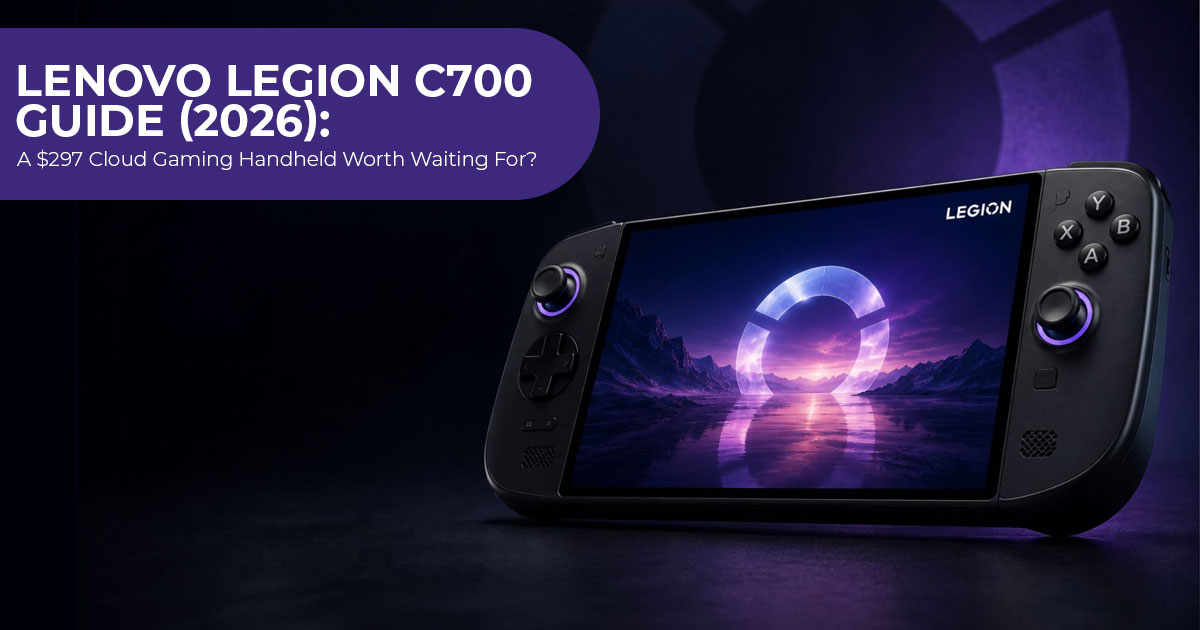
The Lenovo Legion C700 is a different kind of gaming handheld. Instead of using a powerful processor to run demanding games on the device, it relies on Tencent START cloud gaming and uses a mid-range mobile chip for game streaming and Android apps.
Lenovo announced the Legion C700 in China on August 25, 2026. That puts it in a different position from handhelds such as the Lenovo Legion Go 2 and ASUS ROG Ally X, which are built around high-performance AMD chips for local gaming.
The C700 is aimed at people who want a portable way to play streamed PC and console games without buying a handheld designed for high-end local gaming. It may also make sense for cloud gaming users, Android gamers, and casual players who care more about portability, battery life, and price than raw performance.
Click here to buy from Amazon
We have more than 20 years of experience in hardware and application research and development, and we judge products on performance, durability, usability, and value for money. That includes looking at what you get for your money, how the hardware should perform in everyday use, and whether it makes sense for long-term ownership. Our recommendations come from product research, component analysis, real-world usability, and industry experience.
For this article, we checked Lenovo’s official product information and compared it with reports from Notebookcheck, Tech-Insider, VideoCardz, GSM GoTech, and the Retro Handhelds Discord. We have not tested the Legion C700 ourselves, and it is a China-market device at the time of writing. Where a specification comes from a leak rather than Lenovo, we have made that clear.
So, is the Lenovo Legion C700 a better choice for cloud gaming than a conventional Windows gaming handheld? That’s what we’ll look at here.
At a Glance: Lenovo Legion C700 Specifications
| Category | Details |
|---|---|
| Official Product Name | Lenovo Legion C700 (Legion Cloud Gaming Handheld C700) |
| Announcement Date | August 25, 2026 (China) |
| Sale Start | September 8, 2026 (China) |
| Launch Configuration | 8GB RAM + 256GB storage, white chassis |
| Launch Price | CNY 1,999 (~US$297) launch price; CNY 2,199 (~US$325) list price |
| Display | 7.82-inch IPS LCD, 1920 × 1080 (16:9), 120Hz refresh rate, and 500 nits peak brightness |
| Processor | MediaTek Dimensity 7400, 4nm octa-core SoC |
| RAM / Storage | 8GB / 256GB at launch; 6GB / 128GB variant planned with availability date TBA; microSD expansion supported |
| Operating System | Android 16 with Lenovo Legion Stream launcher |
| Battery | 8,000mAh; USB-C charging with PD fast charging reported but not officially confirmed |
| Rated Battery Life | Up to 9 hours of cloud gaming based on Lenovo’s claimed figure |
| Dimensions | 293 × 117 × 14.9 mm |
| Weight | 556 grams |
| Controls | TMR joysticks, Hall-effect linear triggers, omnidirectional D-pad, two back macro buttons (LC/RC), two additional shoulder buttons (LC1/RC1), and vibration feedback |
| Cloud Service | Tencent START as the primary cloud gaming service for the Chinese market |
| Global Availability | Not announced as of August 2026 |
Lenovo's official product page (item.lenovo.com.cn, product 1057241) headlines three features: “Full Hall + TMR technology | 8,000mAh large battery | 120Hz high-refresh large screen”, which matches the specs above. The official Lenovo store lists the 8GB/256GB model at CNY 2,199 (~$325), while launch reporting lists CNY 1,999 (~$297) as the launch price
Product Overview: What the Legion C700 Is
It is worth being clear about what the Legion C700 is and is not.
This is a cloud-first handheld. Its primary purpose is to receive a streamed video feed from remote servers (in this case, Tencent’s START cloud gaming platform) while sending controller inputs back. AAA titles such as Black Myth: Wukong are rendered on remote hardware and pushed to the C700’s screen as a compressed video stream. Lenovo claims Tencent START can reach 60 FPS with end-to-end round-trip latency under 10 ms. Lenovo says its Legion Stream system can deliver around 10 ms of latency in its own testing. The earlier test used a Legion Y9000P laptop with an RTX 4060 at 1080p and 120Hz, so the figure should not be treated as a typical home-network result. Neither figure has been independently verified in real-world use, so we treat both as manufacturer claims.
The Legion C700 is not a Windows handheld. It does not run Steam natively. It is not positioned to replace a Steam Deck OLED or a Lenovo Legion Go 2 for buyers who want to run AAA PC titles without a fast internet connection. The MediaTek Dimensity 7400 inside is a mid-range mobile processor on a 4nm node, not an x86 chip, and it is not designed to run modern AAA games locally. It should handle Android games and retro emulation, but that is a secondary capability rather than the selling point.
The C700 measures 14.9 mm thick and weighs 556 grams. Its reported introductory price of roughly $297 is well below the current US prices of the Steam Deck OLED and ROG Ally X cited below.
Display
The Legion C700 features a 7.82-inch IPS LCD panel running at 1920 x 1080 resolution in a 16:9 aspect ratio, with a 120Hz refresh rate and a listed 500 nits peak brightness.
What that means in practice:
- The screen is physically larger than the panels on the Logitech G Cloud Gaming Handheld (7.0 inches) and the Razer Edge (6.8 inches). The PlayStation Portal Remote Player uses a slightly larger 8-inch panel.
- The 120Hz refresh rate is double the 60Hz refresh rate of the Logitech G Cloud and the PlayStation Portal. For the C700’s advertised 60 FPS cloud gaming, the higher refresh rate mainly leaves room for smoother menus and UI, while the extra headroom may matter if higher-frame-rate streaming becomes available.
- At 500 nits, the display should be comfortable indoors, while direct sunlight may be challenging. We have not tested outdoor visibility The Steam Deck OLED’s HDR peak is rated significantly higher.
- The panel is LCD rather than OLED, so contrast ratios and black levels will not match the Razer Edge or Steam Deck The benefit is that LCD panels do not carry the same burn-in risk and typically handle fast motion well when paired with a high refresh rate.
The 16:9 aspect ratio is a deliberate choice for a cloud-streaming device. Most PC and console games are rendered at 16:9, so streamed content uses the full panel without letterboxing. Many Windows handhelds use 16:10 screens, which are versatile for desktop-style use but add unused bars when streaming standard-format games.
Controls
This is one of the C700’s more notable hardware features. The Legion C700 uses TMR (tunneling magnetoresistance) joysticks rather than the traditional potentiometer sticks found in most budget handhelds and older controllers.
For anyone who has dealt with stick drift — the problem where analog sticks register movement when your thumbs are off them — TMR sensors remove the contact-based sensing used by traditional potentiometer sticks, which should reduce one common source of wear-related drift. Instead of using physical contact wipers, TMR sticks measure changes in magnetic fields. The design removes the contact wear associated with potentiometer wipers. The Hall-effect linear triggers work on the same magnetic principle, avoiding contact wear and providing proportional input rather than a digital on/off press.
The full control layout includes:
- Two TMR analog joysticks
- Two Hall-effect linear triggers (L2 / R2)
- Two shoulder bumpers (L1 / R1)
- An omnidirectional D-pad
- Four standard face buttons
- Two programmable back macro buttons (labeled LC/RC)
- Two additional shoulder buttons (LC1/RC1) beyond the standard bumper/trigger pair
- Vibration feedback
- Full button remapping via Lenovo’s software
A published spec sheet shared in the Retro Handhelds Discord (consistent with Lenovo’s post-launch imagery) also lists a six-axis gyroscope, accelerometer, and geomagnetic sensor, which would enable motion controls and gyro aiming. We have not seen these confirmed on Lenovo’s official specification tab, so we note them as reported rather than confirmed.
The control layout gives the C700 several notable hardware features, including TMR joysticks and Hall-effect triggers. We have not independently verified the underlying stick sensor technology in every competitor.
Processor and Performance
The MediaTek Dimensity 7400 is an octa-core mobile chip built on a 4nm manufacturing process, paired with active cooling and a heatsink and either 8GB or 6GB of RAM depending on configuration.
This is the spec that has generated the most debate online, so it is worth being direct about what it can and cannot do. The Dimensity 7400 is not a flagship mobile processor, and it is not in the same performance class as the x86 APUs found in Windows handhelds. For cloud gaming, that is largely the point: the chip’s job is to decode a video stream, run the Android OS, and handle wireless connectivity, all of which are within the capabilities of a modern mid-range SoC. The same logic applies to the Logitech G Cloud, which uses a Qualcomm Snapdragon 720G — a chip originally released in 2020 — and still delivers adequate streaming performance.
For local use, the Dimensity 7400 should handle:
- Day-to-day Android apps, media playback, and streaming video
- Casual 2D Android games
- Retro emulation through platforms like RetroArch (good compatibility through the PS1 and N64 era; PS2 and GameCube emulation will vary by title)
- Local PC streaming from a home gaming PC over Wi-Fi, using the offline streaming mode
It is not suited to:
- Running AAA Windows PC games locally
- Running demanding 3D Android games at maximum settings over long sessions
- Replacing a dedicated handheld gaming PC for offline play
The device uses active cooling, but we have not tested fan noise or thermal performance. Independent testing will be needed to assess sustained performance and noise levels.
Click here to buy from Amazon
Battery Life and Charging
The 8,000mAh battery is large for a cloud-gaming handheld. Lenovo rates the device for up to 9 hours of cloud gaming, with USB-C charging.
We treat battery-life claims from manufacturers as best-case figures rather than guaranteed results. Real-world endurance depends on several factors: screen brightness, streaming bitrate, Wi-Fi band and signal quality, speaker vs. headphone use, and background app activity. That said, 8,000mAh is a substantial cell for a 556g device. As a point of comparison, the Logitech G Cloud uses a 6,000mAh battery and is rated for up to 12 hours on its less powerful hardware and 60Hz screen, so Lenovo’s 9-hour figure still needs independent testing.
The Retro Handhelds Discord spec sheet lists USB-C PD (Power Delivery) fast charging, but we have not seen PD charging speeds (wattage or 0–100% charge time) published on Lenovo’s official product page, so we note this as reported rather than confirmed.
Design and Ergonomics
At 293 x 117 x 14.9 mm and 556 grams, the Legion C700 is notably thin for a device with integrated controls and active cooling. For context:
- The Logitech G Cloud measures roughly 257 x 117 x 33 mm and weighs 463g — nearly 100g lighter, but more than twice as thick.
- The Razer Edge is thinner in its tablet portion (~11 mm) but requires the Kishi V2 Pro controller for handheld play, bringing total weight to around 401g.
- The PlayStation Portal measures 337 x 150 x 95 mm and weighs 529g.
- The Steam Deck OLED weighs 640g, and the ASUS ROG Ally X weighs 678g.
Lenovo’s promotional imagery shows a white chassis with asymmetric thumbstick placement, consistent with the design language of the Legion Go family. The C700 uses an all-in-one (non-detachable) controller form factor, unlike the Razer Edge / Kishi combination.
We have not held the C700, so we cannot comment on grip comfort, button travel, trigger feel, or the subjective quality of the chassis from direct experience. We will update this section once hands-on reviews are available.
Software and Cloud Integration
The Legion C700 runs Android 16 with a custom launcher Lenovo calls Legion Stream, which surfaces Tencent START as the primary entry point. Lenovo’s software suite includes three streaming modes and a custom management overlay:
- One-click streaming for quick access to cloud gaming sessions
- Offline / local streaming mode uses Lenovo’s Legion Stream system to stream games from a compatible PC to the C700 over a local connection. The game still runs on the PC; the handheld receives the video stream and sends controller input back. Lenovo says this setup can work without an internet connection.
- High-speed streaming mode for low-latency connections
The management center includes a real-time performance widget and quick controls for:
- Button remapping
- Stick sensitivity tuning
- Fan speed adjustment
- Screen brightness and refresh-rate mode
- Game-mode switching during play
The important limitation is service availability. The C700’s Tencent START integration is focused on the Chinese market, and Lenovo has not announced international support for the device.
International buyers importing the device would not have the primary cloud service available in the same way out of the box and would need to rely on sideloaded alternatives (such as Steam Link, GeForce NOW, or Moonlight), VPN workarounds (which add latency and may violate terms of service), or local PC streaming. We would not recommend importing the C700 as a primary device unless you are comfortable troubleshooting those constraints.
Ports, Connectivity, and Audio
Based on Lenovo’s post-launch imagery and the published spec sheet shared on the Retro Handhelds Discord, the Legion C700 is reported to include:
- USB-C port for charging and data
- microSD card slot for storage expansion
- 5 mm headphone jack
- Stereo chamber speakers
- Vibration motor
- Gyroscope, accelerometer, and geomagnetic sensor (per leaked spec sheet)
- Wi-Fi and Bluetooth
Post-launch reporting lists Wi-Fi 6E and Bluetooth 5.3 for the C700. Lenovo's public product information is less detailed on these specifications, so we treat the connection standards as reported specifications rather than independently tested features.
The inclusion of a 3.5 mm headphone jack and microSD expansion is practical. Wired headphones avoid Bluetooth latency during fast-paced streaming, and microSD expansion is useful given the 128GB and 256GB internal storage options.
Real-World Performance Expectations
Because independent reviews are not yet widely available and we have not tested the unit ourselves, we want to be careful about performance claims. Based on the confirmed hardware, here is what we consider reasonable to expect:
What should work well
- Cloud gaming through Tencent START under strong network conditions — the Dimensity 7400, 120Hz display, and Lenovo’s streaming software are purpose-built for this.
- Local PC streaming from a gaming rig using Legion Stream; the game still runs on the PC while the C700 receives the stream.
- Android apps, media streaming (Netflix, YouTube, ), and casual Android games.
- Retro emulation through platforms like RetroArch, particularly for systems through the 16-bit and N64/PS1 era.
- Lengthy play sessions on a single charge thanks to the 8,000mAh battery.
What may not work well
- AAA cloud gaming on unreliable or slow internet — this is true of every cloud gaming handheld, but it is the C700’s primary use case.
- Demanding local Android games at maximum settings over sustained play sessions.
- Windows PC game compatibility or Steam library access without a separate gaming PC to stream from.
- Out-of-box cloud gaming outside China, due to Tencent START’s China-focused availability.
Lenovo’s claims of sub-10 ms latency and 60 FPS in Black Myth: Wukong are impressive on paper. We would wait for independent testing with frame-time and latency measurement tools before treating those as typical real-world numbers. Cloud gaming latency depends heavily on server proximity, network conditions, and household bandwidth.
Pricing and Availability
Pricing for the Lenovo Legion C700 has been reported as follows:
| Configuration | Launch Price | Listed MSRP |
|---|---|---|
| 8GB RAM + 256GB Storage (White) | CNY 1,999 (~US$297) | CNY 2,199 (~US$325) |
| 6GB RAM + 128GB Storage | Not announced | Not announced |
Launch pricing for the Lenovo Legion C700 is CNY 1,999 (~$297), with a listed price of CNY 2,199 (~$325). Lenovo’s official store currently lists the 8GB/256GB model at CNY 2,199.
Lenovo announced sales for the C700 to begin September 8, 2026 in China. The 6GB/128GB configuration has been referenced in reporting but has no announced release window.
No global version has been announced, and Lenovo has not confirmed which cloud services an international model would support.
Competitor Comparison
To understand whether the Lenovo Legion C700 represents good value, we have compared it against the handhelds buyers in this category are likely to be choosing between. We split the comparison into cloud-first handhelds (devices built primarily for streaming) and local-compute handhelds (devices that run AAA games natively), because the two categories serve different needs.
Cloud-First Handhelds
| Feature | Lenovo Legion C700 | Logitech G Cloud | Razer Edge (Wi-Fi) | PlayStation Portal |
|---|---|---|---|---|
| Launch MSRP | CNY 1,999 (~$297) launch / CNY 2,199 (~$325) list | $349.99 | $399.99 | $199.99 |
| Display | 7.82-inch IPS, 1080p, 120Hz, 500 nits | 7.0-inch IPS, 1080p, 60Hz, 450 nits | 6.8-inch AMOLED, 2400 × 1080 (20:9), 144Hz | 8.0-inch IPS, 1080p, 60Hz, ~300 nits |
| Processor | MediaTek Dimensity 7400 (4nm) | Qualcomm Snapdragon 720G | Qualcomm Snapdragon G3x Gen 1 | Qualcomm Snapdragon 680 |
| RAM / Storage | 8GB / 256GB + microSD; 6GB / 128GB variant planned | 4GB / 64GB + microSD | 6GB / 128GB + microSD | N/A — no user-accessible storage |
| Battery | 8,000mAh (~9 hours claimed) | 6,000mAh / 23.1Wh (~12 hours rated) | 5,000mAh | 4,370mAh |
| Weight | 556g | 463g | 264g tablet / ~401g with controller | 529g |
| Dimensions | 293 × 117 × 14.9mm | 257 × 117 × 33mm | 260 × 85 × 11mm (tablet) | 337 × 150 × 95mm |
| Joystick Type | TMR magnetic joysticks designed for improved drift resistance | Not specified | Not specified | Not specified |
| Primary Cloud Services | Tencent START (China market) | GeForce NOW, Xbox Cloud Gaming, Steam Link | GeForce NOW, Xbox Cloud Gaming, Steam Link | PS5 Remote Play and PS Plus Premium cloud streaming |
| Operating System | Android 16 | Android with custom launcher | Android | Custom Android-based OS |
| Global Availability | China only at launch | Yes | Yes; 5G variant also offered through Verizon at $599.99 | Yes |
| 3.5mm Audio Jack | Yes | Yes | Yes | Yes |
| Wireless Connectivity | Wi-Fi 6E, Bluetooth 5.3 | Wi-Fi 5 (802.11ac), Bluetooth 5.1 | Wi-Fi 6E, Bluetooth 5.2 | Wi-Fi 5, PlayStation Link; no standard Bluetooth audio support |
A few observations from this table:
- The Legion C700 has the second-largest display of the four devices at 82 inches, behind the 8-inch PlayStation Portal. At the CNY 1,999 launch price, it pairs a sub-$300 price with a 120Hz display.
- The C700’s TMR joysticks are one of its more notable control features at this We have not independently verified the underlying stick sensor technology in every competitor.
- At the CNY 1,999 launch price (~$297), the C700 is less expensive than the Logitech G Cloud and Razer Edge, while offering more RAM than both (8GB 4GB and 6GB), more internal storage than both, and a larger battery.
- The PlayStation Portal is the least expensive at $199.99, but it is designed primarily as a PS5 remote-play device (PS Plus Premium cloud streaming is now supported) and lacks the general-purpose Android app support of the other It also does not support standard Bluetooth audio.
- The primary drawback remains availability and service The Logitech G Cloud and Razer Edge work with multiple cloud services, while the C700’s Tencent START integration is focused on the Chinese market.
Local-Compute Handhelds (For Reference)
| Feature | Lenovo Legion C700 | Steam Deck OLED (2026 Pricing) | ASUS ROG Ally X (2024) |
|---|---|---|---|
| Typical US Price (Aug 2026) | ~$297–$325 (China only) | $789 (512GB) / $949 (1TB) | $799.99 |
| Primary Use Case | Cloud game streaming | Local PC gaming through SteamOS | Local PC gaming through Windows |
| Processor Type | Mobile ARM SoC (MediaTek Dimensity 7400) | AMD APU (x86, 6nm) | AMD Ryzen Z1 Extreme (x86) |
| Weight | 556g | 640g | 678g |
| Plays AAA Games Offline? | No — limited to supported Android games and emulation | Yes | Yes |
| Cloud Gaming Support | Tencent START (primary service) | Steam Link plus third-party cloud gaming apps | Xbox Cloud Gaming plus third-party services |
The comparison shows what you give up: local gaming performance in exchange for a cheaper, lighter streaming device. Devices like the Steam Deck OLED and ROG Ally X are full PCs that can run AAA games offline, but they cost much more and are designed for higher local performance. The C700 targets buyers who value portability, price and streaming over local gaming power.
Valve raised Steam Deck OLED US pricing on May 27, 2026; the 512GB model is currently $789 and the 1TB model is $949 at the Steam Store. The original ROG Ally X (2024, Ryzen Z1 Extreme) retails for $799.99. A newer ROG Xbox Ally X with AMD Ryzen AI Z2 Extreme was announced more recently at $999.99 and weighs 715g; we have used the $799 Ally X model for this comparison as the most direct price-point reference.
Strengths
- Competitive introductory At the reported CNY 1,999 launch price (~$297), the Legion C700 is less expensive than the Logitech G Cloud and Razer Edge while offering a larger 120Hz display and TMR joysticks.
- Large, high-refresh The 7.82-inch 120Hz IPS panel is the second-largest screen in this comparison, behind the 8-inch PlayStation Portal, and its 120Hz refresh rate is double that of the Logitech G Cloud and PlayStation Portal.
- TMR controls. The TMR joysticks and Hall-effect triggers remove contact wear from the sensing mechanisms used in traditional potentiometer-based sticks and triggers.
- Thin and relatively At 14.9 mm and 556g, the C700 is considerably thinner than the Logitech G Cloud (33 mm) and lighter than most Windows handhelds.
- Large The C700 has a large 8,000mAh battery.
- Expandable storage and headphone Two features that are disappearing from many consumer devices, both included here.
- Configurable Back buttons, extra shoulder buttons, and software-level remapping are included.
- Android 16 provides modern app compatibility and is not locked to a single-purpose OS.
Limitations
- China-only at Global availability has not been announced, and the C700’s Tencent START integration is focused on the Chinese market.
- Service lock-in. Out-of-box cloud gaming is tied to Tencent START, which limits utility outside its home market.
- No x86 The Dimensity 7400 is suited to streaming and Android apps, but it cannot run Windows PC games locally.
- LCD panel, not Black levels and contrast will not match the Razer Edge or Steam Deck OLED.
- No cellular option has been Unlike the Razer Edge, which has a 5G version in some markets, Lenovo has not announced a cellular C700.
- No independent testing yet. Claims of sub-10 ms latency and 60 FPS in Black Myth: Wukong come from Lenovo’s own marketing and have not been verified by third parties at the time of writing.
- Active cooling in a cloud The device uses active cooling, but we have not tested its noise level or thermal performance.
- Official specifications are still partially unconfirmed. As of publication, Lenovo’s product listing had not published a full specs tab; some details (Wi-Fi standard, Bluetooth version, charging wattage, sensors) come from third-party reporting and leaked spec sheets.
Click here to buy from Amazon
Who Should Consider the Lenovo Legion C700?
The Legion C700 is a good fit for a specific set of buyers:
Worth considering if
- You live in China and already use or are interested in Tencent START cloud gaming.
- You want a dedicated device for cloud gaming and local PC streaming without buying a Windows gaming handheld.
- You value a large, high-refresh screen and TMR controls at a budget price.
- You already own a gaming PC and primarily want a device for in-home streaming, with cloud play as a secondary use case.
- You prioritize battery life and portability over local gaming performance.
Consider alternatives if
- You live outside China and want a device that works out of the box with GeForce NOW, Xbox Cloud Gaming, or PlayStation Plus — the Logitech G Cloud, Razer Edge, or PlayStation Portal serve those markets directly today.
- You want to play AAA PC games offline or without reliable internet — consider the Steam Deck OLED, ASUS ROG Ally X, or Lenovo’s own Legion Go 2 instead.
- You want an OLED display — the Razer Edge or Steam Deck OLED are better choices for screen quality.
- You need cellular 5G connectivity for cloud gaming away from Wi-Fi — the Razer Edge also has a 5G version in some markets.
- You are an early adopter who needs reliable post-purchase support and warranty coverage in Western markets — Warranty and after-sales support for an imported C700 should be confirmed with Lenovo before purchase, since coverage can depend on the sales region.
We would also recommend waiting for independent reviews and real-world latency testing before purchasing, especially given how heavily Lenovo’s marketing leans on the sub-10 ms latency figure. Launch pricing is attractive, but early production runs of new devices carry risk.
Practical Buying Advice
If you are in China and the Lenovo Legion C700 matches your needs, the 8GB/256GB configuration at the CNY 1,999 launch price appears to be the better value at launch. If the 6GB/128GB variant launches at a lower price, it may offer another option, but 8GB of RAM provides more headroom for Android apps and multitasking, while 256GB of storage is a meaningful step up from the 64GB base storage of the Logitech G Cloud.
If you pick one up, we would budget for a microSD card for sideloaded apps, emulators, and media, as the microSD slot is included for a reason. For extended sessions away from outlets, a USB-C power bank that supports Power Delivery is a sensible accessory; the 8,000mAh battery is large, but cloud gaming over Wi-Fi at higher brightness will drain it faster than Lenovo’s rated 9 hours.
For readers outside China, our honest guidance is to wait. The hardware is compelling at this price, but a cloud gaming handheld tied to a China-focused service integration is a difficult recommendation for buyers in the US, UK, EU, India, or other markets. If Lenovo announces a global version with GeForce NOW and Xbox Cloud Gaming support — or if the community verifies that sideloaded streaming services work reliably without VPN workarounds — the C700 could become a stronger option for cloud gaming. Until then, it is a product to watch.
Final Verdict
The Lenovo Legion C700 is an interesting handheld because Lenovo has focused on streaming rather than raw local performance. At roughly $297 at the reported launch price, Lenovo is delivering a device with a larger, faster screen than the Logitech G Cloud, TMR joysticks designed to reduce wear-related drift, 8GB of RAM and 256GB of storage, and a large 8,000mAh battery — all in a chassis under 15 mm thick.
The catch is availability and ecosystem lock-in. The Tencent START partnership makes the C700 a China-first product, and there is no confirmed roadmap for a global release as of this writing. Buyers outside China who import the device will need to work around the service limitation, which adds friction most people should not have to deal with on a device that is supposed to make cloud gaming simple.
For buyers in China who want a dedicated cloud gaming handheld without paying flagship-handheld prices, the Legion C700 appears to be a strong value in the category at launch. For everyone else, it is a sign of lower-cost cloud-gaming hardware — and a device to track in case Lenovo announces a global version.
Check Prices and Availability
Cloud gaming handhelds in this category see frequent discounts and bundle offers, especially around launch windows and holiday periods. We recommend checking current pricing before purchasing, as promotional pricing can differ from list pricing.
For readers in the United States
The Lenovo Legion C700 is not officially available in the US at the time of writing. For cloud gaming handhelds available stateside with warranty support, you can check current pricing on these alternatives:
- Logitech G Cloud (Amazon US) — The established Android cloud handheld with GeForce NOW, Xbox Cloud Gaming, and Steam Link support.
- Razer Edge (Amazon US) — AMOLED display with a 144Hz refresh rate; a 5G model is offered via Verizon.
- PlayStation Portal (Amazon US) — Lower-cost option if you primarily stream from a
- Steam Deck OLED (Amazon US) — If you decide that local AAA gaming rather than cloud-only is the better fit (currently $789 / $949 via Steam, with third-party listings on Amazon).
We will add direct links to the Lenovo Legion C700 on Amazon US if and when it becomes available through official channels. Bookmark this page and check back for updates.
For readers in India
The Lenovo Legion C700 has not been announced for the Indian market. Any third-party listing showing an India price at this stage should be treated as a placeholder. For alternatives currently available in India:
- Razer Edge (Amazon India) — AMOLED screen and Snapdragon G3x Gen 1 chipset.
- PlayStation Portal (Amazon India) — Best paired with a PS5 for Remote Play.
- Steam Deck OLED (Amazon India) — For offline AAA gaming without cloud dependency.
As soon as Lenovo officially announces Legion C700 India pricing and availability, we will update this section with direct purchase links.
Frequently Asked Questions
Q: What is the Lenovo Legion C700?
A: The Lenovo Legion C700 is a cloud gaming handheld that integrates Tencent START and Lenovo’s Legion Stream software. It runs Android 16 and uses a MediaTek Dimensity 7400 processor rather than a high-end x86 chip. It is designed to be thinner, lighter, and less expensive than Windows-based gaming handhelds.
Q: When was the Lenovo Legion C700 announced?
A: Lenovo announced the Legion C700 at an event in China on August 25, 2026. Sales are scheduled to begin September 8, 2026 in China.
Q: How much does the Lenovo Legion C700 cost?
A: The launch configuration with 8GB RAM and 256GB storage has been reported at CNY 1,999 (~$297) as the launch price, with a listed CNY 2,199 (~$325) list price. Confirm the live price before purchase.
Q: Is the Lenovo Legion C700 available globally?
A: No. As of August 2026, Lenovo has not announced availability outside China. The device’s Tencent START integration is focused on the Chinese market. Lenovo has not announced which cloud services an international model would support.
Q: What processor is in the Legion C700?
A: The Legion C700 uses the MediaTek Dimensity 7400, an octa-core chip built on a 4nm process. This is a mobile-class processor, not a PC-class APU like the AMD Ryzen chips found in the Legion Go 2 or ASUS ROG Ally X.
Q: How large is the Legion C700’s display?
A: The display is a 7.82-inch IPS LCD with 1920 x 1080 resolution, a 16:9 aspect ratio, a 120Hz refresh rate, and a listed 500 nits peak brightness.
Q: Does the Legion C700 use TMR joysticks?
A: Yes, according to Lenovo’s marketing and product-page headlines. The Legion C700 uses TMR (tunneling magnetoresistance) joysticks, which measure input via magnetic fields rather than physical contact wipers. This design removes the contact wear associated with traditional potentiometer-based joysticks. The triggers use Hall-effect sensing on the same magnetic principle.
Q: How long does the Legion C700 battery last?
A: The 8,000mAh battery is rated by Lenovo for up to 9 hours of cloud gaming. Real-world battery life will depend on screen brightness, network conditions, streaming quality, and audio output, as with any mobile device.
Q: Can the Legion C700 run games locally, or only through the cloud?
A: The Legion C700 is designed primarily for cloud gaming via Tencent START, but it runs Android 16, so it can run Android apps and games locally, as well as retro emulators. It is not designed to run AAA Windows PC games locally.
Q: How does the Legion C700 compare to the Logitech G Cloud?
A: The Legion C700 offers a larger 7.82-inch 120Hz display (vs. 7-inch 60Hz on the G Cloud), more RAM (8GB vs. 4GB), more storage (256GB vs. 64GB), a larger battery (8,000mAh vs. 6,000mAh), TMR joysticks (vs. standard potentiometer sticks), and a lower reported launch price (~$297 vs. $349.99). The trade-off is that the G Cloud is available globally and supports multiple cloud services (GeForce NOW, Xbox Cloud Gaming, Steam Link) out of the box, while the C700 is China-only with Tencent START at launch.
Q: How does the Legion C700 compare to the Steam Deck?
A: They are different devices for different use cases. The Steam Deck OLED is a full x86 PC that runs AAA games locally via SteamOS, currently priced starting at $789 in the US (following a May 2026 price increase), and weighs 640g. The Legion C700 is a cloud-focused device with a launch price of ~$297 and a list price of ~$325 and a weight of 556g, but it requires a strong internet connection and cannot run AAA PC games offline.
Q: Will there be a Lenovo Legion C700 India launch?
A: Lenovo has not announced plans for an India launch as of August 2026. We recommend waiting for an official announcement from Lenovo India before expecting availability or warranty support.
What do you think about the Lenovo Legion C700 and its cloud-first approach? Would you choose it over a traditional gaming handheld? Share your thoughts in the comments, follow us for more gaming hardware reviews and buying guides, and if you have any questions or doubts about the C700, drop them below—we’ll be happy to help.
***Disclaimer***
This blog post reflects our research, analysis, and opinions based on available product information, user feedback, and industry knowledge. It should not be taken as the official position of any brand, manufacturer, or company mentioned here. We make every effort to keep this guide accurate, but product specifications, pricing, and availability may change after publication. We recommend double-checking important details before making a purchase.
Some links in this article may be affiliate links. If you choose to buy through these links, we may earn a small commission at no extra cost to you. This helps support our work and allows us to keep publishing in-depth, unbiased reviews. Affiliate partnerships never influence our recommendations.
Opinions expressed by readers are their own and do not necessarily reflect ours. We are not responsible for outcomes resulting from the use of information on this site. Please seek professional advice where appropriate.
All product names, logos, and brands mentioned are the property of their respective owners. These names are used for identification and informational purposes only and do not imply endorsement.